

Why Los Angeles Workers Need Wrongful Termination Legal Protection
If you’re searching for a wrongful termination lawyer los angeles, you are likely dealing with the shock and financial stress of an unfair job loss. Being fired, especially for what you suspect are illegal reasons, can be devastating.
While losing your job creates immediate financial and emotional distress, California law provides legal rights that protect you from being fired for illegal reasons.
Federal data shows that workplace discrimination complaints in California are common, with 4,404 filed in 2022 alone, highlighting the prevalence of wrongful termination issues.
California is an “at-will” employment state, which generally allows employers to fire workers without giving a reason. However, this rule has significant exceptions. It is illegal to be fired based on your race, age, gender, disability, or for reporting illegal activities at work.
Understanding these rights is crucial, as many workers are unaware they may have a strong legal claim. This guide will explain your rights under California employment law and outline the steps to take if you believe you were wrongfully terminated.
What Is Wrongful Termination in California?
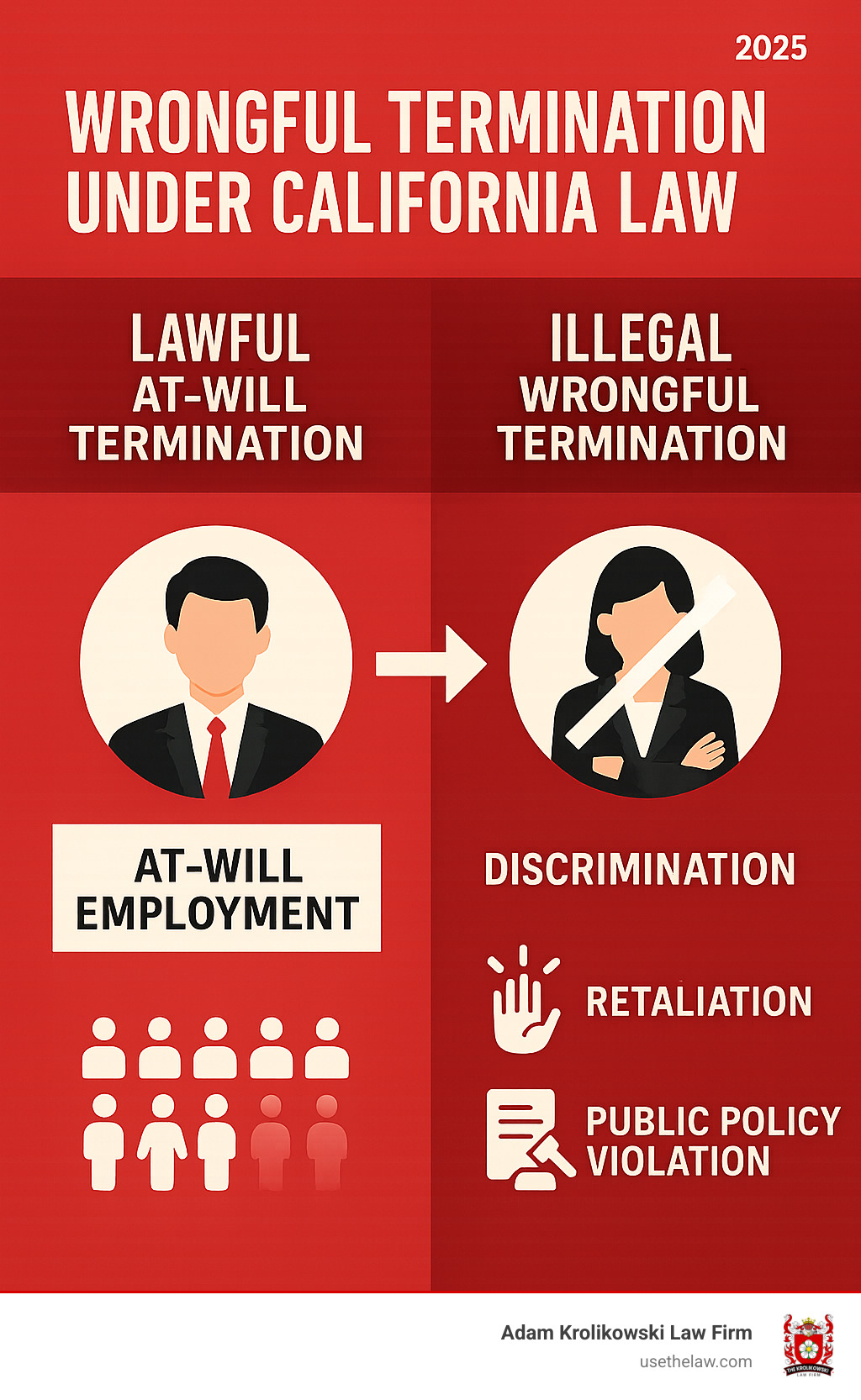
California is an “at-will” employment state, meaning an employer can typically terminate an employee for almost any reason, or no reason at all. Likewise, an employee can quit at any time.
However, this rule has important legal exceptions. A termination is “wrongful” if it violates federal or state laws, public policy, or an employment contract. Employers may try to hide an illegal firing behind a seemingly valid reason like “restructuring,” but a wrongful termination lawyer Los Angeles can help uncover the truth.

What Is Wrongful Constructive Termination?
Sometimes, an employer won’t directly fire you but will instead create such a miserable work environment that you feel you have no choice but to quit. This is known as “wrongful constructive termination” or “constructive discharge.”
To have a valid claim, you generally must show that your employer intentionally created or knowingly allowed working conditions so intolerable that a reasonable person would feel compelled to resign. You must also show that you were forced to resign because of these conditions and that the employer’s actions were illegal, such as severe harassment, discrimination, or retaliation.
As highlighted by legal precedent, notifying someone in authority about the intolerable working conditions is a crucial step. If you inform your employer and they fail to fix the situation, your resignation may be considered a constructive termination. Examples include drastic cuts in hours, an unjustified demotion, or a failure to stop severe harassment.
Can Contract Employees Be Wrongfully Terminated?
Yes. While “at-will” employment is the default, many people work under contracts that offer stronger protection against unfair termination.
These agreements can take several forms:
-
Written Contracts: These clearly outline the terms of your job, including how you can be fired. They may contain “good cause” provisions, meaning your employer needs a valid reason for termination, or require a specific notice period.
-
Implied Contracts: An implied contract can exist based on an employer’s words, actions, or company policies found in an employee handbook. For instance, consistent praise, regular raises, and promises of long-term employment might create an implied agreement that you would not be fired without good cause.
-
Oral Agreements: Verbal promises made during hiring or employment can sometimes create a binding agreement. While harder to prove than written contracts, they can be legally enforceable.
If your employer violates the terms of any employment contract, it could be a wrongful termination due to breach of contract, which is a powerful exception to the at-will rule.
Common Illegal Reasons for Termination in Los Angeles
While California is an “at-will” state, employers cannot fire employees for illegal reasons. A termination is wrongful if it is based on discrimination, retaliation, or violates public policy. Employers may try to hide an unlawful motive, so it’s important to understand what constitutes an illegal firing.
Firing Based on Discrimination
Both federal and California laws prohibit employers from firing you based on your identity. California’s Fair Employment and Housing Act (FEHA) is particularly strong, often providing more protection than federal laws like Title VII. It is illegal to be fired for belonging to a “protected class.”
California law protects a wide range of personal traits. You can learn more about them here. It is illegal to be fired because of your:
- Race, Color, National Origin, or Ancestry.
- Gender and Sex, including pregnancy, childbirth, and related medical conditions.
- Age (if you’re 40 or older).
- Physical or Mental Disability, if you can perform your job with reasonable accommodation.
- Sexual Orientation or Gender Identity/Expression.
- Religion, unless your practice causes an undue hardship on the business.
- Medical Condition.
If you suspect your firing was related to one of these characteristics, a wrongful termination lawyer Los Angeles can help determine if discrimination occurred.
Retaliation for Legally Protected Activities
Retaliation occurs when an employer punishes you for exercising a legal right. It is illegal for them to fire you or create a hostile work environment because you took a protected action. If you were fired shortly after any of the following, it could be a sign of illegal retaliation:
- Whistleblowing: Reporting illegal or unsafe activities by your employer. California has strong protections for whistleblowers. You can learn more about state whistleblower protections here.
- Taking Protected Leave: Using time off under the Family and Medical Leave Act (FMLA) or the California Family Rights Act (CFRA). Find FAQs on FMLA/CFRA here.
- Filing a Workers’ Compensation Claim: You cannot be punished for filing a claim after a work-related injury. Get more info on workers’ comp FAQs here.
- Reporting Unsafe Working Conditions: Informing your boss or an agency like Cal/OSHA about workplace dangers. Read about health and safety rights for workers here.
- Jury Duty or Military Service: Taking time off for civic duties.
- Taking Time Off to Vote: You have a right to take time off to vote. Check out details here.
- Opposing Discrimination or Harassment: Speaking up against discrimination or supporting a coworker who is facing it.
- Refusing to Do Something Illegal: Your employer cannot fire you for refusing to break the law.
If you were fired soon after one of these actions, a wrongful termination lawyer Los Angeles can help investigate what truly happened.
How to Build Your Wrongful Termination Case
Proving you were fired unfairly can feel daunting, especially if your employer provided a “pretext”—a fake reason to hide an illegal one. The burden of proof is on you to show the termination was unlawful, but you don’t have to do it alone. Building a strong case involves gathering evidence to connect your firing to a protected status or activity.

Gathering Evidence and Proving Your Claim
Every piece of evidence helps paint a clearer picture of what happened. Even small details can be important.
Key types of evidence include:
- Employment Records: Your employment contract, offer letter, and the company’s employee handbook can establish expectations and company rules.
- Performance Reviews: Positive performance reviews can challenge a sudden termination for “poor performance.” A sudden shift to negative reviews can also be a red flag.
- Emails and Text Messages: Written communications like emails, texts, or internal chats about your job, complaints you made, or your firing can be very helpful.
- Termination Letter: The official reason for your termination may be vague or false, which can be useful evidence.
- Witness Statements: Statements from colleagues who witnessed discriminatory behavior or other key events can be invaluable.
- Timeline of Events: A detailed list of events with dates, times, and individuals involved helps establish a “causal link” between a protected activity and your termination.
As your wrongful termination lawyer Los Angeles, we can guide you on what to look for and how to organize it.
What Damages and Compensation Can You Seek?
If your claim is successful, the goal is to recover compensation for your losses. The types of compensation we typically seek include:
- Economic Damages: These cover direct financial losses.
- Lost Wages (Back Pay): Money lost from the date of firing until the case is resolved.
- Future Lost Wages (Front Pay): Income you are likely to lose in the future.
- Lost Benefits: The value of lost health insurance, retirement contributions, bonuses, and other perks.
- Non-Economic Damages: Compensation for non-tangible harm.
- Emotional Distress: Acknowledges the pain, suffering, anxiety, and emotional impact of the termination.
- Reputational Harm: For damage to your professional standing.
- Punitive Damages: In cases of extreme employer misconduct, these are awarded to punish the employer and deter future wrongdoing.
- Attorney’s Fees and Legal Costs: In many successful cases, the law allows for your attorney’s fees and costs to be covered by the employer.
The specific compensation depends on your unique situation. We will fight to get you the maximum compensation you deserve.
The Role of a Wrongful Termination Lawyer in Los Angeles
Navigating complex legal rules after losing your job can be overwhelming. A wrongful termination lawyer los angeles can act as your guide and advocate during this challenging time, helping you steer the legal system.
Our goal is to stand by your side, help you understand employment laws, and build a strong plan to pursue justice. We know the rules and are familiar with how employers and their legal teams operate.
We will work with you to gather evidence and tell your story clearly. Many employers prefer to settle cases out of court, and we are skilled at negotiating fair settlements. If an agreement isn’t possible, we are prepared to fight for you in court. With over 25 years of experience handling complex cases, we are committed to seeing that justice is served.
We will push for every type of compensation you are owed, including lost wages, benefits, emotional distress, and punitive damages. Having legal help can provide peace of mind and greatly improve your chances of a positive outcome. You can learn more about our employment law services.
Immediate Steps to Take if You’ve Been Fired
If you believe your firing was unfair, your initial actions can impact your case. Here are some key steps:
- Do Not Sign Anything Without Legal Review: Employers may offer a severance package that requires you to waive your right to sue. Do not sign it without an attorney’s review.
- Remain Calm and Professional: Avoid emotional outbursts, as anything you say or do could be used against you.
- Document Everything: Gather your employment contract, performance reviews, emails, and termination letter. Write down your account of events with dates and names while the details are fresh.
- Request Your Personnel File: In California, you have the right to request this file, which may contain useful information.
- Apply for Unemployment Benefits: This does not hurt your wrongful termination claim and can help reduce financial stress.
- Stay Off Social Media: Avoid posting about your termination or former employer online.
The most important step you can take is to contact an attorney as soon as possible. A wrongful termination lawyer los angeles can quickly assess your situation and explain your rights.
Filing a Claim with the CRD or EEOC
Before filing a lawsuit for discrimination or retaliation, you must typically file a complaint with a government agency.
In California, you’ll likely work with the California Civil Rights Department (CRD). For claims under state law, you generally must first file a complaint with the CRD. The federal Equal Employment Opportunity Commission (EEOC) enforces federal anti-discrimination laws. You might file with the EEOC if your claim falls under federal statutes.
These agencies may investigate, mediate, or take legal action. If they close the investigation, they issue a “right-to-sue” letter, which is required to file a lawsuit in court.
Deadlines for Filing a Wrongful Termination Lawsuit in Los Angeles
There are strict deadlines, or “statutes of limitations,” for filing legal claims. Missing them can mean losing your right to sue. The deadlines vary by claim type.
For discrimination or retaliation, you have a limited time to file with an agency. Under California law (FEHA), you generally have three years to file a discrimination complaint with the CRD from the date of the unlawful act. The federal EEOC deadline is typically 180 days, sometimes extended to 300 days.
After receiving a “right-to-sue” notice, you have a short window—often 90 days or one year, depending on the agency—to file your lawsuit in court.
For a written contract breach, you typically have four years to file a lawsuit in California. For an oral or implied contract, it’s generally two years. For claims that a firing violated public policy, the statute of limitations is usually two years.
These deadlines are complex, so it is vital to contact a wrongful termination lawyer los angeles as soon as possible to ensure all steps are taken on time.
Frequently Asked Questions

Losing your job unfairly raises many questions. Here are answers to some of the most common ones.
How much does a wrongful termination lawyer in Los Angeles cost?
We understand legal fees are a concern, especially after losing a job. That’s why many wrongful termination lawyer los angeles firms work on a contingency fee basis.
This means:
- You pay no upfront attorney’s fees.
- We offer free initial consultations to discuss your case and options at no cost.
- We only get paid if we win your case. Our fee is a percentage of the compensation we recover for you. If we don’t win, you owe us no attorney’s fees.
This structure ensures everyone can seek justice without financial barriers.
What if my employer gave a fake reason for firing me?
This is a common tactic called “pretext,” where an employer gives a false reason to hide an illegal one, such as discrimination or retaliation.
Our job is to uncover the truth by looking for evidence, such as:
- Inconsistencies: Shifting reasons for your termination.
- Lack of Documentation: Claims of poor performance with no prior warnings or negative reviews.
- Different Treatment: Other employees not in a protected class were treated more favorably.
- Suspicious Timing: Being fired shortly after taking medical leave or reporting illegal activity.
- “Me-Too” Witnesses: Testimony from other employees who experienced similar illegal conduct.
A wrongful termination lawyer los angeles can gather this circumstantial evidence to build a strong case that the stated reason was a smokescreen for an illegal firing.
What are the key differences between California and federal laws?
California law often provides stronger protections for employees than federal law.
- Scope of Protection: The California Fair Employment and Housing Act (FEHA) offers broader protections, such as for sexual orientation and gender identity, than federal laws like Title VII.
- Employer Size: For most discrimination claims, FEHA covers employers with as few as five employees, while many federal laws only apply to employers with 15 or more.
- Leave Policies: The California Family Rights Act (CFRA) is often more generous than the federal Family and Medical Leave Act (FMLA), covering more family members and situations.
- Whistleblower Protections: California has very robust state whistleblower laws that encourage employees to report unlawful activities without fear of retaliation.
Because California law often provides more protection, it’s crucial to work with a wrongful termination lawyer los angeles who is well-versed in both state and federal statutes.
Conclusion
Losing your job is a stressful and uncertain experience. However, California’s “at-will” employment rule does not give employers a free pass to act unlawfully.
Employers cannot fire someone based on illegal discrimination, as retaliation for a protected activity, or in breach of contract. You have significant rights under both federal and California state laws that protect you from such unfair treatment.
If you suspect your firing was illegal, you must act quickly. Strict deadlines apply to these cases, and missing them could mean losing your right to seek justice.
Having a knowledgeable legal advocate on your side can make a significant difference. A wrongful termination lawyer Los Angeles can help you steer the legal system, gather evidence, and fight for the compensation you deserve.
At Adam Krolikowski Law Firm, we have over 25 years of experience helping employees in Los Angeles and throughout California. We are known for handling complex employment law cases that other firms may avoid. Our goal is to ensure your voice is heard and you achieve the justice you are entitled to.
Don’t wait. If you have questions about your termination, let’s talk.
