

Uber accident statistics: 2025’s Critical Truth
Understanding the Reality of Rideshare Safety in Santa Ana
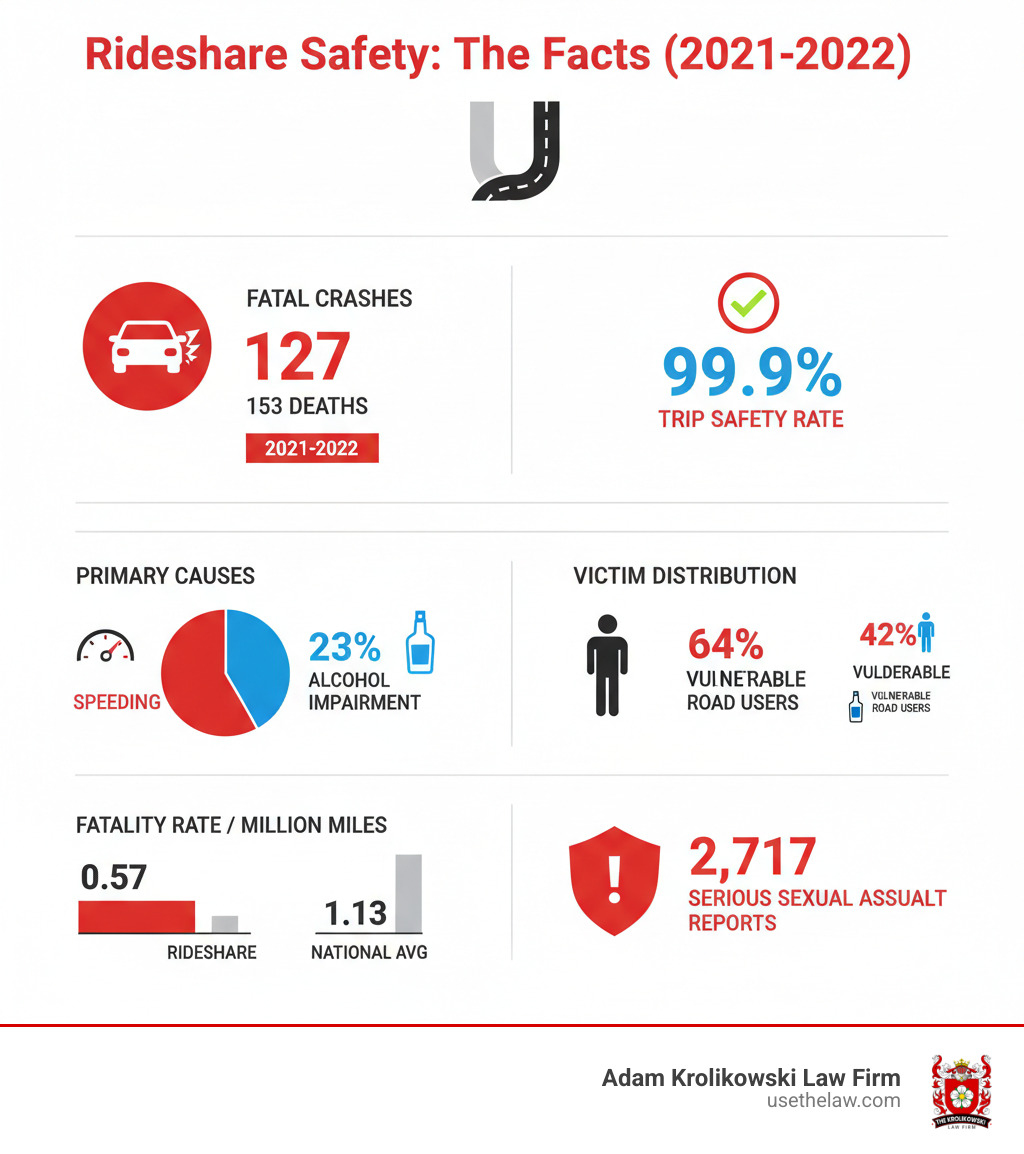
Uber accident statistics reveal a complex picture. According to Uber’s 2021-2022 safety report, there were 127 fatal crashes resulting in 153 deaths in the U.S. At the same time, the company reports that 99.9% of Uber trips end without a safety issue.
Here are the key statistics you need to know:
- Fatal accident rate: 0.57 per million vehicle miles traveled for Uber in 2018, compared to the national average of 1.13
- Annual fatalities: Approximately 100 deaths per year in Uber-related crashes (2017-2020 data)
- Primary causes: 32% involved speeding, 23% involved alcohol-impaired driving
- Victim breakdown: 64% pedestrians, 42% vulnerable road users, 21% riders, 21% drivers
- Sexual assault reports: 2,717 in the most serious categories (2021-2022)
- Overall safety: 6.3 billion trips in 2021 with rare critical incidents
Ridesharing offers convenience but introduces new safety considerations in a complex legal and insurance landscape. The data is contradictory: while Uber’s per-mile fatality rate is lower than the national average, some research suggests ridesharing has contributed to a 2-3% increase in overall traffic fatalities since 2011. This is likely due to more vehicles on the road, increasing congestion and accident risk.
For residents of Southern California—where Los Angeles, San Francisco, and San Diego counties account for nearly 64% of the state’s rideshare trips—these statistics are particularly relevant. If an accident occurs, the aftermath can involve severe injuries, mounting medical bills, and lost wages. Understanding the facts is crucial for protecting your safety and your rights.
Related content about uber accident statistics:
Decoding Uber’s Official Safety Reports
To understand Uber accident statistics, it’s best to start with Uber’s own US Safety Reports. The company publishes this data, believing transparency improves safety. These reports cover motor vehicle accidents, physical assaults, and sexual assaults on the platform from 2017 through 2022. The data is collected from reports by both riders and drivers, offering a broad, though not fully verified, view of safety incidents. You can read the Full 2021-2022 report for detailed findings.
Fatal Crashes and Deaths
The 2021-2022 report documented 127 fatal crashes resulting in 153 deaths in the U.S., an increase from the 97 fatal accidents and 107 deaths in the 2017-2018 report. While these numbers have risen alongside Uber’s growth to 6.3 billion trips in 2021, the company notes that 99.9% of trips are completed without safety incidents.
The 2017-2018 data shows that victims are not just those inside the Uber: riders accounted for 21% of fatalities, drivers 21%, and third parties (like pedestrians and occupants of other vehicles) made up the remaining 58%. This highlights that rideshare accidents pose a risk to everyone on the road.
Serious Safety Incidents: Assault Statistics
Beyond crashes, Uber tracks other serious safety incidents. The 2021-2022 report included 2,717 reports in the most serious sexual assault categories and 36 fatal physical assaults. These risks affect both riders and drivers, with earlier data showing drivers made up 42% of sexual assault reporters.
Uber provides in-app tools for reporting safety concerns, including an On-Trip Reporting feature. You can learn more about how to report a safety incident to Uber. While most trips are safe, these statistics show the severe consequences when incidents do occur.
The Broader Impact: Uber Accident Statistics vs. National Averages
The rise of ridesharing, or the ‘Uber Effect,’ has changed our roads, impacting traffic patterns and accident rates. Interpreting Uber accident statistics is complex because it involves understanding the broader effect of millions of additional trips. While Uber highlights its lower per-mile fatality rate, a study from the University of Chicago suggests ridesharing contributed to a 2-3% increase in traffic fatalities since 2011. The same research links ridesharing to increased congestion, which creates more opportunities for accidents.

Analyzing the Fatality Rate: Is Uber Safer?
In 2018, Uber’s fatal crash rate was 0.57 per million vehicle miles, significantly lower than the national average of 1.13. This suggests an individual Uber trip may be safer. However, the same University of Chicago Booth School of Business study found ridesharing may be responsible for a 3% rise in overall traffic fatalities. This paradox is explained by exposure: millions of additional rideshare miles on the road create more total accidents, even with a lower per-mile rate.
Uber’s own fatality rate has also trended upward, from 0.58 per 100 million vehicle miles in 2017-2018 to 0.887 in 2021-2022. Furthermore, Uber operates mostly in dense urban areas, which have unique risks like heavy pedestrian traffic and complex intersections.
Ridesharing’s Effect on DUI and Road Safety
One of ridesharing’s most positive impacts is its role as an alternative to drunk driving. Studies show a 15% to 62% annual decrease in DUI accidents in areas where Uber operates. In 2019, Uber was credited with reducing alcohol-related traffic fatalities by over 6%, with metropolitan areas seeing up to a 16% reduction in traffic fatalities.
By providing a convenient option, especially during late-night hours when impaired driving peaks, ridesharing has saved lives. However, this benefit is part of a trade-off, as the increased number of vehicles on the road contributes to other types of accident risks. For more information on the complexities of accidents involving ridesharing services, you can explore our resources on Uber/Lyft Accidents.
Key Factors Contributing to Uber Accidents
Beyond the numbers, Uber accident statistics reveal why crashes happen. Collisions are often the result of driver behavior, the pressures of gig work, and the hazards of navigating busy roads, creating an environment where the need to earn can conflict with safety.
Insights from Uber’s Crash Data
Uber’s 2019-2020 safety report highlights key causes of fatal crashes:
- Speeding was a factor in 32% of fatal crashes, often driven by the pressure to complete more trips.
- Alcohol-impaired driving contributed to 23% of fatal crashes, involving either the rideshare driver or another driver.
The data also shows who is most at risk. Pedestrians accounted for 64% of victims in Uber-related incidents from 2019-2020, reflecting the urban environments where rideshares operate. Vulnerable road users (pedestrians, cyclists, motorcyclists) made up 42% of all victims. This shows that rideshare accidents pose a significant risk to those outside the vehicle, and even common incidents like rear-end collisions can be severe in city traffic.
The Link Between Driver Working Conditions and Risk
The gig economy model creates unique pressures for rideshare drivers that can increase accident risk.
- Driver Fatigue: Long hours and the need to make ends meet can lead to exhaustion, slowing reaction times. A study in the Journal of Safety Research found one-third of rideshare drivers had been in a crash while working, with fatigue being a key factor.
- Distracted Driving: Drivers must constantly interact with the app for navigation and ride requests, taking their eyes off the road. The same study identified cellphone use as a major crash risk.
- Unfamiliar Roads: Relying on GPS in unknown areas can cause confusion and distraction.
- Economic Pressures: Low pay incentivizes drivers to rush, skip breaks, and drive while tired. Research suggests better pay could improve safety by allowing for shorter hours.
Understanding these systemic factors is important after a crash. An Uber/Lyft Car Accident Attorney can help steer the complexities.
Navigating an Uber Accident in California
If you’re in an Uber accident in California, from Los Angeles to Santa Ana, you must understand the state’s specific regulations and insurance rules. These laws can significantly affect your accident claim.

Understanding California’s Unique Uber Accident Statistics
Specific Uber accident statistics for California are hard to obtain. The California Public Utilities Commission (CPUC) collects this data, but confidentiality issues and disputes, like a $59 million fine against Uber in 2020, have delayed its public release. What is known is that California is a rideshare hub, with nearly 64% of all TNC trips concentrated in Los Angeles, San Francisco, and San Diego counties. This high volume in dense urban areas magnifies accident risks. If you need guidance in this region, an Orange County Uber/Lyft Accident Lawyer can provide localized help.
What to Do Immediately After a Rideshare Crash
The moments after an Uber crash are chaotic. Taking these immediate steps can protect your health and legal rights:
- Ensure Safety and Call 911: Check for injuries and call for police and medical help if needed. Move vehicles out of traffic if it’s safe.
- Seek Medical Attention: See a doctor as soon as possible, even if you feel fine. Adrenaline can mask injuries that may appear later, and medical records are vital for a claim.
- Document the Scene: Use your phone to take photos and videos of vehicle damage, road conditions, and injuries. Crucially, take screenshots of the Uber app to capture trip details and driver information.
- Exchange Information: Get contact and insurance details from all drivers and contact information from any witnesses.
- Report the Crash to Uber: Use the app to create an official record of the incident with the company.
- Avoid Admitting Fault: Stick to the facts when speaking with police and others. Do not apologize or accept blame.
- Contact an Attorney: Rideshare claims involve complex insurance policies. Early legal guidance is crucial. Our page on Car Accident Injury Claims provides more detail.
Legal Rights and Compensation for Victims
Determining who pays after an Uber accident depends on the driver’s status at the time of the crash. Uber’s insurance is structured in periods:
- Period 0 (App Off): The driver’s personal auto insurance is the only coverage.
- Period 1 (App On, Waiting for Request): Uber provides limited liability coverage (typically $50k/$100k/$30k in California).
- Periods 2 & 3 (En Route to Pick Up or During Trip): Uber’s $1 million third-party liability policy applies. This also includes $1 million in uninsured/underinsured motorist coverage in California.
Navigating these periods is complex, making legal guidance essential. Victims may be entitled to compensation for economic damages (medical bills, lost wages) and non-economic damages (pain and suffering). California’s “pure comparative fault” rule allows you to recover damages even if you are partially at fault, though your award is reduced by your percentage of fault. The legal process can involve investigation and negotiation. Our insights on Rideshare Accident Lawsuits explain more.
Frequently Asked Questions about Uber Accidents
We understand that Uber accident statistics and the legal side of rideshare accidents can feel overwhelming. Here are answers to some common concerns.
How does Uber’s accident rate compare to the national average?
Uber’s fatality rate of 0.57 per million vehicle miles traveled (2018) is lower than the national average of 1.13. This suggests a single trip is statistically safer. However, the overall picture is more complex. Research from the University of Chicago suggests ridesharing has contributed to a 2-3% increase in total traffic fatalities since 2011. This is likely because the sheer volume of rideshare vehicles adds to road congestion and creates more opportunities for accidents, even if the per-mile rate is lower.
What steps can passengers take to improve their safety?
Passengers can take several steps to improve their safety. Before getting in, verify the car and driver by matching the license plate, vehicle model, and driver photo to the app. You can also use Uber’s PIN verification feature. During the ride, always wear your seatbelt and sit in the back seat for better protection. Use the app to share your trip status with a contact. If you feel unsafe due to the driver’s behavior, use the in-app emergency button to contact 911 or the On-Trip Reporting feature. Trust your instincts and end the trip if something feels wrong.
Can I file a lawsuit if I’m injured in an Uber accident?
Yes. If you are injured in an Uber accident due to someone else’s negligence, you have the right to file a lawsuit for compensation. These cases are often more complex than standard car accidents because of Uber’s multi-layered insurance policies, which depend on the driver’s status at the time of the crash. Legal representation can be crucial for navigating these complexities. You may be entitled to compensation for medical bills, lost wages, and pain and suffering. For more information, see our page on rideshare accident lawsuits.
Conclusion
Ridesharing offers convenience, but Uber accident statistics reveal a complex safety picture. While Uber’s per-mile fatality rate is lower than the national average, the sheer volume of rideshare vehicles may contribute to an overall increase in traffic fatalities. The data shows a human cost, with 127 fatal crashes and 153 deaths in 2021-2022, and serious non-crash incidents. Conversely, ridesharing has significantly reduced drunk driving accidents.
In California, particularly in Los Angeles, Orange County, and San Diego, these risks are concentrated. If you are injured in a rideshare accident, you face a confusing aftermath of complex insurance policies and mounting costs. You have rights that deserve protection.
The team at Adam Krolikowski Law Firm has over 25 years of experience with personal injury cases in Orange County, Los Angeles, and Santa Ana. We handle complex cases to help accident victims secure the compensation they deserve.
If you need guidance after a rideshare accident, we are here to help. Get help from an Orange County rideshare accident lawyer who can guide you forward.