Understanding Your Rights After a Devastating Loss in Santa Ana
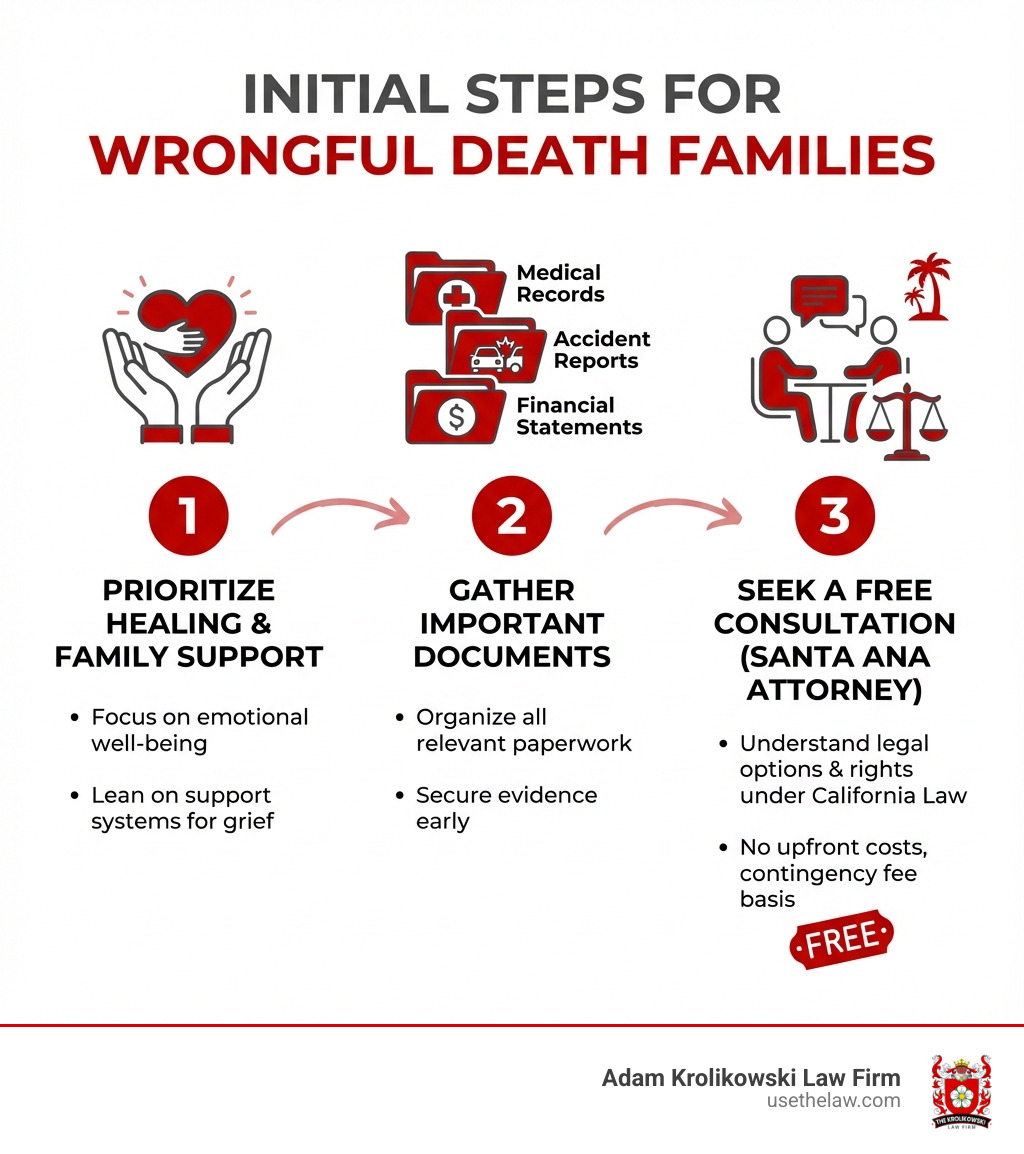
A wrongful death lawyer Santa Ana can help families pursue justice and financial recovery after losing a loved one due to another party’s negligence or wrongful actions. These attorneys handle complex legal proceedings while families focus on healing, offering services on a contingency fee basis—meaning no upfront costs.
If you’re searching for legal help in Santa Ana, here’s what you need to know:
- Who can file: Surviving spouses, domestic partners, children, grandchildren, or other eligible heirs under California law
- What you can recover: Economic damages (lost income, funeral costs) and non-economic damages (loss of companionship, guidance)
- Time limit: Two years from the date of death to file a lawsuit (six months for government claims)
- How attorneys help: Investigate the incident, prove negligence, negotiate with insurance companies, and handle all legal paperwork
- Cost: Most wrongful death attorneys work on contingency—you pay nothing unless they win your case
When tragedy strikes in Santa Ana—whether through a fatal car accident on one of the city’s dangerous streets, a workplace incident, or medical malpractice—the emotional impact is overwhelming. Families face not only profound grief but also unexpected financial burdens from medical bills, funeral expenses, and lost income.
Nearly every day in Santa Ana and across California, wrongful deaths occur due to preventable accidents. In one recent year alone, 11 people were killed in Santa Ana auto collisions, with speed contributing to approximately 24% of accidents resulting in injuries or fatalities. While the number of fatal accidents has been steadily declining since 2016, each loss leaves behind devastated families searching for answers and accountability.
A wrongful death claim offers a path to justice—a civil lawsuit that holds negligent parties financially accountable while helping families recover compensation for their losses. These cases can also involve related injuries like severe burns from fires or explosions, and catastrophic injuries from slips and falls that prove fatal.
The legal process may seem daunting during such a difficult time, but you don’t have to steer it alone. Understanding your rights is the first step toward securing the financial stability your family deserves.
What Constitutes a Wrongful Death Claim in Santa Ana?
Losing a loved one is an unimaginable pain, made even more difficult when their death results from someone else’s carelessness or intentional harm. In Santa Ana, as throughout California, our legal system provides a way for families to seek justice through a wrongful death claim. This is a civil lawsuit aimed at holding the responsible party financially accountable for the harm caused. It’s not about replacing your loved one, because nothing ever could, but about providing financial stability and a sense of closure during a profoundly difficult time.

Defining Wrongful Death Under California Law
In California, a death is considered “wrongful” when it results from the “wrongful act or neglect of another.” This means that if a person’s death was caused by the failure to use reasonable care (negligence), recklessness, or intentional actions of another individual, business, or entity, a wrongful death claim may be pursued.
Negligence is a cornerstone of many personal injury and wrongful death cases. It essentially means that someone failed to act with the level of care that a reasonably prudent person would have exercised under the same circumstances, and this failure led to the death. For instance, a distracted driver failing to stop at a red light, a property owner neglecting to fix a dangerous hazard, or a medical professional making a fatal error could all be considered negligent acts leading to a wrongful death.
A wrongful death claim is a civil lawsuit, distinct from any criminal charges that might be pursued by the state. While a criminal case focuses on punishment for a crime, a civil wrongful death claim focuses on providing compensation for the survivors and beneficiaries for their losses. This also means that the standard of proof is different: a civil case has a lower burden of proof than a criminal case. Even if a defendant is acquitted in criminal court, a wrongful death claim can still be successfully pursued in civil court. Our local Santa Ana court system is where these civil actions are litigated, and understanding its nuances can be crucial for a successful outcome.
Who Is Eligible to File a Lawsuit in California?
California law carefully defines who can file a wrongful death lawsuit. This ensures that those most directly affected by the loss are given the opportunity to seek compensation. Generally, the right to file a claim is reserved for specific family members of the deceased.
According to California Code of Civil Procedure Section 377.60, eligible individuals typically include:
- The deceased person’s surviving spouse or domestic partner.
- The deceased person’s children.
- The issue of deceased children (grandchildren), if their parent (the deceased’s child) has also passed away.
- If there is no surviving spouse, domestic partner, or children, then the deceased person’s parents may file.
Beyond these primary claimants, other individuals may also be eligible under specific circumstances, such as:
- Financially dependent stepchildren.
- A “putative spouse” (someone who believed in good faith they were married to the deceased, even if the marriage was legally invalid due to a technicality). Their children may also be eligible.
- Any minor who was dependent on the deceased for support and resided in the deceased’s household for at least 180 days prior to the death.
- Other individuals who would be entitled to the deceased’s property under California’s intestate succession laws (laws governing how property is distributed when someone dies without a will), if no closer relatives exist or if closer relatives waive their right to file.
It’s a unique aspect of California law that all eligible heirs must join together in a single wrongful death case. Separate claims are generally not allowed. This can make assembling the case complex, as it requires coordination among all parties who have a right to claim. Our team can help identify all eligible parties and ensure everyone’s interests are represented in a unified claim.
Common Causes of Fatal Accidents in Santa Ana
Wrongful deaths can arise from a wide range of tragic incidents, often stemming from preventable acts of negligence. In Santa Ana, many of these fatalities are linked to the busy urban environment and various occupational hazards. Some of the most common causes we see include:
- Car Accidents: Given Santa Ana’s busy roadways, car accidents are a significant cause of wrongful death. In one year alone, there were 2,881 car accidents in Santa Ana, with speed contributing to approximately 24% of those resulting in injuries or fatalities. Sadly, 11 people were killed as a result of Santa Ana auto collisions in that same year. Orange County, where Santa Ana is located, ranked 49th out of 58 cities and counties in California for total fatal and injury crashes. We also know that the majority of fatal accidents in Santa Ana occur at night, and October is often the most dangerous month.
- Truck Accidents: Collisions involving large commercial trucks can be particularly devastating due to their size and weight, often leading to severe or fatal injuries.
- Motorcycle, Bicycle, and Pedestrian Accidents: Vulnerable road users are at high risk in traffic, and accidents involving motorcycles, bicycles, or pedestrians frequently result in fatalities.
- Medical Malpractice: Errors by healthcare professionals, such as misdiagnosis, surgical mistakes, or medication errors, can lead to a patient’s death.
- Premises Liability: Property owners have a duty to maintain safe environments. Deaths can occur from hazards like dangerous conditions leading to slips and falls, or inadequate security resulting in violent crime.
- Defective Products: When a faulty product causes a death—whether it’s a car part, a household appliance, or a piece of machinery—the manufacturer can be held liable.
- Workplace Accidents: Unsafe working conditions, lack of proper training, or employer negligence can lead to fatal incidents in various industries.
- Construction Accidents: Construction sites are inherently dangerous, and negligence can lead to fatal falls, equipment malfunctions, or other tragic events.
- Nursing Home Abuse: Neglect or abuse in nursing homes can lead to severe health deterioration and, ultimately, death for vulnerable residents.
- Assault and Sexual Assault: Intentional violent acts causing death can also be the basis for a wrongful death claim, separate from any criminal prosecution.
Understanding the specific cause of death is crucial for building a strong wrongful death claim. Our team can investigate these incidents thoroughly, gathering the necessary evidence to establish liability.
Navigating the Legal Process and Recovering Damages
When pursuing a wrongful death claim in Santa Ana, the legal process can be intricate and emotionally draining. Our role is to build a compelling case on your behalf, navigating the complexities so you can focus on healing. This involves meticulous evidence gathering, proving negligence, and accurately assessing the full scope of damages your family has suffered.

How Negligence Is Proven in a Wrongful Death Claim
Proving negligence is fundamental to a successful wrongful death claim. It requires establishing four key elements:
- Duty of Care: We must demonstrate that the responsible party owed a legal duty to the deceased. This means they had an obligation to act in a reasonable and safe manner to prevent harm. For example, a driver has a duty to operate their vehicle safely, a property owner has a duty to maintain a safe premises, and a doctor has a duty to provide competent medical care.
- Breach of Duty: Next, we need to show that the responsible party failed to uphold that duty of care. This “breach” could be an action they took or a failure to act that a reasonably prudent person would have avoided. For instance, a driver speeding, a property owner ignoring a dangerous stairwell, or a doctor misdiagnosing a critical condition.
- Causation: This is a critical link. We must prove that the breach of duty directly caused the preventable accident or incident, and that this accident resulted in the death of your loved one. There must be a clear connection between the negligent act and the tragic outcome.
- Damages: Finally, we must establish that the death resulted in actual losses or “damages” for the surviving family members, which we will discuss in detail below.
To prove these elements, we start on a thorough investigation. This involves gathering critical evidence such as:
- Police reports and accident reports: These official documents often provide initial details, witness statements, and sometimes preliminary conclusions about fault.
- Medical records: These can establish the cause of death, the extent of injuries sustained before death, and any medical negligence involved.
- Witness statements: Accounts from eyewitnesses can provide crucial perspectives on how the incident unfolded.
- Video footage and photographs: Surveillance videos, dashcam footage, or photos of the scene can offer objective evidence.
- Professional testimony: We often enlist the help of various professionals—such as accident reconstructionists, medical professionals, economists, or engineers—to analyze evidence, explain complex technical details, and weigh in on the claim. Their insights can be invaluable in establishing the duty of care, breach, and causation.
By carefully collecting and presenting this evidence, we work to clearly demonstrate the negligence that led to your loved one’s death.
What Damages Can Be Recovered in a Santa Ana Wrongful Death Case?
While no amount of money can truly compensate for the loss of a loved one, a wrongful death claim in Santa Ana aims to provide financial recovery for the losses suffered by the surviving family members. California law categorizes these recoverable damages into two main types: economic and non-economic.
Economic Damages are quantifiable financial losses that can be calculated. These may include:
- Lost Financial Support: This covers the income, wages, and benefits (like health insurance or retirement contributions) that the deceased would have earned and contributed to the household if they had lived. This often requires projections of future earnings, which we can calculate with the help of financial professionals.
- Funeral and Burial Expenses: The costs associated with the funeral, burial, or cremation are recoverable.
- Loss of Household Services: This accounts for the monetary value of services the deceased provided around the home, such as childcare, home maintenance, cooking, or other domestic tasks.
- Medical Expenses: Any medical bills incurred for the care of the deceased from the time of injury until their death are also recoverable.
Non-Economic Damages are more subjective and relate to the intangible losses experienced by the surviving family members. These are often harder to quantify but are critically important for recognizing the full scope of the family’s suffering:
- Loss of Companionship, Comfort, Care, Assistance, Affection, and Moral Support: This acknowledges the profound emotional void left by the deceased.
- Loss of Guidance and Training: For children, this can involve the loss of a parent’s mentorship and upbringing.
- Loss of Enjoyment of Sexual Relations (for a spouse or domestic partner): This recognizes the intimate aspect of a marital or partnership relationship.
- Emotional Suffering (in specific circumstances): If a survivor witnessed the accident or passing, they may also be compensated for their emotional suffering.
It’s important to note that, in California, pain and suffering or mental anguish of the survivors themselves are generally not considered as a separate category of non-economic damages in a wrongful death claim. Instead, the focus is on the value of the relationship lost.
Punitive Damages: In rare cases, if the defendant’s conduct was particularly egregious—meaning oppressive, malicious, or fraudulent—punitive damages may be awarded. These are not meant to compensate the family but rather to punish the wrongdoer and deter similar conduct in the future. However, punitive damages are not typically allowed in most California wrongful death claims and are reserved for exceptional circumstances involving gross negligence or intentional acts.
Our team can consult with economic and financial professionals to accurately assess and calculate all potential damages, ensuring we seek the maximum compensation your family deserves.
The Difference Between a Wrongful Death Claim and a Survival Action
While often related and sometimes filed concurrently, a wrongful death claim and a survival action are distinct legal avenues under California law, each designed to address different aspects of a fatal incident. Understanding the differences is important for comprehending the full scope of potential recovery.
Here’s a comparison:
| Feature | Wrongful Death Claim | Survival Action |
|---|---|---|
| Purpose of Claim | To compensate surviving family members for their own losses resulting from the death. | To recover damages that the deceased person would have been entitled to had they survived the incident. |
| Types of Damages Recovered | Economic losses (lost financial support, funeral costs) and non-economic losses (loss of companionship, guidance, and affection). | Damages the deceased incurred before death (medical bills, lost wages) and, in some cases, punitive damages. |
| Who Receives the Compensation | Eligible heirs (spouse, children, domestic partner, etc.) directly. | The deceased person’s estate, which is then distributed to heirs according to a will or state law. |
