

What You Need to Know About Breast Implant Defects: Santa Ana Attorney Guide
Breast implant defects are a serious concern for the hundreds of thousands of women who receive implants each year in the United States. If you or someone you love is experiencing problems after breast implant surgery, here is a quick overview of the most common defects and risks:
Most common breast implant defects and complications:
- Capsular contracture – scar tissue hardens around the implant, causing pain and deformity (affects 5-8% of patients)
- Implant rupture or deflation – the implant shell tears or leaks (affects 10-15% of implants within 10-15 years)
- Implant malposition – the implant shifts or moves out of place
- Rippling or wrinkling – visible or felt through the skin
- Infection or seroma – fluid buildup or bacterial infection around the implant
- Breast Implant Illness (BII) – systemic symptoms including fatigue, brain fog, joint pain, and hair loss
- BIA-ALCL – a rare but serious form of lymphoma linked to textured implants
Approximately 400,000 women in the U.S. receive breast implants every year. Many of them are never fully informed about the risks before surgery. When a defective implant causes harm — whether from a manufacturing flaw, a design failure, or inadequate warnings — patients may have the right to seek legal compensation.
If you are in Santa Ana and believe you have been injured by a defective breast implant, a breast implant attorney at Adam Krolikowski Law Firm can review your case during a Free Consultation.
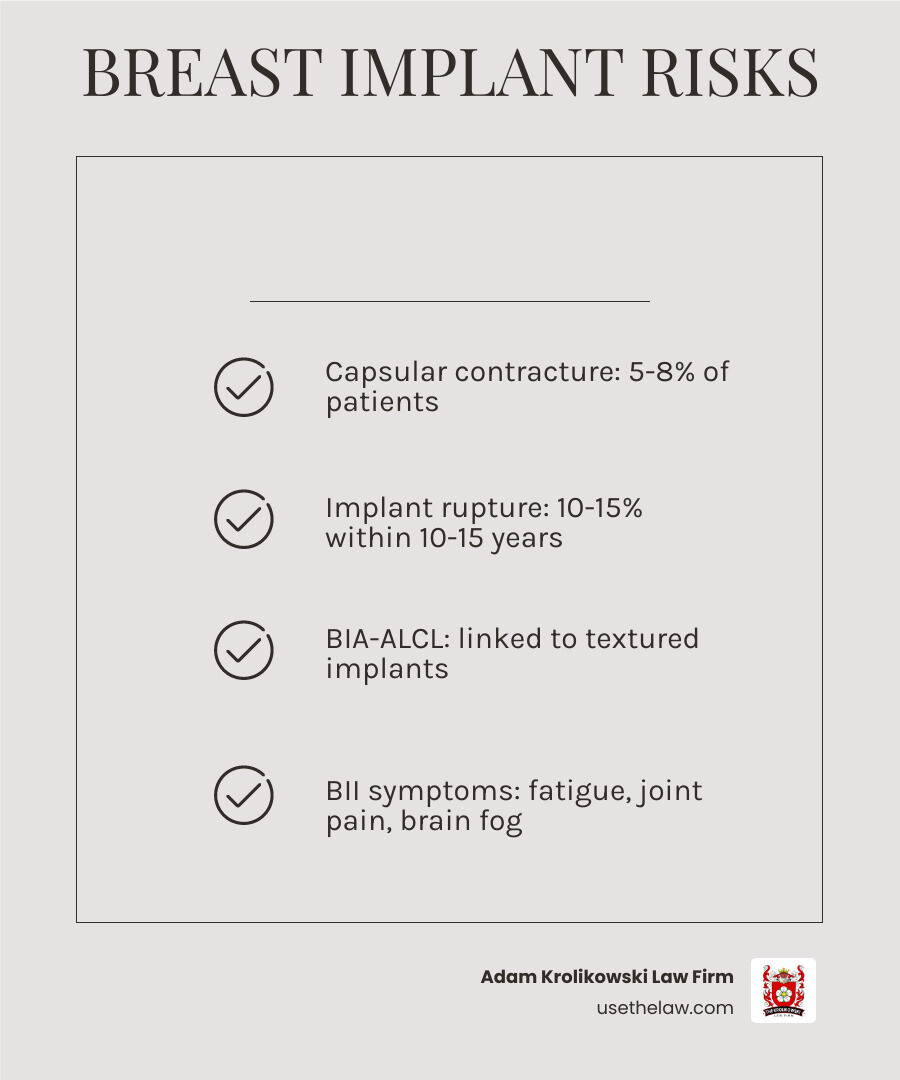
Must-know breast implant defects terms:
Understanding the Legal and Medical Realities of Breast Implant Defects with a Santa Ana Lawyer
When we undergo any medical procedure, we place an immense amount of trust in the medical devices selected for our bodies. Unfortunately, medical devices do not always perform as intended. For many women in Santa Ana, what was supposed to be a life-enhancing cosmetic or reconstructive procedure turns into a painful medical ordeal due to structural failures.
Legally, when a medical device fails to perform safely under normal conditions, it may fall under the category of product liability. In California, product liability laws protect consumers from dangerous medical devices. If a manufacturer distributes an implant with structural flaws or design failures, they can be held legally responsible for the resulting injuries, medical bills, and emotional distress.
When evaluating these cases, we generally look at three main types of legal defects:
- Manufacturing Flaws: These occur during the actual construction of the physical implant. Even if the design is flawless, a mistake on the factory floor can result in a weakened outer shell, poor sealing, or chemical contamination.
- Design Defects: These are inherent issues built into the product’s blueprint. If an entire line of implants is designed in a way that makes them prone to premature tearing or mechanical failure, the product is considered inherently defective.
- Failure to Warn (Marketing Defects): Manufacturers have a strict legal duty to warn doctors and patients about known risks. If a company hides clinical data about rupture rates or systemic health complications, they may face severe legal consequences through product liability claims.
Common Manufacturing and Design Breast Implant Defects
At the heart of many medical device lawsuits are the physical failures of the implants themselves. The outer envelope of a breast implant, known as the elastomer shell, is designed to withstand everyday physical pressures. However, manufacturing inconsistencies can lead to localized thin spots in this shell. Over time, the repeated friction of muscle contractions and natural body movements can cause these thin spots to wear down, resulting in a structural tear.
Another frequent physical defect involves the valve system. Saline implants are filled through a small valve during surgery. If this valve leaks or fails to seal properly, the saline solution will slowly escape, causing the breast to lose its shape and volume rapidly.
When these design failures occur, patients do not just suffer from physical pain. They often face severe cosmetic deformities, asymmetrical breast shapes, and deep psychological distress. To learn more about how physical failures impact your body and mind, you can read the official FDA Risks and Complications guidelines.
How Breast Implant Defects Differ Between Silicone and Saline
Silicone and saline implants behave very differently when they fail. This difference affects not only how a patient recognizes a defect but also how we approach the legal case.
Saline implants are filled with sterile saltwater. When a saline implant develops a shell defect, the saline leaks out rapidly and is safely absorbed by the body. The breast deflates within a matter of days, making the defect immediately obvious.
Silicone implants, on the other hand, are filled with a thick, cohesive silicone gel. When a silicone shell tears, the gel may remain inside the surrounding scar tissue capsule. This is known as a “silent rupture.” Because there is no sudden change in breast shape, a patient can live with a ruptured silicone implant for years without knowing it, allowing the silicone to slowly migrate into other tissues and lymph nodes.
| Feature | Saline Implants | Silicone Gel Implants |
|---|---|---|
| Primary Fill Material | Sterile saltwater (saline solution) | Cohesive silicone gel |
| Rupture Visibility | Immediate deflation (visible within days) | Silent rupture (often invisible without imaging) |
| Diagnostic Method | Physical examination | MRI or high-resolution ultrasound |
| Leakage Behavior | Saltwater is safely absorbed by the body | Silicone gel can migrate into surrounding tissues |
| Primary Legal Claim | Valve failure, deflation, manufacturing defect | Silent rupture, gel migration, rupture lawsuits |
According to the comprehensive Breast Implant Rupture Study, silicone ruptures are primarily identified through diagnostic imaging rather than physical symptoms. This means patients with silicone implants must be exceptionally vigilant, scheduling regular imaging to ensure their devices remain intact.
Clinical Complications and Systemic Illnesses
Beyond physical failures of the implant shell, patients frequently suffer from clinical complications caused by the body’s natural reaction to a foreign object.
The most common local complication is capsular contracture, which occurs when the immune system forms an abnormally tight, thick layer of scar tissue around the implant. This scar tissue squeezes the device, making the breast feel rock-hard, look distorted, and cause chronic, throbbing pain. Clinicians use the Baker Grading Scale to evaluate this condition:
- Baker Grade I: The breast is normally soft and looks natural.
- Baker Grade II: The breast is slightly firm but looks normal.
- Baker Grade III: The breast is firm, feels hard, and looks distorted.
- Baker Grade IV: The breast is hard, cold to the touch, highly deformed, and severely painful.
In addition to local tissue issues, thousands of women have reported systemic health issues collectively known as Breast Implant Illness (BII). While BII is not yet recognized as an official medical diagnosis in standard billing manuals, the medical community and the FDA acknowledge that a subset of patients experience severe, life-altering systemic symptoms. These symptoms include chronic fatigue, cognitive issues (“brain fog”), joint and muscle pain, unexplained hair loss, skin rashes, and new-onset autoimmune conditions.
For a detailed clinical review of these issues, healthcare providers and patients can consult the medical analysis on implant complications.
Rare and Severe Risks: BIA-ALCL and Squamous Cell Carcinoma
In recent years, medical researchers have identified rare but highly dangerous cancers associated with the scar tissue capsule surrounding breast implants.
The most prominent of these is Breast Implant-Associated Anaplastic Large Cell Lymphoma (BIA-ALCL). This is not breast cancer; it is a type of non-Hodgkin’s lymphoma (a cancer of the immune system). It has been heavily linked to textured implants, as the rough surface of the shell is believed to trigger chronic, severe inflammation that eventually leads to cellular mutation. Symptoms of BIA-ALCL include sudden swelling, fluid accumulation (seroma) around the implant years after surgery, and localized lumps.
Additionally, the FDA has issued warnings regarding reports of Squamous Cell Carcinoma (SCC) and various other lymphomas forming in the scar tissue capsule. While these cancers are rare, they are highly aggressive. Treatment typically requires immediate surgical removal of the implant and the entire surrounding capsule (total capsulectomy), and in some cases, chemotherapy or radiation.
FDA Regulations, Safety Requirements, and Patient Rights
Because of these severe health risks, the FDA has taken major steps to protect consumers and ensure patients are fully informed before surgery.
In late 2021, the FDA implemented strict new safety requirements for breast implant manufacturers and plastic surgeons. These include:
- A Boxed Warning: A highly visible “black box” warning on all packaging highlighting the risks of systemic symptoms (BII) and the risk of BIA-ALCL.
- Patient Decision Checklist: A detailed document that the surgeon must review and sign alongside the patient, ensuring the patient understands the risks of rupture, capsular contracture, and the likelihood of needing future revision surgeries.
- Device Tracking: Strict tracking requirements to ensure patients can be easily notified in the event of a product recall.
If a plastic surgeon fails to review these risks or skips the mandatory checklist, they may be guilty of medical malpractice. When a surgeon or manufacturer fails to meet these strict regulatory standards, we can help patients hold them accountable by legally proving negligence.
Legal Recourse for Patients in Santa Ana
If you are living in Santa Ana and have suffered due to a defective breast implant, you do not have to carry the financial and physical burden alone. Under California law, you may be entitled to significant financial compensation to cover:
- The cost of revision surgeries or explantation (implant removal)
- Past and future medical bills related to implant complications
- Lost wages if your health prevented you from working
- Pain, suffering, and emotional distress
However, taking legal action requires quick decision-making. In California, the statute of limitations for personal injury and product liability claims is generally two years from the date you discovered (or should have discovered) the injury and its connection to the defective product.
Navigating these claims requires a dedicated breast implant attorney who understands both complex medical device litigation and local Santa Ana court procedures.
Frequently Asked Questions About Breast Implant Injuries
What are the primary signs of breast implant defects?
The most common signs of a defect include sudden changes in breast shape or size, asymmetrical appearance, localized burning or throbbing pain, hardness or tightening of the breast tissue (capsular contracture), and visible rippling. For saline implants, a defect will cause rapid, obvious deflation within a few days.
How is Breast Implant Illness (BII) diagnosed?
Because BII is not yet an official medical diagnosis, there is no single laboratory test to confirm it. Instead, doctors diagnose BII through a process of exclusion. This involves conducting thorough clinical evaluations, autoimmune screenings, and imaging to rule out other underlying conditions while tracking systemic symptoms like chronic fatigue, joint pain, and cognitive issues. Many patients experience a complete resolution of symptoms following a total capsulectomy and implant removal.
Can I file a lawsuit for a ruptured silicone implant in Santa Ana?
Yes. If your silicone implant ruptured prematurely due to a manufacturing defect, design flaw, or surgical error, you can file a civil lawsuit to recover damages. A local Santa Ana personal injury attorney can help you gather your medical records, secure the necessary diagnostic imaging, and build a strong liability claim against the manufacturer or negligent surgeon.
What is the statute of limitations for medical device claims in California?
In California, the statute of limitations for personal injury and product liability claims is typically two years. Under the “discovery rule,” this clock usually begins when you first discover—or reasonably should have discovered—that your injury was caused by the defective implant. Because medical device litigation is highly complex, it is vital to speak with a lawyer as soon as you suspect a problem.
How much does it cost to hire a Santa Ana breast implant lawyer?
Most personal injury attorneys handle these cases on a contingency fee basis. This means you pay nothing upfront, and your attorney only gets paid if they successfully secure compensation for you.
What is a total capsulectomy?
A total capsulectomy is a surgical procedure to remove the breast implant along with the entire surrounding scar tissue capsule. This is often recommended for severe capsular contracture or BIA-ALCL.
Can I still file a claim if my implants are over 10 years old?
Yes. While older implants are more prone to natural wear and tear, you may still have a claim if the failure was caused by a manufacturing defect or if you were never warned about the long-term risks.
What evidence is needed for a breast implant defect claim in Santa Ana?
Key evidence includes your medical records, product identification cards (showing the implant serial numbers), surgical reports, diagnostic imaging (like MRIs), and documentation of your physical and financial damages.
Conclusion
Living with a defective breast implant can be an incredibly isolating, painful, and frightening experience. You shouldn’t have to pay out-of-pocket to fix a physical problem caused by a manufacturing flaw, a surgical error, or a lack of honest warnings.
At Adam Krolikowski Law Firm, we have spent over 25 years handling complex personal injury cases that other law firms turn away. We represent residents of Santa Ana, CA, fighting to secure the financial compensation they need to heal and move forward with their lives.
If you suspect your health issues or implant failures are the result of a product defect or medical negligence, reach out to us today. We provide a supportive, stress-free environment where you can share your story.
Contact us to schedule your Free Consultation with an experienced Orange County lawyer who will stand by your side.