

Facing Age Discrimination: Your Rights and What to Do
If you’re seeking an Age discrimination attorney, you’re likely facing a tough situation at work, feeling overlooked, mistreated, or even pushed out because of your age.
Here’s what that means:
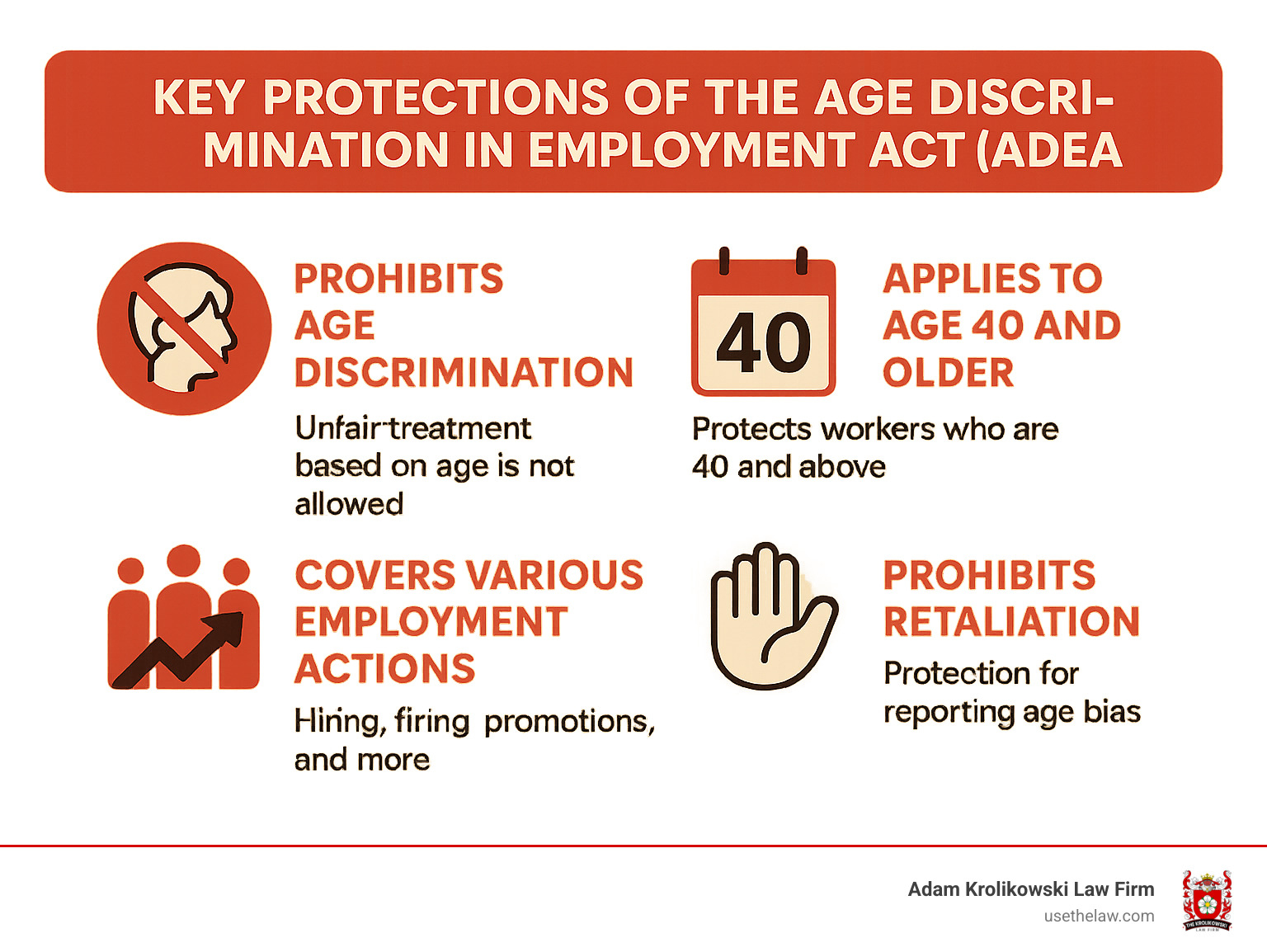
- What is it? Age discrimination is when an employer treats you unfairly because of your age. This can affect hiring, firing, promotions, or job assignments.
- Who is protected? Federal law (the ADEA) protects workers who are 40 or older. Many state laws, like California’s, offer similar or broader protections.
- Why get help? An attorney can help you understand your rights, gather proof, and fight for fair treatment or compensation.
Workplace fairness should be a given, but many people face bias based on age, gender, or race, which can make work life incredibly difficult.
Age discrimination is a real problem. Nearly one in four workers aged 45 and older has heard negative comments about their age from supervisors or coworkers. This guide will help you understand how to spot age discrimination, what laws protect you, and the steps you can take.
Identifying Age Discrimination in the Workplace
Age discrimination is when someone treats you unfairly at work simply because of your age. This unfavorable treatment can show up in many ways, from being passed over for a promotion to facing harassment from coworkers.
While age discrimination can happen to anyone, it most commonly affects workers who are 40 years or older. The law recognizes that older workers face unique challenges, which is why specific protections are in place.
Sometimes age discrimination creates a hostile work environment. This isn’t just a single bad day; it’s when age-related jokes, negative remarks, or other conduct becomes so frequent or severe that it makes your workplace feel intimidating or offensive. For example, supervisors might regularly comment about an employee being “over the hill” or suggest they should “make room for younger blood.”

There are several common signs of age discrimination. These include being overlooked when hiring younger candidates with less experience, noticing negative performance reviews that suddenly appear without good reason, or receiving forced retirement offers when you have no plans to stop working.
Layoffs targeting older workers are another red flag. If a company cuts jobs and mostly lets go of people over 40 while keeping younger, less experienced employees, that’s worth investigating.
Common Examples and Subtle Signs
Age discrimination isn’t always obvious. It can hide behind seemingly innocent actions or comments that mask unfair treatment.
Hiring younger candidates over qualified older applicants is a common form. An employer might claim they want someone with “fresh ideas,” but this can be code for wanting someone younger.
Being denied promotions or career development opportunities can also signal age bias. Some employers wrongly assume older workers aren’t interested in advancing their careers or won’t be around long enough to make training worthwhile.
Exclusion from training, important meetings, or key projects often happens to older workers, leaving them out of the loop while younger colleagues get career-building opportunities.
Derogatory comments and age-related jokes might seem harmless, but they can create a pattern of discrimination. Comments like “Can you even see the computer screen?” can be illegal if they happen regularly.
Watch out for code words that mask age bias. Job postings asking for someone “energetic” or managers wanting “digital natives” might really be saying they don’t want older workers. An age discrimination attorney can help you recognize when these terms indicate bias.
Common Myths vs. Reality
Let’s clear up some common misunderstandings about age discrimination.
- Myth: Only affects those near retirement. Reality: Protects workers 40+. The law protects anyone 40 or older, so discrimination can happen to people in their 40s and 50s too.
- Myth: It’s rare. Reality: AARP statistics show it’s common. Nearly 1 in 4 workers aged 45 and older report hearing negative comments about their age from supervisors or coworkers.
- Myth: A single comment isn’t illegal. Reality: Severe or pervasive comments can create a hostile environment. While one isolated comment might not be enough, a pattern of age-related remarks can be illegal if it makes your work environment hostile.
Understanding that age discrimination comes in many forms—from overt acts to subtle behaviors—is the first step toward protecting your rights.
Your Legal Protections Under Federal and California Law
Facing age discrimination is unfair, but both federal and state laws are in place to protect you. These laws make it illegal for employers to treat you unfairly because of your age in any part of your job.
At the federal level, the Age Discrimination in Employment Act (ADEA) of 1967 prohibits employers from discriminating against employees and job applicants who are 40 years of age or older. It covers hiring, firing, promotions, job assignments, training, benefits, and pay. The Equal Employment Opportunity Commission (EEOC) is the federal agency that enforces the ADEA.
In California, the Fair Employment and Housing Act (FEHA) provides even stronger protections for workers 40 and older. The California Civil Rights Department (CRD) (formerly DFEH) is the state agency that enforces FEHA.
The U.S. Department of Labor (DOL) also outlines protections against age discrimination, especially for federal contractors. You can learn more about these protections on their website.

Federal vs. State Law: What’s the Difference?
While both the ADEA and FEHA fight age discrimination, key differences can affect your case, especially regarding employer size and filing deadlines.
Here’s a quick look at how they compare:
| Feature | ADEA (Federal Law) | FEHA (California State Law) |
|---|---|---|
| Protected Age | 40 years of age or older | 40 years of age or older |
| Employer Size | 20 or more employees | 5 or more employees |
| Filing Deadline | 180 or 300 days (with EEOC) | 3 years (with CRD) |
| Available Remedies | Back pay, front pay, liquidated damages (for willful violations), attorney’s fees | Back pay, front pay, emotional distress, punitive damages, attorney’s fees |
Crucially for California workers, FEHA protects employees of smaller businesses (5+ employees), while the federal ADEA only applies to businesses with 20+ employees. This ensures many more workers are protected from age discrimination.
The EEOC is central to federal age discrimination cases. If you believe you’ve been treated unfairly due to age, you typically must first file a “charge” with the EEOC before you can file a lawsuit in federal court. The EEOC will investigate your claim and may try to help resolve the issue. If not, they will issue a “right to sue” letter, which is your green light to move forward with a lawsuit.
Exceptions and Employer Questions
While age discrimination is mostly off-limits, there are rare situations where age can be a factor in job decisions.
One such exception is a Bona Fide Occupational Qualification (BFOQ). This means age is a necessary requirement for a particular job, and the employer must prove it is essential to the business. For example, a mandatory retirement age for airline pilots is a BFOQ due to safety concerns. However, BFOQs are uncommon and interpreted very strictly.
Employers can also take actions based on legitimate, non-discriminatory reasons. For instance, if a company lays off workers based on performance or seniority, and it affects all age groups equally, it might not be discrimination. An Age discrimination attorney often must prove the employer’s stated reason is a pretext for age bias.
Employers can ask for your birth date or proof of age, usually for identification or to ensure you’re old enough to work legally. However, they cannot use this information to discriminate against you based on your age. A company can’t use your birthdate to filter out older applicants unless a rare BFOQ applies.
Steps to Take if You Suspect Age Discrimination
If you believe you’ve experienced age discrimination, you have options. There are concrete steps you can take to protect your rights and build a strong case.
Proving discrimination is often the biggest challenge. Direct evidence, like an email saying “We need someone younger,” is rare. More commonly, you’ll rely on circumstantial evidence to show a pattern suggesting age was behind an employer’s actions. This could include younger, less qualified people getting promoted over you or a history of positive performance reviews suddenly turning negative.
Disparate impact is another form of discrimination. This occurs when a seemingly neutral company policy hurts older workers more than others. For example, requiring recent training but denying older workers access to it could be discriminatory.
If you win your case, the law aims to make you whole. Back pay covers lost wages and benefits. If getting your job back isn’t feasible, front pay compensates for future lost earnings. Emotional distress damages recognize the pain and suffering you’ve endured. For particularly egregious violations, federal law allows for liquidated damages (which can double your back pay), while California law allows for punitive damages. If you win, the employer typically has to pay your attorney’s fees and court costs.
How to Document and Report a Claim
Building a strong case starts with good documentation. Every detail matters.
- Keep a detailed log of every incident. Write down dates, times, who was there, what was said or done, and any witnesses. Include even minor comments about your age, as a pattern can be significant.
- Save everything that might be relevant: emails, text messages, performance reviews, job postings, and company memos.
- Review your company’s policies on discrimination and harassment. Following the internal reporting procedures can strengthen your case.
- Report the discrimination to HR or your supervisor. It is illegal for your employer to retaliate against you for making a good faith complaint.
- Be careful with recordings. California requires all parties to consent to a recording. Other states have different rules, so it’s important to understand the laws on recording conversations where you work.
- File a charge with the EEOC or California Civil Rights Department (CRD). This is usually a required step before you can sue.
What is the time limit for filing a claim?
You don’t have unlimited time to file an age discrimination claim. The law sets strict deadlines called statutes of limitations, and missing them can end your case.
For federal claims under the ADEA, you typically have 180 days from the incident to file with the EEOC. In states like California with their own anti-discrimination laws, this deadline extends to 300 days.
California’s FEHA gives you three years to file with the CRD. While this is much longer than the federal deadline, don’t wait. Evidence gets stale, and witnesses’ memories fade.
If you think you’ve faced age discrimination, don’t wait to get help. An age discrimination attorney can help you understand which deadlines apply and ensure everything is filed on time. Getting legal guidance early can make all the difference.
When and How to Hire an Age Discrimination Attorney
Deciding when to hire an Age discrimination attorney is a big, but often necessary, step. While you can try to solve issues on your own, legal help is sometimes invaluable.
You should consider contacting an attorney if:
- You suspect unlawful discrimination: A lawyer can evaluate your situation, explain your rights, and suggest how to move forward without risking your job.
- You’ve been offered a severance agreement: Employers often ask you to waive your legal rights. An attorney can review the agreement for fairness, ensure it follows rules like the Older Workers Benefit Protection Act (OWBPA), and help you negotiate a better offer.
- You face retaliation: If your employer takes action against you (demotion, pay cut, firing) after you complain about discrimination, that’s illegal. An attorney can help you fight back.
- You’ve been fired or laid off: If you feel age was a factor, an attorney can investigate, help gather proof, and determine if you have a case for wrongful termination.
- You need help with the legal process: The legal process is confusing. An attorney can guide you, ensure you meet deadlines, and present your case effectively.
If you see signs of age bias, like your age being treated as a liability or older workers being pushed out, getting legal advice is a smart move.

Finding the Right Age Discrimination Attorney for Your Case
Picking the right legal team is important. Here’s what to look for in an attorney for age discrimination claims:
First, you want someone with a deep understanding of California employment law, including both federal (ADEA) and state (FEHA) laws. Our firm, Adam Krolikowski Law Firm, has over 25 years of experience in employment law. We have handled many situations, including complex cases other attorneys might not take on. We understand the specific protections and processes in California, with offices in Santa Ana and Los Angeles.
Many employment law firms, including ours, work on a contingency fee basis. This means you don’t pay legal fees upfront; we only get paid if we secure a positive outcome for you. This aligns our goals with yours and lets you seek justice without an immediate financial burden.
An attorney with trial experience is also valuable. While many cases settle, having a lawyer who is ready for trial shows employers you are serious.
Age discrimination cases can be tricky, often involving subtle bias and deep factual analysis. You need a firm that can handle these complex cases with care.
Finally, consider their communication style. Look for an attorney who explains things clearly, keeps you updated, and makes complex legal ideas easy to understand.
What to Ask Your Age Discrimination Attorney
When you first meet with an attorney, come prepared with questions to help you decide if they are the right fit. We suggest asking:
- How do you assess my case? Ask about the strengths and weaknesses of your potential claim.
- What is your strategy for a case like mine? Ask about the expected steps, from filing a charge to settlement or court.
- What are the potential outcomes? Discuss what you might receive if you win, such as lost wages or emotional distress damages.
- How do you handle fees and costs? Confirm their fee structure (like a contingency fee) and ask about other potential costs.
- How will you communicate with me? Understand how they will keep you updated on your case’s progress.
- What do you need from me? Find out what information and help they will need from you.
We believe in being open and clear, so you feel informed throughout the process.
Conclusion
Your work should be judged on skills and experience, not age. Age discrimination in the workplace is illegal, and your rights are protected by law.
Federal laws like the Age Discrimination in Employment Act (ADEA) and California’s Fair Employment and Housing Act (FEHA) shield employees 40 and older from unfair treatment. You have a right to a workplace free from bias in hiring, promotions, pay, training, and termination.
Being overlooked for promotions, facing age-related comments, or being targeted in layoffs are not minor annoyances; they are clear violations of your rights.
Documentation is a powerful tool. Keep a log, save documents, and report issues through proper channels. Also, be aware of the strict time limits for filing claims with the EEOC or CRD, as acting quickly is crucial.
If you suspect you’ve been a victim of age discrimination, you don’t have to face it alone. Adam Krolikowski Law Firm helps employees in Orange County and Los Angeles steer these complex legal waters. With over 25 years of experience, we are ready to handle even the most challenging cases to help you secure the justice you deserve.
Taking action is the first step toward ensuring fairness in your workplace. If you’re looking for a committed Age discrimination attorney who understands your situation, we’re here.
Schedule a consultation to discuss your case and learn how we can help: Schedule a consultation to discuss your case
Contact Us
Practice Areas
Recent Articles
- « Previous
- 1
- 2
- 3
- Next »