

The Dangers of Construction Work
First Steps After a Construction Accident: Protecting Your Health and Your Claim
When an accident happens, it’s easy to feel overwhelmed. But taking the right steps immediately can make a world of difference for your health and any future claim. Think of it as laying the groundwork for your recovery, just like they lay the groundwork for a new building.
What to Do Immediately After an Injury
First things first, your health is paramount. We can’t stress this enough: seek medical attention immediately, even if you think you’re fine. Adrenaline can mask pain, and some serious injuries, like internal bleeding or concussions, might not be immediately apparent. A prompt medical evaluation not only ensures you get the care you need but also creates an official record of your injuries linked to the accident. This documentation is gold for your claim.
Once you’ve addressed your medical needs, it’s time to report the incident. You should notify your employer or supervisor as soon as possible. In California, you generally have a limited time to do this. For a workers’ compensation claim, you must notify your employer in writing within 30 days of the incident. This is a critical step, as outlined in Cal. Lab. Code § 5400. Don’t delay!
Next, if you’re able, document the scene. This is where your inner detective comes out. Take photos and videos of:
- Your injuries.
- The accident site (the wider area, specific equipment, any hazards).
- Anything that might have contributed to the accident (e.g., broken scaffolding, exposed wires, falling debris).
- The weather conditions.
Also, try to gather witness information. Get names, phone numbers, and any other contact details for anyone who saw what happened. Their accounts can be vital. Keep copies of all accident reports, medical records, pay stubs, and any other documents related to your injury and its financial impact.
Finally, and this might seem obvious but it’s important: don’t admit fault. Stick to the facts of what happened. Let the investigation determine liability.
Who Can File a Claim?
Construction sites are busy places, and accidents can affect more than just the direct employees. When something goes wrong, several types of individuals might be able to file a claim:
- Injured Workers: This is the most common scenario. Whether you’re a full-time employee, a temporary worker, or even an independent contractor, you may have rights to compensation. Many construction workers, especially day laborers or contractors, might not qualify for workers’ compensation, making personal injury claims their primary avenue for recovery.
- Independent Contractors and Subcontractors: Often, these individuals are not considered traditional employees and therefore aren’t covered by workers’ compensation. However, they can often pursue a personal injury claim against a negligent third party.
- Passersby and Site Visitors: Construction zones aren’t just dangerous for those working there. Bystanders, delivery drivers, or even curious visitors who are injured due to unsafe conditions or an accident can also file personal injury claims. One source noted, “Construction zone accidents can result in tragic injuries to workers as well as innocent bystanders.”
- Family Members in Wrongful Death Claims: Tragically, some construction accidents are fatal. In these heartbreaking situations, the surviving family members can file a wrongful death claim to seek compensation for their losses, including funeral expenses, lost income, and emotional suffering.
Understanding who can file is the first step in navigating the complex world of construction accident claims. For more insights on this, you can look into Construction Site Injury Claims.
Common Construction Accidents and Determining Who Is Liable
Construction sites change daily, and with that constant motion comes risk. Knowing the most frequent hazards, the injuries they cause, and who may be legally responsible helps you decide what steps to take after an accident.

The “Fatal Four” and Other Common Accidents
OSHA tells us four dangers cause most construction deaths:
- Falls – roofs, ladders, scaffolds, or open edges.
- Struck-by Objects – tools, materials, or vehicles.
- Electrocutions – live wires or faulty equipment.
- Caught-in/Between – trench cave-ins or crushing machinery.
Other recurring problems include scaffolding collapses, crane mishaps, trench failures, and equipment malfunctions. Even small items dropped from height can be disastrous.
Types of Injuries Sustained
Because the work is physical and often at elevation, injuries tend to be serious:
- Brain or spinal trauma
- Multiple fractures or crush injuries
- Severe burns or amputations
- Long-term illnesses from toxic exposure
- Wrongful death
More detail on injury categories is available in our Personal Injury Law Category.
Who Can Be Held Responsible?
Responsibility rarely falls on one person. Any of the following, or a mix of them, could share the blame:
- General contractors guiding overall site safety
- Subcontractors whose crews or gear create hazards
- Property owners who allow unsafe conditions
- Design professionals if a structural flaw contributes
- Equipment makers when a defect triggers failure
- Government entities on public projects
Sorting out this web of parties is why many people turn to a construction accident law firm that understands third-party liability.
Workers’ Compensation vs. Third-Party Lawsuits: Know Your Options
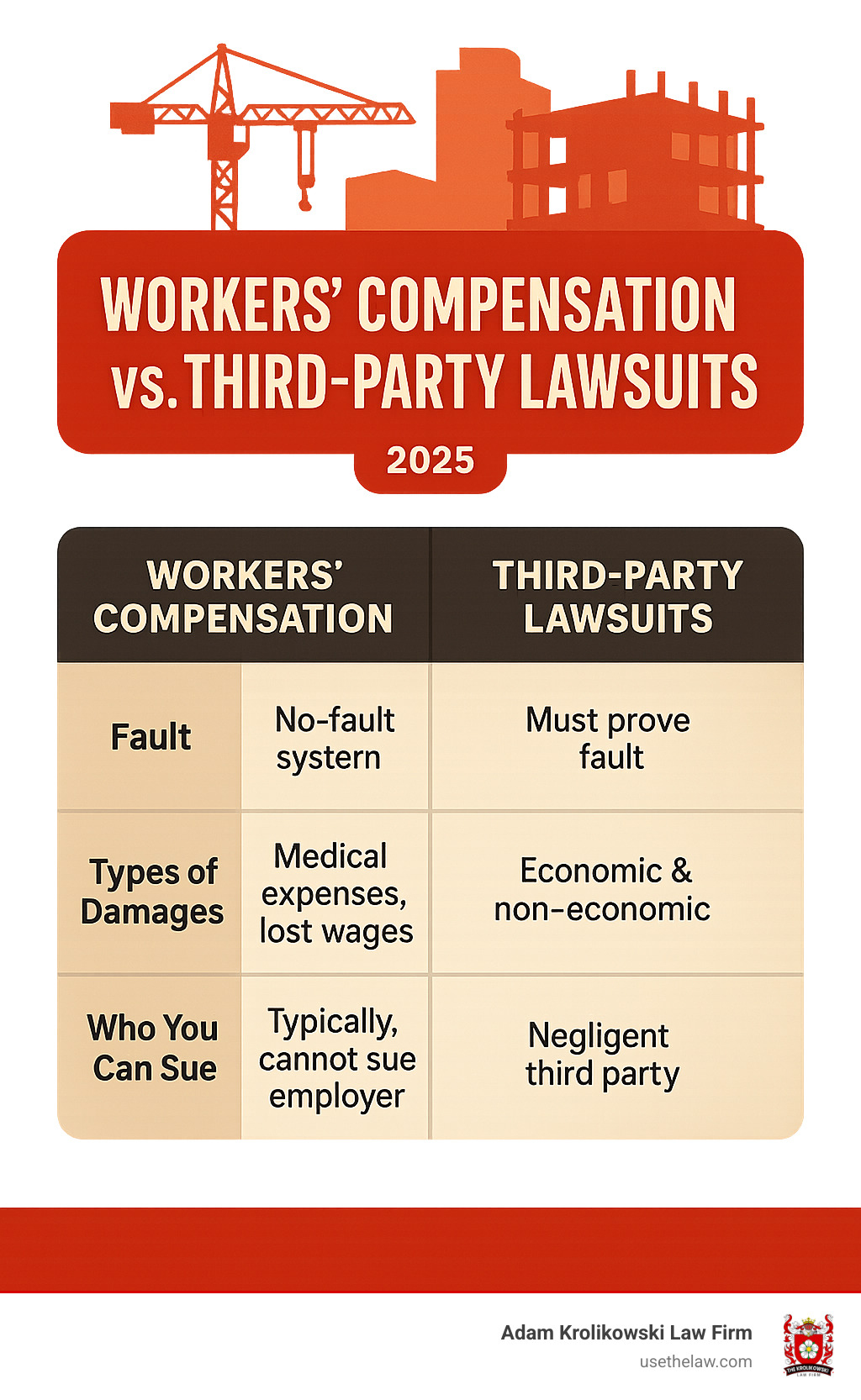
After a construction injury you usually have two overlapping paths: a no-fault workers’ compensation claim and, if someone besides your direct employer played a role, a third-party personal-injury lawsuit. Each path serves a different purpose.
Understanding Workers’ Compensation Benefits
Workers’ comp is meant to start quickly and cover:
- Medical bills
- A portion of lost wages (temporary or permanent disability)
- Job-retraining vouchers when you can’t return to the same work
It does not pay for pain, suffering, or the full value of lost earnings, and it generally shields your employer from being sued. Details on filing are in our Workers Compensation Category.
Pursuing a Third-Party Personal Injury Lawsuit
If a general contractor, subcontractor, equipment supplier, or any other non-employer acted negligently, you may file a civil lawsuit. Unlike workers’ comp, you must prove fault, but you can pursue broader damages, such as:
- Full wage loss and future earning capacity
- Pain, emotional distress, and loss of enjoyment of life
- Loss of consortium for a spouse or partner
- Punitive damages in rare, egregious cases
Most injured workers pursue both claims at once so immediate needs are covered by workers’ comp while the lawsuit seeks complete compensation. Learn more about this strategy through our Personal Injury Law Firm insights.
What Compensation Can You Recover?
In a third-party case we seek:
- Economic losses – all medical care, full past and future wages, and property damage.
- Non-economic losses – pain, suffering, disfigurement, and diminished quality of life.
- Punitive damages – only when the defendant’s conduct was especially reckless.
Why You Need a Capable Construction Accident Law Firm
Dealing with a construction accident is stressful enough without having to battle insurance companies and steer complex legal systems. This is where a capable construction accident law firm becomes your most valuable tool. We’re not just here to file paperwork; we’re here to protect your interests and ensure you get a fair shake, allowing you to focus on healing.

Services a Construction Accident Law Firm Provides
When you partner with us, you’re not just hiring legal representation; you’re gaining a dedicated team ready to manage every aspect of your claim. We start with a free consultation, where we’ll sit down, listen to your story, explain your rights, and outline your options. It’s a no-cost, no-obligation conversation designed to help you understand your path forward.
Once you decide to move forward, we dive into a thorough investigation and evidence gathering. We don’t just take your word for it – we dig deep! We’ll collect crucial evidence like accident reports, your medical records, witness statements, photos of the site, and even any available surveillance footage. We know how important it is to preserve evidence that might otherwise disappear.
For those more intricate cases, we also work with a network of professionals, including accident reconstructionists and medical professionals. These individuals can provide valuable insights and testimony, helping us show exactly how the accident happened and the full extent of your injuries.
One of our biggest roles is negotiation with insurance companies. Insurers are in the business of minimizing payouts, and they often use tactics that can leave accident victims feeling overwhelmed. We know their playbook because some of us even have backgrounds working for insurance companies. We’ll handle all communication, pushing aggressively for a settlement that truly reflects all your losses, from medical bills to lost wages and pain.
If a fair settlement can’t be reached through negotiation, we’re fully prepared for litigation and trial representation. We have a strong track record in court and will advocate fiercely on your behalf before a judge and jury. Construction accident claims are often multi-layered, involving several parties and intricate legal arguments. We are particularly skilled at handling complex cases that other attorneys might shy away from, bringing our extensive background to bear. For a deeper dive into how a firm like ours can assist you, explore Construction Accident Lawyer.
The Importance of OSHA in Your Claim
The Occupational Safety & Health Administration (OSHA) plays a crucial role in preventing construction accidents and, by extension, in proving negligence when accidents do occur. Think of OSHA as the rulebook for safety on the job site.
OSHA sets and enforces safety standards to ensure workers have a reasonably safe environment. These standards cover everything from fall protection and scaffolding requirements to hazard communication and electrical safety. If an accident occurs due to a violation of OSHA safety standards, it can serve as powerful evidence of negligence in your claim. For instance, in 2014 and 2015, OSHA reported that 87% and 90% of construction site deaths involved safety guideline violations. Common violations include those related to fall protection, scaffolding, ladders, and electrical problems.
OSHA also conducts site inspections and investigates accidents. Their findings, while not always legally binding in civil court, can provide valuable insights and support your case by highlighting safety lapses. A thorough understanding of OSHA policies and how to use them to your advantage is a hallmark of a capable construction accident law firm. We know how to examine OSHA reports and regulations to build a strong case for you. Learn more about workplace safety by visiting the Workplace Safety Category. For official information, check out the Occupational Safety & Health Administration (OSHA) website.
How to Choose the Right Construction Accident Law Firm
Choosing the right construction accident law firm is a bit like choosing the right contractor for a complex job—you want someone who knows their stuff, has a good track record, and communicates clearly. Here are some factors to consider:
Look for a firm with significant experience with construction law. These cases are unique due to the multiple parties involved and specific safety regulations. Our firm, Adam Krolikowski Law Firm, for example, has over 25 years of experience in personal injury and workers’ compensation law, including construction accidents, and we are adept at handling complex cases.
While many cases settle, you want a firm that is prepared to go to trial if necessary. Their willingness and ability to litigate can often lead to better settlement offers. Ask about their trial record and their history of successful settlements and verdicts.
What do past clients say? Client testimonials can offer valuable insights into the firm’s client communication, dedication, and overall approach. A reputable construction accident law firm should also work on a contingency fee structure. This means you pay no upfront legal fees, and they only get paid if they win your case. This aligns their success directly with yours. Finally, construction accident cases often require significant resources for complex cases, including investigations and working with various professionals. Ensure the firm has the capacity and financial backing to handle the intricacies of your claim.
Frequently Asked Questions about Construction Accident Claims
How are construction accident lawyers typically paid?
Most firms, including ours, work on a contingency fee. You pay no retainer. If we obtain a recovery, we receive an agreed-upon percentage. We also advance ordinary case costs, which are repaid from the settlement before our fee is calculated.
What is the time limit for filing a construction accident claim in California?
- Workers’ comp notice: 30 days to tell your employer, then up to 1 year to file the claim.
- Third-party lawsuit: 2 years from the accident under CCP § 335.1.
- Findy rule: If the injury or its work connection was not immediately clear, the 2-year clock starts when you reasonably find it.
- Government entity: File a notice within 6 months (sometimes 90 days) if a public agency is involved.
Acting early keeps every option open.
What happens if my employer doesn’t have workers’ compensation insurance?
You can sue the employer directly for negligence, and you may seek benefits from California’s Uninsured Employers Benefits Trust Fund (UEBTF). Penalties against non-insured employers are severe, so lack of insurance should not block your recovery.
If you have other questions, a brief call can clarify your next steps.
Don’t Face a Complex Claim Alone
A construction injury brings pain, medical bills, and lost income. You should be able to focus on healing, not deciphering legal rules or sparring with insurers. Adam Krolikowski Law Firm has more than 25 years of experience guiding injured workers through both workers’ comp and third-party claims, even when the facts are complicated.
Our offices in Orange County, Santa Ana, and Los Angeles are ready to help. If you or someone you love was hurt on a jobsite, contact an Orange County Construction Accident Lawyer for a free consultation today.
