

The High Stakes of Construction Work
Construction site injury incidents make construction one of America’s most dangerous industries. If you’ve been hurt on the job, understanding your rights is crucial for protecting your future.
Most Common Construction Site Injuries:
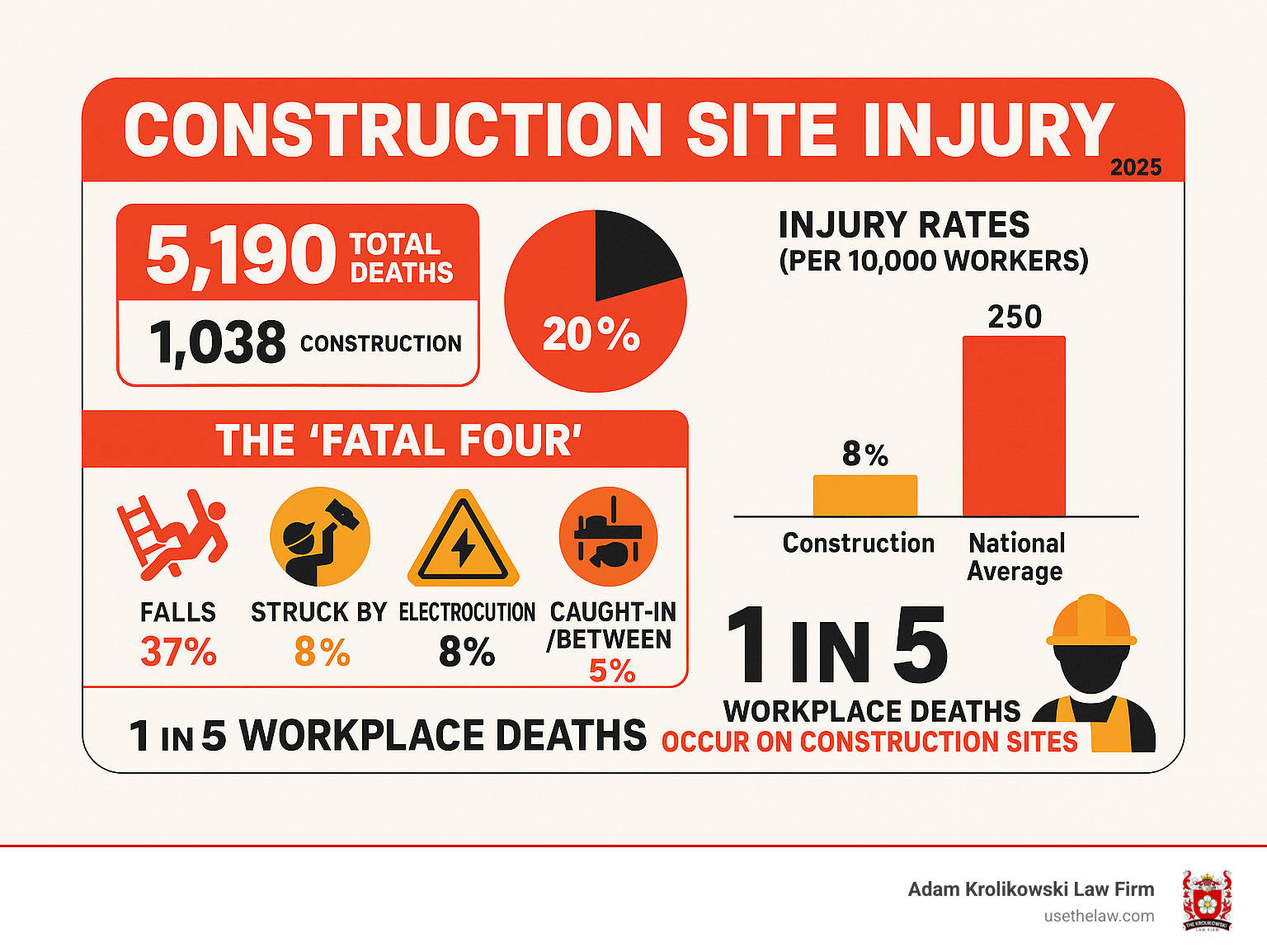
- Falls from heights: The leading cause of construction deaths (37% of fatalities).
- Struck-by objects: Involving heavy equipment, falling tools, or debris (8% of deaths).
- Electrocutions: From faulty wiring, power lines, or wet conditions (8% of deaths).
- Caught-in/between accidents: Such as machinery incidents or trench collapses (5% of deaths).
- Other serious injuries include traumatic brain injuries, spinal cord damage, burns, and amputations.
The Bureau of Labor Statistics reported 5,190 fatal work injuries in the U.S. in 2021, with nearly 20% in construction. This means construction sites account for one in five workplace deaths.
The industry has a consistently higher rate of injury, illness, and death than the national average. With millions working on construction sites daily, the risks are significant. Workers often face multiple hazards at once, from heavy machinery and heights to electrical equipment and busy job sites. Time pressures and changing conditions further increase the danger.
Fortunately, many of these injuries are preventable with proper safety protocols. When these protocols fail, injured workers have legal options beyond workers’ compensation.
The “Fatal Four” & Other Common Causes of Construction Site Injury
When examining serious construction site injury incidents, a clear pattern emerges. The Occupational Safety and Health Administration (OSHA) identifies the “Fatal Four” hazards, which are responsible for a majority of construction worker deaths. These preventable tragedies often occur when safety rules are ignored. Understanding these leading causes—Falls, Struck-by Objects, Electrocutions, and Caught-in or Between hazards—is the first step in prevention and in understanding what went wrong after an injury. You can learn more from OSHA’s own resources on the “Fatal Four”.
Falls from Heights
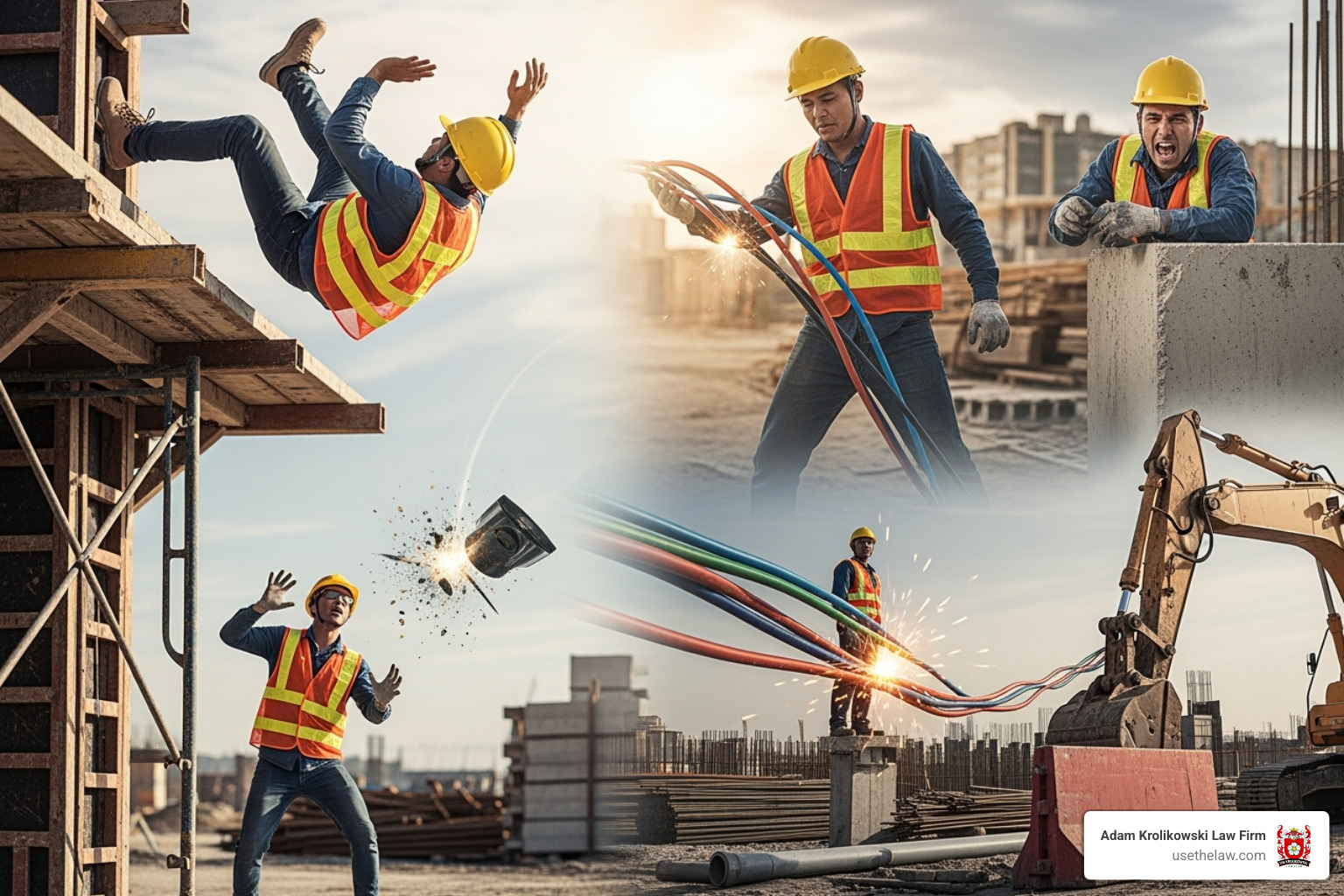
Falls are the number one cause of death in construction, accounting for 37% of all fatalities in 2021. Many construction workers spend their days high above the ground on scaffolding, ladders, or roofs. These falls often happen from:
- Scaffolding: Improperly built, maintained, or overloaded scaffolding can collapse. OSHA has detailed standards for fall protection on scaffolding because it is so widely used.
- Ladders: Unsecured, broken, or improperly used ladders are a common cause of falls.
- Roofs and Unprotected Edges: Working on roofs without proper barriers or near open-sided floors and walls creates a significant fall risk.
OSHA requires fall protection for any construction worker 6 feet or more above a lower level. Despite clear rules, fall protection violations are OSHA’s most frequently cited issue. If you or a loved one was hurt in a scaffolding accident, a Scaffolding Accident Lawyer in Orange County, CA can help you understand your rights.
Struck-By Accidents
A “struck-by” accident involves forceful contact between a person and an object or piece of equipment. These incidents caused about 8% of construction deaths in 2021. Common examples include:
- Falling objects: Tools, debris, or materials dropped from above.
- Heavy equipment: Workers being hit or run over by trucks, forklifts, or excavators. About 75% of struck-by deaths involve heavy equipment, highlighting the need for clear work zones and high-visibility clothing. An Orange County Truck Accident Lawyer can provide advice if you’ve been in an accident with a large vehicle.
- Cranes and forklifts: Being hit by a swinging load or a poorly operated machine.
Preventing these incidents requires strict safety protocols, including equipment checks, clear communication, and designated safe zones. You can find more resources for struck-by hazards to understand prevention methods.
Electrocutions
Electricity is essential on construction sites but also extremely dangerous. Electrocutions caused about 8% of construction deaths in 2021. These accidents can result from:
- Exposed wiring or damaged cords.
- Contact with overhead power lines, especially with tall equipment.
- Faulty equipment or improper grounding.
- Wet conditions, which increase the risk of electrocution.
Companies must provide electrical safety training and use protective measures like ground-fault circuit interrupters (GFCIs). OSHA electrical standards outline strict rules to protect workers.
Caught-In or Between
These frightening accidents occur when a worker is crushed, squeezed, or pulled into machinery or between objects, accounting for about 5% of construction deaths. Common situations include:
- Heavy machinery: Being caught between equipment and a fixed object or pulled into unguarded moving parts.
- Trench collapse: Trenches can collapse suddenly, trapping and burying workers. Proper shoring and sloping are required by OSHA to prevent these deadly accidents. A Trench Excavation Accident Lawyer in Orange County, CA can explain your options if you’ve been hurt in this way.
- Shifting materials: Being crushed by a falling load or trapped under materials during demolition.
These accidents are largely preventable through strict adherence to safety rules, proper machine guarding, and careful job site planning.
From Broken Bones to Brain Trauma: Common On-the-Job Injuries
Beyond the “Fatal Four,” construction sites present many other dangers that lead to serious, life-changing injuries. The nature of the work—heavy lifting, powerful machinery, and material exposure—means a construction site injury can manifest in many ways, from a sudden fracture to a slowly developing illness. The U.S. Department of Labor notes that for every 10,000 full-time construction workers, 250 will experience an injury or illness, one of the highest rates of any job in America.
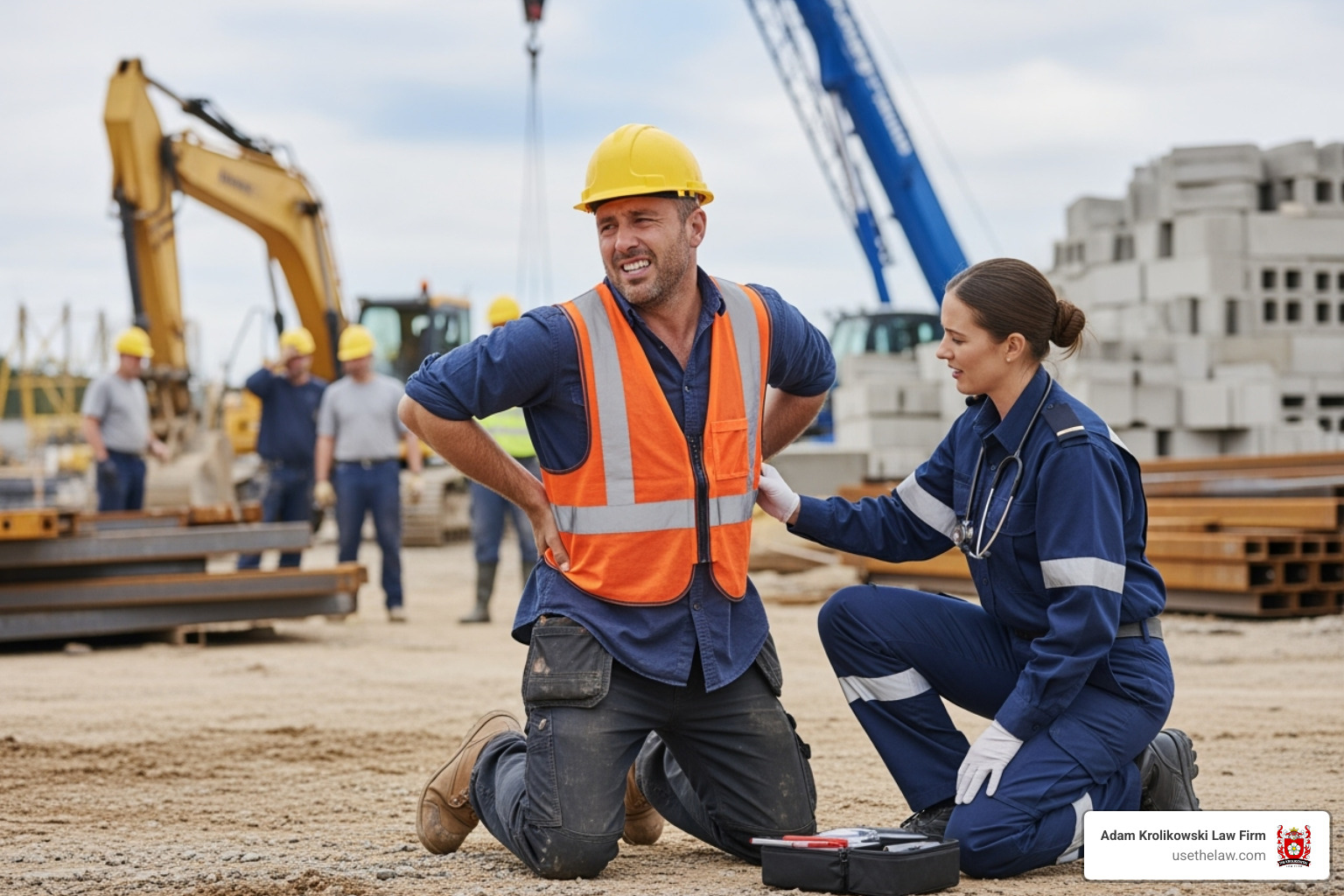
Common injuries include traumatic brain injuries (TBI) from falls, spinal cord damage that may cause paralysis, broken bones, and painful burns. Serious accidents can also lead to amputations. Other risks include deep lacerations, overexertion injuries like strains, hearing loss from loud machinery, and illnesses from toxic exposure to substances like asbestos or silica.
Head, Back, and Neck Injuries
These injuries are particularly concerning due to their potential for severe, long-lasting effects. A blow to the head can cause a concussion or a more serious Traumatic Brain Injury (TBI), affecting memory, cognitive function, and quality of life. Many who suffer a TBI face long-term disability.
Falls, impacts, or repetitive heavy lifting can damage the spine, causing herniated discs or whiplash. Severe spinal cord damage can lead to paralysis, profoundly changing a worker’s life and resulting in extremely high lifetime medical costs.
A Common Construction Site Injury: Burns and Electrocution
Burns are incredibly painful and often leave permanent scars. Construction workers may suffer from:
- Chemical burns from corrosive substances.
- Thermal burns from contact with hot surfaces or flames.
- Electrical burns from electricity passing through the body, which can cause severe internal damage. An arc flash, a sudden release of electrical energy, can cause intense heat and pressure waves.
These injuries range from minor to life-threatening and often require extensive medical treatment, such as skin grafts, leaving victims with permanent disfigurement.
Repetitive Motion and Overexertion Injuries
Not every construction site injury is sudden. Many health issues develop over time from constant physical demands. Overexertion from lifting, pushing, and pulling is a common cause of injury in construction.
This can lead to conditions like carpal tunnel syndrome from repetitive hand movements, tendinitis from overuse, and chronic muscle strains and back problems. These conditions can be debilitating, causing ongoing pain and limiting a worker’s ability to perform their job. Implementing good ergonomics programs and using tools that reduce physical strain are important for prevention.
Who is Liable? Navigating Workers’ Comp and Third-Party Claims
Figuring out who is responsible after a construction site injury can be a puzzle. Job sites are busy, with general contractors, subcontractors, property owners, and equipment manufacturers all playing a role. When an accident happens, identifying the at-fault party is key to understanding your options. Our experience at Adam Krolikowski Law Firm can help you untangle the situation. For a general overview, see our guide on Understanding Liability in Personal Injury Cases.
Potentially responsible parties include general contractors or subcontractors in charge of site safety, the property owner if they failed to maintain a safe site, or equipment manufacturers if a faulty tool caused the injury. In some cases, architects or engineers could be liable for design flaws.
Workers’ Compensation for a Construction Site Injury
For most injured construction workers, workers’ compensation is the first resource. It is a “no-fault” system, meaning you can typically get benefits even if the accident was partially your fault, as long as it happened while you were working. In California, employers must carry workers’ compensation insurance.
Benefits are designed to cover:
- Medical care: All necessary treatment, prescriptions, and rehab.
- Lost wages: Temporary disability payments to replace a portion of your income.
- Disability benefits: For lasting impairments.
- Vocational rehabilitation: To help you learn new skills if you cannot return to your old job.
- Death benefits: Provided to the worker’s family in fatal cases.
Filing a claim involves notifying your employer, filling out a claim form, and submitting it. While workers’ comp is helpful, it has limits and doesn’t cover damages like “pain and suffering.” If your claim is denied or the benefits seem inadequate, a Workers Compensation Lawyer in Orange County can make a significant difference.
Third-Party Liability Lawsuits
While you generally cannot sue your employer, you may have another option if someone other than your employer caused your injury. This is a “third-party liability lawsuit,” and it’s important because it can provide compensation for losses that workers’ comp doesn’t cover.
For example, you might have a claim against:
- The manufacturer of a defective tool.
- A property owner who allowed a dangerous condition to exist.
- Another subcontractor whose negligence caused your accident.
A third-party lawsuit allows you to seek a wider range of damages, including for your pain and suffering, emotional distress, and full lost wages and earning capacity. In rare cases of extreme recklessness, punitive damages may be awarded. Pursuing these claims requires proving negligence, so getting guidance from an experienced Personal Injury Lawyer in Orange County is highly beneficial.
Comparing Workers’ Compensation vs. Third-Party Claims
To clarify the differences, here’s a table comparing Workers’ Compensation and Third-Party Claims:
| Feature | Workers’ Compensation (WC) | Third-Party Claim (Personal Injury Lawsuit) |
|---|---|---|
| Coverage | Medical expenses, lost wages (partial), disability benefits, vocational rehab, death benefits. | Medical expenses (past & future), full lost wages (past & future), pain & suffering, emotional distress, loss of consortium, punitive damages (rare). |
| Fault Req. | No-fault system (generally, employer fault not required). | Requires proving the negligence of a third party. |
| Types of Damages | Economic damages only. | Economic and non-economic damages. |
| Who You Sue | Your employer’s workers’ compensation insurance company. | A negligent third party (e.g., another contractor, property owner, equipment manufacturer). |
| Statute of Limitations | Varies by state; typically 1-2 years to file a claim after injury. | Varies by state; in California, generally 2 years from the date of injury (or findy) for personal injury, but 6 months for claims against public entities. |
| Right to Sue Employer | Generally, no (WC is exclusive remedy). | Only in extremely rare cases of “actionable negligence” by the employer. |
Critical Steps to Take After a Construction Accident
Experiencing a construction site injury can turn your world upside down. The moments after an accident are often confusing, but what you do next can make a significant difference in protecting your rights and securing the compensation you deserve. It’s essential to act promptly and be aware of critical deadlines like the statute of limitations. For example, understanding the statute of limitations for truck accident claims in California is crucial, as similar deadlines apply to many personal injury cases.

1. Seek Immediate Medical Attention
Your health is the top priority. Even if you feel okay, adrenaline can mask serious injuries like internal bleeding or head trauma. Seek immediate medical attention at an emergency room or with a doctor. Ensure that all your injuries are thoroughly documented by medical professionals, as this creates an official record vital for any future claim. It is also important to follow your doctor’s orders strictly, including attending all follow-up appointments and completing your treatment plan.
2. Report the Injury to Your Employer
You must report the injury to your employer as soon as possible. This is a critical step for a workers’ compensation claim. Formally notify your supervisor and ask to fill out an official incident report, keeping a copy for your records. Be clear about when, where, and how the accident occurred. In California, you should notify your employer within 90 days of the injury and generally file a formal workers’ compensation claim within two years.
3. Document Everything
Gathering evidence will build a strong foundation for your claim. The more you document, the stronger your case will be.
- Photos and Videos: Take pictures of the accident scene, any faulty equipment, unsafe conditions, and your visible injuries.
- Witness Information: Get the names and contact information of anyone who saw what happened.
- Medical Records and Bills: Keep organized copies of all medical reports, bills, and receipts.
- Journal: Write down your symptoms, pain levels, and how the injury affects your daily life. Note any conversations with your employer or insurance adjusters.
- Pay Stubs: Keep your pay stubs to prove any lost wages.
4. Consult with an Attorney
Seeking legal guidance is a smart move. A lawyer who handles construction site injury cases can evaluate your situation, explain your rights, and help you determine the best path forward. We can identify all potentially responsible parties and the true value of your claim.
Dealing with insurance companies can be difficult. We can handle all communications and negotiations on your behalf, protecting you from common tactics used to minimize payouts. We will help you understand all your options, whether it’s a workers’ compensation claim, a third-party lawsuit, or both, and work to pursue the maximum compensation you deserve.
If you’re in the Los Angeles area, a Construction Accident Attorney in Los Angeles can provide the local knowledge and dedicated support you need.
Conclusion: Rebuilding After a Work Injury
Facing a construction site injury is a difficult experience. It’s a reminder that while construction builds our world, it carries serious risks. We’ve discussed the “Fatal Four” and other hazards that can change lives in an instant, impacting not just workers but also their families, finances, and futures.
Crucially, many of these accidents are preventable and happen when safety rules are ignored. Understanding the common causes of injury is the first step toward knowing your rights. While workers’ compensation provides a safety net, it often doesn’t cover all your losses. Exploring a third-party claim against a negligent party other than your employer can be vital for securing more complete compensation to help you rebuild.
The steps you take right after an accident are critical. Getting medical help, reporting the incident, documenting everything, and consulting with a legal team can protect your future.
You don’t have to steer this challenging time alone. At the Adam Krolikowski Law Firm, we understand the complexities of construction site injury cases. We are dedicated to helping accident victims and employees, taking on complex cases that others may hesitate to handle. We use our experience to fight for the compensation you deserve.
If you or a loved one has been injured on a construction site, knowing your options is crucial. For instance, if you’ve been hurt in a trenching accident, you can learn more about your options here. We are here to provide the guidance and advocacy you need to move forward.
Contact Us
Practice Areas
Recent Articles
- « Previous
- 1
- 2
- 3
- Next »