

Understanding How a Contingency Fee Lawyer Can Help You
A contingency fee lawyer works on a “no win, no fee” basis, meaning you only pay legal fees if your case is successful. If you lose, you owe nothing for the lawyer’s time, though you may still be responsible for out-of-pocket expenses like filing fees.
Quick Facts About Contingency Fee Lawyers:
- No Upfront Payment – You don’t pay hourly rates or retainers to get started.
- Fee is a Percentage – The lawyer receives a portion of your settlement or award (typically 10-45%).
- Common in Personal Injury – This arrangement is standard for accident claims, employment disputes, and workers’ compensation cases.
- Not Available for All Cases – Criminal cases and family law matters generally cannot use contingency fees.
- You Only Pay If You Win – If your case is unsuccessful, you owe no legal fees for the lawyer’s services.
The high cost of legal representation shouldn’t be a barrier to justice. For someone facing medical bills and lost wages after an injury, paying thousands of dollars upfront to a lawyer is often impossible. Contingency fee agreements solve this problem.
When your payment to the lawyer is contingent on winning, you can access legal representation without any upfront financial risk. The lawyer shares in the risk—if you don’t recover compensation, they don’t get paid. This payment structure is common in Southern California for personal injury, workers’ compensation, and employment law cases, leveling the playing field between individuals and large corporations.
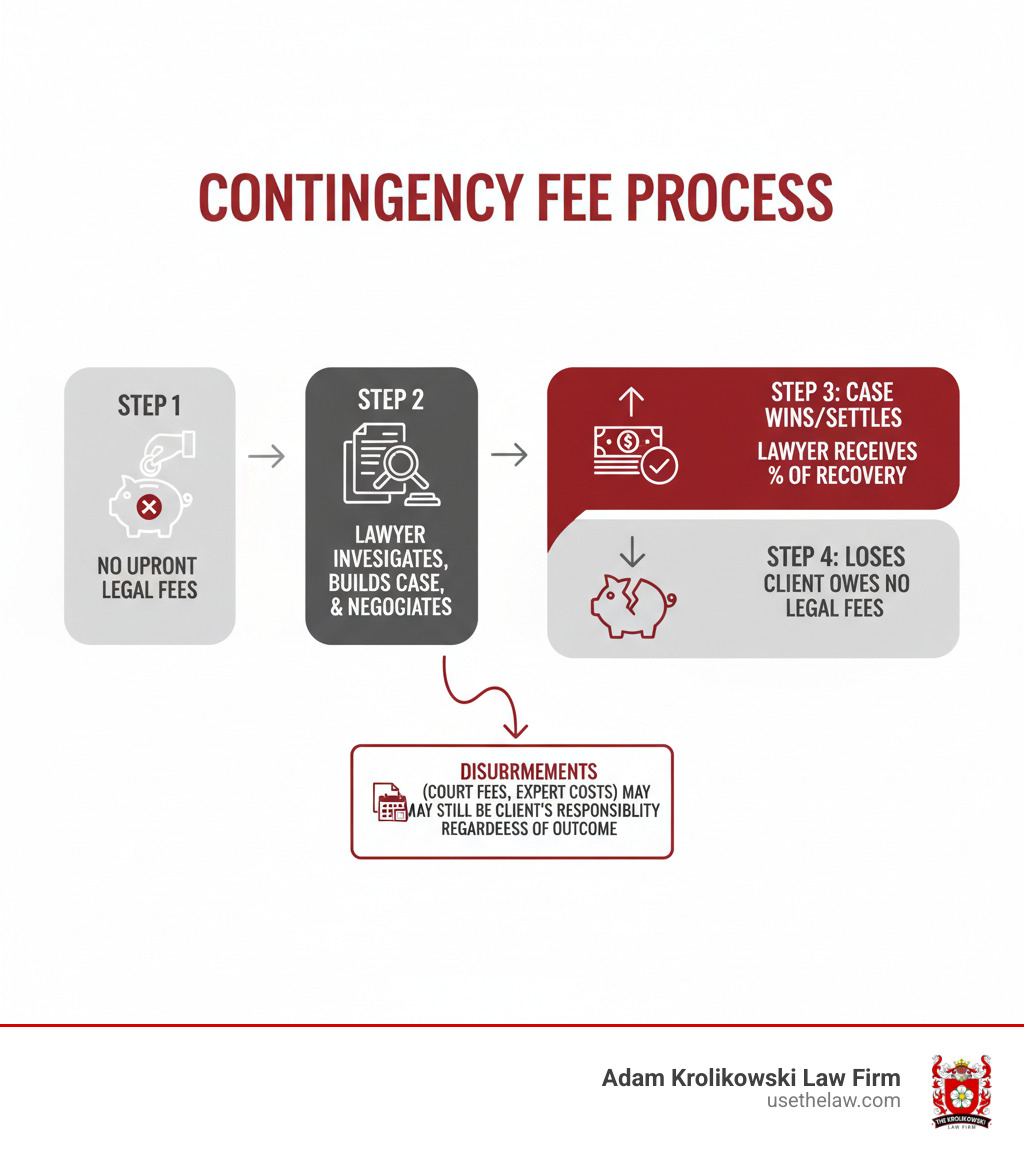
When we say “no win, no fee,” we mean it. We don’t get paid unless you do. This concept is central to our practice, ensuring financial concerns don’t prevent you from seeking justice. For more details, explore our page on No Win, No Fee.
How Contingency Fee Agreements Work
When you hire a contingency fee lawyer, payment for our time and work depends entirely on your case’s success. If we don’t win compensation for you, you don’t pay us legal fees.
In practice, we agree upfront on a percentage of any money you recover, whether from a settlement or a court award. This percentage typically falls between 10% and 45%, depending on case complexity and risk. For example, if your case settles for $100,000 and we agreed on a 33% fee, we would receive $33,000 for our services. If your case results in no recovery, you owe us nothing for the hours we invested.
This arrangement makes legal representation accessible, especially when you’re dealing with medical bills and lost income. Instead of facing hourly rates with no guarantee of success, you can pursue justice without upfront financial strain.
This payment structure is ideal for:
- Personal injury claims: Car accidents, workplace injuries, or other instances of negligence.
- Employment disputes: Wrongful termination, discrimination, or unpaid wages.
- Workers’ compensation claims.
However, contingency fees are not available for all cases. Legal rules prohibit them in criminal law and family law matters like divorce, as these cases don’t typically result in a monetary award from which a fee can be calculated.

Understanding Legal Fees, Disbursements, and Costs
It’s important to understand the different expenses in a legal case:
- Legal Fees: This is what you pay us for our work. In a contingency agreement, this is the agreed-upon percentage of your recovery. If you don’t win, you owe zero in legal fees.
- Disbursements: These are out-of-pocket expenses paid to third parties to advance your case, such as court filing fees, expert witness fees, and costs for medical records. We typically advance these funds, and they are repaid from your settlement or award. Your agreement will specify if you are responsible for repaying disbursements even if you lose.
- Costs: If you win, a court may order the losing side to pay for some of your legal expenses, known as ‘costs.’ These rarely cover all expenses but can help offset what you owe.
For example, on a $100,000 settlement with $8,000 in disbursements and a 33% fee, the $8,000 is typically repaid first. The 33% fee is then calculated from the remaining amount (or the total, depending on your agreement). The rest is your net recovery. Your written agreement will clearly explain this calculation to ensure full transparency.
The Client-Lawyer Partnership
A contingency fee arrangement creates a partnership with shared goals. Since our payment depends on your success, our interests are aligned: to get you the maximum possible compensation.
This model shifts the financial risk from you to us. We invest our time and resources because we believe in your case. This also means we are selective and only take cases we believe have merit.
While we handle the legal strategy, you retain control over major decisions. The choice to accept a settlement offer or go to trial is always yours. We provide the information and guidance you need to make an informed choice, but the final decision rests with you.
If you’re concerned about affording legal help for a wrongful termination, we offer a Free Consultation: Wrongful Termination Lawyer to discuss your options.
The Pros and Cons of Contingency Fees
Contingency fees have benefits and drawbacks. Understanding them helps you make an informed choice. Here’s how this model compares to traditional hourly billing:
| Factor | Hourly Rate | Contingency Fee |
|---|---|---|
| Upfront Cost | High (retainer required) | None (no retainer for legal fees) |
| Risk to Client | High (pays regardless of outcome) | Low (pays legal fees only if successful) |
| Lawyer Incentive | Billable hours | Successful outcome & maximum recovery |
| Final Cost Predictability | Unpredictable (can escalate rapidly) | Predictable percentage of recovery (plus disbursements) |
| Access to Justice | Limited for those with low funds | Broad (removes financial barriers) |
Advantages for the Client
The primary advantage is that you pay no legal fees unless we win. This removes the financial barrier to hiring a lawyer, which is crucial when you’re already facing lost wages and medical bills.
Additionally, our motivation is aligned with yours. We only get paid if you do, and our fee is a percentage of your recovery. This incentivizes us to maximize your compensation, not to bill more hours. This model also encourages lawyers to be selective, focusing on cases with genuine merit.
We believe the legal system should be accessible to everyone. You can read more about our approach at Pay What You Can: Making Legal Services Accessible to All.
Potential Disadvantages to Consider
If your case settles very quickly for a high amount, the percentage-based fee might be more than an hourly fee would have been. However, that percentage is the price for transferring the financial risk to the law firm. You get cost certainty from day one, knowing we are committed to seeing the case through, whether it takes ten hours or two years.
Also, while you won’t owe legal fees if you lose, your agreement may still require you to repay disbursements. We ensure you understand how the fee, disbursements, and any court-awarded costs will affect your final net recovery.
How a Contingency Fee Lawyer Determines the Fee
The percentage a contingency fee lawyer charges isn’t arbitrary. It’s based on a “fair and reasonable” standard, as required by ethical guidelines like the ABA Model Rules of Professional Conduct (2004), Rule 1.5: Fees. The fee reflects the case’s unique aspects and the risk we assume.
A straightforward case with a high chance of success involves less risk than a complex case with uncertain outcomes that could require years of litigation. The fee structure, which typically ranges from 10% to 45%, accounts for these differences.

Factors That Influence the Percentage
Several factors shape the contingency fee percentage:
- Likelihood of Success: A case with clear liability and strong evidence presents less risk than one with disputed facts.
- Case Complexity: A simple car accident case requires less work than a multi-defendant lawsuit with complex medical issues.
- Time and Labor Required: A case that settles quickly requires fewer resources than one that goes to a lengthy trial.
- Novelty of the Case: Cases involving new or unsettled legal issues require more research and carry more risk.
- Expected Recovery Amount: The potential award can influence the percentage.
- Risk Assumed by the Lawyer: The core of the fee is the financial risk we take by investing our time and money with no guarantee of payment.
Types of Contingency Fee Structures
There are several common fee structures:
- Fixed Percentage Fee: A single, agreed-upon percentage that applies no matter when the case resolves. This is the most common structure.
- Staged or Graduated Fee: The percentage increases as the case progresses through different stages (e.g., pre-litigation, pre-trial, trial).
- Early Settlement Discount: A lower percentage if the case resolves quickly.
- Partial or Hybrid Models: A combination of a reduced hourly rate or flat fee plus a lower contingency percentage. These are less common but can be useful in certain situations.
We will explain the best fee structure for your case during your initial consultation.
Understanding Your Contingency Fee Agreement
When you hire a contingency fee lawyer, you will sign a legally binding contract that protects both you and the firm. This document outlines how we will work together and how payment is handled. It is crucial to read it carefully and ask questions about anything that is unclear before you sign.
We will walk you through each section to ensure you understand what you are agreeing to.

Key Information Your Agreement Must Include
A transparent contingency fee agreement should clearly state:
- The contingency fee percentage and how it is calculated (e.g., before or after disbursements are deducted).
- How disbursements and costs are handled, including which expenses you are responsible for and when they are paid.
- The process for terminating the agreement, whether by you or the firm, and any financial implications.
- Your right to make final decisions on key matters, such as accepting a settlement offer.
Many jurisdictions provide consumer guides to help you understand these agreements, such as this example: Contingency fees: What you need to know.
Questions to Ask a Contingency Fee Lawyer
Come to your initial consultation prepared with questions. This helps ensure you understand the process and feel confident in your choice of lawyer.
- What is your experience with cases like mine?
- How is the fee percentage calculated, and is it negotiable?
- What disbursements do you anticipate for my case, and who pays for them if we lose?
- What is the estimated value of my claim?
- How and when will I receive my money if the case is successful?
- What happens if I want to switch lawyers?
Asking these questions will help you understand your rights and what to expect.
Frequently Asked Questions about Contingency Fees
Here are answers to common questions about how contingency fees work.
What happens if I lose my case with a contingency fee lawyer?
You will not owe our firm any legal fees for our time and work. That is the “no win, no fee” promise. However, your agreement will specify if you are still responsible for repaying disbursements (out-of-pocket costs) like court filing fees or expert witness fees. The terms for repaying these costs will be clearly defined in your written agreement.
Can a lawyer drop my case if it’s on a contingency basis?
Yes, but only for valid reasons, such as a client being untruthful, refusing to cooperate, or if the case is found to lack legal merit. A lawyer cannot simply abandon a case. The agreement will outline the circumstances for withdrawal and what fees, if any, would be owed for work already completed. This also applies if you choose to switch lawyers.
Is the contingency fee percentage negotiable?
Sometimes. The percentage is not always set in stone. There may be flexibility depending on the strength of your case, its complexity, the expected recovery, and the level of risk the firm assumes. A straightforward case with clear liability might allow for a lower percentage than a highly complex case with an uncertain outcome. We encourage an open discussion about the fee during your consultation to find an arrangement that is fair for everyone.
Conclusion
Contingency fee agreements are designed to give everyone a fair shot at justice, regardless of their financial situation. By working with a contingency fee lawyer, you enter a partnership where the risks are shared and the goal is aligned: securing the compensation you deserve. You shouldn’t have to choose between paying your bills and fighting for what’s right after an injury or unfair treatment at work.
At Adam Krolikowski Law Firm, we have over 25 years of experience helping clients in Orange County and Los Angeles with personal injury, workers’ compensation, and employment law cases. We are not afraid to take on complex cases that other firms might avoid.
The contingency model removes the financial barrier to legal action. We cover the upfront costs and only get paid if you do. If you are wondering whether you have a case or can afford a lawyer, a consultation can provide the answers.
Don’t let financial concerns stop you from exploring your legal options. If you need help with a personal injury claim in Orange County, learn more about how we can assist you by visiting our page for a personal injury lawyer in Orange County. Reach out today to discuss your case with no upfront costs and no financial risk.
Contact Us
Practice Areas
Recent Articles
- « Previous
- 1
- 2
- 3