


Understanding the Serious Nature of Crane Accidents
When massive cranes tower over construction sites, they bring incredible power and efficiency. But with that power comes great risk. If you or a loved one has been involved in such an incident, you need a Crane accident attorney to help you steer the complex legal landscape.
Crane accidents often lead to severe injuries and complex legal questions. Here’s what you should understand right away:
- Causes: These incidents are frequently caused by human error, equipment malfunction, or a failure to follow safety rules. According to a study by the University of Nebraska, human error accounts for 66% of crane accidents.
- Injuries: Impacts can be life-altering. Victims often suffer traumatic brain injuries, spinal cord damage, electrocution, broken bones, and crush injuries. Sadly, some accidents are even fatal. The U.S. Bureau of Labor Statistics reports around 42 crane-related deaths each year.
- Legal Options: If you’re injured on the job, you might have two main paths: a workers’ compensation claim or a personal injury lawsuit. These serve different purposes and can be pursued together in some cases.
- Who is Responsible?: Liability can be complex. It might involve the crane operator, the construction company, the crane manufacturer, or even the property owner.
- How an Attorney Helps: A crane accident attorney can investigate the crash, identify who is at fault, gather evidence, deal with insurance companies, and fight to get you the compensation you deserve. They help ensure your rights are protected.
Crane accidents are not just headline news. Many go unnoticed by the public, yet they cause serious harm to workers and bystanders. For instance, between 1992 and 2006, 323 construction workers died in crane accidents across the U.S. These incidents are often preventable, highlighting a critical need for strict safety measures and accountability.
The Anatomy of a Crane Accident: Common Causes and Devastating Injuries
Cranes are powerful machines essential to construction, but their power carries serious risks. When something goes wrong, the results are often devastating, leading to severe injuries or death. Most of these incidents are preventable.
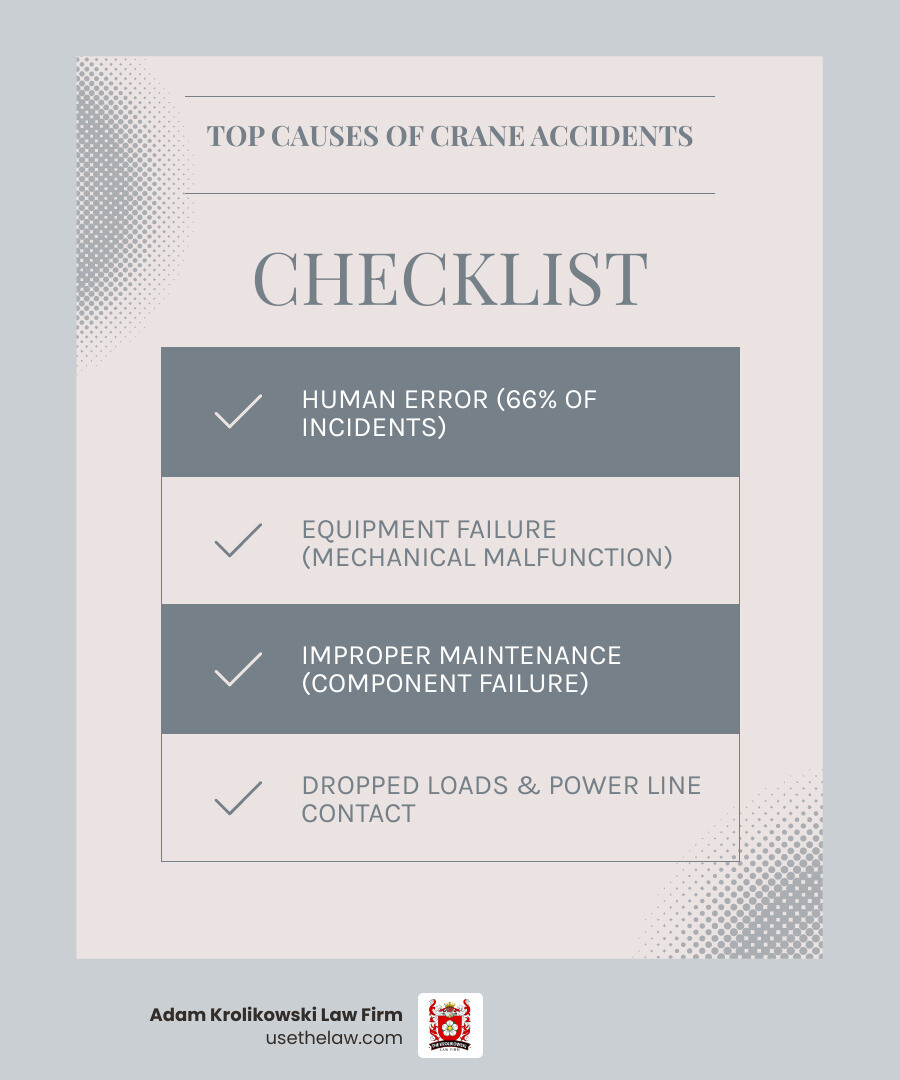
A significant number of crane incidents are linked to human error, involving not just the operator but also planners and maintenance crews. Other major causes include equipment failure, improper maintenance, dropped loads from poor rigging or overloading, and dangerous power line contact.
The U.S. Bureau of Labor Statistics data on crane-related fatalities from 2011 to 2017 highlights the human cost of these accidents. Each statistic represents a life cut short and a family changed forever. You can review the data on fatal occupational injuries involving cranes from the U.S. Bureau of Labor Statistics data.
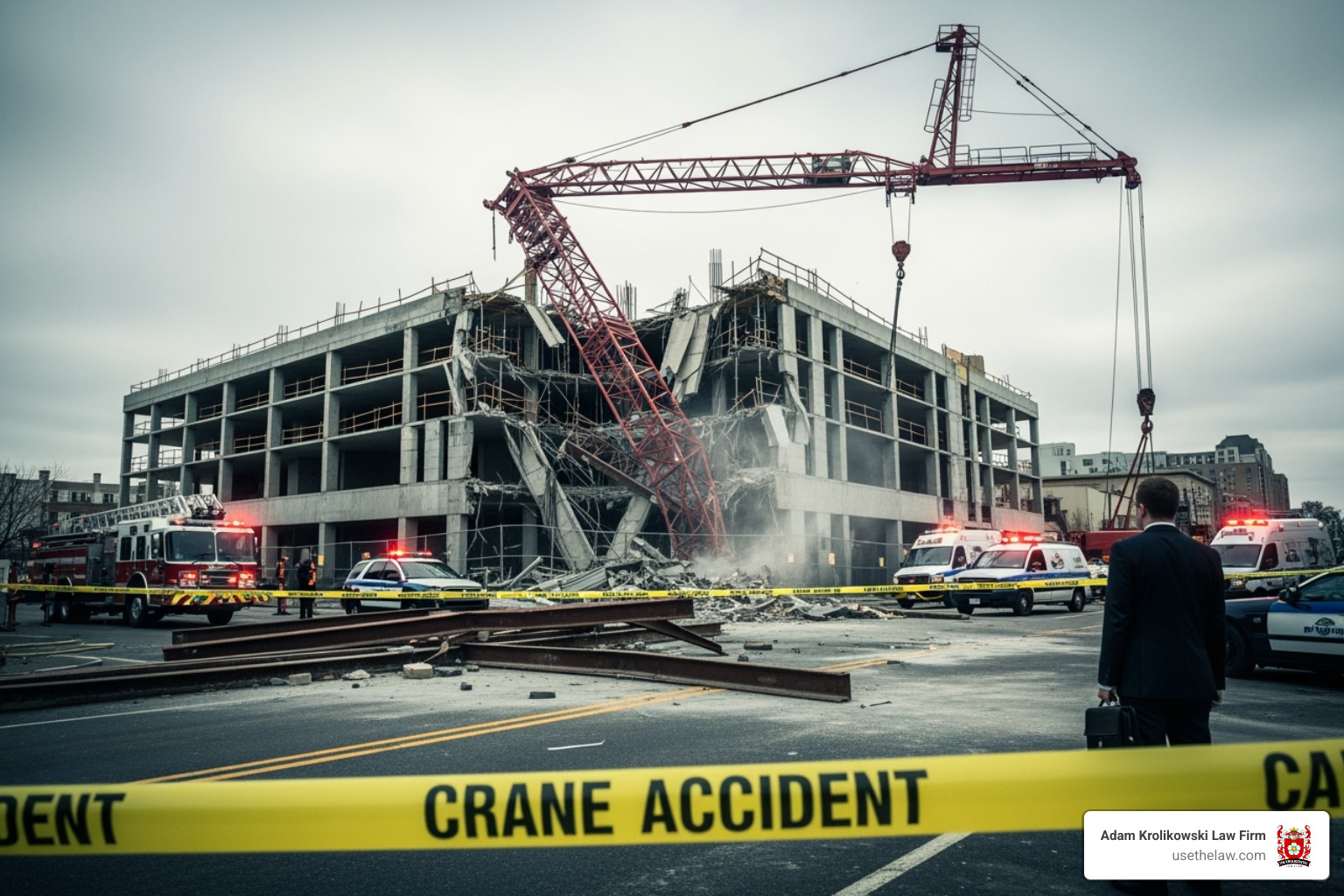
Specific causes often include cranes hitting power lines, counterweight issues causing imbalance, critical part failure from poor maintenance, dropped loads due to rigging or operator error, and improperly trained operators. These factors can combine, making accident investigation complex. A skilled crane accident attorney is essential to uncover the root causes.
Typical Injuries Sustained
The human body cannot withstand the force of a crane accident. The resulting injuries are often catastrophic, leading to lifelong disabilities or wrongful death. Common injuries include:
- Traumatic Brain Injuries (TBI): Caused by falling debris or impacts, ranging from concussions to severe damage affecting cognition and personality.
- Spinal Cord Injuries: Resulting from falls or crush forces, potentially causing partial or complete paralysis.
- Electrocution: Occurs when a crane contacts power lines, causing severe burns, organ damage, or death.
- Broken Bones: Multiple fractures are common, often requiring extensive surgery and long recovery periods.
- Crush Injuries: Severe tissue damage, internal bleeding, and organ failure from being caught between heavy objects, sometimes requiring amputation.
- Amputations: The traumatic loss of a limb due to the severity of the accident.
- Wrongful Death: Tragically, many crane accidents are fatal, leaving families with immense grief and financial burdens.
These injuries require immediate and extensive medical care, and the costs can be overwhelming. For more details on common construction site injuries, you can explore resources like More on construction site injuries.
Who Can Be Held Liable?
Determining responsibility for a crane accident is complex due to the multiple parties on a construction site. Liability can be shared. As your crane accident attorney, our job is to investigate thoroughly to identify all at-fault parties, which may include:
- The Crane Operator: May be liable for careless or unsafe operation, with their employer often sharing responsibility.
- The Construction Company: Can be held liable for unsafe conditions, poor supervision, or rushing work.
- The General Contractor: Responsible for overall site safety and ensuring rules are followed.
- The Property Owner: May be liable if they knew of site dangers and did nothing.
- The Crane Manufacturer: Can be sued for product liability if a design or manufacturing defect caused the accident.
- The Maintenance Company: If an outside company’s negligent maintenance led to failure, they can be held responsible.
- Third-Party Negligence: Other subcontractors, engineers, or utility companies whose actions contributed to the accident.
Identifying all contributing parties is crucial for securing full compensation. Insurers often shift blame to minimize payouts. A dedicated legal team protects your rights from being lost in these disputes.
Navigating the Aftermath: Immediate Steps and Safety Regulations
The moments after a crane accident are chaotic, but your actions are critical for your health and any future legal claim. Your first priority is always your health.
- Get medical attention immediately, even if you feel fine. This documents your injuries from the start.
- Report the accident to your supervisor or employer as soon as possible to create an official record.
- Document everything you can safely. Take photos and videos of the scene, equipment, and injuries. Note the weather and time.
- Preserve evidence by not letting anyone tamper with the scene or equipment.
- Get contact information from witnesses—names and phone numbers.
- Do not admit fault or discuss the incident with anyone but medical staff and your crane accident attorney. Avoid signing documents or giving recorded statements to insurers without legal counsel.
The Role of OSHA in Crane Safety
The Occupational Safety and Health Administration (OSHA) sets and enforces strict crane safety rules that employers must follow. OSHA’s Cranes and Derrick Standard mandates safe setup, clear operating paths, proper maintenance, and certified operators.
Following an accident, an OSHA investigation can uncover safety violations, providing powerful evidence for your case by officially confirming that rules were broken. These regulations exist because crane accidents are preventable with proper safety measures. For more information about how construction accident cases work, you can check out resources about construction accident law firms.
Workers’ Compensation vs. Personal Injury Lawsuits
After a workplace crane accident, you may have two paths for compensation: workers’ compensation and a personal injury lawsuit.
| Feature | Workers’ Compensation Claim | Personal Injury Lawsuit |
|---|---|---|
| Basis | No-fault system (doesn’t require proving employer negligence) | Negligence-based (requires proving another party’s fault) |
| Who Pays | Employer’s workers’ compensation insurance | Negligent party’s insurance or assets (e.g., general contractor, manufacturer) |
| Covered Damages | Medical expenses, partial lost wages, disability benefits, death benefits | All medical expenses (current & future), all lost wages (current & future), pain and suffering, emotional distress, diminished earning capacity, loss of consortium, punitive damages (in some cases) |
| Suing Employer | Generally, no (employer is immune from direct lawsuits if they have workers’ comp insurance) | Generally, no (due to workers’ comp exclusivity rule), but exceptions exist (e.g., intentional tort) |
| Third-Party Claims | Does not prevent you from suing a negligent third party (e.g., crane manufacturer, different subcontractor, property owner) | Primary avenue for suing negligent third parties |
| Legal Fees | Often regulated by state law, usually a percentage of benefits received | Typically contingency fee (no fee unless we win) |
Workers’ compensation is a no-fault system that covers medical bills and a portion of lost wages but not pain and suffering. Personal injury lawsuits seek full compensation by proving another party’s negligence. While you generally cannot sue your employer, you can sue negligent third parties like the crane manufacturer, other contractors, or the property owner.
You can often pursue both claims simultaneously. A knowledgeable crane accident attorney can help you steer both systems to maximize your recovery.
Why You Need a Crane Accident Attorney: Securing Your Rightful Compensation
After a serious crane accident, your focus should be on recovery, not legal battles. A dedicated crane accident attorney is essential because these cases are incredibly complex, involving technical details, multiple parties, and high financial stakes. Key challenges include:
- Complex Investigations: Determining the cause requires a deep dive into maintenance logs, training records, safety plans, and engineering reports.
- Evidence Gathering: Critical evidence like witness statements, photos, and equipment parts can be lost or altered if not secured quickly.
- Insurance Companies: Insurers aim to minimize payouts and will use their resources to settle your claim for less than it’s worth.
- Calculating Full Damages: A proper valuation includes not just current bills but also future medical costs, lost earning capacity, and pain and suffering.
- Legal Deadlines: Strict statutes of limitation mean missing a filing deadline can bar you from recovering any compensation.
At Adam Krolikowski Law Firm, we understand the pressure you’re under. With over 25 years of helping people with personal injury and workers’ compensation cases, we take on complicated situations that many other lawyers might avoid. We are proud to offer reliable support, so you can focus on healing while we work to make things fair.
How a Crane Accident Attorney Builds Your Case
Building a strong crane accident case requires a methodical approach combining knowledge of safety regulations and personal injury law. Our process includes:
- Hiring Investigators: We deploy investigators to the scene to secure evidence and interview witnesses before clues disappear.
- Consulting with Professionals: We work with crane operation professionals and engineers to analyze technical data and reconstruct the accident, identifying how it happened and who is at fault.
- Proving Negligence: We use the evidence to establish that a party had a duty of care, breached that duty, and directly caused your injuries.
- Documenting All Losses: We carefully collect all medical records, bills, and wage statements to calculate your financial damages. We also help you document non-economic impacts like pain and suffering.
Our firm knows the specific challenges that come with construction accident claims, especially in places like Orange County and Los Angeles. We understand how employers might try to stop necessary inspections to hide who’s at fault, and we know how to get the evidence we need. For more details on construction accidents in your area, you can learn more at More on Orange County construction accidents.
What Damages Can a Crane Accident Attorney Help You Recover?
A personal injury lawsuit aims to recover compensation for all your losses, which fall into two main categories:
Economic Damages: These are quantifiable financial losses, including:
- Medical Bills: All current and future costs for treatment, rehabilitation, and long-term care.
- Lost Wages: Income you’ve already lost due to being unable to work.
- Diminished Earning Capacity: Future income you will lose if your injuries prevent you from returning to your previous job or earning potential.
Non-Economic Damages: These compensate for intangible losses that significantly impact your life:
- Pain and Suffering: For the physical pain and discomfort from your injuries.
- Emotional Distress: For anxiety, depression, and other psychological trauma.
- Loss of Consortium: For the negative impact on your relationship with your spouse.
In cases of a fatal accident, surviving family members can file a wrongful death claim to cover funeral costs, lost financial support, and the emotional pain of their loss. Our goal is to secure full compensation to help you rebuild your life.
Frequently Asked Questions about Crane Accident Claims
It’s normal to have questions after a traumatic crane accident. Dealing with injuries, medical bills, and lost work is overwhelming. We’ve put together answers to some of the most common questions to help clarify the legal process.
What is the statute of limitations for a crane accident lawsuit?
The “statute of limitations” is a strict legal deadline for filing a lawsuit. If you miss it, you typically lose your right to seek compensation. The time limit varies by state and the type of claim (e.g., personal injury vs. wrongful death). For example, many states allow two or three years from the accident date.
Because these deadlines are absolute, it is crucial to contact a crane accident attorney promptly. This ensures there is enough time to investigate, gather evidence, and file your claim before the deadline expires. Waiting too long can prevent you from recovering the compensation you deserve.
Can I file a lawsuit if I’m already receiving workers’ compensation?
Yes, in many cases, you can. While workers’ compensation’s “exclusivity rule” generally prevents you from suing your direct employer, it does not protect negligent “third parties.” A third party is another person or company whose actions contributed to your accident. Examples include:
- The crane manufacturer (for equipment defects).
- A different subcontractor on the site.
- The property owner.
- A crane maintenance company.
A third-party lawsuit allows you to pursue compensation for damages not covered by workers’ comp, such as pain and suffering and full wage loss. A crane accident attorney can manage both your workers’ comp claim and a third-party lawsuit to maximize your recovery. For more detailed information on challenges related to workers’ compensation, you can refer to Information on workers’ comp challenges.
How much does it cost to hire an attorney for my case?
Concerns about cost should not prevent you from seeking legal help. We handle crane accident cases on a contingency fee basis, which means:
- No Upfront Costs: You pay no legal fees to start your case.
- We Only Get Paid If You Win: Our fee is contingent on securing a settlement or verdict for you.
- Fees are a Percentage: Our fee is a pre-agreed percentage of the compensation we recover. If we don’t win your case, you owe us no attorney fees.
We also offer a free, no-obligation consultation to discuss your case and answer your questions. This allows you to understand your legal options without any financial risk.
Taking the Next Step Toward Justice
A crane accident isn’t just a news story; it’s a life-altering event. These incidents leave deep physical, emotional, and financial scars that can affect you and your family for years to come. Suddenly, you’re faced with overwhelming legal challenges. Who’s truly at fault? How do you steer confusing safety rules? And how do you deal with insurance companies who just want to pay as little as possible? It’s a lot to handle, especially when you’re trying to heal.
Knowing your legal rights is absolutely vital. It’s the key to getting the compensation you truly need – money for medical bills, lost wages, and to help you rebuild your life after such a traumatic event. After a crane accident, many different parties might be responsible. It could be the crane operator, the construction company, the equipment manufacturer, or even a different contractor on site. Figuring out who is at fault is complex, and it’s a puzzle that needs to be solved correctly to protect your future.
That’s where we come in. At Adam Krolikowski Law Firm, we truly care about helping people just like you. Based in Orange County, Santa Ana, and Los Angeles, we focus on personal injury and workers’ compensation cases. This includes those really tough construction site accidents, which can be incredibly intricate. With over 25 years of experience, we’re ready to tackle even the most intricate cases, digging deep and fighting hard for what’s right.
We firmly believe you shouldn’t have to face this difficult journey alone. We’re here to offer both compassionate support and tough legal representation. If a crane accident has impacted you or a loved one, please don’t hesitate to reach out. Let’s talk about what happened and how we can work to secure the compensation you rightfully deserve.
To learn more about your options after a construction site incident, please visit Learn more about your options after a construction site incident. Your journey toward justice and recovery begins with a conversation.