


Why Denied Workers Comp Claims Are More Common Than You Think
Thousands of California workers receive denied workers comp claims each year, often when they need help most. After getting hurt at work, you filed a claim expecting support, only to get a rejection letter.
Common reasons workers’ compensation claims get denied:
- Missed reporting deadlines – Not telling your employer within 30 days
- Injury disputes – Insurance says it didn’t happen at work
- Medical issues – Insufficient evidence or pre-existing conditions
- Paperwork problems – Incomplete or inconsistent forms
- Employer challenges – Your boss disputes the accident occurred
The good news is that a denial isn’t the end.
Insurance companies deny claims to save money, sometimes legitimately, but often hoping you’ll simply give up. California law gives you strong legal rights to challenge these denials through the state’s appeals process.
Most denials can be overturned with the right evidence. Whether it’s a paperwork error or a complex injury dispute, understanding your options is the first step to getting the benefits you deserve.
Acting fast is key. California has strict appeal deadlines, and every day counts when you’re facing medical bills and lost wages.
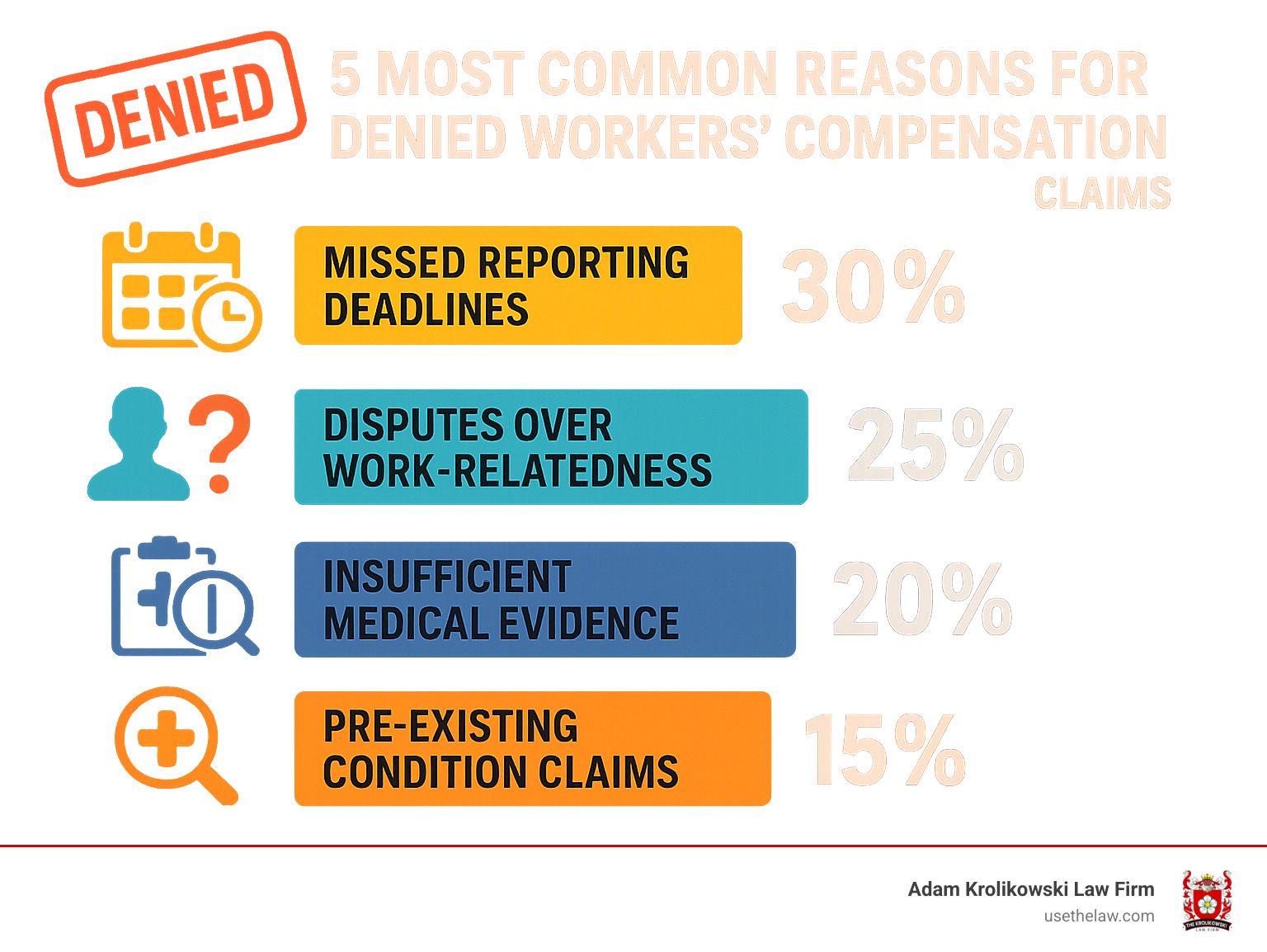
Why Claims Get Rejected: Common Reasons for a Denied Workers’ Comp Claim
Receiving a denied workers comp claim is frustrating, especially when you’re injured and unable to work. You are not alone in this experience.
Insurance companies are businesses focused on their bottom line. They save money by denying claims, scrutinizing every detail to find a reason to avoid paying benefits.
Understanding why claims get rejected can help you see what went wrong and what you can do about it.
| Reason for Denial | Explanation | Potential Solution |
|---|---|---|
| Missed Deadline | You didn’t report your injury within 30 days or file your claim within one year | File an appeal immediately and gather evidence showing good cause for the delay |
| Injury Not Work-Related | Insurance claims your injury didn’t happen during work duties | Collect witness statements, surveillance footage, and detailed incident reports |
| Pre-existing Condition | They argue your current symptoms are from an old injury, not work | Get medical opinions proving work aggravated or worsened your existing condition |
| Insufficient Medical Evidence | Not enough documentation linking your injury to work | Obtain comprehensive medical records and doctor statements supporting your claim |
| Paperwork Errors | Inconsistent or inaccurate information in your reports | Review all documents for accuracy and file corrections through the appeals process |
Employers may dispute claims to keep insurance premiums low, and insurers are often suspicious of legitimate injuries. A denial isn’t the end; it’s a signal to fight back with the right strategy.
If you’re dealing with potential fraud allegations, understanding Workers’ Compensation Fraud California laws can help protect you from false accusations.
Missed Deadlines and Reporting Errors
Missing deadlines is a common reason for denied workers comp claims. California’s time limits are strict and can jeopardize an otherwise valid claim.
The 30-day reporting rule: You must provide written notice to your employer within 30 days of your injury. Waiting longer makes insurers suspicious, and they may argue the injury isn’t work-related. We advise clients to report all injuries immediately, even minor ones.
The one-year filing rule: You have one year from the date of injury to file a formal claim. For cumulative injuries (like carpal tunnel), the deadline starts when you knew or should have known the injury was work-related.
Paperwork consistency is vital. Discrepancies between your accident report and medical records are red flags for adjusters. All documents must tell a consistent story.
Cooperation is also important. You must cooperate with reasonable requests, such as providing medical releases or attending exams. Refusal can give the insurer grounds for denial.
For detailed information about California’s specific deadlines and requirements, check out the DIR’s injured worker resources.
Disputes Over the Injury Itself
Even with timely and correct paperwork, a claim can be denied if the insurer argues the injury doesn’t qualify for coverage.
“Course and scope of employment”: Your injury must happen while performing job duties. While lunch breaks and commutes are usually excluded, exceptions exist for company events, work errands, or required travel. Insurers investigate these claims thoroughly to find inconsistencies.
Workplace misconduct: Injuries from horseplay, fighting, or other non-work behavior are not covered. Workers’ comp is for accidents that happen while you are working.
Intentional self-injury is not covered.
Intoxication or drug use at the time of injury will almost certainly lead to a denial. A positive drug test or refusal to take one provides strong grounds for rejection.
Employers may dispute claims to lower their insurance costs, which is why gathering evidence like witness statements and photos immediately is so important.
Learn more about how safety violations can impact your claim at California Workplace Safety Violations Impact Workers’ Comp Claims.
Medical-Related Reasons for a Denied Workers’ Comp Claim
Medical issues can lead to complex denials.
Insufficient medical evidence: You need detailed documentation from a doctor linking your injury to the workplace incident, including the cause, affected body parts, and treatment plan.
Delayed medical treatment: Waiting to see a doctor is a red flag for insurers. Seek prompt medical attention to protect your health and your claim.
Unapproved doctors: You must generally see doctors within an approved medical provider network. Using an unapproved doctor without authorization can lead to denied coverage.
Medical opinion disputes: Insurers may get second opinions to question whether your treatment is “reasonable and necessary.”
Pre-existing conditions: Insurers often deny claims by blaming pre-existing conditions. However, if your work accident aggravated a prior condition, you are entitled to compensation for the worsening. This requires strong medical evidence.
For information about mental health aspects of workers’ compensation claims, visit Mental Health Claims in Santa Ana Workers’ Compensation Cases.
Your Claim Was Denied. What Are Your Immediate First Steps?

Receiving a denied workers comp letter is upsetting, but it is not the final word. Do not panic. A denial means you need to take the right steps to fight back.
Carefully review the denial letter. The insurance company must state the exact reason for the denial, such as a missed deadline, a dispute over the injury’s work-relatedness, or insufficient medical proof.
The reason for denial dictates your strategy. A paperwork error requires a different approach than a dispute over the cause of your injury.
Next, gather all documents related to your claim. This includes the denial letter, your initial injury report, all medical records, communications with your employer or insurer, pay stubs, and photos of the accident scene.
Write down a detailed account of your injury. Ensure your story is consistent with what you originally reported, as inconsistencies can be used against you.
If the insurance company requests a recorded statement, think twice. You have the right to seek legal advice first. They are often looking for information to support their denial.
Essential Documents to Collect:
- Your denial letter (make copies!)
- The injury report you filed with your employer
- Every medical bill, doctor’s note, and test result
- All prescription receipts and pharmacy records
- Your pay stubs and wage records
- Any emails, letters, or notes from phone calls with your employer or insurer
- Contact information for anyone who witnessed your accident
- Photos or videos of where you got hurt or your injuries
- Any incident reports or safety violations at your workplace
The clock is ticking on your appeal rights, so don’t wait. With the right approach and documentation, many denied workers comp claims can be successfully overturned.
The California Appeals Process: A Step-by-Step Guide

A denied workers comp claim is not the end. California provides a legal process to fight back, and many denials are overturned with the proper approach.
The appeals process follows a clear path through the California Division of Workers’ Compensation (DWC).
Your journey starts by filing an “Application for Adjudication of Claim” with the DWC. This is your formal challenge to the denial. Next, you file a “Declaration of Readiness to Proceed” (DOR), which tells the court you are ready to move forward.
Your case will likely go to a Mandatory Settlement Conference (MSC), an informal meeting with a judge to try and resolve the case. Many cases are settled at this stage.
If no settlement is reached, your case proceeds to trial before a workers’ compensation judge. There is no jury; the judge hears evidence from both sides and makes a decision based on the law and facts.
If you disagree with the judge’s decision, you can file a “Petition for Reconsideration” with the Workers’ Compensation Appeals Board within 20 days. Further appeals can go to the California Court of Appeal and, rarely, the California Supreme Court.
This process has strict deadlines. For more detailed information, check out Appealing Denied Workers’ Compensation Claim California.
Building Your Case with Strong Evidence
Overturning a denied workers comp claim requires proving your case with solid evidence.
Medical records are the foundation of your case. They must be detailed, including diagnostic tests, treatment plans, and a clear explanation of how the work incident caused the injury.
Your doctor’s testimony is critical. Their opinion on how work activities caused or worsened your condition carries significant weight with a judge.
Witness statements from coworkers who saw the accident or your subsequent struggles can powerfully support your claim.
An Independent Medical Examination (IME) may be required by the insurer. The results become part of your case, and your attorney may recommend a separate exam to counter a biased report.
Photos or videos of the accident scene, hazardous conditions, or your injuries provide powerful, undeniable proof.
Incident reports filed by your employer can also support your version of events.
The goal is to paint a complete picture showing your injury is real and work-related. For more general information, General information on denied claims offers helpful insights.
What to Expect at a Workers’ Comp Hearing
Workers’ compensation hearings are focused and business-like.
The judge’s role is to hear evidence, apply the law, and determine if your injury qualifies for benefits, not to assign blame for the accident.
Evidence is presented in an organized manner. Your attorney presents your case, including witness testimony and documents, followed by the insurance company’s attorney.
During cross-examination, the opposing attorney will question your witnesses. Consistent statements and strong evidence are crucial here.
There is no jury; the judge alone decides the case. This is often favorable because these judges understand the specific laws.
The judge can make several decisions: rule in your favor, uphold the denial, or issue a partial award (e.g., approving medical care but not temporary disability).
Having an attorney who understands these procedures is vital. For more information, visit Work Injury Claims Workers’ Comp Lawyer.
How a Lawyer Can Help with Your Denied Workers Comp Claim

When your workers’ comp claim is denied, you’re facing an insurance company with a team of legal and medical professionals. Trying to steer complex legal paperwork while dealing with an injury, lost wages, and medical bills is a significant challenge. This is why legal representation can be the difference between a denied claim and receiving the benefits you deserve.
Navigating legal complexities: California’s workers’ comp system has strict rules and deadlines. Missing a deadline can end your case. An attorney understands these procedures, including requirements for complex injuries like cumulative trauma.
Handling communication with insurers: Adjusters are trained to get you to say things that hurt your case. An attorney handles all communication, protecting you from tactics designed to damage your claim.
Gathering evidence: Overturning a denied workers comp claim requires persuasive evidence. A lawyer helps obtain the right medical records, witness statements, and expert opinions needed to build a strong case and counter the insurer’s arguments.
Representing you at hearings: An attorney represents you at settlement conferences and trials, presenting evidence, cross-examining witnesses, and making legal arguments on your behalf before the judge.
Negotiating settlements: Insurers are more likely to offer fair settlements to claimants with legal representation. An attorney can negotiate to ensure a settlement covers all your medical costs, lost wages, and future needs.
Maximizing benefits: A lawyer fights to ensure you receive all entitled benefits, including temporary and permanent disability payments and full coverage for necessary medical treatment.
For over 25 years, our firm has helped injured workers in Orange County and Los Angeles steer these situations. We handle complex cases, especially those where insurers hope to wear down the claimant.
If your benefits were denied, we can help. Schedule a free consultation to discuss your case and options. For more on how we can guide you through this process, see Workers’ Comp Lawyer in Santa Ana Guidance.
Frequently Asked Questions about Denied Claims
Here are answers to common questions about denied workers’ comp claims:
How long do I have to appeal a denied workers’ comp claim in California?
Appeal deadlines are critical and depend on the stage of your case.
To challenge a judge’s decision, you have only 20 days to file a “Petition for Reconsideration” with the Workers’ Compensation Appeals Board. Missing this deadline is critical.
If the insurance company denied your claim initially, you generally have one year from the date of injury or last benefit payment to file an “Application for Adjudication of Claim” to bring your case before a judge.
These deadlines are strict. Do not wait to act. Contact an attorney as soon as you receive a denial notice.
Can my employer fire me for filing a workers’ comp claim or an appeal?
No. It is illegal for an employer to retaliate against you (fire, demote, cut hours) for filing a workers’ compensation claim or appealing a denied workers comp decision. Such actions can lead to a separate lawsuit against your employer.
However, they can fire you for legitimate, non-retaliatory reasons, such as company-wide layoffs or policy violations.
Suspicious timing is a red flag, for example, being fired for a vague reason immediately after filing a claim. If you suspect retaliation, document everything and contact an attorney immediately. You may be entitled to compensation beyond your workers’ comp benefits.
What if my pre-existing condition was made worse by my work injury?
Insurers often use pre-existing conditions as a reason to deny claims. However, a pre-existing condition does not automatically disqualify you. If your work injury aggravated or worsened a prior condition, you are entitled to benefits for that worsening.
Legally, the work must have “aggravated, accelerated, lighted up, or exacerbated” the condition. For example, if a minor, pre-existing back problem becomes severe and requires surgery after a lifting incident at work, you are entitled to benefits.
The insurer will argue the problem is solely due to the old injury. To counter this, you need strong medical evidence from your doctor clearly explaining how the work incident worsened your condition and led to your current need for treatment. With the right medical evidence and legal arguments, it is possible to prove the work-related aggravation and win the case.
Conclusion
Receiving a denied workers comp letter can be devastating, but it is not the end of your story.
This guide has covered common reasons for denials—from missed deadlines to complex injury disputes—and outlined California’s appeals process. Understanding these steps makes the process more manageable.
However, the clock is ticking. Workers’ compensation deadlines are strict, and missing them can cost you your benefits. Do not wait to act.
For over 25 years, Adam Krolikowski Law Firm has fought for injured workers. We handle the complex cases that other firms may avoid, and we believe you shouldn’t have to face insurance company lawyers alone.
A denied workers comp claim simply means you need an effective advocate in your corner.
Ready to turn that denial around? Contact an Orange County workers’ comp lawyer for help with your case today for a free consultation to review your claim and find the best path forward.