

What Dog Bite Settlement Amounts Really Look Like
Dog bite settlement amount figures can vary dramatically, but understanding the typical ranges helps victims know what to expect. Here’s what the data shows:
Typical Settlement Ranges:
- Average settlement: $58,500 (2023 national average)
- Common range: $30,000 to $50,000 for most cases
- Severe cases: $100,000 to several million dollars
- Minor bites: $10,000 to $30,000
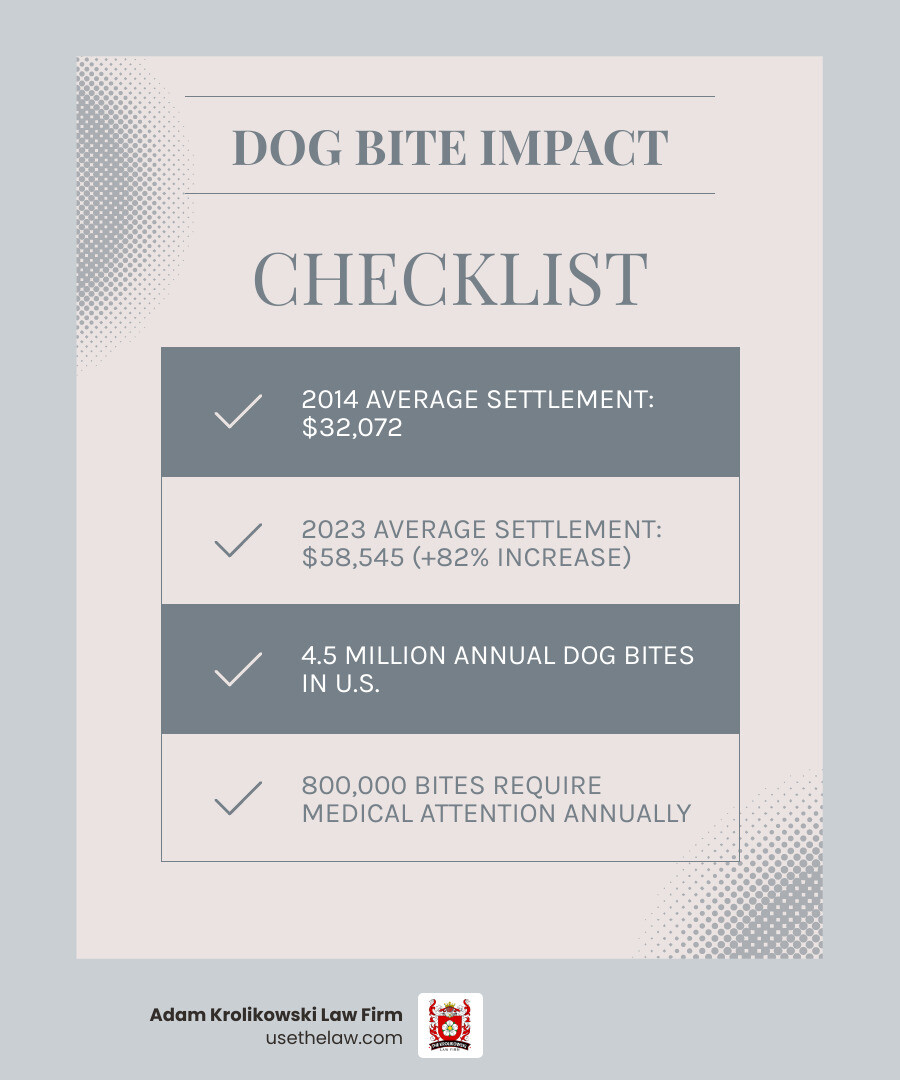
Dog attacks happen more often than most people realize. Nearly 4.5 million dog bites occur in the United States each year, with about 800,000 requiring medical attention. A routine day can quickly turn into a medical emergency with lasting consequences.
The financial impact extends beyond the initial hospital visit, including medical bills, lost wages, and potential long-term treatment costs. The emotional trauma can be just as devastating, especially for children who make up three-fourths of all dog bite victims.
In California, strict liability laws protect victims by holding dog owners responsible for injuries their pets cause. This means you don’t need to prove the owner was negligent – just that their dog bit you.
This guide breaks down how settlements are calculated, what factors influence payouts, and how California’s laws work for you. We’ll review real examples to help you understand what your case might be worth.
Dog bite settlement amount word roundup:
How to Estimate a Potential Dog Bite Settlement Amount
Estimating your dog bite settlement amount isn’t simple. Each case has unique circumstances, but understanding national trends and settlement components provides a realistic sense of what to expect.
Reviewing National Averages and Recent Trends
The numbers tell a striking story about dog bite settlements in America. In 2022, the average claim payout reached $64,555 – a huge jump from $49,025 just one year earlier. That’s a 28% increase that reflects both rising medical costs and a growing understanding of victims’ rights.
Settlement amounts have nearly doubled over the past decade, climbing from an average of $32,072 in 2014 to $58,545 by 2023. The total value of all U.S. dog bite claims reached $1.116 billion in 2023.
Most cases settle somewhere between $30,000 and $50,000, though the full range typically spans from $10,000 to $100,000. These aren’t random numbers – they reflect real costs that victims face, from emergency room visits to long-term therapy.
Why the steady climb? Rising medical costs and inflation affect everything from hospital bills to lost wages. As healthcare costs increase, these averages will likely follow. The Insurance Information Institute tracks these trends and provides valuable insights into the growing financial impact of dog attacks.
Understanding What a “Typical” Settlement Includes
Your dog bite settlement amount is carefully calculated to cover both tangible costs and the intangible impacts on your life.
Medical bills usually make up the biggest chunk. This covers everything from the initial emergency room trip to follow-up visits, prescriptions, wound care, and any necessary surgeries.
But the costs don’t stop when your wounds heal. Future medical care can include physical therapy sessions, reconstructive surgery to minimize scarring, and ongoing treatment for complications. Some victims need years of care.
Lost wages matter too. If you can’t work while recovering, or if the injury affects your ability to do your job long-term, the settlement should account for that lost income.
The emotional side is just as real, even though it’s harder to put a price on. Pain and suffering compensation recognizes the physical agony you’ve endured and the fear that often lingers long after the bite.
Many victims develop lasting psychological effects like anxiety, nightmares, or PTSD. These are normal responses to trauma that deserve compensation for therapy and counseling.
Scarring and disfigurement can affect your confidence and how you interact with the world, especially if the scars are on visible areas like your face or hands. The settlement should reflect this lasting impact on your quality of life.
Examining High-Value Settlement Examples
While most settlements fall into that $30,000 to $50,000 range, some cases involving catastrophic injuries result in life-changing payouts. These aren’t typical, but they show just how devastating a severe dog attack can be.
A Van Nuys woman who lost her arm in a dog attack received a $7.5 million settlement from the City of Los Angeles. The attack involved a dog owned by a city employee, which made the municipality liable for the devastating injury. You can read more about this recent multi-million dollar dog bite case.
In another case, a Gainesville High teacher received a $5.6 million jury verdict after a severe attack that left lasting injuries. The substantial award reflected both the owner’s negligence and the permanent impact on the victim’s life.
Sonoma County paid $1.35 million to settle a case involving a sheriff’s K-9 that mauled someone after deputies used a stun gun and released the dog. This case highlighted issues of excessive force and civil rights violations.
These extreme cases involve permanent disability, severe disfigurement, or institutional negligence. They’re not what most victims can expect, but they demonstrate that when injuries are truly life-altering, the law recognizes that with substantial compensation.
Breaking Down the Key Factors That Calculate Your Settlement

Determining your dog bite settlement amount is a careful calculation based on specific factors that paint a complete picture of your experience. Each piece of evidence helps build your case and justify fair compensation.
The severity of your injury forms the foundation of your claim. A small puncture wound that heals quickly will naturally result in a different settlement than a severe attack requiring multiple surgeries. Beyond physical damage, we also consider the emotional toll, medical expenses, and the incident’s effect on your daily life and ability to work.
Assessing Injury Severity with the Dunbar Scale
The Dunbar Dog Bite Scale provides a standardized way to classify dog bite injuries from Level 1 to Level 6. This system helps insurers, attorneys, and courts understand the incident’s severity, which directly impacts your potential dog bite settlement amount.
Level 1 incidents involve aggressive behavior without actual contact – think growling, lunging, or snapping that doesn’t break skin. While these situations rarely cause physical injury, they can still trigger lasting anxiety, especially if you already had a fear of dogs.
Level 2 bites occur when the dog’s teeth touch your skin but don’t puncture it. You might see minor scrapes or redness, but the economic damages are typically minimal since extensive medical treatment isn’t usually necessary.
Level 3 injuries involve one to four puncture wounds that go up to about half the depth of the dog’s canine teeth. If you pulled away during the attack, you might also have lacerations. These cases often require stitches and wound care, with settlements typically in the hundreds to low five-figure range.
Level 4 bites are significantly more serious, involving deep puncture wounds that exceed half the length of the dog’s teeth, or multiple deep punctures. These attacks can cause severe lacerations, deep bruising, broken bones, and nerve damage. Settlements for Level 4 injuries often range from $10,000 to $50,000 but can climb higher if reconstructive surgery or long-term physical therapy is needed.
Level 5 attacks represent multiple Level 4 bites or repeated attacks, essentially maulings that require intensive medical intervention. These devastating injuries often involve multiple surgeries, extended rehabilitation, and significant psychological trauma including PTSD. Settlements typically range from $30,000 to $75,000, but the amount can increase based on permanent disfigurement and lasting psychological effects.
Level 6 represents fatal attacks, which become wrongful death cases. These tragic situations involve compensation for funeral expenses, loss of companionship, mental anguish for family members, and loss of financial support. Settlements for fatal dog attacks start at $100,000 but can reach multi-million dollar amounts.
For comprehensive information about how these classifications apply in our area, our complete guide to Orange County dog bites provides detailed local context.
Tallying Your Economic Damages (Special Damages)
Economic damages are the concrete, measurable financial losses from the dog bite. These are the bills, receipts, and lost income that show the exact cost of the attack.
Current medical bills form the most immediate component of your economic damages. This includes your emergency room visit, ambulance fees if you needed transportation, doctor consultations, diagnostic tests like X-rays or MRIs, prescription medications, and any surgical procedures. We gather every invoice and receipt to build a complete picture of your immediate costs.
Future medical care becomes crucial when your injuries require ongoing treatment. Working with medical professionals, we estimate costs for physical therapy, reconstructive surgery, and other follow-up care. For severe injuries, these future costs can exceed initial medical bills.
Lost wages and income extend beyond just your base salary. We calculate missed time from work, including bonuses, commissions, and benefits. If your injuries affect your long-term earning capacity, we also factor in this future lost income.
Out-of-pocket expenses might seem minor individually, but they add up quickly. Transportation costs for medical appointments, childcare while you’re receiving treatment, damaged clothing from the attack, and any assistive devices you need all contribute to your economic damages.
Valuing Your Non-Economic Damages (General Damages)
Non-economic damages address the subjective, personal impact of the dog bite. They acknowledge suffering beyond financial loss, recognizing the human cost of your experience.
Pain and suffering compensation covers both the immediate agony of the attack and the ongoing discomfort during your recovery. If you’re dealing with chronic pain from your injuries, this becomes an even more significant component of your settlement.
Emotional distress acknowledges the psychological trauma that often follows a dog attack. The fear, anxiety, depression, and potential PTSD that can develop are real injuries deserving compensation. Children are particularly vulnerable to these lasting psychological effects.
Disfigurement and scarring, especially when visible, can profoundly impact your self-esteem and quality of life. Permanent scars on visible areas are a daily reminder of the attack and often constitute a major portion of non-economic damages.
Loss of enjoyment of life recognizes when your injuries prevent you from participating in activities that once brought you joy. Whether it’s playing sports, spending time outdoors, or simply feeling comfortable around animals, these losses deserve recognition in your settlement.
To calculate these damages, attorneys typically use the multiplier method or per diem method. The multiplier approach takes your total economic damages and multiplies them by a factor between 1.5 and 5, depending on the severity of your non-economic losses. The per diem method assigns a daily rate for your pain and suffering throughout your recovery period.
Legal guidance is essential for calculating your settlement value. An attorney can ensure you don’t overlook any components of your damages and help you understand what fair compensation looks like for your specific situation.
Navigating California’s Laws to Protect Your Claim

California has strong laws protecting dog bite victims, which directly impact your dog bite settlement amount and make it easier to recover compensation. Understanding these protections is crucial for your case.
Leveraging California’s “Strict Liability” Dog Bite Law
California takes a no-nonsense approach to dog bites. Under California Civil Code § 3342, dog owners are responsible for injuries their pets cause – period. This “strict liability” law means you don’t have to prove the owner knew their dog was dangerous or that they were careless.
Unlike many states with a “one-bite rule,” California does not require a dog to have a history of biting for the owner to be liable. If a dog bites you while you’re in a public place or lawfully on private property, the owner is on the hook for your damages.
This law is powerful for victims. You only need to show the dog bit you and that you were lawfully on the property. The owner’s liability is automatic, often leading to faster, higher settlements.
But there are a few situations where this protection doesn’t apply. If you were trespassing on private property, the owner might escape liability. Similarly, if you provoked the dog – maybe you teased it or acted aggressively – your actions could reduce or eliminate the owner’s responsibility. The law also treats professional handlers like veterinarians differently, since they voluntarily work with animals and assume certain risks.
This strict liability law gives victims a strong negotiating position. Insurers can’t argue their client was unaware the dog was dangerous, often leading to more reasonable offers and higher dog bite settlement amounts. If you need help navigating these laws, you can find a Dog Bite Attorney who understands California’s unique legal landscape.
Understanding the Statute of Limitations
Time is not on your side when it comes to dog bite claims. California gives you two years from the date of the bite to file a lawsuit. Miss this deadline, and you lose your right to seek compensation – no matter how strong your case is or how badly you were injured.
Two years might sound like plenty of time, but it passes quickly. Building a strong case takes months of gathering records, interviewing witnesses, and negotiating with insurers. Starting sooner improves your chances of success.
Acting promptly also helps preserve crucial evidence. Photos of your injuries look most compelling when taken right after the attack. Witness memories are sharpest in the days and weeks following the incident. The longer you wait, the harder it becomes to build a compelling case.
For minors, the two-year clock typically doesn’t start until they turn 18. However, these rules can be complex, so it’s wise to seek legal advice.
Preserving evidence should be your top priority after seeking medical care. Take photos of your injuries, the location where the bite occurred, and any torn clothing. Get contact information from witnesses. Keep all medical records and receipts. This documentation becomes the foundation of your claim and directly impacts your potential dog bite settlement amount.
How Your Own Actions Can Affect the Dog Bite Settlement Amount
While California’s strict liability law strongly favors victims, your own behavior can still affect your compensation. This is where “comparative fault” comes into play – a legal concept that can reduce your settlement if you contributed to the incident.
For example, if you had $100,000 in damages but were found 20% at fault, your dog bite settlement amount would drop to $80,000. This could happen if you ignored warning signs or approached an agitated dog.
Insurance adjusters are trained to look for ways to blame the victim. They might argue that you provoked the dog by moving too quickly, making loud noises, or getting too close. They could claim you were partially trespassing or that you should have known the dog was dangerous.
Trespassing is one area where your actions can significantly impact your case. If you were unlawfully on someone’s property when the bite occurred, the owner might not be held liable under the strict liability law. However, even trespassers sometimes have legal protections, especially children who might not understand property boundaries.
This is why legal representation is important. An attorney can counter unfair blame-shifting and protect your rights. Don’t assume you can’t recover compensation even if you think you were partially at fault, as many factors victims blame themselves for don’t affect their legal rights.
The key is being honest about what happened while understanding that insurance companies will try to minimize their payouts. California’s laws are designed to protect you, and in most cases, the dog owner remains responsible regardless of minor mistakes you might have made.
Frequently Asked Questions About Dog Bite Settlements

After a dog bite, you’re probably feeling overwhelmed with questions about what comes next. We get it – the legal process can seem confusing when you’re already dealing with injuries and medical bills. Let’s walk through the most common concerns people have about dog bite settlement amount and the claims process.
How long does it take to settle a dog bite claim?
The timeline depends on the case. Most settle within a few months to a year, but complex cases take longer.
Minor injuries that heal quickly usually move faster through the system. If you needed a few stitches and you’re back to normal activities within weeks, we can often reach a settlement relatively quickly since your medical picture is clear.
Severe injuries are a different story. When you’re dealing with multiple surgeries, ongoing physical therapy, or permanent scarring, we need time to understand the full scope of your recovery. Settling before we know your complete medical future could leave you with less than you deserve.
The negotiation dance with insurance companies also affects timing. Some insurers respond quickly with fair offers. Others drag their feet or lowball initial offers, requiring more back-and-forth discussions.
If a fair agreement isn’t reached and a lawsuit is filed, the timeline extends, sometimes by years. However, most cases settle before trial, as insurers prefer to avoid the cost and uncertainty of court.
Is my dog bite settlement taxable in California?
Tax implications can be tricky, but here’s a general breakdown.
Good news first: Compensation for your physical injuries typically isn’t taxable. This includes money for medical bills, pain and suffering directly related to your physical wounds, and most damages stemming from the actual bite itself.
The gray areas get a bit more complicated. If your case includes punitive damages (awarded to punish the owner’s reckless behavior), those amounts are usually taxable. Lost wages compensation is also generally taxable since it replaces income that would have been taxed normally.
Emotional distress compensation falls somewhere in between. If your psychological impacts stem directly from physical injuries, the compensation is typically not taxable. However, standalone emotional distress claims might be.
Given these nuances, we always recommend discussing your specific situation with a tax professional. Every case is unique, and you don’t want any surprises come tax season.
What if the dog owner’s insurance isn’t enough to cover my damages?
This is a common concern with serious injuries and high medical bills. Most homeowner’s and renter’s insurance policies include liability coverage for dog bites, but the limits vary.
Standard coverage usually ranges from $100,000 to $300,000, which sounds like a lot until you’re facing reconstructive surgery, months of lost work, and ongoing therapy. For severe Level 4 or Level 5 attacks on the Dunbar Scale, damages can easily exceed these amounts.
Our first step is investigating whether the owner carries an umbrella policy. These provide additional coverage beyond standard homeowner’s limits, sometimes reaching $500,000 or more. Many people don’t even realize they have this coverage.
If insurance falls short, we explore going after the owner’s personal assets. This involves a careful assessment of their financial situation – do they own property, have significant savings, or other assets that could cover your remaining damages?
Other potential sources of recovery might include premises liability claims against property owners or businesses where the attack occurred, especially if they knew about a dangerous dog and failed to take action.
These situations require careful investigation and strategic thinking. For more information about your options, our guide on legal recourse for dog bites covers additional recovery strategies in detail.
The bottom line? Don’t assume you’re out of luck just because the dog owner’s insurance seems insufficient. There are often more options than initially apparent.
Steps to Take to Maximize Your Compensation
After a dog bite, the actions you take can dramatically affect your potential dog bite settlement amount. Every piece of evidence, medical record, and documented detail helps build your case.
Seek immediate medical care, even if you think the bite isn’t that serious. This is crucial for your health, as dog mouths carry bacteria that can cause serious infections. Immediate medical documentation also creates a paper trail that is difficult for insurance companies to dispute.
Report the bite to local authorities as soon as possible. Call animal control or the police to file an official report. This creates a government record of what happened, which carries more weight than just your word against the dog owner’s. Some areas have specific deadlines for reporting, so don’t wait.
Now comes the part that might feel overwhelming, but it’s crucial: document everything. Take photos of your injuries right after the bite, and keep taking them as you heal. Yes, it’s unpleasant to look at, but these photos tell the story of your recovery better than any words can. Also photograph the scene where it happened, any torn clothing, and the dog itself if it’s safe to do so.
Keep every single medical bill, prescription receipt, and doctor’s note. If you miss work, get documentation from your employer showing the time and wages lost. Keep a journal about your pain, how the injury affects your daily life, and your emotional state to help capture non-economic damages.
The role of legal counsel becomes critical when you’re dealing with insurance companies. Insurance companies have teams of adjusters whose job is to pay out as little as possible. They may use tactics to get you to accept less than your case is worth.
We handle all the communications with insurance adjusters, protecting you from tactics designed to minimize your claim. We also make sure every aspect of your damages gets calculated properly – not just your current medical bills, but future treatment costs, lost earning capacity, and the full impact on your quality of life.
Our team at Adam Krolikowski Law Firm brings over 25 years of experience to complex cases that other attorneys might pass on. We understand California’s strict liability laws inside and out, and we know how to apply them effectively in places like Orange County and Los Angeles.
If negotiations don’t lead to a fair settlement, we’re prepared to take your case to trial. Sometimes that’s what it takes to get insurance companies to offer the compensation you truly deserve.
If you’ve been injured, understanding your legal options is the first step. Contact an experienced Dog Bite Lawyer in Orange County, California to discuss your case. We also serve clients in Santa Ana and Los Angeles and are dedicated to helping victims of dog bites secure fair compensation. Our team of dog bite attorneys is ready to provide the guidance you need.
