


Why You Need a Hotel Negligent Security Lawyer After Being Injured
A hotel negligent security lawyer handles cases where hotels fail to protect guests from foreseeable crimes. These attorneys know how to prove that inadequate security measures led to your injuries and can help you recover compensation for medical bills, lost wages, and pain and suffering.
What Hotel Negligent Security Lawyers Do:
- Investigate security failures (broken locks, poor lighting, no cameras)
- Prove the hotel knew or should have known about crime risks
- Gather evidence like surveillance footage and incident reports
- Handle insurance negotiations and court proceedings
- Work on contingency fees (no upfront costs)
When you check into a hotel, you expect a safe environment where you can relax. But as one legal source notes: “When you are a guest at a hotel, you have a right to expect your stay to be a safe one.” Unfortunately, this isn’t always the case.
Hotels have a legal duty to protect guests from foreseeable crimes. This means if there’s a history of robberies in the parking lot or assaults in poorly lit hallways, the hotel must take reasonable steps to prevent these incidents.
Common hotel security failures include:
- Broken or inadequate door locks
- Missing security cameras in key areas
- Poor lighting in parking lots and stairwells
- Untrained or absent security personnel
- Failure to respond to prior criminal incidents
Research shows that negligent security lawsuits regularly settle in the millions of dollars due to the severe injuries involved. In one real case, a hotel was found liable after a guest was shot during an attempted robbery in the parking lot – with 82 crimes reportedly committed in that same parking lot over the previous three years.
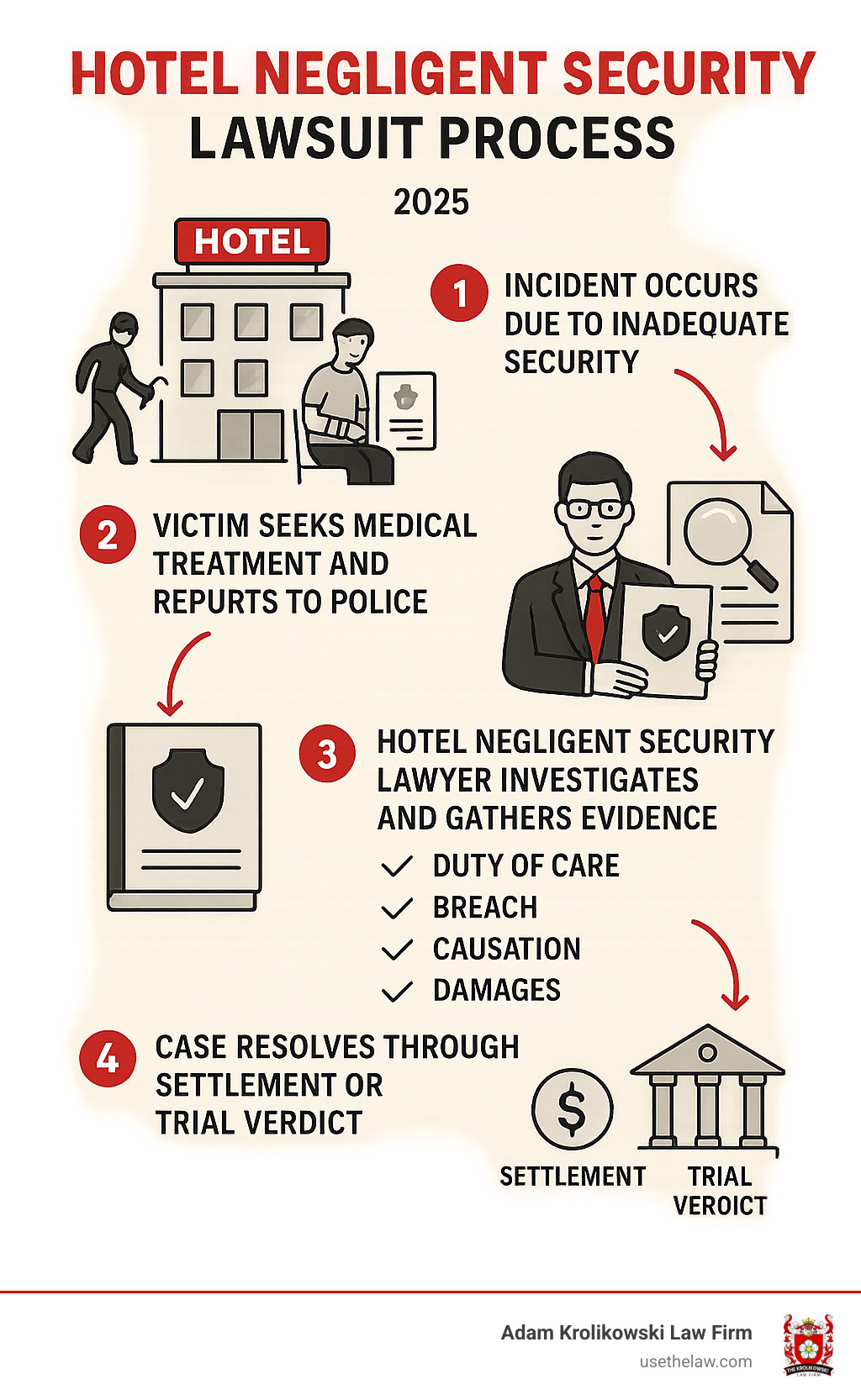
Hotel negligent security lawyer glossary:
How Hotel Negligent Security Happens and Why It Matters
When you check into a hotel, you expect to feel safe—whether you’re walking down the hallway, grabbing ice, or parking your car. That’s not just wishful thinking; it’s the law. Hotels owe every guest a duty of care, which simply means they must keep all areas you might use—rooms, hallways, lobbies, parking lots, and even the pool—reasonably secure.
But what does “reasonably secure” mean? Here’s where the law gets interesting. The magic word is foreseeability. If a danger is foreseeable—if it’s something a hotel could expect based on what’s happened before or what’s happening nearby—the hotel needs to take steps to prevent it. Courts look at things like:
- Crime stats for the area
- Past incidents at the hotel
- Whether hallways or parking lots are well-lit
- How easy it is to see what’s happening on the property
Imagine a hotel parking lot that’s seen several muggings or thefts in the last year. If the hotel ignores this trend and doesn’t add lights or cameras, it’s failing its duty. And if someone gets hurt because of that, the hotel may be responsible under the law.
What Counts as Negligent Security?
Here’s the heart of it: negligent security falls under premises liability. If you’re a registered guest, you’re a “business invitee”—which means the hotel owes you the highest level of care under the law.
A hotel must do what a reasonable hotel would do to protect against foreseeable harm. That includes everything from violent crimes like assault or robbery, to property crimes like theft. The law doesn’t expect hotels to stop every possible crime, but they do have to take sensible precautions—like working locks, decent lighting, and paying attention to warning signs.
Typical Security Lapses Hotels Ignore
Unfortunately, some hotels cut corners—often to save money—and put guests at risk. You’ll see problems like broken door locks, malfunctioning keycards, and security cameras that don’t work. Some hotels leave entrances wide open at night, or let lights burn out in stairwells and parking lots.
On the staffing side, hotels sometimes hire untrained guards, skip background checks, or don’t provide enough coverage during busy or risky times. Maintenance can fall by the wayside, too—broken locks or windows don’t get fixed, bushes grow wild and create hiding spots, and alarms go unchecked.
One memorable case saw a hotel cut its security team after a quiet spell—only for a guest to be seriously hurt when crime returned. As you can imagine, the law took a dim view of that decision.
Foreseeability: The Legal X-Factor
So, how does the law decide if a crime was “foreseeable”? Scientific research on foreseeability shows courts look at a few key things:
Crime Grids: Mapping out recent crimes near the hotel. If there’s a clear pattern, the hotel should act.
Prior Incidents: Records of thefts, assaults, or suspicious activity on the property are big red flags. The more incidents, the clearer the warning.
Neighborhood Risk: Hotels in high-crime areas need to do more to keep people safe than those in quiet suburbs.
Timing and Context: Risk goes up late at night or during big events. Hotels should adjust their security plans when things get busier or riskier.
When hotels don’t pay attention to these warning signs, guests pay the price. That’s why having a hotel negligent security lawyer on your side matters—someone who knows how to prove the hotel should have seen trouble coming, but didn’t take action.
Building a Strong Claim with a Hotel Negligent Security Lawyer
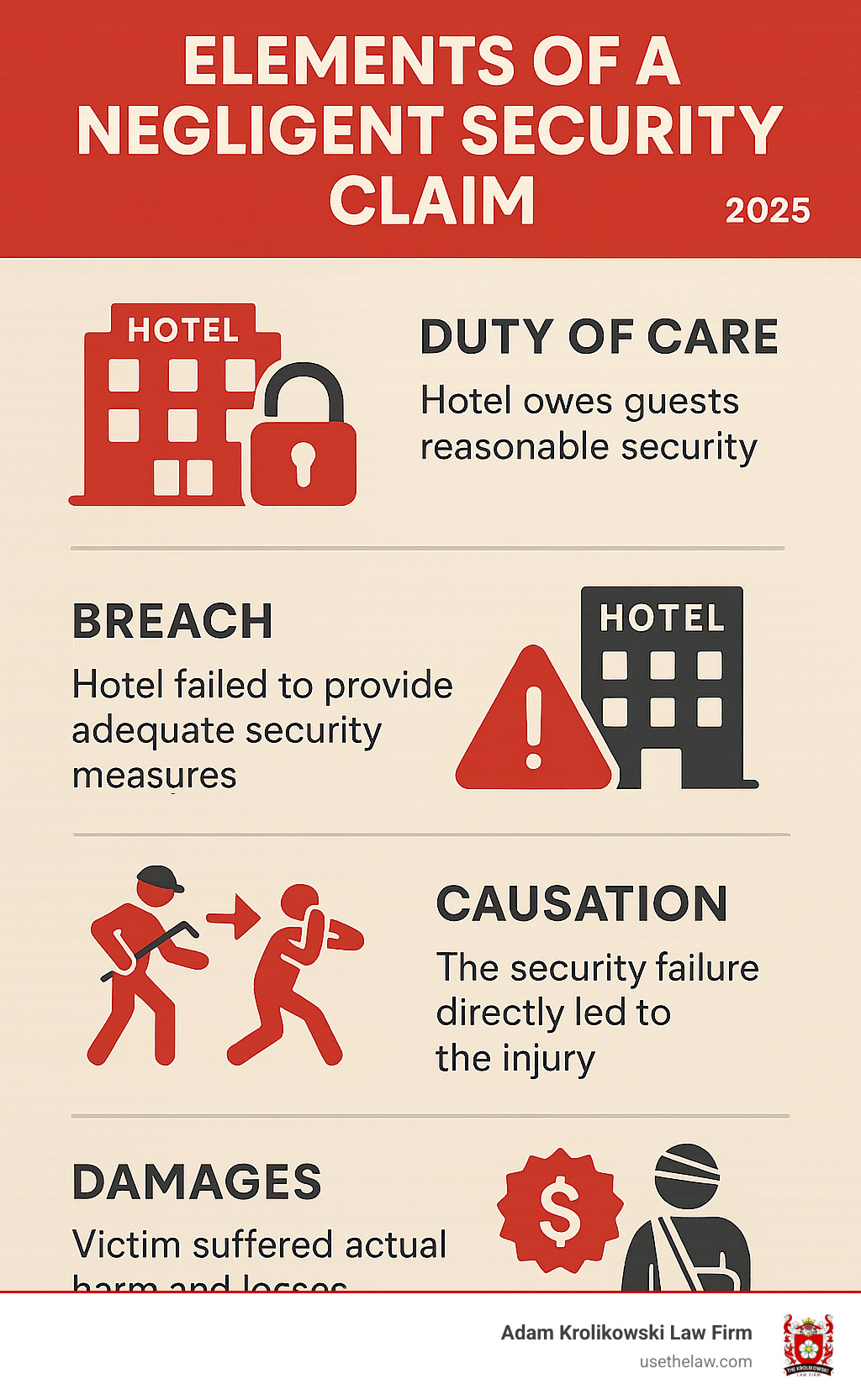
If you’ve been hurt because a hotel didn’t keep you safe, it’s important to know that these cases aren’t simple. A successful claim hinges on four key points: duty, breach, causation, and damages. Trying to handle this on your own can get overwhelming—there are so many moving parts, plus crucial evidence that can vanish fast. That’s why working with a hotel negligent security lawyer can make all the difference.
Think of your case like two paths: one is criminal court, where the government goes after the wrongdoer; the other is civil court, where you seek compensation from the hotel. Here’s a quick “compare and contrast” to show the difference:
| Civil Negligent Security Case | Criminal Case |
|---|---|
| You sue the hotel for money damages | Government prosecutes the attacker |
| Lower burden of proof (“more likely than not”) | Higher burden of proof (“beyond reasonable doubt”) |
| Focuses on hotel’s failure to provide security | Focuses on attacker’s criminal conduct |
| You control whether to file and settle | Prosecutor controls the case |
| Compensation for your losses | Punishment for the criminal |
Proving the Four Elements
First, there’s the duty of care—hotels are responsible for keeping guests safe everywhere you’d expect to go, from your room to the parking lot. If the hotel doesn’t meet this standard, it’s called a breach of duty. This might mean skipping on security cameras, not fixing broken locks, or ignoring reports about suspicious activity.
Next comes causation. You need to connect the dots and show that your injury happened because the hotel dropped the ball on safety—if they’d taken simple steps, the crime probably wouldn’t have happened.
Finally, you must show damages—the real harm you suffered. This isn’t just hospital bills. It can mean lost paychecks, emotional struggles, and even damage to your belongings. Sometimes, courts also look at preventability. They ask: “Would reasonable security have stopped this?” If the answer is yes, your claim gets much stronger.
Gathering and Protecting Vital Evidence
Time is not your friend after an incident. Camera footage gets wiped, broken lights get fixed, and people’s memories fade. The quicker a hotel negligent security lawyer can get to work, the better.
They’ll act fast to secure surveillance videos that might otherwise be erased in weeks. They’ll request any incident reports the hotel filed, which can reveal if there was a pattern of trouble. Maintenance records are checked, too—if a lock was broken for months, that’s a red flag.
Personnel files matter, as well. Did the hotel actually train its security guards? Were they short-staffed the night of your incident? Important clues can hide in those records.
But don’t forget the basics: photos of the scene, pictures of broken lights or doors, and statements from witnesses are all valuable. Every detail helps when building your case.
Who Can You Sue?
You might be surprised how many people can share blame in a hotel negligent security case. The hotel owner is usually first in line—they’re ultimately responsible for guest safety. But the management company (if different) might also be at fault, especially if they cut corners on security.
In some cases, a security contractor (the company that hires the guards) can be responsible if their staff didn’t do their job. If crime happened in a shared parking lot or common area, the property landlord could be on the hook, too. And when a hotel is part of a big franchise, sometimes the parent company can be drawn into the case if their security policies were ignored.
The bottom line? A skilled hotel negligent security lawyer will explore every angle to see who should be held accountable. At Adam Krolikowski Law Firm, we know how complicated these cases can be, and we’re here to help you gather the proof, protect your rights, and hold the hotel accountable for failing to keep you safe.
If you need more guidance or want to talk about your situation, you can always learn more about negligent security services and see how we can support you.
Why and When to Hire a Hotel Negligent Security Lawyer
Trying to handle a hotel’s insurance company on your own after a security incident can feel overwhelming—like playing chess against someone who already knows all your moves. These companies have teams working hard to protect their bottom line, not your recovery. That’s why having a hotel negligent security lawyer in your corner can make all the difference.
At Adam Krolikowski Law Firm, we know how to go up against large hotel chains and their insurers. With over 25 years of experience in personal injury law, we’ve handled many cases that would make others think twice. We’re committed to helping you seek justice after a hotel security failure, no matter how complicated your situation may seem.
More info about negligent security services

When should you get a hotel negligent security lawyer involved? The short answer: as soon as possible. The sooner you reach out, the easier it is to collect vital evidence, protect your rights, and avoid mistakes that could hurt your claim. Don’t wait for the situation to “sort itself out”—insurance companies count on delays and confusion to work in their favor.
How a Hotel Negligent Security Lawyer Guides the Process
We start with a free, no-obligation case evaluation. That means you can tell us what happened, and we’ll walk through the facts together. We look at what security was (or wasn’t) in place, how the incident unfolded, and the impact on your health and finances.
Once we take your case, we move quickly. We gather important evidence—like surveillance footage, witness statements, and maintenance records—before anything can be lost or changed. Working with trusted professionals, we build a strong claim showing exactly how the hotel’s security failed you.
You won’t have to speak with the hotel’s insurance team or worry about what to say. We handle all negotiations, protecting you from tactics meant to lower your compensation. If the insurance company won’t offer a fair settlement, we aren’t afraid to take your case to trial.
Throughout your case, we work with doctors, security consultants, and other authorities to show the full extent of your injuries and losses. Our goal is to make sure you get the support and compensation you need to move forward.
Costs, Fees, and Expected Timeframes
We know the last thing you need right now is another bill. That’s why we work on a contingency fee basis—you only pay if we win for you. There are some costs involved in bringing a lawsuit, like court filing fees or paying for records, but we’ll always discuss those up front so there are no surprises.
It’s important to know there are deadlines. In California, you usually have two years from the date of injury to file your hotel negligent security lawsuit. Sometimes, special circumstances can change this, so don’t wait to ask for help.
Many hotel negligent security cases are resolved within 12 to 24 months, but some complicated claims may take longer. We’ll keep you updated every step of the way so you’ll always know what to expect.
If you’re wondering whether you have a case or just need someone to listen, reach out to Adam Krolikowski Law Firm. We’re here to help you through every part of the process—so you can focus on healing and moving forward.
Compensation You Can Seek After a Hotel Security Failure
When you’re injured because a hotel ignored safety, the financial impact can be overwhelming. Medical bills pile up, you might miss work, and the emotional trauma can last for years. California law lets you pursue compensation for all of these losses.
Economic damages cover your out-of-pocket costs. This includes every medical bill, lost wages, and any reduced earning capacity if you can’t return to your job.
Future costs matter, too. Surgeries, therapy, home modifications, or personal care assistance can all be included in your claim.
Non-economic damages compensate you for losses without a set price tag—pain, emotional distress, loss of enjoyment of life, or visible scars and disfigurement.
Scientific research on trauma impacts shows that victims of violent crime often develop PTSD and other conditions needing long-term treatment, and courts recognize these harms.
Punitive damages are rarer but may be awarded if the hotel’s conduct was especially reckless, to deter similar behavior.
For wrongful death, surviving family members can recover funeral expenses, loss of financial support, and the companionship their loved one provided.
Factors That Influence Settlement Value
- Severity of injuries – Broken bones, traumatic brain injuries, gunshot or stab wounds, burns, and sexual assault trauma typically drive higher awards.
- Liability clarity – Proof the hotel ignored prior crimes or obvious risks strengthens your case.
- Comparative negligence – If you contributed to the incident, your recovery may be reduced under California law.
- Insurance limits – Hotels often carry large policies, but coverage can still cap recovery in some situations.
Real-World Verdicts & Settlements Snapshot
Recent negligent security verdicts show courts take these cases seriously. One DeKalb County case produced an $81 million verdict after a guest was shot in a parking lot. Another suit revealed 82 crimes in the same lot over three years, helping the injured guest secure a multi-million-dollar settlement.
When hotels ignore their duty to protect guests, they face significant financial consequences—even if many of those settlements remain confidential.
What to Do Immediately After a Hotel Security Incident
The steps you take immediately after a security incident can significantly impact your ability to recover compensation later. Here’s what you should do:
1. Seek Medical Attention Immediately
Your health and safety are the top priority. Even if you don’t think you’re seriously injured, get checked out by a medical professional. Some injuries, particularly head injuries and emotional trauma, may not be immediately apparent.
2. Report the Incident to Police
Call 911 and file a police report. This creates an official record of what happened and may help identify the perpetrator.
3. Report to Hotel Management
Notify hotel management about the incident, but be careful about what you say. Stick to the facts and avoid speculating about what the hotel should have done differently.
4. Document Everything
Take photos of the scene, your injuries, and any security deficiencies you notice. Get contact information from witnesses. Keep all medical records and receipts.
5. Preserve Physical Evidence
Keep the clothing you were wearing and any damaged personal property. Don’t wash or alter anything that might be evidence.
6. Avoid Speaking with Insurance Companies
The hotel’s insurance company may contact you quickly. Politely decline to give a statement and refer them to your attorney.

Post-Incident Checklist
- [ ] Seek immediate medical attention
- [ ] Call police and file a report
- [ ] Report incident to hotel management
- [ ] Take photos of scene and injuries
- [ ] Get witness contact information
- [ ] Obtain police report number
- [ ] Keep all medical records and receipts
- [ ] Preserve clothing and damaged property
- [ ] Avoid insurance company statements
- [ ] Consult with a hotel negligent security lawyer
Frequently Asked Questions About Hotel Negligent Security
Can I sue if the attacker was never caught?
Absolutely. This is one of the most common concerns we hear, and the answer might surprise you. Your civil case against the hotel is completely separate from any criminal case against the person who hurt you.
Think of it this way: the hotel’s responsibility isn’t about catching the bad guy – it’s about whether they provided reasonable security to protect their guests. If they failed to install proper lighting, didn’t fix broken locks, or ignored a pattern of crimes in their parking lot, that’s on them regardless of whether police ever identify your attacker.
We’ve successfully handled many cases where the perpetrator was never found. The hotel negligent security lawyer focuses on proving the hotel knew or should have known about the risk and failed to take reasonable steps to protect you.
How long do I have to file my case?
In California, you typically have two years from the date of the incident to file your negligent security lawsuit. This deadline is called the statute of limitations, and courts take it very seriously.
But here’s the thing – waiting until the last minute is a terrible strategy. Evidence starts disappearing almost immediately. Security footage gets recorded over, witnesses move away or forget details, and maintenance records get lost or destroyed.
There are also some situations where the timeline might be different. If you’re dealing with a wrongful death case, if a minor was injured, or if there are other complicating factors, the rules can change. That’s why it’s so important to talk to a hotel negligent security lawyer as soon as possible after your incident.
Don’t let the hotel’s insurance company tell you there’s no rush. They benefit from delays because evidence gets harder to find over time.
Will filing a claim raise my hotel bill or insurance rates?
Not at all. This worry keeps some people from pursuing legitimate claims, but it’s completely unfounded.
Your personal insurance has nothing to do with a hotel negligent security claim. The hotel carries commercial liability insurance specifically for these situations. When you file a claim, you’re dealing with their insurance company, not yours.
Hotels also can’t legally punish you for filing a claim by refusing to serve you or charging you more in the future. That would be retaliation, which is illegal.
The only thing that might happen is the hotel’s insurance rates could go up if they have multiple claims – but that’s their problem, not yours. In fact, maybe higher insurance costs will motivate them to finally fix their security problems so other guests don’t get hurt.
Conclusion
Getting hurt because a hotel failed to keep you safe is stressful and can turn your world upside down. You shouldn’t have to face the legal maze alone, or wonder if the hotel will ever take responsibility. The law is clear: hotels must look out for their guests’ safety. When they don’t and someone gets hurt, they need to answer for it.
At Adam Krolikowski Law Firm, we know how overwhelming it can feel after a security incident. With over 25 years of experience handling challenging personal injury cases—many that other attorneys won’t touch—we’re ready to stand with you. Our team understands the ins and outs of hotel negligent security lawyer claims, and we’re here to help you through every step, from your first call until your case is resolved.
If you’ve been injured because a hotel dropped the ball on security, here’s what you can do right now:
First, take care of your health and follow your doctor’s advice.
Second, keep any evidence—photos, clothing, documents, or witness information.
Third, reach out to us for a free consultation.
Finally, let our team handle the paperwork and tough talks with the hotel and insurance company, so you can focus on getting better.
You have rights as a hotel guest—real, powerful rights. If a hotel’s negligence has hurt you, you deserve both justice and a fair chance to recover.
If you’re ready to talk, we’re here to listen. Contact Adam Krolikowski Law Firm today to discuss your situation with a hotel negligent security lawyer who cares. We help clients throughout Orange County and Los Angeles, and we’re just a phone call away.
More info about negligent security services
Don’t let a hotel’s mistake define your future. Let us help you get the compensation you need to move forward with your life, with dignity and peace of mind.