

How long after head injury can symptoms occur in adults
Understanding Post-Accident Head Pain in Orange County
Head pain after accident is one of the most common yet frequently overlooked symptoms following a collision in Santa Ana and throughout Orange County. Whether you’ve been involved in a minor fender-bender or a serious crash, understanding when and why head pain develops is crucial for your health—and your legal rights.
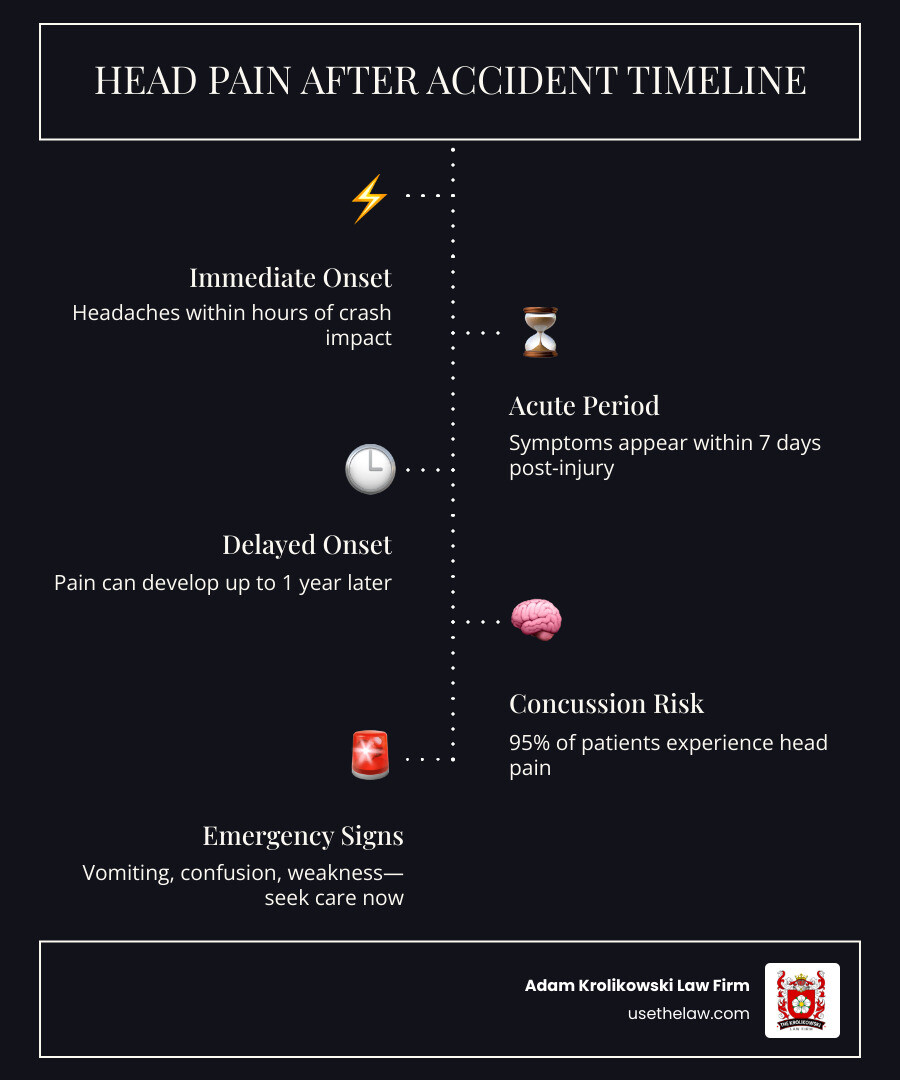
Quick Answer: Head Pain After Accident Timeline
- Immediate onset: Many victims experience headaches within hours of impact
- Delayed symptoms: Post-traumatic headaches can appear within 7 days of injury
- Extended window: Some individuals develop symptoms up to 1 year after the accident
- Common types: Whiplash headaches, tension headaches, migraine-like pain, and concussion-related symptoms
- Critical action: Seek medical evaluation even if symptoms seem mild—they may indicate traumatic brain injury (TBI)
The statistics are sobering. Globally, nearly 1.3 million people die in car crashes each year, with an additional 20 to 50 million injured. Here in the United States, motor vehicle crashes account for 2 million injuries annually. Among those who survive traumatic brain injuries, 30% to 90% develop post-traumatic headaches, and 95% of concussion patients face an increased risk of persistent head pain.
What makes post-accident head pain particularly concerning is its unpredictable nature. You don’t need to hit your head directly to suffer significant injury—the sudden acceleration and deceleration forces in a collision can cause whiplash, brain trauma, and nerve damage even in seemingly minor accidents. Many Orange County residents make the mistake of “toughing it out” when they experience mild discomfort, not realizing that delayed symptoms may indicate serious underlying conditions like subdural hematoma, skull fractures, or undiagnosed concussions.
If you’re experiencing head pain after an accident in Santa Ana, prompt medical evaluation is essential—not just for your recovery, but also to document your injuries for insurance claims and potential legal action. Adam Krolikowski Law Firm offers a Free Consultation to help Orange County residents understand their rights and options after a collision.
Understanding Head Pain After Accident: Causes and Timing
When we look at the sheer volume of traffic on the I-5 or the busy intersections of Santa Ana, it is no surprise that accidents are a daily reality. What is surprising to many is how the human body reacts to the violent forces of a crash. Even if you were wearing your seatbelt and your airbags deployed, the physics of a collision can wreak havoc on your central nervous system.

The global data is staggering: nearly 1.3 million people die in car crashes annually, and up to 50 million suffer non-fatal injuries. In many of these cases, the primary complaint is head pain. According to Scientific research on post-traumatic headaches, these pains are considered some of the most disabling injuries a person can face.
The mechanics of the injury often involve whiplash or “coup-contrecoup” forces. Whiplash occurs when the head is jerked forward and then backward, straining the ligaments and muscles in the neck. Coup-contrecoup refers to the brain literally bouncing off the inside of the skull. You can learn More info about brain injury car accidents to understand how these internal jolts lead to long-term complications.
Identifying Delayed head pain after accident
One of the most dangerous myths we encounter in Santa Ana is the idea that if you don’t feel pain immediately, you aren’t injured. This “adrenaline mask” can hide symptoms for hours or even days. In the medical world, the 7-day onset is a standard benchmark for post-traumatic headaches, but research shows a much wider window.
Some victims experience a “symptom latency” period where the inflammatory response in the brain or neck takes time to build up. It is not uncommon for a resident of Orange County to wake up three days after a crash on the 405 with a throbbing migraine they didn’t have at the scene. In extreme cases, symptoms can even manifest up to one year later. Because of this delay, it is vital to speak with More info about head trauma injury attorneys early on to ensure your medical timeline is properly recorded.
Common Causes of Post-Traumatic Symptoms
Why does your head hurt after a crash? It isn’t always a direct blow to the forehead. Our bodies are complex, and several different physical failures can lead to head pain:
- Muscle Strain: The sudden impact can tear or overstretch the muscles in your neck and upper back.
- Skull Fractures: Even a minor crack in the bone can cause localized or radiating pain.
- Pinched Nerves: Compression of the spinal nerves or irritation of the occipital nerve at the base of the skull is a frequent culprit.
- Disc Herniation: When a disc in the cervical spine bulges, it can press on nerves that send pain signals directly into the head.
According to Scientific data on motor vehicle injuries, these conditions account for a large portion of the 2 million annual crash-related injuries in the U.S.
Common Types of Post-Traumatic Headaches in Santa Ana Victims
Not all headaches are created equal. When we represent clients in Orange County, we often have to help them categorize their pain so their doctors can provide the right treatment.
Tension-Type Headaches
These are the most common. They feel like a tight band is being squeezed around your head. They often stem from the neck and shoulder tension caused by the stress and physical impact of the accident.
Migraine-Like Headaches
Post-traumatic migraines involve throbbing pain, often on one side of the head, and are frequently accompanied by nausea and sensitivity to light or sound. Research suggests that two-thirds of people with concussions experience these migraine-like symptoms.
Cervicogenic Headaches
These are “referred” pains. The problem is actually in your neck (the cervical spine), but the pain is felt in your head. This is very common in whiplash cases. You can find More info about traumatic brain injury to see how these neck-to-head pain patterns develop.
Occipital Neuralgia
This happens when the nerves that run from the top of the spinal cord up through the scalp are injured or inflamed. The pain is often described as “electric shocks” or sharp, jabbing sensations at the base of the skull.
| Headache Type | Primary Location | Key Symptom |
|---|---|---|
| Tension | Forehead/Sides | Pressure or “squeezing” |
| Migraine | One side of head | Throbbing, nausea |
| Cervicogenic | Back of head/Neck | Worsens with neck movement |
| Occipital | Base of skull | Sharp, electric shocks |
Whiplash and Musculoskeletal Pain
In Santa Ana, rear-end collisions are incredibly frequent. These are the “perfect storm” for whiplash. When your car is hit from behind, your body is pushed forward, but your head lags behind, then whips forward. This movement can cause soft tissue tears and “micro-trauma” to the ligaments.
Symptoms of whiplash-related head pain after accident include:
- Pain at the base of the skull.
- Tenderness in the scalp and neck.
- A reduced range of motion (feeling like you have a “stiff neck”).
- Pain that radiates into the shoulders or upper back.
Concussion and Brain-Based Symptoms
A concussion is a mild traumatic brain injury (mTBI), but there is nothing “mild” about the way it affects your life. With a 95% incidence rate of headaches following a concussion, it is almost a guarantee that a brain jolt will lead to pain.
Beyond the physical ache, concussion victims in Orange County often report:
- Brain Fog: Feeling like you’re moving through a cloud or having trouble “finding words.”
- Light Sensitivity: Sunlight or bright office lights becoming unbearable.
- Nausea: A constant feeling of motion sickness.
- Fatigue: Feeling exhausted even after a full night’s sleep.
For those navigating these complex symptoms, speaking with More info about concussion injury lawyers in Orange County CA can help in securing the resources needed for long-term recovery.
Why You Should Not Ignore Symptoms After a Collision
We have seen too many people in Santa Ana try to “walk it off.” They take a couple of over-the-counter pain relievers and hope for the best. This is a mistake for two major reasons: your health and your legal protection.
The Danger of Hidden TBIs
A headache is your body’s alarm system. It’s telling you that something is wrong. Ignoring it could mean overlooking internal bleeding or a subdural hematoma (a collection of blood on the brain’s surface). These conditions can be life-threatening if not treated immediately.
Research on TBI headache prevalence shows that over 30% of people with moderate to severe TBI continue to suffer from headaches long after the initial injury. If left untreated, these can lead to permanent cognitive decline, memory loss, and personality changes. You can read More info about coup-contrecoup brain injury after an accident in Santa Ana CA to understand why early intervention is so critical.
When to Seek Emergency Care in Santa Ana
If you experience any of the following “red flag” symptoms after an accident in Orange County, do not wait for an appointment. Go to the nearest emergency room or call 911:
- Slurred speech or difficulty communicating.
- Weakness in the arms or legs.
- Persistent, projectile vomiting.
- Worsening confusion or agitation.
- Seizures.
- One pupil appearing larger than the other.
If you are unsure about your symptoms, we encourage you to reach out for a Free Consultation. We can help you understand the next steps to take.
Diagnosis and Treatment for Santa Ana Patients
Getting a proper diagnosis is the first step toward living pain-free. In Orange County, we are lucky to have access to advanced medical technology, but you have to know what to ask for.
The Diagnostic Process
Doctors typically start with a physical exam and a review of your accident history. They may order:
- CT Scans: Usually the first step to rule out immediate brain bleeding or skull fractures.
- MRI: Provides a more detailed look at soft tissues and can identify smaller areas of brain injury or disc issues.
- Neurological Exams: Testing your reflexes, coordination, and cognitive function.
We often recommend that our clients keep a “headache diary.” Note the time of day the pain starts, what you were doing, and how long it lasts. This documentation is invaluable for both your doctor and for More info about head injury attorneys who are building your case.
Managing Chronic head pain after accident
For many, the pain doesn’t go away in a week. Chronic head pain after accident is defined as pain that occurs 15 or more days a month for at least three months. Treatment options include:
- Physical Therapy: Essential for whiplash, focusing on stretching and myofascial release.
- Medications: This can range from NSAIDs for inflammation to preventive drugs like beta-blockers or antidepressants.
- Botox Injections: FDA-approved for chronic migraines, these can help reduce the frequency of attacks.
- Lifestyle Adjustments: Maintaining a consistent sleep schedule and avoiding caffeine can significantly lower the “trigger threshold” for post-traumatic headaches.
According to Research on whiplash headache recovery, most acute post-traumatic headaches resolve within a few weeks, but a significant portion of patients develop persistent symptoms that require professional management.
Therapeutic Interventions
Beyond traditional medicine, several interventions have shown success for Santa Ana victims:
- Nerve Blocks: Injections that “shut off” pain signals from specific nerves.
- Cognitive Behavioral Therapy (CBT): Helping patients manage the emotional and psychological toll of chronic pain.
- Aerobic Exercise: Low-impact walking can improve blood flow to the brain and aid in the healing process.
Legal and Insurance Considerations for Orange County Residents
Dealing with insurance companies while your head is throbbing is a nightmare. In Santa Ana, the legal landscape for car accidents involves specific rules about documentation and timing.
The Importance of Medical Evidence
If you don’t go to the doctor, the insurance company will assume you aren’t hurt. It’s that simple. To get the compensation you deserve for head pain after accident, you need a clear paper trail. This includes:
- Emergency room records.
- Diagnostic scan results.
- Referrals to neurologists.
- Records of physical therapy attendance.
For more detailed guidance, check out More info about brain injury lawyers in Orange County CA. We help our clients gather this evidence to ensure their “invisible” injuries are taken seriously.
Protecting Your Rights After an Injury
Many insurance adjusters will try to settle your case quickly, often before you even know the full extent of your brain injury. Once you sign a settlement, you cannot go back for more money if your headaches become permanent.
In California, you may be entitled to:
- Coverage for all medical bills (past and future).
- Compensation for lost wages if you can’t work.
- “Pain and suffering” damages for the impact on your quality of life.
We specialize in handling these complex cases that other attorneys might shy away from. You can find a More info about brain injury lawsuit guides on our site to help you navigate the process. And remember, we offer a Free Consultation to get you started.
Frequently Asked Questions about Head Pain After Accident
Can a headache start months after a car accident?
Yes. While most post-traumatic headaches appear within the first week, medical literature confirms that symptoms can be delayed. Factors like slow-acting inflammation or the gradual development of a subdural hematoma can cause pain to manifest months down the road.
How long do post-traumatic headaches typically last?
For many, they resolve within a few weeks. However, for about 30% of moderate-to-severe TBI victims, the pain can become chronic, lasting a year or longer. The duration often depends on the type of headache and how quickly you began treatment.
Should I see a doctor if my head pain is mild?
Absolutely. What feels like a “mild” headache could be the first sign of a concussion or a slow brain bleed. Furthermore, from a legal standpoint, failing to report “mild” pain early on can make it much harder to claim compensation if that pain later becomes severe.
Conclusion
At Adam Krolikowski Law Firm, we understand that head pain after accident is more than just a physical ache—it’s a disruption to your life, your family, and your career in Santa Ana. With over 25 years of experience, we have seen how these “invisible” injuries can have the most visible impact on a person’s future.
We take pride in representing Orange County residents in complex cases that require deep investigation and a compassionate touch. You don’t have to navigate the medical bills and insurance adjusters alone. If you are suffering, we are here to help you secure the medical care and financial compensation you need to move forward.
Contact us today for a Free Consultation and let us put our experience to work for you. For more information, visit our More info about brain injury lawyers in Santa Ana CA guide. We are located right here in Santa Ana, CA, ready to stand up for your rights.
Contact Us
Practice Areas
Recent Articles
- « Previous
- 1
- 2
- 3
- Next »