


Compensation for injuries: Secure 2026 OC Payouts
Why Understanding Your Rights After a Fall in Orange County Matters
Compensation for injuries encompasses all the losses you can recover after an accidentfrom medical bills and lost wages to pain, suffering, and the impact on your daily life. In Orange County, these claims can range from a few thousand dollars to hundreds of thousands, depending on the severity of your injuries and how they’ve affected your ability to work and enjoy life.
What You Can Claim After a Fall Injury in Orange County:
- Medical Expenses – Past and future treatment costs, including surgery, therapy, and medication
- Lost Income – Wages you’ve missed while unable to work, plus reduced earning capacity
- Pain and Suffering – Physical discomfort, emotional distress, and diminished quality of life
- Special Expenses – Home modifications, mobility equipment, and ongoing care needs
- Property Damage – Clothing, personal items, or equipment damaged in the fall
If you’ve suffered a fall in Orange Countywhether at work, in a store, or on someone else’s propertyyou’re likely wondering what you’re entitled to receive. It’s natural to ask: How much is my case worth? The answer depends on many factors, including the type and severity of your injuries, how long you’ll be unable to work, and whether your own actions contributed to the accident.
The reality is that calculating compensation isn’t a simple formula. While some jurisdictions use structured guidelines (like Ireland’s Personal Injuries Assessment Board or the UK’s Judicial College Guidelines), California evaluates each case individually. This means your claim’s value reflects your specific circumstancesyour medical expenses, how the injury has disrupted your life, and the long-term consequences you’re facing.
For workplace accidents in Orange County, the path forward may involve California’s workers’ compensation system, which operates differently from a traditional personal injury lawsuit. Understanding which route applies to your situation is crucial for securing the financial stability you need while you recover.
A Free Consultation with an attorney serving Orange County can help you understand what your case is truly worth and ensure you don’t settle for less than you deserve.
Terms related to compensation for injuries:
Understanding “Damages”: The Building Blocks of Your Claim
When we talk about compensation for injuries in a personal injury case, the legal term we use is “damages.” These damages represent all the losses you’ve suffered as a result of an accident, from the moment you hit the ground in a fall to the long-term impact on your life. Our goal is to help you recover these losses by holding the responsible party accountable for their wrongful act, known as a tort. A tort can be an intentional act, like assault, or an unintentional act, like negligence in a slip and fall.
Damages are typically categorized into two main types: special damages, which cover your economic losses, and general damages, which address your non-economic suffering.

Special Damages: Your Economic Losses
Special damages are the most straightforward to calculate because they represent quantifiable financial losses. Think of these as the expenses you can prove with bills, receipts, and pay stubs. They are intended to compensate you for specific, out-of-pocket costs and lost income directly caused by your injury.
Here are the common types of special damages we help our clients in Orange County recover:
- Medical treatment costs: This includes everything from emergency room visits, ambulance rides, doctor consultations, surgeries, physical therapy, prescription medications, and even future medical care that your injury will require. We gather all medical bills and records to demonstrate the full extent of these costs.
- Lost income: If your injury prevented you from working, you’re entitled to compensation for the wages you lost. This includes not just your regular salary but also any bonuses, commissions, or benefits you would have earned. Even if you used sick days or vacation days to cover time off, those days represent a loss to you.
- Future earning capacity: For more severe injuries, you might be unable to return to your previous job or work at the same capacity, leading to a diminished ability to earn money in the future. We work with economic professionals to project these long-term losses, considering potential promotions, wage increases, and the remaining years in your career.
- Property damage: If any personal items were damaged during your fall—like a phone, glasses, or clothing—the cost of repairing or replacing them can be included in your special damages.
- Out-of-pocket expenses: This category covers any other direct costs you incurred due to your injury, such as transportation to medical appointments, assistive devices (crutches, wheelchairs), or modifications to your home or vehicle to accommodate your injury.
General Damages: The Non-Economic Impact
General damages are more challenging to quantify because they don’t come with an invoice or a bill. These damages compensate you for the subjective, non-financial losses that profoundly impact your quality of life after an injury. While there’s no exact formula, we work diligently to articulate and prove the full extent of your suffering to ensure you receive fair compensation for injuries.
Common types of general damages include:
- Pain and suffering: This covers the physical discomfort and agony you endure from your injury, both immediately after the fall and throughout your recovery. This can be ongoing and chronic.
- Emotional distress: Accidents and injuries can cause significant psychological trauma, including anxiety, depression, fear, anger, and post-traumatic stress. We understand that these emotional scars are as real as physical ones and deserve compensation.
- Loss of enjoyment of life: If your injury prevents you from participating in hobbies, social activities, or daily routines you once enjoyed—whether it’s playing with your children, gardening, or exercising—this loss diminishes your overall quality of life.
- Loss of consortium: This refers to the negative impact your injuries have on your relationships, particularly with your spouse. It can encompass the loss of companionship, affection, and the inability to maintain a sexual relationship.
- Inconvenience: The daily struggles and disruptions caused by your injury, such as needing help with personal care, household chores, or transportation, also constitute a form of general damage.
Punitive Damages: Punishing Gross Negligence
Punitive damages are quite different from special and general damages. While the latter aim to compensate you for your losses, punitive damages are awarded in rare cases to punish the defendant for particularly egregious conduct and to deter similar behavior in the future.
In California, punitive damages are typically reserved for situations where the defendant acted with malice, oppression, or fraud—meaning they intentionally caused harm or acted with a conscious disregard for your safety. They are not designed to make you “whole” but to send a message. Because of their nature, punitive damages are not common in most personal injury cases, and specific legal standards must be met for them to be awarded. We carefully evaluate whether the circumstances of your fall in Orange County warrant seeking punitive damages.
How Is Compensation for Injuries Calculated in California?
The question of “How much is my case worth?” is one we hear often in our Santa Ana office. The truth is, there’s no simple formula or average settlement amount that applies to every case. Each personal injury claim in California is unique, and its value is determined through a careful, case-by-case evaluation. This process considers a multitude of factors, all aimed at putting a fair monetary value on your losses and suffering.

Key Factors That Influence Your Claim’s Value
When we assess the value of your personal injury claim after a fall in Orange County, we look at several critical elements:
- Severity of the injury: This is often the most significant factor. A minor bruise or sprain will naturally result in less compensation for injuries than a broken bone, a traumatic brain injury, or an injury requiring surgery and long-term rehabilitation. The more serious and debilitating your injury, the higher the potential value of your claim.
- Long-term prognosis and permanent impairment: Will your injury heal completely, or will you face permanent limitations, chronic pain, or disability? The long-term impact on your health, ability to work, and daily life plays a substantial role. For example, if you can no longer perform certain tasks at work or enjoy your favorite hobbies, this adds significant value to your claim.
- Amount of medical bills: The total cost of your medical treatment, both past and projected future expenses, directly contributes to your special damages. Extensive medical care often correlates with more severe injuries, thus increasing the claim’s overall value.
- Impact on daily life and quality of life: How has the injury affected your ability to perform routine activities, engage in social events, or care for your family? This goes to the heart of general damages—your pain, suffering, and loss of enjoyment of life.
- Clarity of fault (liability): How clearly can we establish that another party’s negligence caused your fall? If liability is undisputed, the path to compensation is smoother. If there’s ambiguity or shared fault, it can complicate the claim and potentially reduce the final award.
- Lost wages and future earning capacity: As discussed under special damages, the income you’ve lost and your potential future income reduction are crucial components.
- Insurance coverage: The amount of available insurance coverage from the at-fault party can also influence the practical limits of a settlement or award.
The Impact of Your Own Actions: Comparative Negligence in Orange County
California follows a legal principle known as “pure comparative negligence.” This means that if you were partially at fault for your fall, your compensation for injuries award would be reduced by your percentage of fault. Unlike some states where even a small percentage of fault can bar you from recovery entirely, California allows you to recover damages even if you are mostly at fault.
For example, if a jury determines your total damages are $100,000, but they also find you 20% responsible for your fall (perhaps you weren’t watching where you were going, even though the property owner was negligent for a hazardous condition), your award would be reduced by 20%. In this scenario, you would receive $80,000.
This is why proving liability and minimizing any perceived fault on your part is incredibly important. We carefully investigate every detail of your fall to ensure your actions are accurately assessed and that you receive the maximum possible compensation under California law.
Are There Caps or Limits on Compensation for Injuries?
In general personal injury cases, such as slip and falls, California law does not impose a cap on economic damages (like medical bills and lost wages) or non-economic damages (like pain and suffering). This means that if your injuries are severe and your losses are substantial, you can pursue full compensation without an arbitrary upper limit.
While there’s no general cap in California for personal injury cases, there are specific exceptions. For instance, California law does impose a cap on non-economic damages in medical malpractice cases. However, this is not typically relevant for fall injuries on someone else’s property.
We sometimes see examples from other jurisdictions, like the Supreme Court of Canada, which has imposed a maximum amount of damages recoverable for pain and suffering ($414,689 in 2022). Such caps are specific to those regions and do not apply to your personal injury claim in Orange County. Our focus is always on securing the full, uncapped compensation you deserve under California law.
While there aren’t caps, the practical limit often comes down to the defendant’s available insurance policy limits. If the at-fault party has limited insurance, collecting a very large award might become challenging, even if your damages are high. This is another area where our experience in navigating complex cases, even those other attorneys might shy away from, proves invaluable.
Navigating the Claims Process in Orange County
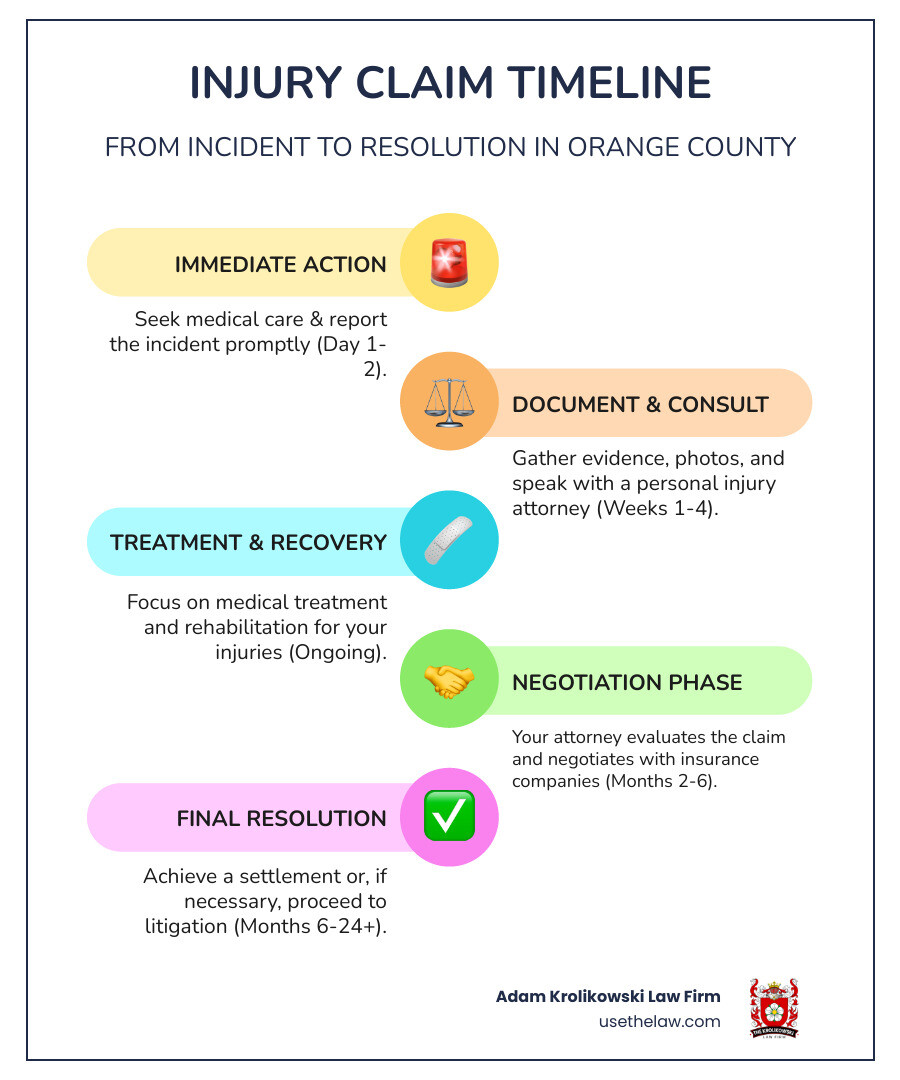
Suffering a fall injury can be disorienting, but knowing the steps to take afterward is crucial for protecting your right to compensation for injuries in Orange County. The process can feel overwhelming, but we are here to guide you through every stage, from immediate actions to potential legal proceedings in Orange County.
Critical First Steps: What to Do Immediately After a Fall
The actions you take immediately following a fall can significantly impact your claim. These steps are vital for documenting the incident and ensuring your well-being:
- Seek medical attention: Your health is the top priority. Even if you feel fine, some injuries may not be immediately apparent. See a doctor or go to an urgent care facility in Santa Ana or elsewhere in Orange County as soon as possible. This creates an official record of your injuries and links them directly to the fall.
- Report the incident: Inform the property owner, manager, or your employer about the fall. Request that an official incident report be filed. If possible, get a copy of this report. Do not admit fault or minimize your injuries.
- Document the scene: If you’re able, take photos and videos of the exact location in Orange County where you fell. Capture the hazard that caused your fall, the surrounding area, and any warning signs (or lack thereof).
- Gather witness information: If anyone saw your fall, ask for their names and contact information. Their testimony can be invaluable in establishing what happened.
- Preserve evidence: Keep the clothes and shoes you were wearing. Do not discard any damaged items. Maintain a detailed journal of your pain, medical treatments, and how the injury affects your daily life.
Workers’ Comp vs. Personal Injury Lawsuit: Which Path to Take in Orange County?
The type of claim you pursue depends on where and how your fall occurred. This distinction is critical for determining your rights to compensation for injuries in Orange County.
- Injury at work: If you fell while on the job or performing work-related duties in Orange County, your primary recourse is typically through the California workers’ compensation system. This is a no-fault system, meaning you don’t have to prove your employer was negligent to receive benefits. Workers’ comp covers medical treatment, temporary disability payments (lost wages), permanent disability benefits, and vocational rehabilitation. However, it generally limits your ability to sue your employer for pain and suffering. We can help you steer the complexities of workers’ compensation claims in Santa Ana and throughout Orange County. You can find more information about California’s workers’ compensation system through the DWC Information and Assistance Unit.
- Injury on someone else’s property (personal injury lawsuit): If your fall occurred on a commercial property (like a store, restaurant, or mall), a private residence, or public property in Orange County due to a hazardous condition, you would typically pursue a personal injury lawsuit. In these cases, you must prove that the property owner or manager was negligent in maintaining their premises, and this negligence directly caused your fall and injuries. This type of claim allows you to recover both economic and non-economic damages, including pain and suffering.
Sometimes, a fall at work might also involve a “third party”someone other than your employer who contributed to the accident. In such cases, you might be able to pursue both a workers’ compensation claim and a personal injury lawsuit against the third party. We can help you determine the best legal strategy for your unique situation in Orange County.
The Statute of Limitations: A Deadline You Can’t Miss in Orange County
One of the most critical aspects of any personal injury claim in Orange County is the statute of limitations. This is a strict legal deadline by which you must file your lawsuit. If you miss this deadline, you generally lose your right to pursue compensation for injuries forever, regardless of the merits of your case.
In California, the general statute of limitations for personal injury claims (including most slip and falls) is two years from the date of the injury. However, there are exceptions:
- If the injury was not immediately discovered, the “discovery rule” might allow the clock to start when the injury was or should have been discovered.
- Claims against a government entity in Orange County usually have a much shorter deadline, often just six months, and require specific notice procedures.
- For minors, the statute of limitations typically doesn’t begin until they turn 18.
Given these strict timelines and potential complexities, it’s incredibly important to act quickly. Contacting a personal injury attorney in Santa Ana or elsewhere in Orange County as soon as possible after your fall ensures that all deadlines are met and your rights are protected.
Resolving Your Claim in Orange County: Negotiation, Mediation, and Litigation
Most personal injury cases don’t go to trial. Instead, they are resolved through negotiation and settlement. Here’s how the process typically unfolds in Orange County:
- Settlement negotiations: Once we have gathered all necessary evidencemedical records, bills, witness statements, incident reports, and opinions from relevant professionalswe will send a demand letter to the at-fault party’s insurance company. This letter outlines your injuries, losses, and the compensation we are seeking. Negotiations then begin, where both sides present their arguments and try to reach an agreement.
- Role of an attorney: Having an attorney during negotiations is vital. Insurance companies are motivated to pay as little as possible. We know how to counter their tactics, present a strong case, and ensure you don’t accept a lowball offer that doesn’t fully cover your losses. We handle all communications and paperwork, allowing you to focus on your recovery in Orange County.
- Mediation: If initial negotiations don’t lead to a satisfactory settlement, we might suggest mediation. This is a process where a neutral third party (the mediator) helps both sides communicate, understand each other’s positions, and explore potential solutions. Mediation is confidential, often quicker, and less expensive than going to court. It can be a very effective way to negotiate a settlement using mediation without the need for a full trial in Orange County.
- Litigation: If all attempts at negotiation and mediation fail to yield a fair offer, we are prepared to take your case to court. Litigation involves filing a lawsuit, engaging in discovery (exchanging information with the other side), and potentially going to trial before a judge or jury in Orange County. While litigation can be more time-consuming and expensive, it sometimes becomes necessary to secure the full compensation for injuries you deserve. Our firm has over 25 years of experience handling complex cases that other attorneys may not take, and we are not afraid to fight for your rights in court.
Frequently Asked Questions about Injury Compensation
What is the average settlement for a slip and fall in Orange County?
There’s truly no such thing as an “average” settlement for a slip and fall case in Orange County or anywhere else in California. As we’ve discussed, every case is unique, and the value depends heavily on specific factors like the severity of your injuries, the medical treatment required, your lost wages, and the impact on your quality of life. An individual with a minor sprain will receive significantly less than someone who suffered a traumatic brain injury or a broken hip requiring surgery and long-term care. Be wary of any figures that claim to represent an average, as they rarely reflect the true value of a specific claim. A Free Consultation with us can provide a more accurate assessment of your potential compensation for injuries.
Do I have to pay taxes on my personal injury settlement in California?
Generally, no. Under federal and California tax laws, compensation for injuries received for physical injuries or physical sickness is typically not considered taxable income. This includes amounts received for medical expenses, pain and suffering, and emotional distress directly related to the physical injury.
However, there are exceptions:
- Punitive damages: If you receive punitive damages, these are usually taxable.
- Lost wages: While compensation for lost wages due to physical injury is often tax-free, if your settlement explicitly includes lost wages that would have been taxable income (e.g., if you were employed), those portions might be subject to income tax.
- Emotional distress without physical injury: If you receive compensation solely for emotional distress that is not tied to a physical injury, that portion might be taxable.
It’s always wise to consult with a tax professional regarding the specifics of your settlement to ensure compliance with all tax laws.
Can I still get compensation for injuries if the accident was partially my fault?
Yes, in California, you can still get compensation for injuries even if you were partially at fault for your fall. As explained earlier, California operates under a “pure comparative negligence” system. This means that your total damages award will be reduced by your percentage of fault. For example, if your total damages are assessed at $100,000, but you are found to be 30% at fault, you would still be able to recover $70,000.
This system ensures that even if you bear some responsibility, you are not entirely barred from recovering damages from the other negligent party. Our role is to minimize your attributed fault and maximize the recovery from the responsible party.
Conclusion: Securing the Payout You Deserve in Orange County
Navigating the aftermath of a fall injury in Orange County can be a challenging and complex journey. Understanding your rights to compensation for injuries means knowing the difference between economic and non-economic damages, how your own actions might influence your claim, and the critical deadlines you must meet under California law.
Whether your injury occurred at work in Orange County, leading to a workers’ compensation claim, or on someone else’s property, necessitating a personal injury lawsuit, the path to recovery and fair compensation is rarely straightforward. We understand the nuances of California law and the tactics insurance companies employ. Our firm is dedicated to handling even the most complex cases, ensuring that your unique circumstances are fully accounted for and that you receive every dollar you deserve.
Don’t let the complexity deter you. If you’ve suffered a fall injury in Santa Ana or elsewhere in Orange County, we are here to offer a Free Consultation. Let us assess your situation, explain your options, and fight for the payout you need to recover and rebuild your life in Orange County.