

Why Finding the Right Gender Discrimination Attorney Matters
When you need a los angeles gender discrimination lawyer, you’re facing one of the most challenging workplace situations possible. Gender discrimination affects workers across Los Angeles daily, from unequal pay to denied promotions to hostile work environments.
Quick Answer for Los Angeles Workers:
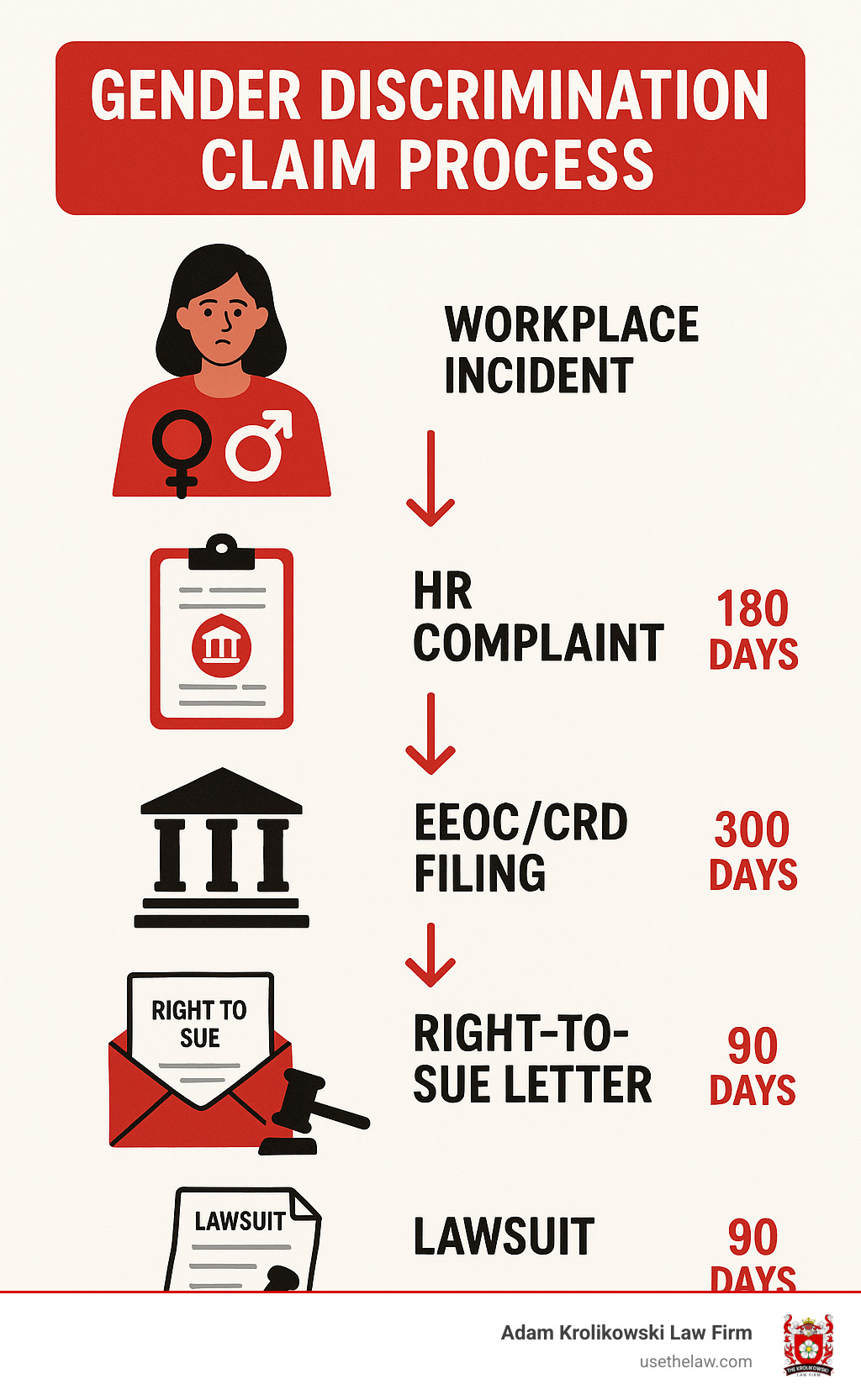
- File Timeline: 180-300 days with EEOC/CRD, then 90 days for lawsuit
- Protected Traits: Sex, gender identity, gender expression, pregnancy status
- Potential Damages: Back pay, front pay, emotional distress, attorney fees
- Key Laws: Title VII (federal), FEHA (California), Equal Pay Act
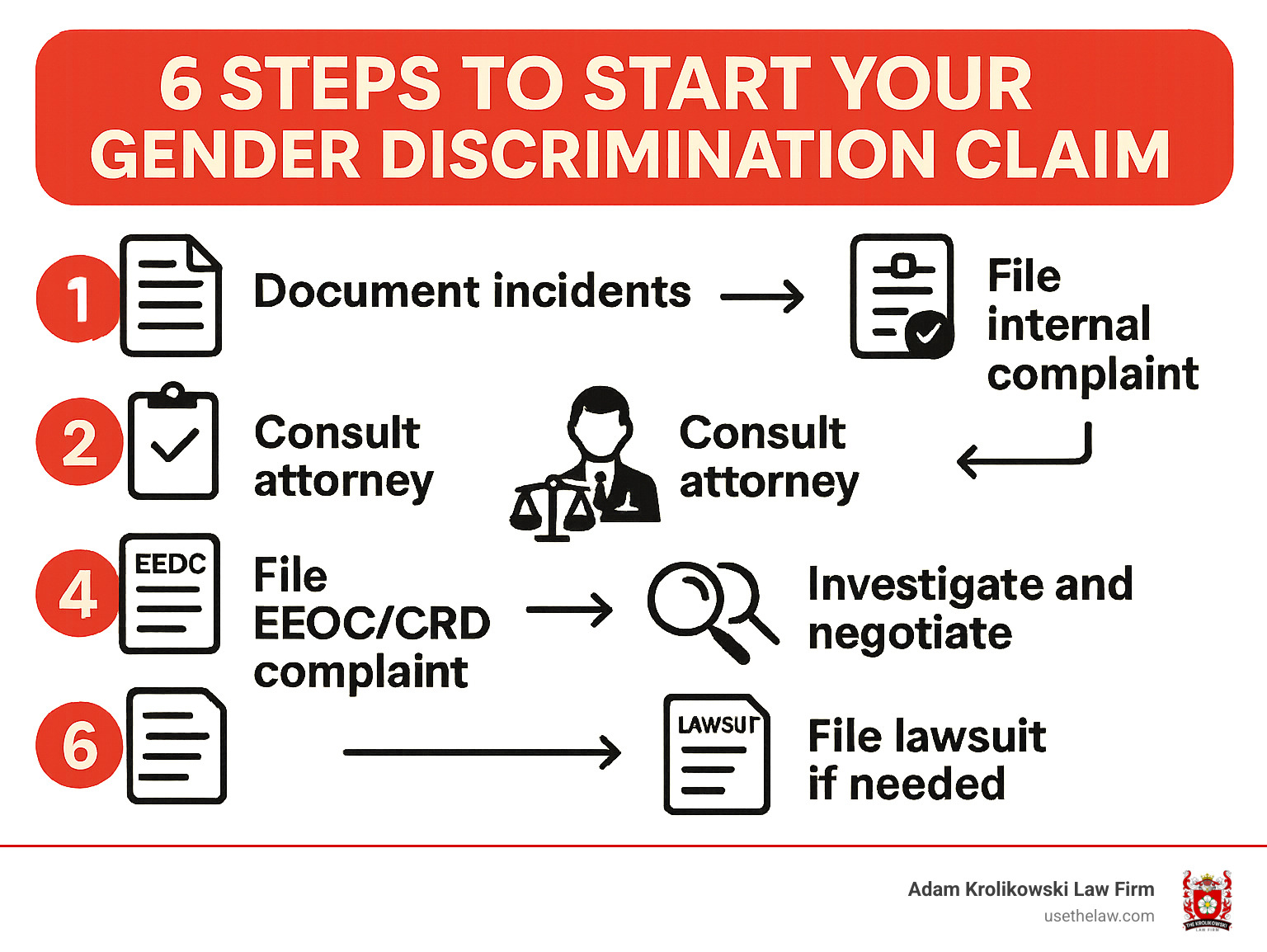
- First Step: Document incidents and consult an employment attorney
Research shows that women in California earn just 88 cents for every dollar earned by men. This pay gap represents just one form of gender discrimination that violates both federal and state laws.
California’s Fair Employment and Housing Act (FEHA) provides broader protections than federal law. It covers workplaces with five or more employees and explicitly protects gender identity and expression. The law also gives workers the right to use preferred pronouns and access appropriate facilities.
Gender discrimination cases follow a specific legal process. You typically must file with the Equal Employment Opportunity Commission (EEOC) or California Civil Rights Department (CRD) before pursuing a lawsuit. Missing these deadlines can destroy your case forever.
The right attorney makes all the difference. They know how to gather evidence, steer agency procedures, and maximize your compensation. A skilled lawyer can turn a weak internal complaint into a strong federal lawsuit.
Los angeles gender discrimination lawyer further reading:
Gender Discrimination 101: California & Federal Protections
Understanding your legal rights is the first step in choosing the right attorney. Gender discrimination in Los Angeles workplaces violates multiple federal and state laws, each with different protections and remedies.
Title VII of the Civil Rights Act of 1964 prohibits sex discrimination in workplaces with 15 or more employees. The Supreme Court’s 2020 decision in Bostock v. Clayton County expanded Title VII to explicitly cover gender identity and sexual orientation discrimination. This means firing someone for being transgender or gay violates federal law.
California’s Fair Employment and Housing Act (FEHA) goes much further. It applies to employers with five or more employees and provides comprehensive protections for gender identity and gender expression. Under FEHA, employers cannot discriminate based on actual or perceived gender characteristics, including how someone dresses, speaks, or presents themselves.
The Equal Pay Act of 1963 requires equal pay for equal work regardless of gender. California’s Equal Pay Act uses a broader standard of “substantially similar work” rather than “equal work,” making it easier to prove pay discrimination. California law also permits employees to ask coworkers about their salaries to identify pay gaps.
California’s Gender Non-Discrimination Act makes it unlawful to treat individuals unfairly based on actual or perceived gender identity or expression in employment, housing, and public accommodations. This law covers nearly every aspect of daily life, not just the workplace.
For pregnancy-related discrimination, the federal Pregnancy Discrimination Act and California’s Pregnancy Disability Leave Act provide overlapping protections. California law requires employers to provide up to four months of pregnancy disability leave and reasonable accommodations for pregnancy-related conditions.
Key Laws Every Worker Should Know
Title VII basics are straightforward: employers with 15 or more employees cannot discriminate in hiring, firing, pay, promotions, or other terms of employment based on sex. This includes discrimination against pregnant workers and gender-based harassment that creates a hostile work environment.
FEHA’s threshold is lower at five employees, and its protections are broader. FEHA explicitly protects gender identity, gender expression, and transitioning employees. It also requires employers to provide reasonable accommodations for employees undergoing gender transition, including time off for medical appointments and procedures.
Equal Pay Act elements focus on four factors that can justify pay differences: seniority systems, merit systems, systems measuring production quantity or quality, and bona fide factors other than sex. Employers must prove these factors are job-related and applied reasonably to justify pay disparities.
Where State Law Goes Further Than Federal Rules
California provides broader coverage than federal law in several key areas. While Title VII covers employers with 15 or more employees, FEHA covers those with five or more. This means smaller businesses in California must comply with anti-discrimination laws that don’t apply federally.
Pronoun rights represent a uniquely California protection. Under FEHA regulations, employees have the right to be addressed by their preferred gender pronouns. Intentionally misgendering an employee can constitute harassment under state law, even if it wouldn’t violate federal protections.
Restroom access is another area where California leads. The state requires employers to allow employees to use facilities consistent with their gender identity, regardless of their assigned sex at birth. Employers cannot require documentation of gender identity or proof of medical treatment.
California Code 11030 defines key terms like “gender identity” and “gender expression” with specificity that federal law lacks. These definitions help courts and employers understand exactly what conduct is prohibited.
Scientific research on employment discrimination shows that discrimination often involves subtle behaviors rather than obvious bias. California’s detailed regulations help identify and address these more nuanced forms of discrimination.
Do You Need a Los Angeles Gender Discrimination Lawyer?

Many workers wonder whether they need legal representation for gender discrimination issues. The answer depends on several factors, but certain warning signs indicate you should consult an attorney immediately.
Unequal pay is one of the most common forms of gender discrimination. If you find that colleagues of a different gender earn more for substantially similar work, you may have a valid claim. California law makes it easier to prove pay discrimination by using a broader definition of comparable work.
The glass ceiling effect occurs when qualified workers are repeatedly passed over for promotions based on gender stereotypes. This might involve assumptions that women won’t travel for work, that men are better suited for leadership roles, or that non-binary individuals don’t fit traditional corporate structures.
Retaliation happens when employers punish workers for complaining about discrimination. This can include termination, demotion, reduced hours, or creating a hostile work environment. Retaliation claims are often easier to prove than the underlying discrimination.
Misgendering and pronoun violations create hostile work environments under California law. If supervisors or coworkers intentionally use wrong pronouns or refuse to acknowledge your gender identity, this constitutes harassment that employers must address.
Denial of leave for pregnancy, medical transition, or other gender-related needs violates both federal and state laws. California requires employers to provide reasonable accommodations, including time off for medical appointments and procedures.
Warning Signs Your Rights Are Being Violated
Passed-over promotions become suspicious when they follow a pattern. If you’re consistently more qualified than promoted colleagues of different genders, document these incidents. Look for patterns in promotion decisions and whether they correlate with gender.
Pay secrecy policies may violate California law. Employers cannot prohibit employees from discussing their wages or asking coworkers about compensation. If your employer discourages salary discussions, this could indicate they’re hiding pay discrimination.
Sexist remarks and gender-based comments create hostile work environments. This includes jokes about women’s abilities, comments about appearance, or assumptions about family responsibilities. Even seemingly minor comments can add up to actionable harassment.
Exclusion from meetings, projects, or opportunities based on gender assumptions violates anti-discrimination laws. If you’re routinely excluded from important business functions because of your gender, this constitutes discrimination in terms and conditions of employment.
How a los angeles gender discrimination lawyer Levels the Field
Demand letters from attorneys carry more weight than employee complaints. A well-crafted demand letter can resolve discrimination issues quickly and cost-effectively, often leading to policy changes and compensation without litigation.
Agency filings with the EEOC or CRD require specific forms and procedures. Attorneys know how to present your case persuasively from the start, increasing the chances of successful mediation or investigation outcomes.
Negotiation skills become crucial when employers offer settlements. Experienced attorneys understand the full value of discrimination claims and can negotiate for appropriate compensation, including back pay, front pay, and emotional distress damages.
Litigation strategy involves complex procedural rules and evidence requirements. If your case goes to court, you need an attorney who understands how to present gender discrimination claims effectively to judges and juries.
Step-by-Step: From Internal Complaint to Courtroom
Understanding the legal process helps you choose an attorney who can guide you through each stage effectively. Gender discrimination cases follow a specific sequence that begins with agency complaints and may end in federal court.
EEOC charges must be filed within 180 days of the discriminatory act under federal law. However, California’s dual-filing system extends this to 300 days when state law also applies. Missing these deadlines can destroy your case permanently.
CRD filing in California gives you three years from the last discriminatory act to file a complaint. This longer timeline provides more flexibility than federal deadlines, but earlier filing is generally better for evidence preservation.
Right-to-Sue letters come from the EEOC after they complete their investigation or after 180 days if you request early release. You then have 90 days to file a federal lawsuit, making timing crucial for preserving your rights.
Mediation opportunities exist at both the agency and court levels. Many cases settle during mediation, which can be faster and less expensive than full litigation. However, you need an attorney who can evaluate settlement offers fairly.
Federal court litigation involves complex procedures and strict deadlines. From initial pleadings through findy, depositions, and trial, each stage requires legal knowledge and courtroom experience.
Trial preparation includes witness preparation, evidence organization, and legal argument development. While most cases settle before trial, you need an attorney prepared to take your case to a jury if necessary.
Filing Your Initial Agency Complaint
Forms for EEOC and CRD complaints require specific information and legal theories. Your attorney should help you articulate your claims clearly and include all relevant discriminatory acts within the appropriate time periods.
The 180/300-day clock starts from the last discriminatory act, not when you first experienced discrimination. For ongoing discrimination like pay disparities, each paycheck can constitute a new violation, keeping your claim alive.
Cross-filing between EEOC and CRD happens automatically in most cases, but you should verify that both agencies have jurisdiction over your employer. This dual protection ensures you don’t lose rights due to procedural errors.
More info about retaliation claims shows how employers often respond to discrimination complaints with additional violations. Your attorney should anticipate and document any retaliatory conduct.
Lawsuit Phases Explained by a los angeles gender discrimination lawyer
Pleading stage involves drafting your complaint and responding to the employer’s answer. Your attorney must include all legal theories and factual allegations that support your discrimination claims.
Evidence exchange through findy allows both sides to request documents, depositions, and other information. Your attorney should know what evidence to seek and how to protect your privacy during this process.
Depositions involve sworn testimony from witnesses and parties. Your attorney should prepare you thoroughly for your deposition and conduct effective depositions of employer witnesses.
Settlement conferences occur throughout litigation, often facilitated by judges or mediators. Your attorney should evaluate settlement offers based on the strength of your case and the full range of available damages.
Jury trial represents the final stage if settlement negotiations fail. Your attorney must be prepared to present your case effectively to a jury, including calling witnesses and presenting evidence persuasively.
Building a Strong Case & Maximizing Compensation

The strength of your gender discrimination case depends largely on the evidence you can present. Documentation is crucial because discrimination often involves subtle behaviors and unwritten policies that are difficult to prove without careful record-keeping.
Emails and written communications provide some of the strongest evidence in discrimination cases. Save all emails that show discriminatory comments, unequal treatment, or policy violations. Include messages between coworkers that demonstrate bias or harassment.
Pay stubs and compensation records help prove pay discrimination claims. Gather your pay stubs, bonus records, and any information about colleagues’ compensation. California law protects your right to ask coworkers about their salaries.
Witness statements from coworkers who observed discriminatory treatment can corroborate your claims. However, workplace witnesses may be reluctant to testify against their employer, so document incidents as they occur.
Performance reviews and personnel files often reveal discriminatory patterns. Request copies of your personnel file and compare your evaluations to those of colleagues. Look for sudden changes in performance ratings after complaints or protected activities.
Damages in gender discrimination cases can include both economic and non-economic losses. Economic damages cover lost wages, benefits, and career advancement opportunities. Non-economic damages compensate for emotional distress, humiliation, and other intangible harms.
Emotional distress damages recognize the psychological impact of discrimination. Courts understand that workplace discrimination affects every aspect of a person’s life, from career prospects to personal relationships and mental health.
Gathering and Preserving Critical Evidence
Document logs should record every discriminatory incident with dates, times, witnesses, and detailed descriptions. Create a timeline of events that shows patterns of discrimination or escalating harassment.
Digital backups protect your evidence from loss or destruction. Save emails and documents to personal accounts or storage devices. Don’t rely solely on company systems that employers control.
Corroborating witnesses strengthen your case significantly. Identify coworkers, clients, or vendors who witnessed discriminatory treatment. Even witnesses who won’t testify can provide valuable information for your attorney’s investigation.
Expert reports may be necessary for complex pay discrimination cases. Statisticians can analyze compensation data to identify patterns of gender bias. Workplace culture consultants can explain how discrimination manifests in corporate environments.
What Compensation Can Include
Back pay covers wages and benefits you should have received but for the discrimination. This includes salary increases, bonuses, and promotions you were denied. Interest on back pay compensates for the time value of money.
Front pay provides compensation for future lost earnings when reinstatement isn’t appropriate. This might apply when the working relationship is too damaged to continue or when you’ve found other employment.
Promotion and reinstatement restore your rightful position when possible. Courts can order employers to promote you to positions you should have received or reinstate you to jobs you lost due to discrimination.
Punitive damages punish employers for particularly egregious conduct. These damages are available when employers act with malice or reckless indifference to your rights. California law allows unlimited punitive damages, while federal law caps them based on employer size.
Attorney fees shift the cost of litigation to employers who violate discrimination laws. This fee-shifting provision makes it economically feasible to pursue discrimination claims, even when damages are modest.
Employment Attorney Los Angeles Free Consultation explains how many attorneys handle discrimination cases on contingency, meaning you pay nothing unless you win.
Comparing Attorneys & Making Your Final Choice
Choosing the right los angeles gender discrimination lawyer requires careful evaluation of several factors. Experience length matters, but the type of experience is equally important. Look for attorneys who focus on employment law rather than general practitioners who handle discrimination cases occasionally.
Contingency fees align your attorney’s interests with yours. Most employment attorneys work on contingency, taking a percentage of any recovery rather than charging hourly fees. This arrangement makes legal representation accessible to workers who couldn’t otherwise afford it.
Courtroom record indicates whether an attorney can effectively litigate your case if settlement negotiations fail. While most cases settle, employers take attorneys more seriously when they know the lawyer will take cases to trial.
Communication style affects your entire legal experience. You want an attorney who explains complex legal concepts clearly and keeps you informed about case developments. Poor communication can lead to misunderstandings and missed opportunities.
Client reviews provide insights into an attorney’s reputation and results. Look for reviews that mention specific outcomes and the attorney’s handling of discrimination cases. Be wary of attorneys with consistently negative reviews about communication or results.
Questions to Ask During Consultations
Case assessment discussions should cover the strength of your claims, potential damages, and likelihood of success. A good attorney will give you an honest evaluation rather than making unrealistic promises about outcomes.
Fee structure conversations should clarify contingency percentages, cost responsibilities, and what happens if you lose. Understand whether you’ll be responsible for court costs and expert witness fees regardless of the outcome.
Expected timeline questions help you plan for the legal process. Ask about agency filing deadlines, typical investigation periods, and how long litigation might take. Understanding the timeline helps you make informed decisions about settlement offers.
Role of paralegals and support staff affects the cost and quality of your representation. Many attorneys use paralegals for routine tasks, which can reduce costs. However, ensure that an attorney will handle the important aspects of your case personally.
Red Flags to Avoid
Upfront retainers are unusual in employment discrimination cases. Most employment attorneys work on contingency, so demands for large upfront payments may indicate inexperience with discrimination law or financial problems.
Lack of employment focus suggests the attorney may not understand the nuances of workplace discrimination law. Employment law is complex and constantly evolving, requiring focused practice to stay current.
Unrealistic promises about case outcomes or damages amounts should raise concerns. Honest attorneys will explain that case outcomes depend on many factors and cannot be guaranteed.
Poor responsiveness during the consultation process likely indicates communication problems throughout your case. If an attorney doesn’t return calls promptly or answer questions clearly, look elsewhere.
Frequently Asked Questions about Gender Discrimination Claims in LA
What is the statute of limitations for a CRD complaint?
California gives you three years from the last discriminatory act to file a complaint with the Civil Rights Department. This is much longer than the federal EEOC deadline of 180-300 days. However, filing earlier is generally better for evidence preservation and witness memory.
The three-year period applies to most discrimination claims under FEHA. For equal pay claims, you have two years from the last unequal paycheck, or three years if the violation was willful. These deadlines are strict, and missing them can destroy your case permanently.
Can men or non-binary workers file gender discrimination claims?
Absolutely. Gender discrimination laws protect all workers regardless of their gender identity. Men can file claims for discrimination based on gender stereotypes, such as being denied family leave or facing harassment for not conforming to masculine stereotypes.
Non-binary and transgender workers have particularly strong protections under California law. FEHA explicitly protects gender identity and expression, and California regulations provide detailed guidance on workplace accommodations for transitioning employees.
The Supreme Court’s Bostock decision also extended federal Title VII protections to transgender and non-binary workers. This means discrimination based on gender identity or expression violates both federal and state law.
How is gender discrimination different from sexual harassment?
Gender discrimination encompasses a broader range of conduct than sexual harassment. While sexual harassment involves unwelcome sexual advances or conduct of a sexual nature, gender discrimination includes any adverse treatment based on gender, gender identity, or gender expression.
Examples of gender discrimination that aren’t sexual harassment include:
- Paying women less than men for the same work
- Denying promotions based on gender stereotypes
- Excluding employees from opportunities because of their gender
- Misgendering transgender employees
- Enforcing different dress codes based on gender
Sexual harassment is actually a form of gender discrimination. Both quid pro quo harassment (demanding sexual favors for job benefits) and hostile work environment harassment constitute discrimination based on sex under Title VII and FEHA.
The legal remedies are similar for both types of claims, including back pay, front pay, emotional distress damages, and attorney fees. However, the evidence and legal theories may differ depending on the specific conduct involved.
Conclusion
Choosing the right los angeles gender discrimination lawyer can make the difference between a successful claim and a missed opportunity for justice. Gender discrimination continues to affect workers throughout Los Angeles, from subtle pay disparities to blatant harassment and retaliation.
At Adam Krolikowski Law Firm, we understand the complexities of employment law and the challenges facing discrimination victims. With over 25 years of experience handling complex cases that other attorneys may not take, we’re prepared to fight for your rights and maximize your compensation.
Our approach combines thorough investigation with aggressive advocacy. We know how to gather evidence, steer agency procedures, and negotiate favorable settlements. When necessary, we’re prepared to take your case to trial to achieve the justice you deserve.
California’s strong anti-discrimination laws provide powerful tools for fighting workplace bias. From FEHA’s broad protections to the Equal Pay Act’s remedies, state law offers multiple avenues for addressing gender discrimination. Federal laws like Title VII add additional protections and remedies.
The legal process can seem overwhelming, but you don’t have to face it alone. Our team guides clients through every step, from initial consultations through final resolution. We work on contingency, meaning you pay nothing unless we win your case.
Time is critical in discrimination cases. Agency filing deadlines can destroy your case if missed, and evidence becomes harder to gather as time passes. If you’re experiencing gender discrimination, don’t wait to seek legal help.
Contact us today for a free case evaluation. We’ll review your situation, explain your legal options, and help you decide on the right course of action. Your rights matter, and we’re here to protect them.
More info about our California Employment Law Firm provides additional resources about our employment law practice and how we can help with your discrimination claim.
Gender discrimination is illegal, and you have the right to a workplace free from bias and harassment. With the right attorney by your side, you can hold employers accountable and secure the compensation you deserve.
