


Why Medical Device Injuries Are More Common Than You Think
A medical device injury happens when equipment like a hip implant, pacemaker, or surgical mesh harms a patient. These injuries often stem from design defects, manufacturing errors, or inadequate warnings about risks.
Key Facts About Medical Device Injuries:
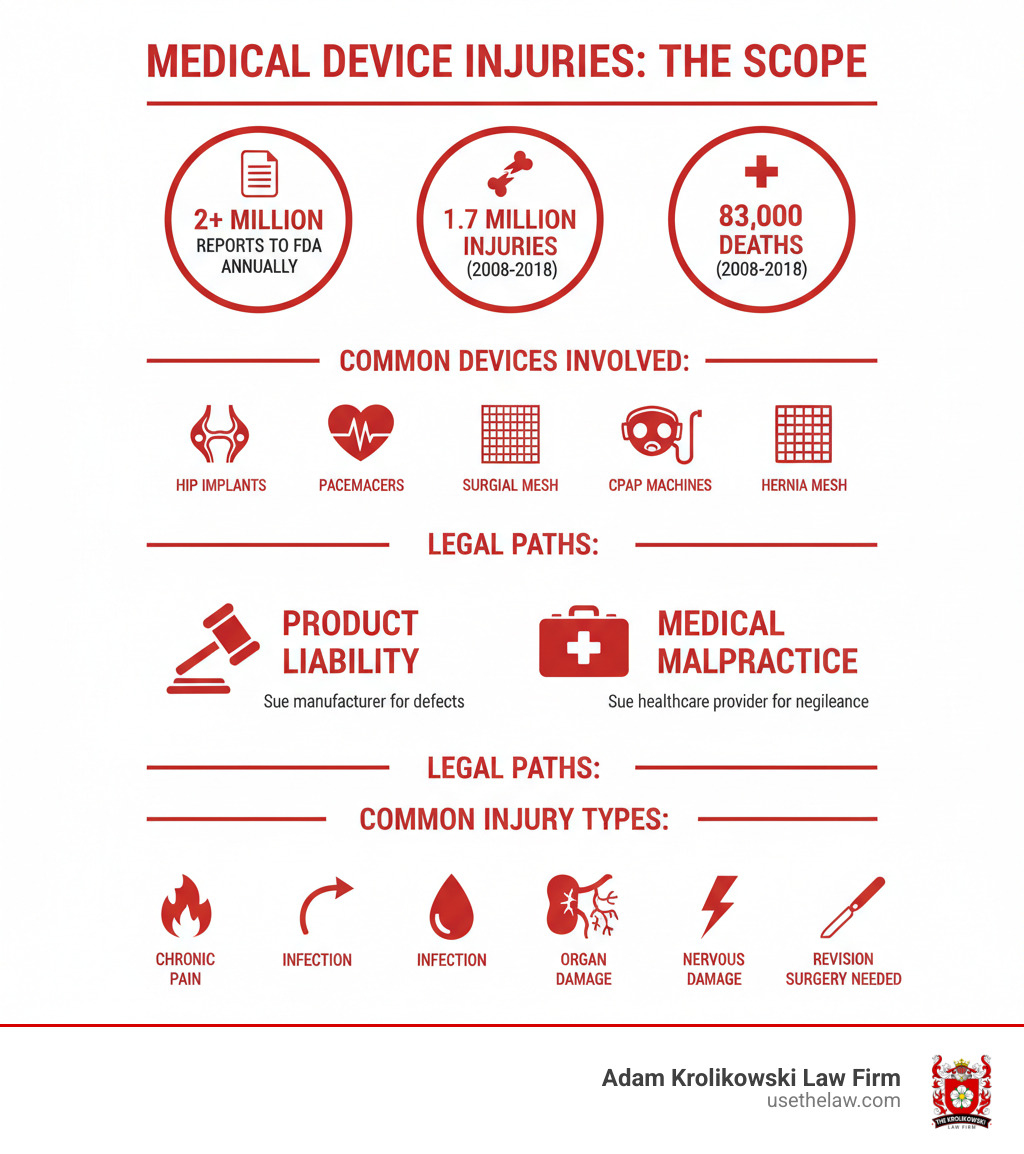
- Widespread Harm: From 2008 to 2018, defective medical devices were linked to 1.7 million injuries and 83,000 deaths.
- Annual Reports: The FDA gets over two million reports of suspected device-related deaths, injuries, and malfunctions each year.
- Legal Paths: Victims can file product liability claims against manufacturers or medical malpractice claims against healthcare providers.
- Common Injuries: These include chronic pain, infections, organ damage, device migration, and the need for revision surgery.
Medical devices are intended to improve health, but when they fail, the consequences can be devastating. Many people are unaware they have legal rights when a device causes harm. You may be entitled to compensation for medical bills, lost income, and pain and suffering.
The legal process is complex, particularly against large manufacturers. Understanding what qualifies as a medical device injury and who can be held responsible is the first step. You don’t have to face this challenge alone; knowing your options can help you make informed decisions.
Related content about medical device injury:
What Are Medical Devices and How Can They Be Defective?
The FDA defines a medical device as any instrument, apparatus, or implant used to diagnose, treat, or prevent a medical condition without using chemical action in the body. This broad category includes everything from tongue depressors and wheelchairs to complex implants like pacemakers and robotic surgery systems.
While most devices work as intended, a medical device injury can occur due to one of three types of defects: design, manufacturing, or marketing.
Design Defects
A design defect is a flaw in the device’s original blueprint, making the entire product line inherently unsafe. No matter how well it’s made, the danger exists from the start.
Metal-on-metal hip implants are a key example. Their design caused metal particles to break off into patients’ bodies, leading to pain, tissue damage, and the need for replacement surgery. Similarly, transvaginal mesh was designed to treat pelvic organ prolapse but led to complications like mesh erosion, chronic pain, and infections. A design defect claim can arise when a manufacturer chooses a dangerous design over a known, safer alternative.
Manufacturing Defects
A manufacturing defect is an error that occurs during production. Unlike design defects, these problems usually affect specific batches. This can involve contamination of sterile products, incorrect assembly, or the use of faulty materials.
The Philips Respironics CPAP machine recall is a real-world example. The foam inside the machines broke down, sending particles and chemicals into users’ airways. This was a problem with the materials used in manufacturing, not the intended design. Tracing these defects can be difficult, but the manufacturer is still responsible for the harm they cause. For more information, see our article on Personal Injury Claims Defective Products.
Marketing Defects (Failure to Warn)
A device can be designed and manufactured correctly but still cause harm if patients and doctors aren’t given proper information. Marketing defects, or “failure to warn,” occur when manufacturers provide inadequate instructions, downplay known risks, or promote unapproved “off-label” uses.
If a manufacturer fails to clearly warn about a known danger, they can be held liable for resulting injuries. The DePuy ASR hip implant lawsuits included claims that the company deceptively marketed the device by overselling its benefits and hiding known risks. These three defects—design, manufacturing, and marketing—are the basis for most medical device injury claims.
Legal Responsibility for a Medical Device Injury
When a medical device injury occurs, determining legal responsibility is key. The issue may lie with the device itself (a product liability claim) or with how a healthcare provider used it (a medical malpractice claim). Understanding this distinction is crucial as it dictates who you sue and what you must prove.
Product liability claims target the manufacturer or others in the supply chain, arguing the device was defective. Medical malpractice claims focus on a healthcare provider’s negligence, such as choosing the wrong device or implanting it incorrectly.
| Feature | Product Liability Claim | Medical Malpractice Claim |
|---|---|---|
| Primary Target | Manufacturer, designer, distributor, seller of device | Healthcare provider (doctor, surgeon, hospital, clinic) |
| Core Allegation | The device itself was defective or unsafe. | Healthcare provider’s negligence caused injury. |
| What to Prove | Device defect, defect caused injury, suffered damages. | Duty of care, breach of duty, causation, damages. |
| Basis of Claim | Strict liability, negligence, breach of warranty. | Negligence (deviation from standard of care). |
| Focus | The product’s safety and fitness for use. | The professional conduct of the healthcare provider. |
Who Can Be Held Liable?
The chain of responsibility for a medical device injury can be long. Liable parties may include:
- Manufacturers: Responsible for the device’s entire lifecycle, from design and testing to production.
- Designers: Can be liable if the device’s blueprint was inherently flawed.
- Testing Laboratories: May be responsible if they failed to identify safety issues or falsified results.
- Sales Representatives: Can be liable for misrepresenting a device’s safety or promoting unapproved uses.
- Doctors and Surgeons: May face malpractice claims for improper device selection, surgical errors, or failure to warn of risks. Our medical malpractice lawyer in Orange County California has experience in these cases.
- Hospitals and Clinics: Can be held liable for improper equipment maintenance, inadequate staff training, or for the actions of their employees.
Proving a Medical Device Injury Claim
Winning a medical device injury case requires specific proof. For a product liability case, you must show: 1) the device was defective, 2) the defect caused your injury, and 3) you suffered actual damages (medical bills, lost income, pain).
For a medical malpractice case, you must prove: 1) the provider owed you a duty of care, 2) they breached that duty by failing to meet the accepted standard of care, 3) this breach caused your injury, and 4) you suffered damages.
Proving causation—the link between the defect or negligence and your injury—is often the hardest part. These cases almost always require expert testimony from medical or engineering professionals to explain what went wrong.
Medical Malpractice in Device Cases
Even a perfect device can cause harm if a healthcare provider is negligent. Common examples include:
- Improper Device Selection: Choosing a device that is unsuitable for the patient’s specific condition or anatomy.
- Surgical Errors During Implantation: Mistakes made in the operating room, such as placing the device incorrectly or damaging surrounding tissue. Our Surgical Errors Attorney has seen the devastating results of these mistakes.
- Failure to Monitor: Not watching for signs of complications or device malfunction after implantation.
- Failure to Warn of Risks: Neglecting to explain the known dangers of a device, preventing the patient from giving informed consent.
The FDA’s Role and Common Complications
The U.S. Food and Drug Administration (FDA) is tasked with ensuring medical devices are safe, but its oversight has limitations. Many devices are approved through the 510(k) clearance process, which only requires a manufacturer to show their product is “substantially equivalent” to an existing device. This can lead to less rigorous testing than the full Pre-Market Approval (PMA) process.
After a device is on the market, the FDA relies on post-market surveillance, primarily through the Medical Device Reporting (MDR) system. Manufacturers and hospitals must report serious problems, while patients and doctors can file voluntary reports via MedWatch. These reports are collected in the publicly searchable The FDA’s MAUDE database.
However, this system is imperfect. Data can be incomplete, and under-reporting is common. It can take years for the FDA to identify a pattern and issue a recall, by which time thousands may have been harmed. FDA oversight does not guarantee safety or provide compensation for injuries.
Common Types of Medical Device Injury
When a device fails, the harm can be severe. Common complications in medical device injury cases include:
- Chronic Pain: Persistent, debilitating pain from nerve damage or inflammatory reactions.
- Device Migration: The implant moves from its intended location, damaging surrounding tissue.
- Infections: Bacteria can form on implanted devices, often requiring surgical removal to resolve.
- Organ Damage: Devices can puncture or erode through internal organs, often requiring emergency surgery.
- Revision Surgery: Additional, often riskier, operations to repair or replace a faulty device.
- Nerve Damage: Can cause numbness, weakness, or severe neuropathic pain.
- Allergic Reactions: Inflammation and tissue breakdown caused by an allergy to device materials, like metal.
In the worst cases, defective devices can be fatal. The financial and emotional toll is immense. Our article on medical device injury lawyer discusses recoverable damages.
Challenges in Device Injury Lawsuits
Pursuing a medical device injury lawsuit involves significant challenges. You are often up against large corporations with vast legal resources.
- Preserving the Device: The removed implant is critical evidence. You must instruct your surgeon to preserve it, as hospitals may otherwise dispose of it.
- Statutes of Limitations: Strict deadlines exist for filing a lawsuit. These time limits vary by state and can be complex. Missing the deadline can bar your claim entirely.
- Complex Evidence: These cases require extensive evidence, including manufacturing records, internal company documents, and expert testimony from engineers and medical professionals.
- Multidistrict Litigation (MDL): Many cases involving the same device are consolidated before one federal judge for pretrial proceedings. MDLs can streamline the process but may take years to resolve. You can learn about Multidistrict Litigation to understand how it works.
- Proving Causation: You must prove the device’s defect directly caused your injury. Manufacturers will often argue that other factors, like pre-existing conditions, are to blame.
Steps to Take and Compensation You Can Seek
If you believe you have suffered a medical device injury, taking immediate and deliberate steps is crucial to protect your health and your potential legal claim. The process can feel overwhelming, but you don’t have to steer it alone.

Immediate Steps After a Suspected Injury
- Seek Medical Attention: Your health is the priority. Get a proper diagnosis and treatment, which also creates an official record of your injuries. Be thorough with your doctor about your symptoms and concerns regarding the device.
- Document Everything: Keep detailed records of all medical appointments, treatments, and expenses. Start a journal to track your symptoms, pain levels, and how the injury impacts your daily life.
- Preserve the Device: If the device is removed, it is your most important piece of evidence. Ask your medical provider to preserve it and not send it back to the manufacturer or discard it.
- Report to the FDA: File a report through the FDA’s MedWatch program. This contributes to public safety and helps the agency track device issues. You can find instructions on How to report a problem to the FDA via MedWatch.
- Consult with a Medical Device Injury Lawyer: A medical device injury lawyer who handles medical device cases can evaluate your situation and explain your options. At Adam Krolikowski Law Firm, we have over 25 years of experience with complex cases and often work on a contingency fee basis, meaning you pay nothing unless we win. Contact an Orange County lawyer for guidance to understand your rights.
Types of Damages Available
If your medical device injury claim is successful, you may be entitled to various types of compensation, known as “damages.” These are designed to cover the losses you’ve incurred. These can include:
- Medical Expenses: Costs for past and future medical care, including doctor visits, surgeries, rehabilitation, and medication.
- Lost Wages and Earning Capacity: Compensation for income lost due to your injury and for any permanent reduction in your ability to earn a living.
- Pain and Suffering: Damages for the physical pain and emotional distress caused by the injury. You can learn more about Understanding pain and suffering damages.
- Loss of Enjoyment of Life: Compensation for the inability to participate in hobbies and activities that once brought you joy.
- Loss of Consortium: Damages for the negative impact the injury has had on your marital relationship.
- Punitive Damages: In rare cases of extreme manufacturer misconduct, these may be awarded to punish the defendant and deter similar behavior.
Conclusion
When a medical device injury turns your hope for healing into a source of pain and frustration, the road ahead can feel overwhelming. You’ve trusted a device to improve your health, only to find yourself dealing with chronic pain, additional surgeries, and financial strain.
Throughout this guide, we’ve walked through what constitutes a medical device, how these products can fail through design, manufacturing, or marketing defects, and who might be held responsible. The legal path is complex, requiring specialized knowledge to steer. Proving your case involves gathering technical evidence, meeting strict deadlines, and standing up to powerful corporate legal teams.
That’s where having someone in your corner makes all the difference. At Adam Krolikowski Law Firm, we’ve spent over 25 years taking on the kinds of complex, challenging cases that others might turn away. We understand that behind every case is a real person whose life has been disrupted, and we take that responsibility seriously.
You deserve to be heard and to have someone fight for your rights. Whether your medical device injury stems from a defective product or negligence by a healthcare provider, we’re here to help you pursue the compensation you need to move forward.
If you’re dealing with the aftermath of a medical device failure, don’t wait. The sooner you reach out, the better we can protect your rights and build your case. Contact an Orange County medical device injury lawyer for guidance today. We’re ready to listen to your story and explore your legal options together.