

Why Understanding Motorcycle Lane Splitting Accident Liability Matters in Orange County
Motorcycle lane splitting accidents are a common concern on Orange County’s congested freeways. While lane splitting is legal in California, it’s often misunderstood by both riders and drivers. When a collision occurs, determining who is at fault can be a complex legal battle that significantly impacts your ability to recover compensation.
Quick Answer: Liability in Lane Splitting Accidents
Fault in a motorcycle lane splitting accident in Orange County is not automatically assigned to the motorcyclist. California uses a comparative negligence system, meaning:
- Motorcyclist’s Fault: May be found partially at fault for exceeding safe speeds (over 10-15 mph faster than traffic), lane splitting in fast-moving traffic (over 50 mph), or riding recklessly.
- Other Driver’s Fault: May be found at fault for unsafe lane changes, distracted driving, or failing to check blind spots.
- Shared Fault: Responsibility can be divided between both parties based on their contribution to the accident.
- Evidence is Key: Police reports, witness statements, and video footage are crucial in determining fault.
Lane splitting—riding a motorcycle between lanes of slow or stopped traffic—is a practical way for many to steer Southern California’s notorious traffic. However, it can be startling for other drivers.
California is the only state where lane splitting is explicitly legal, but this doesn’t give motorcyclists a free pass. The California Highway Patrol (CHP) has established safety guidelines to minimize risks. Despite these guidelines, approximately 17% of motorcycle crashes in California involve lane splitting, according to a UC Berkeley study. While lane-splitting motorcyclists are less likely to be rear-ended, they are more likely to rear-end another vehicle.
If you’ve been in a motorcycle lane splitting accident in Orange County, you may face an uphill battle with insurance companies. They often try to place blame on the motorcyclist, even when the rider followed all safety guidelines. This article will explain California’s laws, how fault is determined, and what evidence you need to protect your rights. If you’ve been injured, Adam Krolikowski Law Firm offers a Free Consultation to help you steer your personal injury claim.
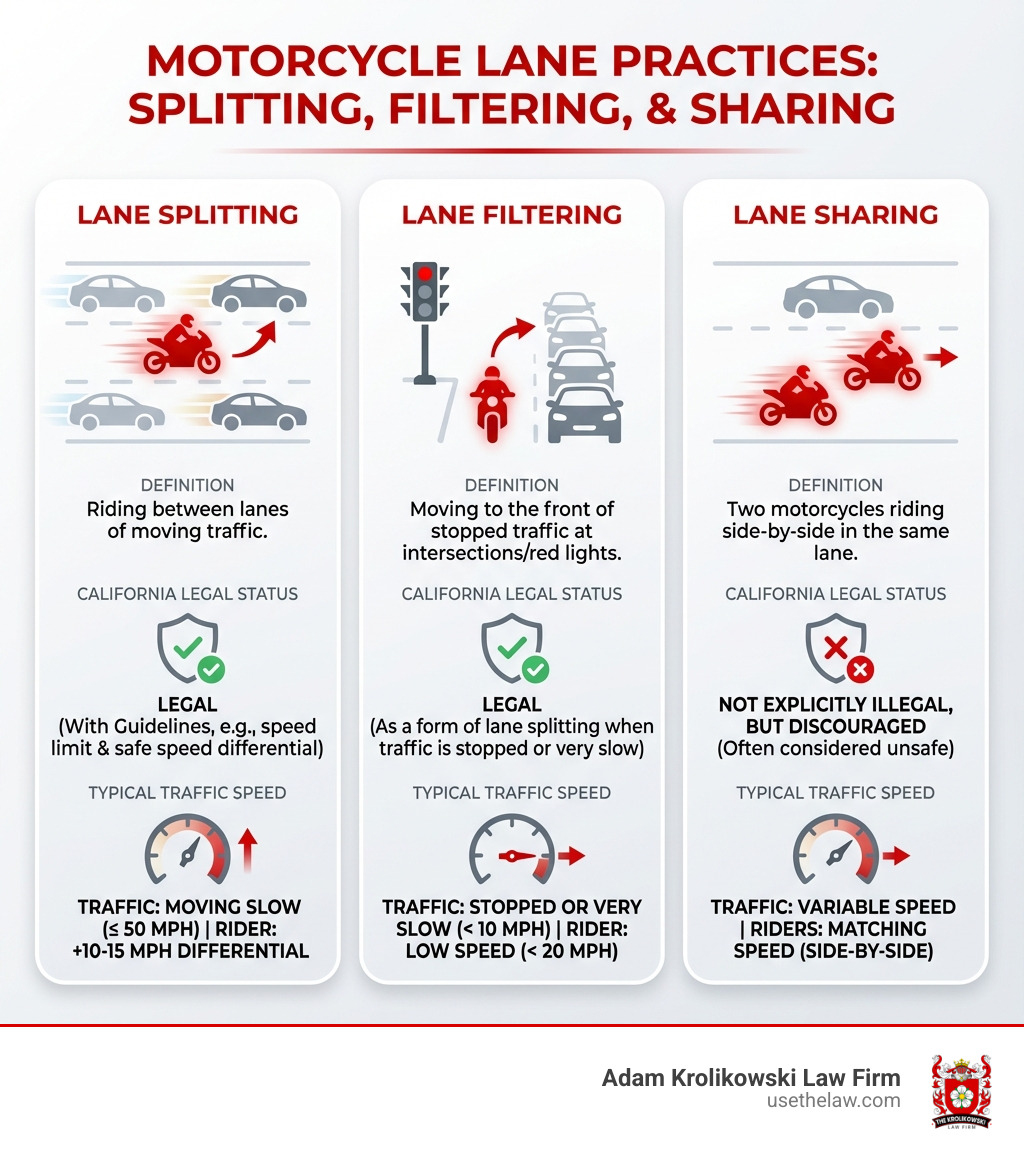
Motorcycle lane splitting accident definitions:
- Motorcycle accident brain injury
- Motorcycle accident compensation claims
- Motorcycle accident legal representation
Understanding Lane Splitting: The Law in California
Lane splitting can be a confusing topic, especially given the various terms used. For riders in Orange County, understanding California’s specific regulations is paramount.
Let’s clarify the key terms:
- Lane Splitting: Riding a motorcycle between lanes of stopped or slow-moving traffic moving in the same direction.
- Lane Filtering: A specific type of lane splitting, usually referring to moving to the front of stopped traffic at an intersection.
- Lane Sharing: Two or more motorcycles riding side-by-side in the same lane.
California is the only state where lane splitting is explicitly legal, thanks to Assembly Bill 51, which added Section 21658.1 to the California Vehicle Code. However, this legality isn’t a free-for-all. The law requires motorcyclists to perform the maneuver in a “safe and prudent” manner.
The California Highway Patrol (CHP) provides safety guidelines for this:
- Speed Differential: Don’t ride more than 10 mph faster than surrounding traffic.
- Overall Speed: Avoid lane splitting when traffic exceeds 30 mph.
- Lane Position: It’s generally safest between the far-left lanes (No. 1 and No. 2).
- Environment: Be extra cautious in bad weather, at night, or around large vehicles like trucks and buses.
While these are guidelines, not laws, they are the standard by which law enforcement and insurance companies will judge your actions if a motorcycle lane splitting accident occurs. For more detailed information on motorcycle accidents in the area, you can explore our resources on Motorcycle Accident in Orange County.
The Risks and Realities of a Motorcycle Lane Splitting Accident
While legal in California, lane splitting is not without its dangers. A motorcycle lane splitting accident can happen in an instant, often with severe consequences for the rider.
Common Causes and Dangers
Several factors contribute to the risk of a lane-splitting accident:
- Limited Visibility: Motorcyclists are smaller and can easily be hidden in a car’s blind spot. Drivers often don’t expect a vehicle to be passing between lanes and may not check thoroughly before changing lanes.
- Reduced Reaction Time: The tight space between cars leaves little room for error. A sudden stop or a car drifting into the lane can lead to a collision with no time to react.
- Driver Inattention: Distracted driving, such as texting or talking on the phone, significantly increases the risk of a driver not seeing a motorcyclist.
- Unsafe Lane Changes: A driver changing lanes without signaling or checking their mirrors is one of the most common causes of lane-splitting accidents.
- “Dooring”: In stopped or slow-moving traffic, a driver or passenger might open their door without looking, directly into the path of an oncoming motorcycle.
- Rider Speed: A motorcyclist traveling significantly faster than the flow of traffic reduces the time other drivers have to see and react to them.
What the Statistics Say
A study by UC Berkeley’s SafeTREC program shed light on the realities of lane splitting in California. It found that when done in traffic moving at 50 mph or less, and with the motorcyclist going no more than 15 mph faster than other vehicles, lane splitting was not significantly more dangerous than not splitting.
Key findings include:
- Lane-splitting motorcyclists were less likely to be rear-ended than those not splitting.
- They were also less likely to suffer head or torso injuries, likely due to a higher rate of helmet use.
- However, they were more likely to rear-end another vehicle themselves.
These statistics highlight that while lane splitting can offer some safety benefits in heavy traffic, it requires immense caution and adherence to safe practices. For more on the potential injuries, see our Motorcycle Accident Brain Injury Guide.
Determining Fault in a Lane Splitting Accident
When a motorcycle lane splitting accident happens in Orange County, determining who is at fault is not always straightforward. California uses a comparative negligence system, meaning that a percentage of fault can be assigned to each party involved. Even if you were lane splitting, you may still be entitled to compensation if the other driver was also at fault.
How Fault is Determined
Fault is not automatically assigned to the motorcyclist. Instead, investigators and insurance companies will look at the actions of all parties involved.
A motorcyclist may be found partially at fault if they were:
- Speeding: Traveling more than 10-15 mph faster than surrounding traffic or lane splitting when traffic is moving over 30-40 mph.
- Riding Recklessly: Weaving erratically or making sudden, unpredictable movements.
- Riding in Unsafe Conditions: Lane splitting in poor weather, low light, or in lanes that are too narrow.
The other driver may be found at fault for:
- Unsafe Lane Changes: Failing to check blind spots or signal before moving into another lane.
- Distracted Driving: Using a phone, eating, or being otherwise inattentive.
- Opening a Door: Suddenly opening a car door in the path of a motorcycle.
- Aggressive Driving: Intentionally blocking or intimidating a motorcyclist.
The Importance of Evidence
Because fault can be contested, gathering strong evidence is critical. This includes:
- The official police report
- Photos and videos of the accident scene, vehicle damage, and your injuries
- Contact information for any witnesses
- Dashcam or surveillance footage if available
- All medical records related to your injuries
This evidence will be crucial for building a strong case and proving the other party’s negligence. For more information on how fault is determined, see our article on Proving Fault in Intersection Motorcycle Accidents. If you’ve been in an accident, seeking legal advice from a Santa Ana Motorcycle Wreck Attorney can help protect your rights.
Your Legal Options and Safety After a Collision
If you’ve been in a motorcycle lane splitting accident in Orange County, knowing your rights and how to proceed is crucial.
Navigating Insurance and Liability
Even though lane splitting is legal, insurance companies may try to use it against you to reduce or deny your claim. They often argue that the motorcyclist was at least partially at fault, regardless of the other driver’s actions. This is why having an experienced attorney is so important. We understand these tactics and can help you build a strong case to counter them. For more tips, read our guide on How to Handle Insurance Adjusters After an Accident.
Safety Tips for Lane Splitting
To minimize your risk, always prioritize safety:
- Follow CHP Guidelines: Don’t exceed the speed of traffic by more than 10 mph, and avoid splitting when traffic is moving over 30-40 mph.
- Be Visible: Wear bright gear and use your headlights.
- Stay Alert: Watch for sudden lane changes, opening doors, and road hazards.
- Avoid Blind Spots: Don’t linger where drivers can’t see you.
- Be Cautious: Be extra careful around large trucks and in poor weather conditions.
For more safety advice, check out our Motorcycle Accident Lawyer Santa Ana Tips.
Seeking Compensation for Your Injuries
If you’ve been injured, you may be entitled to compensation for:
- Medical Bills: All treatment related to the accident.
- Lost Wages: Income lost while you were unable to work.
- Pain and Suffering: Compensation for physical and emotional distress.
- Property Damage: Repair or replacement of your motorcycle.
Navigating the claims process can be complex. We can help you fight for the full compensation you deserve. Learn more on our Motorcycle Accident Compensation Claims page.
Conclusion: Protecting Your Rights After a Crash in Orange County
Understanding the intricacies of a motorcycle lane splitting accident and its liability in Orange County is essential for any rider or driver. We’ve covered the legality of lane splitting in California, the crucial differences between lane splitting, filtering, and sharing, and the significant risks involved for everyone on the road.
While lane splitting is legal here, fault determination in an accident is never automatic. California’s comparative negligence laws mean that responsibility can be shared, and insurance companies will often attempt to place undue blame on the motorcyclist. This is why having robust evidence, including police reports, witness statements, and photos, is critical to protecting your claim.
If you or a loved one has been involved in a motorcycle lane splitting accident in Orange County or Santa Ana, don’t face the insurance companies alone. Our firm has over 25 years of experience handling complex personal injury cases that other attorneys may shy away from. We are here to help you understand your rights, gather the necessary evidence, and fight for the compensation you deserve.
We offer a Free Consultation to discuss your specific situation, provide clarity on your legal options, and help you steer the challenging aftermath of an accident. If you’ve been injured in a collision, contact a Motorcycle Accident Lawyer in Orange County today to ensure your rights are protected.
Contact Us
Practice Areas
Recent Articles
- « Previous
- 1
- 2
- 3