

What Is Negligent Security and When Do You Need Legal Help?
A negligent security lawyer helps victims harmed by inadequate safety measures on someone else’s property. These attorneys handle cases where property owners failed to provide reasonable security, leading to assaults, robberies, or other violent crimes.
Quick Answer: You need a negligent security lawyer if:
- You were attacked, robbed, or assaulted on commercial property
- The property owner failed to provide adequate lighting, security guards, or working cameras
- Prior crimes occurred at the same location but security wasn’t improved
- You suffered physical injuries, emotional trauma, or financial losses
- The incident happened within the last two years in California
Under premises liability law, property owners have a legal duty to protect visitors from foreseeable criminal acts. When they fail, victims can pursue compensation for their injuries and damages.
For example, a teenager was rendered quadriplegic after being shot at an apartment complex, resulting in a $28.9 million settlement. The owner’s failure to provide adequate security despite knowing about criminal activity made them liable.
These cases often involve:
- Apartment complexes with broken gates or poor lighting
- Parking garages without adequate surveillance
- Hotels and motels in high-crime areas
- Shopping centers with insufficient security personnel
- Bars and nightclubs with untrained security staff
The key is foreseeability. If similar crimes happened before at the property or nearby, and the owner didn’t take reasonable steps to prevent future incidents, they may be held responsible.
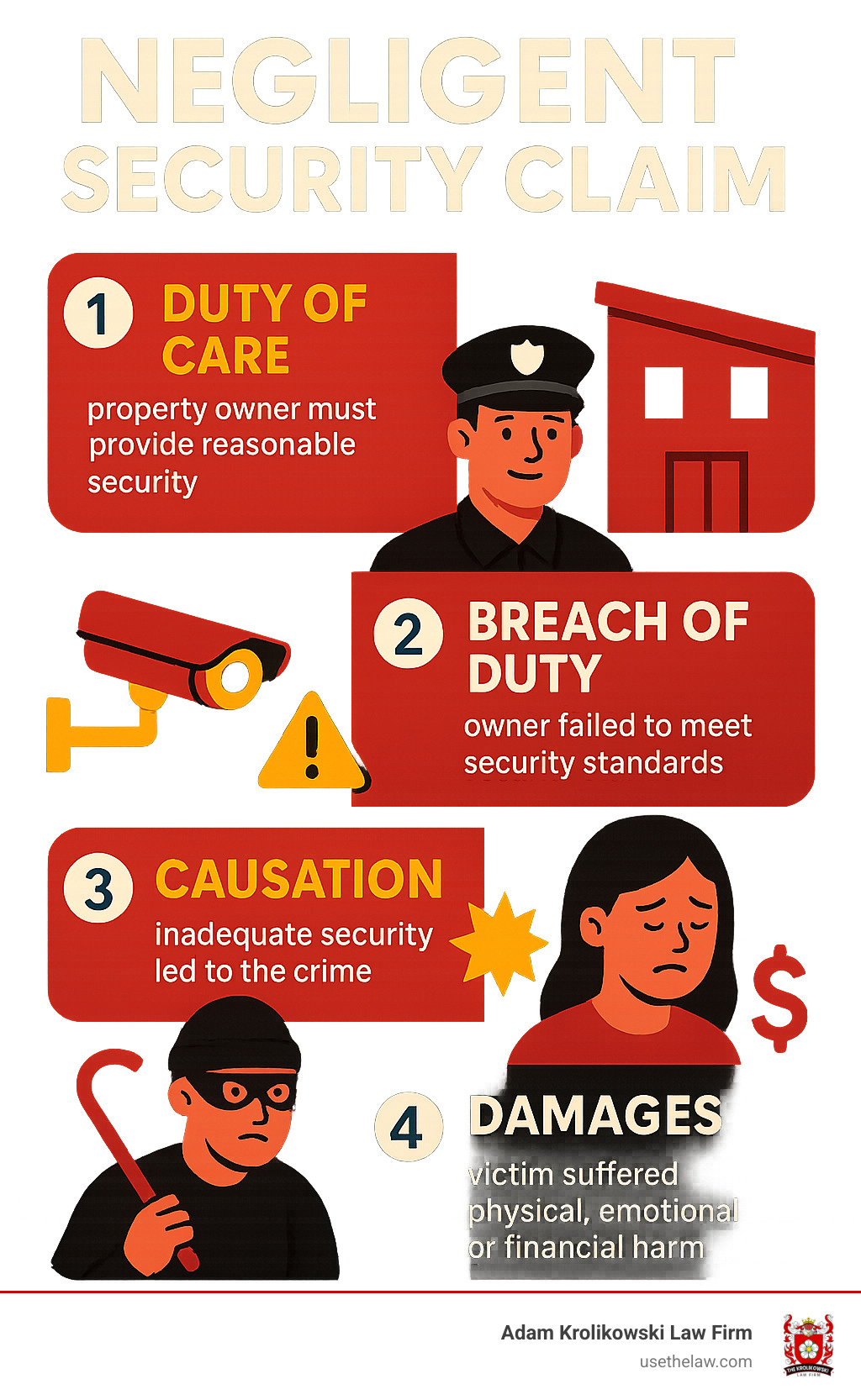
Negligent security lawyer definitions:
Understanding the Legal Foundations of Your Claim
Property owners have a legal “duty of care” to take reasonable steps to protect visitors from foreseeable criminal harm. This legal requirement applies whether you’re at a hotel, shopping center, or apartment complex.
The required level of security varies by location and risk. A nightclub in a high-crime area needs more security than a coffee shop in a safe neighborhood. The law adjusts expectations accordingly.
Foreseeability is the key concept in these cases. It means the property owner should have anticipated the crime. If previous robberies, assaults, or break-ins occurred nearby, future crimes are considered “foreseeable.” Owners who know these risks but fail to act can be held responsible when someone gets hurt.
Police reports and crime statistics help prove foreseeability. You can use crime data to establish foreseeability to see local crime rates. A higher crime rate demands stronger security measures.
Your legal status on the property also matters. Invitees (customers, hotel guests) receive the highest level of protection. Licensees (social visitors) must be warned of known dangers. Trespassers receive the least protection, though owners cannot intentionally harm them.
Claims against government entities have much shorter deadlines and special notice requirements, sometimes as short as 90 days, making it crucial to act quickly.
For a deeper dive into how responsibility works, check our guide on understanding liability in personal injury cases.
Common Examples of Negligent Security
Negligent security often involves simple, preventable oversights with devastating consequences.
- Inadequate lighting: Dark parking lots, stairwells, and walkways provide cover for criminals.
- Broken locks or gates: Faulty locks on hotel rooms or broken gates at apartment complexes are an invitation for intruders.
- Malfunctioning security cameras: Cameras that don’t record or are poorly aimed create a false sense of security.
- Untrained or insufficient security guards: Guards who are not properly trained or are spread too thin can fail to prevent or even escalate conflicts.
- Other failures: These include blocked emergency exits, failure to warn visitors of known dangers, and poor maintenance of fences or alarm systems.
We’ve handled cases where hotels failed to secure parking areas, leading to assaults, and nightclubs understaffed security, resulting in violence. These are preventable tragedies. You can read more on hotel security failures to understand these risks.
Where Negligent Security Incidents Occur
Inadequate security can create risks anywhere people gather, where an owner has a duty to ensure reasonable safety.
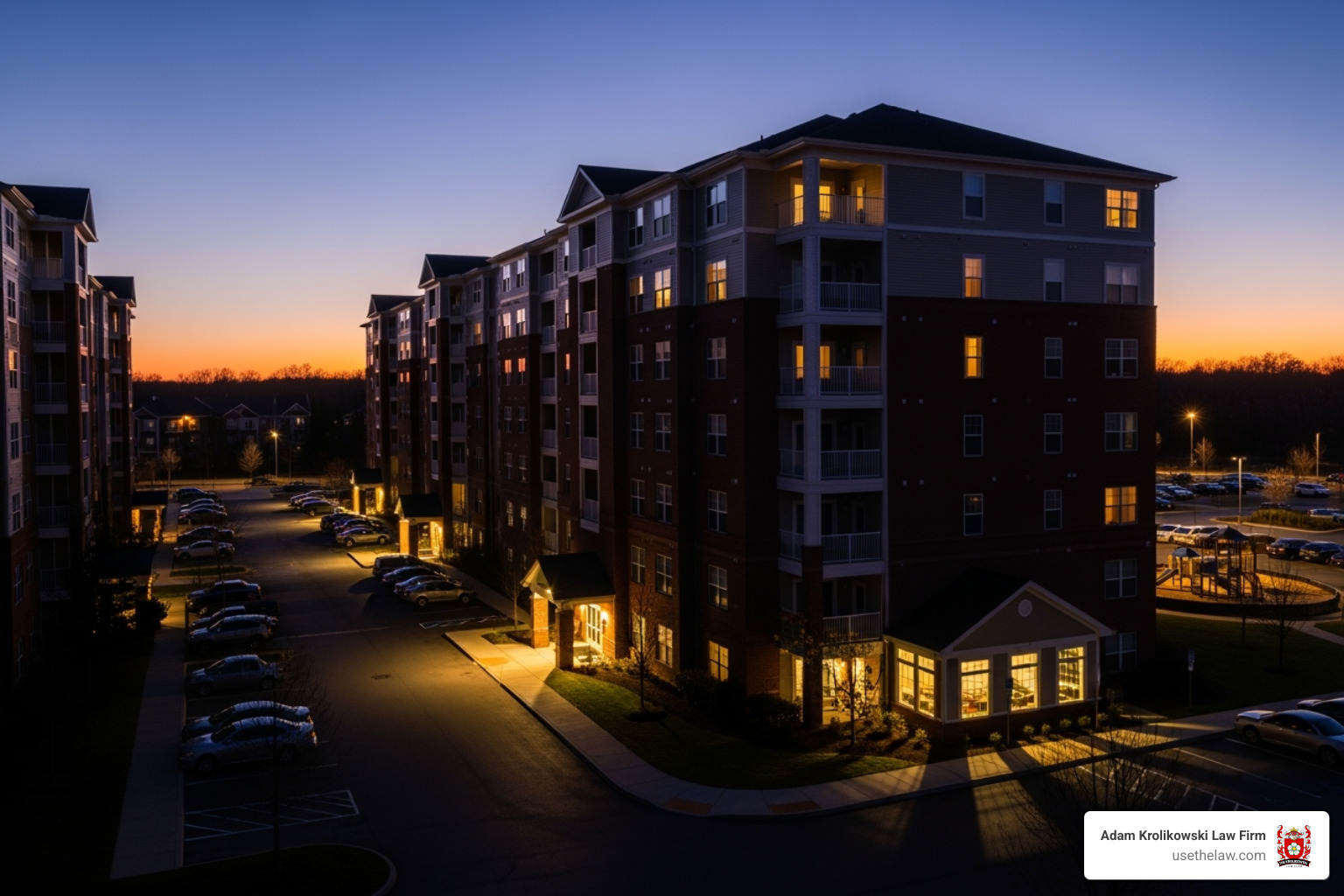
- Apartment buildings and residential complexes: Broken fences, malfunctioning gates, poor lighting, and unmonitored entrances put residents at risk.
- Parking garages and lots: These isolated and often poorly lit areas are common sites for robberies and assaults.
- Hotels and motels: Owners have a special duty to protect guests, who are often unfamiliar with the area, from risks like faulty door locks or unsecured parking.
- Shopping malls and retail stores: Insufficient security personnel or surveillance can endanger customers when known problems are ignored.
- Gas stations and convenience stores: As frequent robbery targets, they require proper lighting, working cameras, and sometimes security personnel.
- Bars and nightclubs: The presence of alcohol and crowds requires trained security to manage conflicts before they become violent.
- Hospitals and nursing homes: Inadequate security can endanger vulnerable patients who cannot protect themselves.
- ATMs: Poor lighting or isolated locations can make these crime magnets even more dangerous.
- Workplaces: Employers have a duty to protect employees from foreseeable criminal acts.
All these situations fall under premises liability law. For a broader understanding, explore more on general premises liability.
The Role of a Negligent Security Lawyer in Building Your Case
If you were hurt due to unsafe property conditions, you face a complex legal battle. A negligent security lawyer acts as your advocate, holding property owners accountable.
Building a strong case requires a thorough investigation to understand why the incident happened and if it was preventable. Our process involves gathering all relevant evidence. We obtain police reports, track down witnesses, and analyze security footage. The role of witnesses in personal injury cases is often crucial.
We also bring in security consultants to evaluate whether the property owner took reasonable steps to prevent crime. Proving causation—that better security would have prevented your injuries—is a key part of the case. We analyze crime data and document missing security measures to show the owner knew or should have known about the danger.
Time is critical. California gives you two years to file a lawsuit, but claims against government entities have much shorter deadlines. Evidence like security footage can be deleted, so the sooner we investigate, the stronger your case will be.
Navigating Your Claim with a Negligent Security Lawyer
After building a solid case, we guide you through the legal process to seek the compensation you deserve.

The process begins with a case evaluation where we review what happened and explain your legal options. We then file a lawsuit against the property owner. During the findy phase, we exchange information with the other side, requesting security policies, maintenance records, and reports of prior crimes. We also conduct depositions, questioning witnesses and the property owner under oath.
Many cases settle during negotiations with the property owner’s insurance company. We know how to value these cases properly, considering your medical bills, lost wages, and pain and suffering. If a fair settlement isn’t reached, we are prepared to take your case to trial. With over 25 years of experience, we know how to present your story to a jury.
Our focus is on proving the property owner had a duty to keep you safe, breached that duty, and caused your harm. We provide comprehensive legal representation for personal injury victims.
The Physical and Emotional Toll of Inadequate Security
A crime resulting from negligent security impacts every part of a victim’s life, leading to a long journey of physical, emotional, and financial recovery.
Physical injuries can be devastating. According to CDC data on assault injuries, victims suffer head injuries, broken bones, and worse. The invisible wounds are often just as severe. Many victims develop Post-Traumatic Stress Disorder (PTSD), anxiety, and depression, making it difficult to work or enjoy life.
The financial impact compounds the trauma. Medical bills mount, and time off work leads to lost wages. Some victims never fully recover their earning capacity. In the most tragic cases, inadequate security leads to wrongful death, leaving families with funeral costs and the loss of a loved one’s support.
As your negligent security lawyer, we work to secure compensation that addresses all these consequences.
Seeking Fair Compensation for Your Injuries
If you were harmed by inadequate security, you face physical, financial, and emotional challenges. As your negligent security lawyer, our job is to pursue full compensation for every aspect of your losses.

The law recognizes losses beyond immediate medical bills. Economic damages cover calculable financial impacts, including current and future medical bills for therapy, counseling, or long-term care. Lost wages are also a key component, along with reduced earning capacity if your injuries prevent you from returning to your previous job or advancing your career.
Non-economic damages address the human cost. Pain and suffering compensation acknowledges the physical agony and ongoing discomfort you’ve experienced. Emotional trauma—the nightmares, anxiety, and fear—is often the most lasting injury and deserves recognition.
In cases of particularly shocking negligence, such as ignoring repeated complaints about security, punitive damages may be available. These are intended to punish reckless behavior and deter future negligence.
Negligent security cases can result in substantial awards. Our firm obtained an $8.6 million settlement in a wrongful death case at an apartment complex and a $7.5 million verdict for a fatal shooting at a car wash. These figures reflect the profound impact these crimes have.
What Is a Negligent Security Case Worth?
While every case is unique, certain factors consistently influence its value and help set realistic expectations.
- Severity of your injuries: Catastrophic injuries like paralysis or traumatic brain injuries require extensive care and lead to higher compensation.
- Clarity of liability: A stronger case exists when we can clearly show the property owner knew about security risks and failed to act.
- Egregiousness of the negligence: Deliberately cutting corners on security despite known dangers increases liability.
- Foreseeability: A history of similar crimes at the location or in a high-crime area strengthens your claim.
- Economic damages: High medical bills and significant lost wages provide a concrete foundation for your claim.
- Non-economic damages: Documented psychological treatment and testimony about how the incident changed your life are crucial for this portion of your recovery.
- Available insurance coverage: The defendant’s insurance policy and assets can limit the amount that can be recovered.
- Victim’s comparative fault: If you contributed to the situation, California’s comparative fault rules might reduce your recovery.
Our cases have ranged from $25,000 for less severe injuries to multi-million dollar recoveries for catastrophic harm. Our goal is always to secure the maximum possible compensation.
For more information, review our guide to compensation in Los Angeles.
Frequently Asked Questions about Negligent Security Claims
When you’re recovering from a crime that could have been prevented, you likely have many questions. Here are answers to some of the most common ones we hear.
How is “foreseeability” proven in a negligent security case?
Foreseeability is the core of a negligent security case. We must show a reasonable property owner should have anticipated the crime and taken action. Evidence often includes:
- Prior similar crimes on or near the property. If the owner knew about previous assaults or robberies but didn’t improve security, that’s powerful proof.
- High crime rates in the area. Police reports and crime statistics can establish that the neighborhood was dangerous, requiring a higher level of care.
- Direct complaints that were ignored. If tenants or customers warned the owner about broken locks or poor lighting, it shows the owner knew about the danger.
- Violations of safety standards, such as inadequate lighting or broken cameras, help prove the owner was not taking reasonable precautions.
Can I still have a case if the person who attacked me was never caught?
Yes. Your civil case against the property owner is separate from any criminal case against the attacker.
The focus of a negligent security lawyer is on the property owner’s failure to keep you safe, not on punishing the criminal. We don’t need to identify the attacker to prove that better security—like a working gate or adequate lighting—could have prevented the incident. Property owners and businesses typically carry insurance policies to cover these situations, while most criminals lack the assets to compensate you for your injuries and losses.
How long do I have to file a negligent security lawsuit in California?
The deadline to file depends on who owns the property, and acting quickly is critical.
For most claims against private property owners (businesses, apartment complexes, hotels), you have two years from the date of injury to file a lawsuit. While this seems like a long time, evidence like security footage can be lost and witness memories fade.
If a government entity owns the property (a city park, county hospital), the rules are much stricter. You generally have only six months to file a formal “notice of claim.” Missing this deadline can permanently bar you from seeking compensation.
Contact a negligent security lawyer as soon as possible to preserve evidence and protect your rights.
Take the First Step Towards Justice
Being harmed because a property owner failed to provide adequate security is a betrayal of trust. When owners cut corners on safety, people suffer the physical and emotional consequences.
You have the right to hold negligent property owners accountable through the civil justice system and seek the compensation needed to rebuild your life. However, these cases are complex and require a detailed approach to gather evidence and steer strict legal deadlines. Insurance companies often try to minimize or deny claims, hoping you’ll accept less than you deserve.
At the Adam Krolikowski Law Firm, we understand the profound impact these incidents have on victims and their families. With over 25 years of experience, we handle complex cases that other attorneys might avoid, fighting against well-funded insurance companies and corporations.
Don’t let time work against you. California’s statute of limitations is generally two years, but it’s even shorter for claims against government entities. Evidence disappears quickly, so the sooner you act, the stronger your case.
You don’t have to face this alone. We serve accident victims and employees across Orange County, Santa Ana, and Los Angeles. For a comprehensive evaluation of your situation and to understand how we can help you pursue the compensation you deserve, contact a Negligent Security Attorney in Orange County, CA today.
Your recovery matters. Let us handle the legal complexities while you focus on healing.
Contact Us
Practice Areas
Recent Articles
- « Previous
- 1
- 2
- 3
- Next »