

Negligent Security Settlement Amounts: 2025 Unlocked
What You Need to Know About Negligent Security Settlement Amounts in Santa Ana
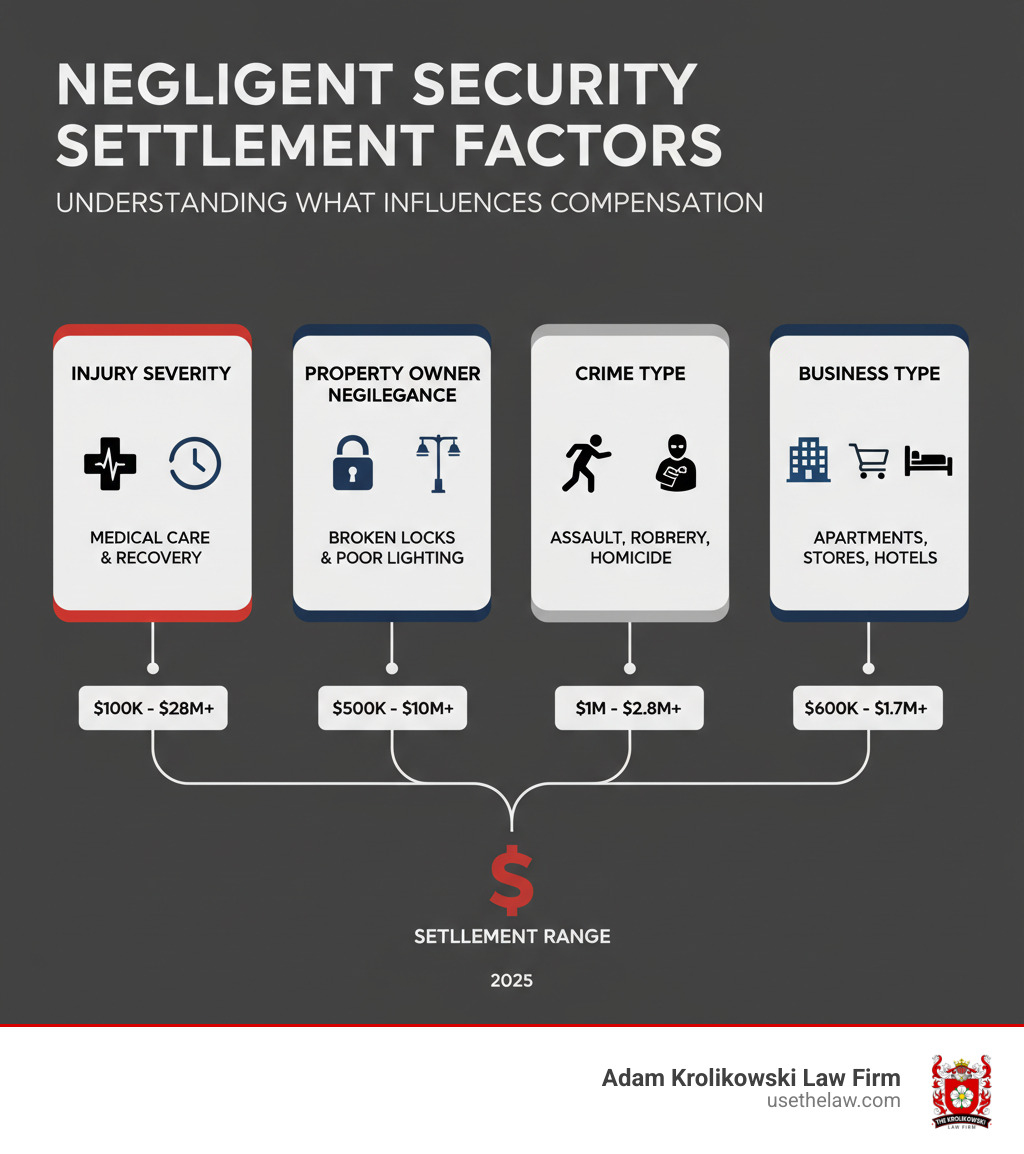
If you were injured because of inadequate security, negligent security settlement amounts can vary widely. Understanding what influences these figures is essential for pursuing fair compensation. Key factors include the severity of your injuries, the type of crime, the property owner’s degree of negligence, and the type of business where the incident occurred.
When property owners fail to provide reasonable security measures—such as proper lighting, working locks, or security personnel—they can be held financially responsible for resulting injuries. This is based on premises liability law, which requires owners to protect visitors from foreseeable criminal acts.
These claims are vital because criminals are often “judgment-proof,” meaning they lack the assets to pay damages. Property owners, however, usually carry substantial liability insurance. This provides a practical source of compensation for victims facing medical bills, lost wages, and long-term care needs.
While statistical averages offer context, your final settlement will depend on the unique facts of your case, including the strength of your evidence and available insurance coverage.
Negligent security settlement amounts helpful reading:
Understanding Negligent Security: The Foundation of Your Claim
Negligent security is a legal claim you can bring when a property owner fails to provide reasonable safety measures, and that failure allows you to be harmed by a preventable criminal act. Under premises liability law, property owners have a legal duty of care to keep lawful visitors reasonably safe from foreseeable crimes. When they fail, they can be held financially accountable.
To win a claim, we must prove four elements: the owner owed you a duty of care; they breached that duty with inadequate security; this breach directly caused your injuries; and you suffered actual damages (e.g., medical bills, trauma).
A key part of the claim is foreseeability—showing the owner knew or should have known about the risk of crime. This can be established through evidence of prior incidents on the property or by citing local crime statistics from the Bureau of Justice Statistics. For more on how fault is determined, see our guide on Understanding Liability in Personal Injury Cases.

You might wonder why you should sue the property owner instead of the criminal. The answer is practical: criminals are often “judgment-proof,” meaning they lack the money to compensate you. Property owners, however, typically carry large liability insurance policies, which provide a real source of compensation for your medical bills, lost income, and trauma.
Common Examples of Inadequate Security
Recognizing security failures is the first step toward accountability. Common examples include:
- Poor lighting: Dark parking garages, stairwells, and walkways create opportunities for criminals.
- Broken locks and gates: Non-working locks on doors or broken security gates at residential complexes invite unauthorized entry.
- Inadequate video surveillance: This includes having no cameras, non-working cameras, or cameras that are poorly positioned or unmonitored. Learn more about what makes effective video surveillance systems.
- Insufficient security personnel: A property may lack enough guards, or the guards may be poorly trained or inattentive.
- Other failures: These can include unsecured ground-floor windows, a failure to monitor the premises, and a lack of regular security patrols.
Who Can Be Held Liable?
Multiple parties may share liability for a security failure:
- Property owners: The individual or corporation that owns the land or building is ultimately responsible for security.
- Landlords: They have specific duties to maintain safe common areas and ensure basic security features like locks and lights are functional.
- Property management companies: Hired to manage a property, they can be liable if their failure to maintain security systems leads to harm.
- Commercial businesses: Retail stores, restaurants, bars, and hotels owe a duty of care to their customers and can be liable for foreseeable crimes.
- Security companies: A third-party security firm can be a defendant if its guards were negligent in their duties.
- Government entities: In some cases, government bodies can be liable for crimes on public property like parks or transit stations, but these claims have strict rules and short deadlines.
Identifying all responsible parties is a key part of building a strong Premises Liability Claim and can impact your final negligent security settlement amounts.
Key Factors That Determine Negligent Security Settlement Amounts
Many clients ask, “What’s my case worth?” While a precise number is impossible without a full review, we can explain the key factors that determine negligent security settlement amounts.

The Severity and Nature of Your Injuries
The more severe your injuries, the higher the potential settlement. Catastrophic injuries like traumatic brain injuries (TBI) or spinal cord damage that leads to paralysis can result in multi-million dollar settlements, as they require a lifetime of care.
When negligent security leads to a wrongful death, surviving family members can seek compensation for their loss. The average jury verdict in these cases is around $2.8 million.
The psychological trauma from an attack, such as Post-Traumatic Stress Disorder (PTSD), can be as debilitating as physical wounds. According to the CDC, the long-term effects can be severe. These invisible injuries can impact your career, relationships, and quality of life. Our firm handles Distress Claims Personal Injury Law Attorney cases.
Calculating Economic and Non-Economic Damages
Compensation is divided into two categories. Economic damages are your calculable financial losses, including past and future medical expenses, lost wages, and reduced earning capacity.
Non-economic damages compensate for non-financial losses like pain and suffering, emotional distress, and loss of enjoyment of life. They acknowledge the profound personal impact of the attack.
In cases of extreme negligence, punitive damages may be awarded. These are intended to punish the property owner for a willful disregard for safety and deter similar conduct in the future. For a full overview, see our Compensation Available Los Angeles Personal Injury Guide.
The Property Owner’s Degree of Negligence
The owner’s level of negligence significantly affects the settlement. The key is foreseeability—whether the owner should have anticipated the crime.
- Prior incidents of similar crimes on or near the property are strong evidence of foreseeability.
- Location matters; properties in high-crime areas have a higher duty to provide security, a fact that can be proven with police reports and Bureau of Justice Statistics (BJS) data.
- Willful ignorance or gross negligence, such as ignoring known security flaws or removing safety features to cut costs, can lead to higher settlements. Our overview of Negligent Security Cases provides more detail.
The Impact of Comparative Fault on Your Settlement
In some cases, the defense may argue that your own actions contributed to the incident. This is called comparative fault. For example, they might claim you left a door propped open or that intoxication made you more vulnerable.
California uses a pure comparative negligence rule. This means you can still recover damages even if you are partially at fault, but your compensation will be reduced by your percentage of responsibility. An experienced attorney can fight back against unfair attempts to shift blame onto you.
Negligent Security Settlement Amounts by the Numbers
While every case is unique, reviewing settlement data can provide a realistic picture of potential negligent security settlement amounts. These figures are guideposts, not guarantees. It’s also important to note that many cases settle confidentially, so public data only shows part of the story. Interestingly, while defendants win a slight majority of jury trials, the awards for plaintiffs who do win have been rising significantly.

Average Settlement Amounts by Crime Type
The nature of the crime heavily influences compensation. Data shows the following average jury verdicts:
- Wrongful death: $2.8 million
- Robbery: $1.9 million
- Sexual assault and rape: $1.5 million
- Assault and battery: $1.2 million
Assault and battery are the most common claims, making up 42% of cases. The data also reveals a troubling disparity, with male victims often awarded more than female victims for similar crimes.
How Settlement Values Vary by Business Type
Where the crime occurred also plays a significant role:
- Apartment complexes: Median settlement of $1.7 million.
- Retail stores: Average settlement of $1.2 million.
- Restaurants and bars: Average settlements can reach $2.8 million for restaurants, while bars are frequent sites of assault cases.
- Hotels: Average settlement of $632,000. For more information, see our Hotel Negligent Security Lawyer page.
- Parking lots: The single most frequent location for these lawsuits, as their isolated nature makes them prime spots for crime when unsecured.
Real-World Examples of Negligent Security Settlement Amounts
Real cases illustrate the wide range of outcomes:
- A $28.9 million settlement was awarded to a teenager rendered quadriplegic in a shooting at an apartment complex.
- A 26-year-old man who became paraplegic after being shot in his apartment secured a $10 million settlement.
- The family of a vendor killed at a Georgia flea market received a $6 million wrongful death settlement.
- CVS faced a $43 million premises liability verdict after a patron was shot in one of its stores, showing that major corporations are held to a high standard.
- A man kidnapped from a parking garage, raped, and infected with AIDS received a $4.4 million award after a security barrier was removed.
- On the lower end of the scale, a mall kiosk worker who was robbed and raped received a $350,000 settlement, demonstrating that even cases with smaller awards can provide crucial compensation.
These examples show that outcomes depend entirely on the specific facts of a case, from the severity of the injury to the degree of the owner’s negligence. At Adam Krolikowski Law Firm, we have over 25 years of experience building strong cases that reflect the true impact of these incidents.
Navigating the Legal Process for a Negligent Security Claim
If you’ve been injured due to a property owner’s negligence, the legal path can seem daunting. We are here to guide you through each stage.
The process generally begins when we file a claim, which formally starts the lawsuit. This is followed by a thorough investigation to gather evidence of the property owner’s security failures. During the findy process, both sides formally exchange information through depositions and document requests. Most cases are resolved during settlement negotiations, but if a fair offer isn’t made, we proceed with trial preparation.
Having dedicated legal representation is crucial. You can learn more about the Benefits Hiring Personal Injury Law Attorney on our site.
Essential Evidence to Build a Strong Case
A strong case is built on solid evidence. We work to gather:
- Police reports: The official record of the crime.
- Medical records: Documentation of your injuries and treatment costs.
- Surveillance footage: Video can show the attack or reveal security gaps. The lack of footage can also be evidence of negligence.
- Witness statements: Testimony from people who saw the incident or were aware of security issues. Learn more about The Role of Witnesses in Personal Injury Cases.
- Security and maintenance logs: These documents can expose a pattern of neglect.
- Prior incident reports: This is powerful evidence that the owner was aware of a crime risk but failed to act.
- Expert testimony: Security consultants and medical professionals can provide testimony to strengthen your claim.
The Statute of Limitations: A Critical Deadline
You cannot wait forever to file a lawsuit. Each state has a statute of limitations, a legal deadline that will bar your claim if missed.
In California, you generally have two years from the date of injury to file a negligent security lawsuit. For wrongful death claims, the two-year clock typically starts from the date of death.
Claims against government entities have a much shorter timeline, sometimes as little as six months to file a formal notice. This is why it is critical to contact a legal team quickly to protect your rights. Don’t let a deadline prevent you from seeking justice. Our guide on When to Contact a Personal Injury Law Attorney can help.
Frequently Asked Questions about Negligent Security Settlements
Here are answers to some of the most common questions we receive from clients.
What is the average settlement for a negligent security case?
There is no single “average” settlement, as each case’s value is unique. The amount depends on factors like the severity of your injuries, the strength of the evidence, the defendant’s degree of negligence, and available insurance limits. While studies show median jury verdicts ranging from $1.2 million to $2.8 million depending on the crime, your case’s value will be determined by its specific circumstances. Settlements have ranged from hundreds of thousands to tens of millions of dollars.
Why sue the property owner instead of just the criminal?
This is a practical decision. Most criminals are “judgment-proof,” meaning they lack the financial assets to pay a court judgment. Even if you win a lawsuit against them, you are unlikely to collect any money. Property owners, on the other hand, are required to carry substantial liability insurance policies. These policies provide a viable source of funds to compensate victims for their medical bills, lost income, and pain and suffering. The property owner is held responsible for creating the dangerous conditions that allowed the crime to occur.
How long does a negligent security lawsuit take to settle?
The timeline varies significantly. Some cases may settle within several months, while more complex cases can take a few years to resolve. The duration depends on several factors, including the case’s complexity, the severity of the injuries (as we must wait for a clear long-term prognosis), the defendant’s willingness to negotiate in good faith, and the court’s schedule. Our goal is to work efficiently while never rushing to accept an unfair settlement. We will keep you informed at every step.
Conclusion
If you were harmed because a property owner failed to provide adequate security, you are facing a difficult journey. As we’ve discussed, negligent security settlement amounts are not based on a simple formula but on a careful evaluation of your injuries, the owner’s negligence, and the total impact on your life.
Navigating this process requires a legal team that understands premises liability law and knows how to build a compelling case. At Adam Krolikowski Law Firm, we have over 25 years of experience standing up for the injured. We are known for taking on the complex cases that other firms may avoid because we believe everyone deserves a strong advocate.
If inadequate security led to your injury or the loss of a loved one, you don’t have to face this alone. Let us help you move forward. Your recovery can start today.
Contact a Negligent Security Attorney in Orange County, CA for a consultation. We’re here to listen and ready to help.
Contact Us
Practice Areas
Recent Articles
- « Previous
- 1
- 2
- 3