

What Does ‘No Upfront Fees’ Really Mean?
The phrase no upfront fees promises access to services without an immediate financial burden. This model changes how consumers pay, especially when initial costs are a barrier.
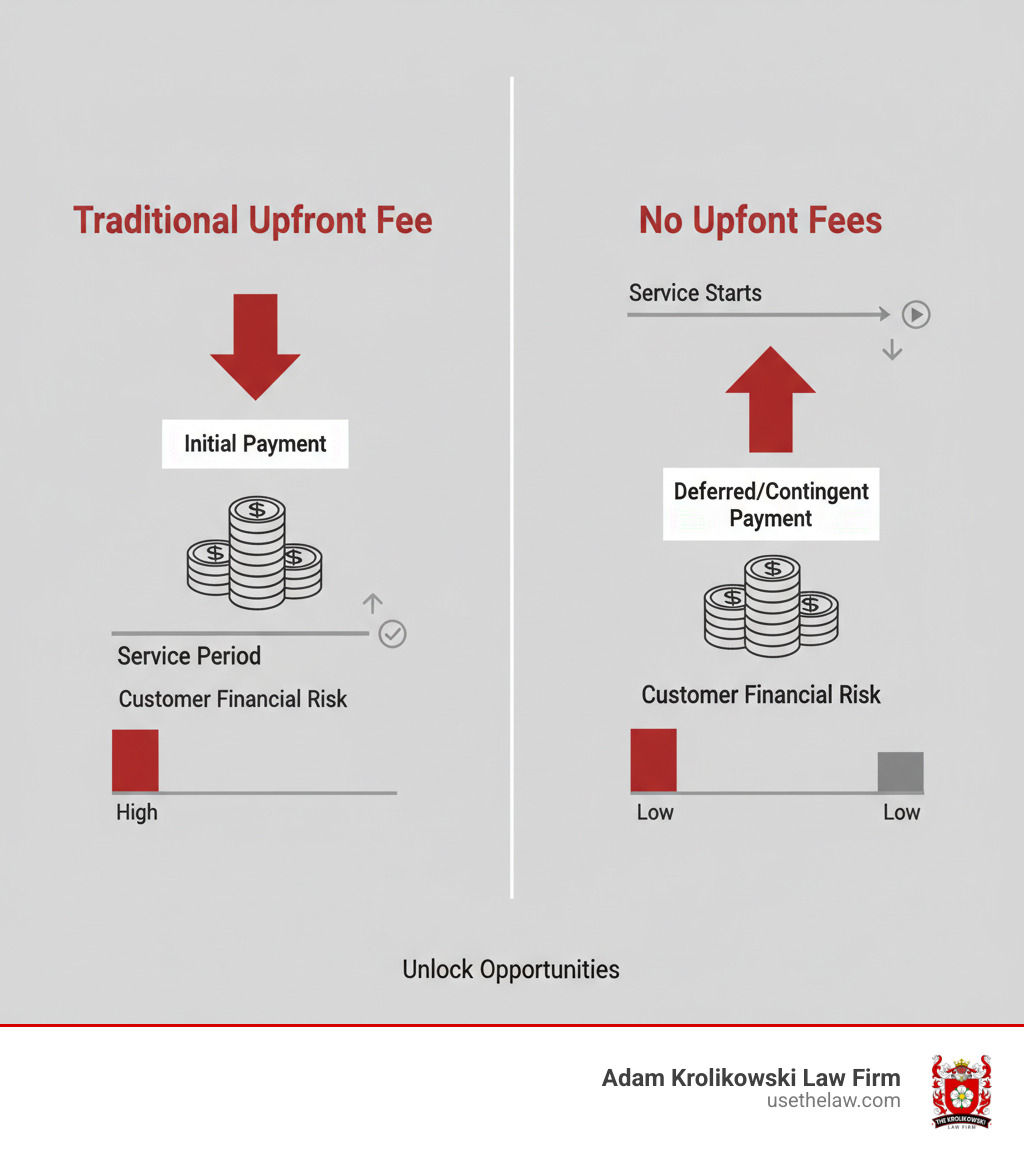
Here’s what ‘no upfront fees’ typically means:
- No initial payment: You don’t pay anything at the start of a service.
- Provider covers costs: The service provider takes on the initial financial risk.
- Deferred or contingent payment: Payment is made later, often spread out or contingent on a successful outcome.
- Minimizes consumer risk: This reduces your financial risk and makes services more accessible.
This approach makes services like legal help more available, based on the idea that quality assistance shouldn’t be blocked by initial costs.
No upfront fees terms to remember:
- bicycle accident lawyer
- brain injury lawyer
- santa ana car accidents lawyer
The Power of Accessibility: Key Benefits for Consumers
If you’ve been hurt or face a serious issue, the upfront cost of help can feel impossible. The no upfront fees model removes this barrier, opening doors that would otherwise remain locked.

When you don’t pay upfront, you take on almost zero financial risk. You aren’t gambling your savings on an uncertain outcome, which is crucial for legal cases where results aren’t guaranteed. This protection provides peace of mind. Your budget also gets a break. Instead of a large initial payment, you can use that money for immediate needs like medical bills. Payments are deferred, spread out, or contingent on success, which can make all the difference for families.
When providers are paid only for success, their motivation aligns with yours. A lawyer on contingency, for example, is driven to get the best outcome because their payment depends on it. This creates a true partnership. The model also offers flexibility, as you aren’t locked into a large financial commitment from day one.
No upfront fees levels the playing field, ensuring quality help isn’t just for those with deep pockets. If you’re injured or treated unfairly, you can pursue justice without draining your savings. This arrangement also builds trust. A provider willing to shoulder the initial risk shows confidence in their abilities, fostering a relationship built on commitment to your success.
At its heart, no upfront fees shifts the burden from you, creating access, reducing risk, and aligning everyone toward a successful outcome.
Reading the Fine Print: Potential Drawbacks and Hidden Costs
While no upfront fees sounds appealing, it’s important to understand that the cost is often deferred, not eliminated. Knowing the potential drawbacks is crucial.

Higher overall costs are a possibility. When a provider assumes the initial financial risk, they may charge more upon success to cover losses from unsuccessful ventures. For instance, “no sale, no fee” conveyancing can be about 15% higher, and real estate referral fees can be 25% to 40% of the commission. This accounts for the times they work but don’t get paid.
Be aware of hidden fees and excluded costs. The term “no upfront fees” usually applies only to the provider’s service fees. Third-party costs, or disbursements, are often your responsibility. In legal cases, this includes court filing fees or costs for medical records. For property purchases, it means searches and surveys. These costs exist regardless of the fee model and can add up, so always ask what’s included.
Also, consider the long-term financial implications. A higher percentage fee or increased monthly payments might mean you pay more over time compared to a model with an upfront charge. It’s a trade-off between immediate relief and total cost. Some “no sale, no fee” arrangements may even require a small deposit for third-party costs.
Finally, the performance-based model could, in rare cases, incentivize a provider to seek a quick, smaller resolution over a longer fight for a better outcome. This is uncommon with reputable firms but is a possibility to consider.
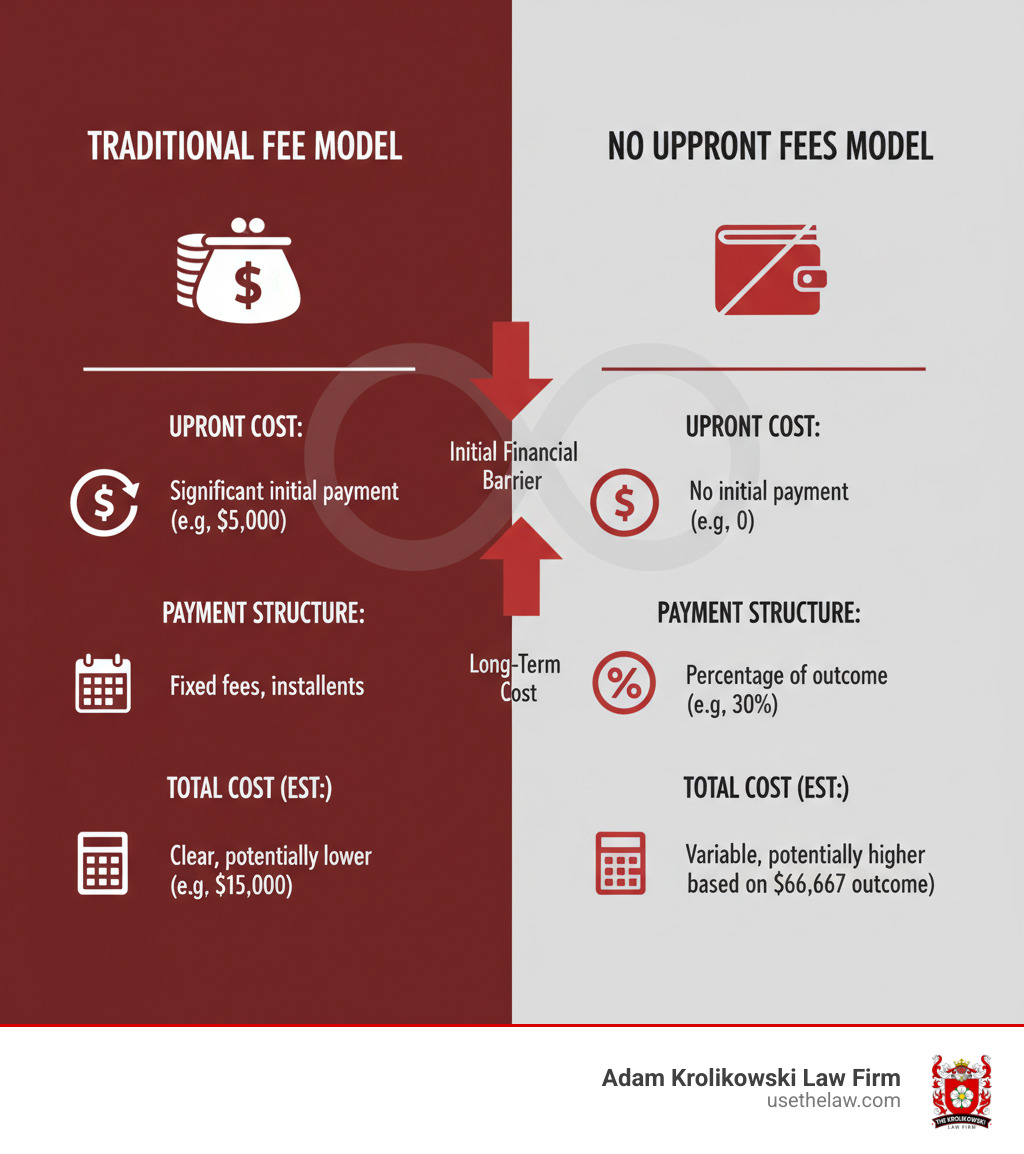
The bottom line is to read any no upfront fees agreement carefully. Ask questions until you fully understand what you’re signing, what you might owe, and when.
Where You’ll Find This Model: Common Industries and Services
The no upfront fees model is appearing in more industries, making services more accessible. You’ll find this model in legal services, real estate, digital marketing, home services, and subscription services and utilities.
Legal Services: The Contingency Fee Model
In legal fields like personal injury, workers’ compensation, and employment law, the no upfront fees model is common, often as a “contingency fee agreement.” This is particularly helpful for our clients in Santa Ana and Los Angeles.
With no upfront fees, you don’t pay out-of-pocket to start your case. Our attorneys are paid only if we win compensation for you, either through a settlement or a court verdict. This is a “No Win, No Fee” arrangement. Our law firm assumes the initial financial risks, covering costs like court fees and medical record retrieval. If we don’t win, you owe nothing for our time. If we win, our payment is a percentage of your recovery, typically 33 to 40 percent. This links our success to yours and makes legal help accessible, which is the model you’ll likely encounter during an Employment Attorney Los Angeles Free Consultation.
Real Estate and Property Services
The no upfront fees model also appears in real estate, offering comfort during a stressful process.
- Pay-at-Closing Referral Fees: Services connecting agents with clients often use this model. Agents pay a referral fee, typically 25 to 40 percent of their commission, only after a sale closes.
- No Sale, No Fee Conveyancing: This popular option means you don’t pay legal fees if your property deal falls through, as explained in “No Sale, No Fee Conveyancing: How It Works and Benefits“. However, you’re still responsible for third-party costs like property searches. The total legal fees may also be slightly higher to account for the provider’s risk.
Subscriptions and Utilities
This model is also common for subscriptions and utilities.
- Broadband Deals: Internet providers often advertise no upfront fees, waiving costs for activation or setup. However, read the fine print. You might still pay for line installation, and as “Broadband with No Upfront Cost and Free Installation” notes, these deals may have higher monthly payments. It’s wise to compare the total contract cost.
- Other Subscriptions: Similar offers exist for streaming services, software, and gym memberships, often as free trials or waived setup fees.
In all these areas, the no upfront fees model removes the initial cost barrier, making services more accessible.
Your Checklist Before Committing to a No Upfront Fees Agreement
The appeal of no upfront fees is strong, but due diligence is essential to avoid future problems.

Understanding the Contractual Terms
The contract is your rulebook, so take the time to understand every detail.
Ensure the no upfront fees promise is explicitly stated in a written agreement, as verbal assurances are rarely binding. Clarify the scope of services—what’s included and what’s not. For performance-based models, understand how success is defined, as your payment depends on it.
You must also understand the payment triggers and structure: when payment is due and how it’s calculated. In legal settings, agreements like Conditional Fee Agreements (CFA) involve the firm assessing a case’s strength before taking it on. While our firm operates under different rules than the UK-based example, the principle of assessing risk is similar. You can learn more about these principles at resources like Understanding the 1995 Conditional Fee Agreement (CFA).
How to clarify all potential costs in a no upfront fees arrangement
Even with no upfront fees, other costs can exist. Request an itemized list of all potential charges not covered by the main promise. These are often third-party disbursements or “case expenses,” like court filing fees or property searches. Clarify who pays for these costs and when.
In legal matters, distinguish between the attorney’s fee (for legal services) and case expenses (costs for pursuing the case). While fees are often contingent, expenses may be handled differently. The most critical question is, what do you owe if you lose? In many “no win, no fee” agreements, you won’t owe attorney fees, but you might still be responsible for case expenses. It’s crucial to know this upfront. For more on making legal services accessible, explore concepts like Pay What You Can: Making Legal Services Accessible to All.
Verifying the Provider’s Legitimacy
A little research can protect you.
Check credentials and licenses to ensure the provider is properly regulated. For law firms, check with your state bar association. Read reviews and testimonials from past clients to see what they say about the provider’s fee model.
Ask for clarification on anything unclear. A trustworthy provider will explain everything. We encourage questions during a Free Consultation Wrongful Termination Lawyer session. Finally, compare offers from different providers, including those with traditional fee structures, to ensure you’re getting a fair deal. These steps will help you steer no upfront fees agreements confidently.
Clearing Up Common Misconceptions
The phrase “no upfront fees” can lead to misconceptions. Let’s clarify how this payment model works.
Are services with no upfront fees really free?
No, services with no upfront fees are not free. Payment is still required, but it’s structured differently. Deferred payment means you pay later, not never. For example, you might be invoiced monthly or upon reaching milestones instead of paying at the start.
In our legal practice, we use a contingent payment model for personal injury, workers’ compensation, and employment law. Our payment is contingent on winning your case. If we don’t win, you owe no legal fees. If we do, our fee is a percentage of your recovery. This differs from traditional models where you pay an hourly or flat fee regardless of the outcome. The bottom line is that no upfront fees removes the initial barrier and shifts the risk to the provider.
Is this model always more expensive in the long run?
Not always. It depends on the situation. To determine the total cost, you must do the math. A deal with no setup fee but a higher monthly cost might be more expensive over the contract term. In some services, successful outcomes may have higher fees to cover the provider’s risk premium and the cost of unsuccessful cases.
However, consider the value of immediate access. For someone who can’t afford a lawyer upfront, a No Win, No Fee arrangement provides a priceless opportunity for justice. It’s a trade-off: weighing a potentially higher total cost against immediate access and peace of mind.
What happens if the provider is unsuccessful?
This is a crucial question. Under our contingency fee agreement, if we don’t win your case, you generally owe no attorney fees. This is the core of the “No Win, No Fee” promise. We take on the financial risk so you don’t have to, which aligns our interests with yours.
However, it’s important to distinguish between attorney fees and case expenses (out-of-pocket costs like filing fees). While attorney fees are often waived in a loss, some agreements require you to repay advanced case costs. Every agreement differs, so we explain all contractual obligations in plain English. When seeking a Free Consultation Wrongful Termination Lawyer, be sure to ask these questions. The no upfront fees model is a powerful tool for accessibility, but it requires you to fully understand its operation.
Conclusion
The no upfront fees model is reshaping access to essential services. For many in Santa Ana, Los Angeles, and Orange County, it’s a lifeline that removes financial barriers to getting needed help.
This approach allows you to pursue justice or secure services without a large initial payment. It encourages smarter budget planning and ensures your provider is motivated to succeed. When a lawyer’s pay is contingent on winning, it creates a partnership built on shared goals.
However, this model requires vigilance. Total costs can sometimes be higher, and you must be aware of third-party costs. No upfront fees isn’t free; it’s a different payment structure that prioritizes immediate access to help.
At Adam Krolikowski Law Firm, our practice is built on this philosophy. We handle complex personal injury, workers’ compensation, and employment law cases in Orange County and Los Angeles because we believe justice shouldn’t be denied due to cost. When clients come to us after a bicycle accident, a brain injury, or wrongful termination, they’re worried about paying for help. Our contingency agreements remove that worry, allowing them to focus on recovery. We are invested in their success because we don’t get paid unless they do.
Making a smart decision means weighing immediate relief against the total financial picture. Read your contract, ask questions, and compare options. A reputable provider will welcome your scrutiny.
If you or someone you care about needs legal representation in Orange County—whether it’s a personal injury case, a workers’ compensation claim, or an employment law matter—we’re here to help you move forward without the weight of upfront legal costs.
Find representation for your personal injury case in Orange County
