
Why Understanding Premises Liability Law Matters After an Accident
A premises liability accident lawyer helps people injured by unsafe property conditions hold the owner accountable. These cases arise from various incidents, including:
- Slip and fall accidents on wet floors or uneven surfaces
- Trip and fall incidents from debris or broken walkways
- Inadequate security leading to assault or robbery
- Dog bites on another person’s property
- Swimming pool accidents from a lack of safety measures
- Construction site accidents injuring visitors
Property owners have a legal duty to keep their premises reasonably safe. If they fail to fix or warn of a hazard they knew or should have known about (a concept called “notice”), they can be held liable for any resulting injuries. In California, the level of care owed depends on your legal status as a visitor—with business customers receiving the highest protection.
Be aware that time limits are strict. California generally gives you two years to file a claim, but the deadline is much shorter for accidents on government property.
Understanding Premises Liability: Who is Responsible When You’re Injured?
When an unsafe condition on someone else’s property causes an injury, premises liability law determines who is responsible. This legal concept establishes a duty of care for property owners, landlords, tenants, and managers to maintain reasonably safe conditions for visitors. If they are negligent—for example, by ignoring a spill or a broken step—and someone gets hurt, they can be held liable.
Property controllers are not expected to eliminate every risk, but they must take reasonable steps to prevent foreseeable accidents through inspections, repairs, and warnings. To learn more about how liability works in injury cases, see our guide on Understanding Liability in Personal Injury Cases.
Your Legal Status on the Property Matters
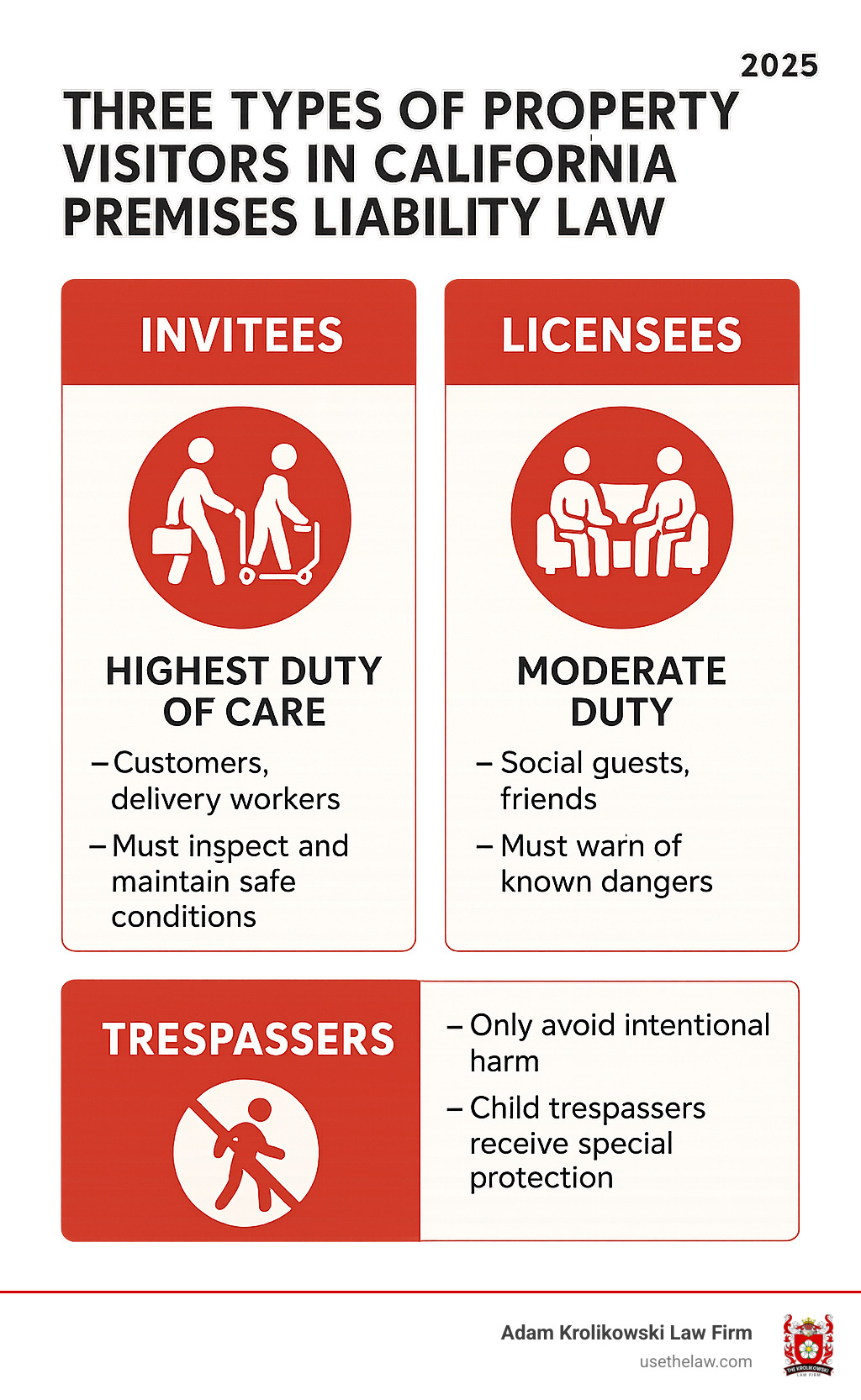
In California, the duty of care owed to you depends on your legal status at the time of the injury:
- Invitees: These are customers or members of the public on property for business reasons. They receive the highest level of protection. Owners have a duty to inspect for hidden dangers and maintain reasonable safety.
- Licensees: These are social guests or friends. Owners must warn them of known dangers but do not have a duty to inspect for unknown hazards.
- Trespassers: These individuals receive minimal protection. Owners must only avoid intentionally harming them. An important exception exists for children, who may be attracted to dangerous conditions like swimming pools, as the law recognizes they may not make sound safety decisions.
Who Can Be Held Liable?
Liability is not always limited to the property owner. A thorough investigation may reveal that multiple parties share responsibility for an accident. Potentially liable parties include:
- Homeowners and Business Owners: Responsible for safety on their residential or commercial properties, such as retail stores or restaurants.
- Landlords and Tenants: Landlords are often liable for common areas (lobbies, parking lots), while tenants may be responsible for hazards within their leased space.
- Property Managers: Companies hired to handle daily operations, maintenance, and safety inspections.
- Third-Party Companies: This can include maintenance crews, security firms, or contractors whose negligence contributed to the unsafe condition.
- Government Entities: Public bodies can be held liable for accidents on public property, but these cases have special rules and much shorter deadlines.
Common Accidents and Injuries in Premises Liability Claims
Premises liability covers a wide range of incidents beyond the classic slip and fall. A premises liability accident lawyer handles cases where accidents happen in unexpected ways due to a property owner’s negligence.

Common types of premises liability accidents include:
- Slip and Fall Accidents: Caused by wet floors, spills, icy patches, or loose rugs. For help with these cases, see our Irvine Slip and Fall Attorney page.
- Trip and Fall Accidents: Resulting from cracked sidewalks, potholes, debris, or uneven flooring, often made worse by poor lighting.
- Negligent Security: When inadequate security measures (e.g., poor lighting, broken locks, no guards) lead to assault or robbery. Our California Negligent Security Attorney handles these complex claims.
- Dog Bites and Animal Attacks: Owners are generally responsible for injuries caused by their pets. A Dog Bite Lawyer Orange County CA can assist with these traumatic cases.
- Swimming Pool Accidents: Including drownings, falls on wet decks, or injuries from inadequate fencing or malfunctioning equipment.
- Construction Accidents: When visitors or passersby are injured by falling debris, unsafe scaffolding, or other hazards. A Construction Accident Lawyer can clarify your rights.
- Falling Objects: Injuries caused by items falling from store shelves or unsecured fixtures.
Types of Injuries Sustained
A moment of negligence can cause injuries that alter a person’s life, affecting their health, work, and relationships. Common injuries in these cases include:
- Broken Bones and Fractures: Often requiring surgery and lengthy rehabilitation, with the potential for permanent limitations.
- Sprains and Strains: Severe soft tissue injuries to ligaments and muscles that can be debilitating and take months to heal.
- Head Injuries: Ranging from concussions to traumatic brain injuries (TBI), which can cause cognitive issues and long-term disability. Our Head Trauma Injury Attorney can provide guidance.
- Spinal Cord Damage: Catastrophic injuries that can lead to partial or complete paralysis, requiring lifelong medical care.
- Lacerations and Burns: Wounds from sharp objects or exposure to hot liquids or faulty wiring can cause permanent scarring and emotional distress.
Holding negligent property owners accountable is about securing compensation and encouraging safer conditions for everyone.
Proving Your Case: The Key Elements of a Negligence Claim
An injury on someone else’s property does not automatically guarantee a successful claim. To win a premises liability case, a premises liability accident lawyer must prove the property owner was negligent by establishing four key elements.

- Duty of Care: The property owner had a legal responsibility to keep the premises reasonably safe for you.
- Breach of Duty: The owner failed to meet that responsibility by not acting as a reasonable property owner would have (e.g., ignoring a spill or a broken handrail).
- Causation: The owner’s failure directly caused your accident and injuries.
- Damages: You suffered actual losses, such as medical bills, lost wages, or pain and suffering.
Building a strong case requires solid proof, including accident reports, witness statements, surveillance footage, and photos. For more information, see our resource on Evidence in a Strong Personal Injury Case.
The Importance of “Notice”
A crucial part of proving a breach of duty is showing the property owner had “notice” of the dangerous condition. This means they either knew about it or should have known about it.
- Actual Notice: The owner or their employees were directly aware of the hazard (e.g., they saw a spill and didn’t clean it up).
- Constructive Notice: The hazard existed for long enough that a reasonable owner conducting regular inspections should have found it.
Without proving notice, it is difficult to hold a property owner liable.
What if You Were Partially at Fault?
Even if your own actions contributed to the accident, you may still be able to recover compensation. California follows a pure comparative negligence rule. This means your total compensation is reduced by your percentage of fault, but you are not barred from recovery entirely.
For example, if you were found to be 20% at fault for an accident and your total damages were $50,000, you could still receive $40,000 (80% of the total). Do not assume you have no case if you were partially responsible.
What Your Claim is Worth: Compensation and Damages
After an injury on someone else’s property, you may face mounting medical bills, lost income, and significant emotional distress. A premises liability claim is designed to provide financial recovery for these losses. The goal is to secure fair compensation that helps you move forward without the burden of financial strain caused by another’s negligence.
A premises liability accident lawyer can help you pursue all available damages, which fall into two main categories: economic and non-economic. It is important to account for both immediate costs and future losses. You can review examples of case outcomes on our Verdicts and Settlements page.
Comparing Economic vs. Non-Economic Damages
Understanding the types of compensation you can recover is a key first step.
| Type of Damage | Description | Examples |
|---|---|---|
| Economic Damages | Tangible financial losses that are objectively verifiable and calculable. | – Medical Bills: Past and future costs for doctor visits, hospital stays, surgeries, medications, physical therapy, rehabilitation, medical equipment, and nursing care. – Lost Wages: Income you’ve lost because you couldn’t work due to your injury, including salary, bonuses, commissions, and benefits. – Loss of Future Earning Capacity: If your injury prevents you from returning to your previous job or limits your ability to earn at the same level in the future. – Property Damage: Costs to repair or replace personal property damaged in the accident (e.g., eyeglasses, clothing). – Household Services: Costs for services you now need because you’re unable to perform them yourself, such as cleaning, cooking, or childcare. |
| Non-Economic Damages | Intangible losses that are subjective and do not have a direct monetary value, compensating for the impact on your quality of life. | – Pain and Suffering: Compensation for the physical pain and discomfort you’ve endured and will continue to endure. – Emotional Distress/Mental Anguish: This includes anxiety, depression, fear, frustration, and other psychological impacts resulting from the accident and your injuries. – Loss of Enjoyment of Life: If your injuries prevent you from participating in hobbies, recreational activities, or daily pleasures you once enjoyed. – Loss of Consortium: In cases of severe injury or wrongful death, this compensates a spouse for the loss of companionship, affection, and support. – Disfigurement/Scarring: Compensation for the physical alteration of your appearance and the emotional distress associated with it. |
While economic damages are calculated from bills and records, non-economic damages compensate for the real but intangible impact on your life. In rare cases of extreme negligence, punitive damages may be awarded to punish the wrongdoer. The value of your claim depends on the unique facts of your case, including the severity of your injuries and their long-term effects.
Why You Need a Premises Liability Accident Lawyer and Critical Deadlines
Trying to manage a premises liability claim while recovering from an injury is a significant challenge. A premises liability accident lawyer can handle the legal complexities so you can focus on your health. An attorney will manage all aspects of your case, including:
- Dealing with Insurance Companies: Insurers often try to minimize payouts. A lawyer can counter their tactics and fight for fair compensation.
- Navigating Legal Procedures: We handle the complex rules, paperwork, and deadlines to ensure your case is not jeopardized by a procedural error.
- Conducting a Thorough Investigation: We gather crucial evidence like accident reports, surveillance footage, witness statements, and maintenance logs.
- Calculating Full Damages: We work to assess the complete scope of your losses, including future medical needs and lost earning capacity, not just current bills.
- Negotiating Settlements and Representing You in Court: We prepare every case for trial, which strengthens our position in settlement negotiations and ensures we are ready to fight for you in court if needed.
The Role of a Premises Liability Accident Lawyer in Complex Cases
Our firm has built a reputation for handling complex cases that other attorneys may pass on. With over 25 years of experience, we have the background to address intricate legal problems, from proving constructive notice with limited evidence to dealing with multiple liable parties. We excel at navigating these challenges to protect your rights and maximize your compensation. We know how to subpoena records, analyze technical evidence, and build a strong claim. To learn more about our work for clients in Orange County, visit our page on Personal Injury Lawyer in Orange County.
Why a Premises Liability Accident Lawyer Must Address the Statute of Limitations
Waiting too long to act can permanently bar you from seeking compensation. The statute of limitations is an unforgiving deadline.
In California, you generally have two years from the date of your injury to file a lawsuit. You can find the specific law here: California’s Statute of Limitations for Injury.
Crucially, claims against government entities have a much shorter deadline, often requiring a formal notice to be filed within six months of the injury. Missing this initial deadline can be fatal to your case.
Acting quickly is essential. Contacting a lawyer immediately allows for the preservation of evidence and ensures all deadlines are met, protecting your right to pursue a claim.
Conclusion: Taking the Next Step After an Accident
An injury on someone else’s property can leave you facing pain, medical bills, and uncertainty. The core principle of premises liability law is that when a property owner’s negligence causes you harm, they should be held accountable. You do not have to steer this difficult process alone.
Proving your case requires showing the owner had a duty of care, breached it, and caused your damages. This often involves demonstrating they had “notice” of the hazard. Even if you were partially at fault, California’s comparative negligence rule may still allow you to recover compensation.
Time is critical. California’s two-year statute of limitations—and an even shorter six-month deadline for government claims—means you must act quickly to protect your rights. Evidence can disappear and witness memories fade, so prompt action is essential.
At Adam Krolikowski Law Firm, we have over 25 years of experience helping clients with personal injury claims, including complex cases that others might not take. We are prepared to stand up to insurance companies and fight for the compensation you need to rebuild your life.
If you were injured on someone else’s property in Orange County, take the first step toward protecting your rights. Let us handle the legal fight while you focus on your recovery.
Contact a Premises Liability Attorney in Orange County CA today for a no-obligation consultation to understand your options.