

Injured on property: 5 Crucial Steps in Santa Ana
When Property Hazards Turn Into Personal Injuries in Santa Ana
If you’ve been injured on property that belongs to someone else in Santa Ana, you likely have legal rights to compensation—especially if the property owner’s negligence caused your accident. Property owners and occupiers in California have a legal duty to maintain reasonably safe conditions for visitors, and when they fail, they can be held financially responsible for resulting injuries.
Your rights when injured on someone else’s property in Santa Ana:
- Property owners must maintain safe conditions – California law requires owners to use reasonable care to prevent injuries
- You can seek compensation for damages – Including medical bills, lost wages, pain and suffering, and emotional distress
- Time limits apply – California’s statute of limitations restricts how long you have to file a claim
- Evidence is crucial – Photos, witness statements, and medical records strengthen your case
- Insurance often covers these claims – Homeowner’s or commercial liability policies may pay for your injuries
Accidents happen unexpectedly—whether it’s slipping on a wet floor in a grocery store, tripping over a broken sidewalk outside an apartment building, or being injured by a poorly maintained staircase at a friend’s home. The painful reality is that these incidents can leave you with mounting medical bills, lost income from missing work, and ongoing physical or emotional trauma.
As a middle-aged Santa Ana resident already dealing with workplace injuries, the last thing you need is another setback from someone else’s negligence. But understanding your legal rights can make all the difference between struggling financially and securing the compensation you deserve. Falls are, by far, the most common of all premises liability cases, and in many situations, the dispute is resolved through settlement negotiations rather than lengthy court battles.
The key question isn’t just whether you were hurt—it’s whether the property owner failed to take reasonable steps to keep their property safe, and whether that failure directly caused your injuries.
Simple injured on property word guide:
Understanding Premises Liability in California
When we talk about being injured on property in Santa Ana, we’re delving into a legal area known as premises liability. In short, premises liability, as defined by Merriam-Webster, is “liability arising from injuries or losses occurring on one’s premises.” This broad definition encompasses various injuries resulting from a dangerous condition on someone’s property. At its core, premises liability refers to injuries caused by unsafe conditions on a property due to the owner’s negligence.
The legal concept of “liability” means responsibility. To hold another party responsible for injuries suffered on their property, we typically need to prove that the property owner or operator failed to take reasonable steps to fix an unsafe condition or prevent an injury.
California stands out from many other states because it has largely moved away from a strict “status-based” approach to premises liability. Instead, California applies a “reasonable care” standard, also known as the ordinary negligence standard. This means that property owners in Santa Ana and throughout California generally owe a duty of reasonable care to all lawful visitors on their property. This legal duty requires property owners to inspect their premises regularly, maintain them in a reasonably safe condition, and warn visitors of known dangers that are not obvious.
Sometimes, the property owner and the occupier are different entities. For example, a property might be owned by one company but leased and operated by another. When the owner and occupier of a property are different, figuring out who bears responsibility can be tricky. However, the bottom line is that both the owner and the occupier can potentially be held liable. If you’re unsure, it’s always best to file a notice of claim against both parties, letting their insurance companies sort out the specifics of responsibility.
For more detailed information, you can explore our Premises Liability Legal Advice Guide.
What is a Dangerous Condition?
A dangerous condition on a property is anything that poses an unreasonable risk of harm to visitors. These are the underlying issues that often lead to someone being injured on property. They can be obvious or hidden, temporary or permanent.
Common examples of unsafe property conditions we encounter in Santa Ana include:
- Wet or slippery floors: Often found in stores or restaurants due to spills, leaks, or recent cleaning without adequate warning signs.
- Poor lighting: In stairwells, parking lots, or walkways, making hazards difficult to see.
- Broken stairs or handrails: Leading to falls and serious injuries.
- Uneven pavement: Cracks, potholes, or raised sections in sidewalks and parking lots.
- Unsecured hazards: Such as falling objects from high shelves, unstable displays, or dangerous chemicals.
- Criminal or violent activity: This falls under negligent security. If a property owner fails to provide adequate security measures (like proper lighting, working locks, or security personnel) in an area with foreseeable crime, they could be held liable if someone is injured as a result of criminal activity. This is a crucial aspect of premises liability, as property owners might have a duty to provide security, particularly in places where tenants, customers, or other visitors have been injured by criminal or other violent activity.
- Improperly designed or constructed buildings: Structural flaws that create inherent dangers.
Understanding what constitutes a dangerous condition is the first step in determining if a property owner can be held responsible for an injury. Our Negligent Security Guide 2025 offers more insights into security-related liabilities.
Common Injuries in Premises Accidents
When someone is injured on property, the consequences can range from minor scrapes to life-altering conditions. The most common loss in these cases is medical expenses. Physical injuries are often the most obvious result of premises accidents.

Some of the common types of injuries we see from premises accidents in Santa Ana include:
- Fractures and broken bones: These are frequent, especially in slip and fall accidents or falls down stairs. A person may twist an ankle, break a wrist, or suffer a more severe injury, such as a hip fracture. These injuries often require extensive medical treatment, including surgery and rehabilitation.
- Traumatic brain injuries (TBIs): Falls, especially those involving a blow to the head, can lead to concussions or more severe TBIs, affecting cognitive function, memory, and personality.
- Spinal cord injuries: These may also occur, particularly in falls from height or accidents involving heavy objects. Damage to the spine can cause partial or total paralysis, which may change a person’s life permanently.
- Soft tissue damage: Sprains, strains, and tears to ligaments, tendons, and muscles are common, often leading to chronic pain and limited mobility.
- Emotional distress and Post-traumatic stress disorder (PTSD): In addition to physical injuries, visitors may experience significant mental and emotional harm as a result of an accident. People who experience an unexpected fall or dangerous incident may have flashbacks, nightmares, anxiety, and depression.
- Chronic pain: Many injuries, even seemingly minor ones, can lead to long-term or chronic pain, significantly impacting quality of life.
These injuries can be devastating, leading to extensive medical bills, lost income, and a diminished quality of life. For more on severe injuries, see our resources on Catastrophic Injuries.
The Owner’s Negligence: Proving Your “Injured on Property” Claim
Proving that a property owner was negligent is the cornerstone of any successful claim when you’ve been injured on property in Santa Ana. “Negligence” is a legal concept that holds people accountable for the unintentional harm they cause to others. Put simply, you must show that the defendant failed to act as a reasonably careful person would act in similar circumstances.

In a premises liability case, we start the negligence inquiry by asking if the property owner had a legal duty to make their property safe. As discussed, in California, this generally means exercising reasonable care for all lawful visitors.
The next step is to prove that the property owner breached that duty of care. This means they failed to uphold their responsibility to keep the property safe. A key component of proving this breach is demonstrating the “notice” requirement. For a property owner to be found negligent due to a dangerous condition, they must have had notice of the dangerous condition and a reasonable opportunity to fix it or warn about it. This can be:
- Actual notice: The owner knew about the dangerous condition (e.g., they were told, they saw it).
- Constructive notice: The owner should have known about the dangerous condition because it had existed for a sufficient period that a reasonable property owner would have finded and remedied it through proper inspection and maintenance.
Finally, we must establish that the property owner’s negligence was a substantial factor in causing your injury. This means the harm you suffered was a reasonably foreseeable consequence of the dangerous condition, and the owner’s action or inaction materially contributed to it. The defendant’s negligence does not have to be the sole cause of the injury, but it must have materially contributed to it.
For a deeper dive into how liability is determined, refer to our guide on Understanding Liability in Personal Injury Cases.
What Evidence Do You Need to Collect?
Building a strong premises liability claim when you’ve been injured on property requires compelling evidence. The more information you gather immediately after the incident, the stronger your case will be.
Here’s what we typically advise our clients in Santa Ana to collect:
- Photographs of the hazard: Take clear, timestamped photos and videos of the dangerous condition that caused your injury before it can be repaired or removed. This preserves crucial evidence.
- Video of the accident scene: If available, surveillance footage can be invaluable in showing how the accident occurred and the presence of the hazard.
- Witness contact information: If anyone saw the accident, get their names, phone numbers, and email addresses. Their testimony can corroborate your account.
- Official incident reports: If the injury occurred at a business or public property, request a copy of any incident report filed.
- Medical records and bills: Document all medical treatment you receive, from emergency room visits to ongoing therapy. These records establish the nature and extent of your injuries and the costs incurred.
- Clothing and shoes: Preserve any clothing or shoes you were wearing at the time of the accident, as they may show damage consistent with the fall or incident.
Collecting this evidence can be challenging, especially when you’re in pain and disoriented. That’s why contacting us promptly can be beneficial; we can help guide you through this critical evidence-gathering process. For more on this, visit our guide on Evidence in a Strong Personal Injury Case.
Common Accidents When You’re Injured on Property
While “slip and fall” is often the first thing that comes to mind when thinking about being injured on property, premises liability covers a much broader range of incidents in Santa Ana. Here are some of the common types of accidents we see:
- Slip and fall accidents: These are the most prevalent, caused by wet or slippery floors, uneven surfaces, loose rugs, poorly maintained sidewalks, or ice and snow on walkways.
- Staircase and elevator accidents: Injuries due to broken steps, loose handrails, faulty elevators, or malfunctioning escalators.
- Swimming pool incidents: Drownings or near-drownings, slip and falls on wet decks, or injuries due to lack of proper fencing, supervision, or maintenance.
- Dog bites and animal attacks: Property owners can be held liable if their animal injures a visitor, especially if the owner knew or should have known of the animal’s aggressive tendencies. Our Dog Bite Law Complete Guide provides comprehensive details.
- Fires or flooding: Injuries caused by fire safety violations, faulty wiring, or water damage from neglected plumbing.
- Negligent security: Assaults, robberies, or other criminal acts occurring on the property due to inadequate security measures like poor lighting, broken locks, or insufficient security personnel, especially common at apartments, hotels, or nightclubs.
- Construction site injuries: While often covered by workers’ compensation, if a visitor is injured on property at a construction site due to unsafe conditions, it can fall under premises liability. See our Construction Site Injury resources.
- Falling objects: Injuries caused by items falling from shelves, unsecured displays, or poorly maintained structures.
Each of these scenarios presents unique challenges in proving negligence, but they all hinge on the property owner’s failure to maintain a safe environment.
Visitor Status and Special Circumstances in Santa Ana
As mentioned earlier, California’s approach to premises liability has evolved. While some states still strictly classify visitors as invitees, licensees, or trespassers to determine the property owner’s duty of care, California generally applies a “reasonable care” standard to all lawful visitors. This means that property owners in Santa Ana owe a general duty to exercise reasonable care to prevent injuries to anyone legally on their property.
This “reasonable care” standard requires property owners to act as a reasonably prudent person would under similar circumstances. This includes proactively inspecting the property for hazards, making necessary repairs, and warning visitors of any dangers that are not obvious. This modern approach simplifies the legal landscape for lawful visitors, ensuring they are afforded a consistent level of protection.
Our Premises Liability Lawyer Santa Ana resources can provide more specific guidance on local applications of these laws.
What if You Were Trespassing When Injured on Property?
While California’s “reasonable care” standard applies broadly to lawful visitors, the situation becomes more complex if you were trespassing when injured on property.
As a general rule, property owners typically owe no duty of care to trespassers. This means that if someone is on a property without permission and gets hurt, the owner is usually not held liable. The reasoning is that the owner couldn’t foresee or prevent the trespasser’s presence, and therefore, doesn’t have a duty to ensure their safety.
However, there are exceptions to this rule:
- Willful or wanton harm exception: A property owner cannot intentionally or recklessly cause harm to a trespasser. For instance, setting booby traps to injure someone would still lead to liability.
- Known trespassers: If a property owner is aware that people frequently trespass on their land, and they acquiesce to this presence (meaning they don’t actively try to stop it), their duty of care might increase slightly. They may then have a duty to warn known trespassers of highly dangerous artificial conditions on the land.
These exceptions highlight that even for trespassers, there are limits to what a property owner can do, or fail to do, without facing potential legal consequences.
The “Attractive Nuisance” Doctrine and Children
The “attractive nuisance” doctrine is a significant exception to the general rule regarding trespassers, specifically designed to protect children. This doctrine applies when a dangerous condition on a property is likely to attract children who may not understand the risks involved.
If a property owner in Santa Ana has an “attractive nuisance” on their land, they may be held liable if a child trespasses and is injured on property as a result. Common examples of attractive nuisances include:
- Unfenced swimming pools: A classic example, as pools are inherently alluring to children.
- Abandoned appliances: Old refrigerators or freezers that children can get trapped inside.
- Construction sites: With heavy machinery, open pits, or tempting structures that children might explore.
- Piles of lumber or unsecured equipment: Anything that might seem like a playground to a child but poses a hidden danger.
The law recognizes that children, due to their youth and lack of judgment, may not perceive dangers that an adult would. Therefore, property owners have a higher responsibility to secure their property and prevent harm to trespassing children. This means taking extra precautions, such as installing fences, locking gates, or removing hazardous items, to ensure child safety, even if the child is technically trespassing.
Steps to Take and Compensation You Can Recover
If you’ve been injured on property in Santa Ana, understanding the steps involved in seeking compensation and what you can recover is crucial. The process typically involves either filing an insurance claim or, if necessary, a lawsuit.
Many premises liability cases, especially those involving less severe injuries, are resolved through settlement negotiations with the property owner’s insurance company. However, if a fair settlement cannot be reached, we may need to file a personal injury lawsuit to pursue justice.
It’s important to be aware of the statute of limitations in California. For most personal injury claims, including premises liability, you generally have two years from the date of the injury to file a lawsuit. Missing this deadline can mean losing your right to seek compensation forever. That’s why acting quickly is essential.
For more information on the legal process, check out our Premises Liability Claim guide and our Personal Injury Lawyer California Guide.
Immediate Steps After an Injury in Santa Ana
Being injured on property can be a frightening and disorienting experience. However, the actions you take immediately after the incident can significantly impact the success of any future claim.
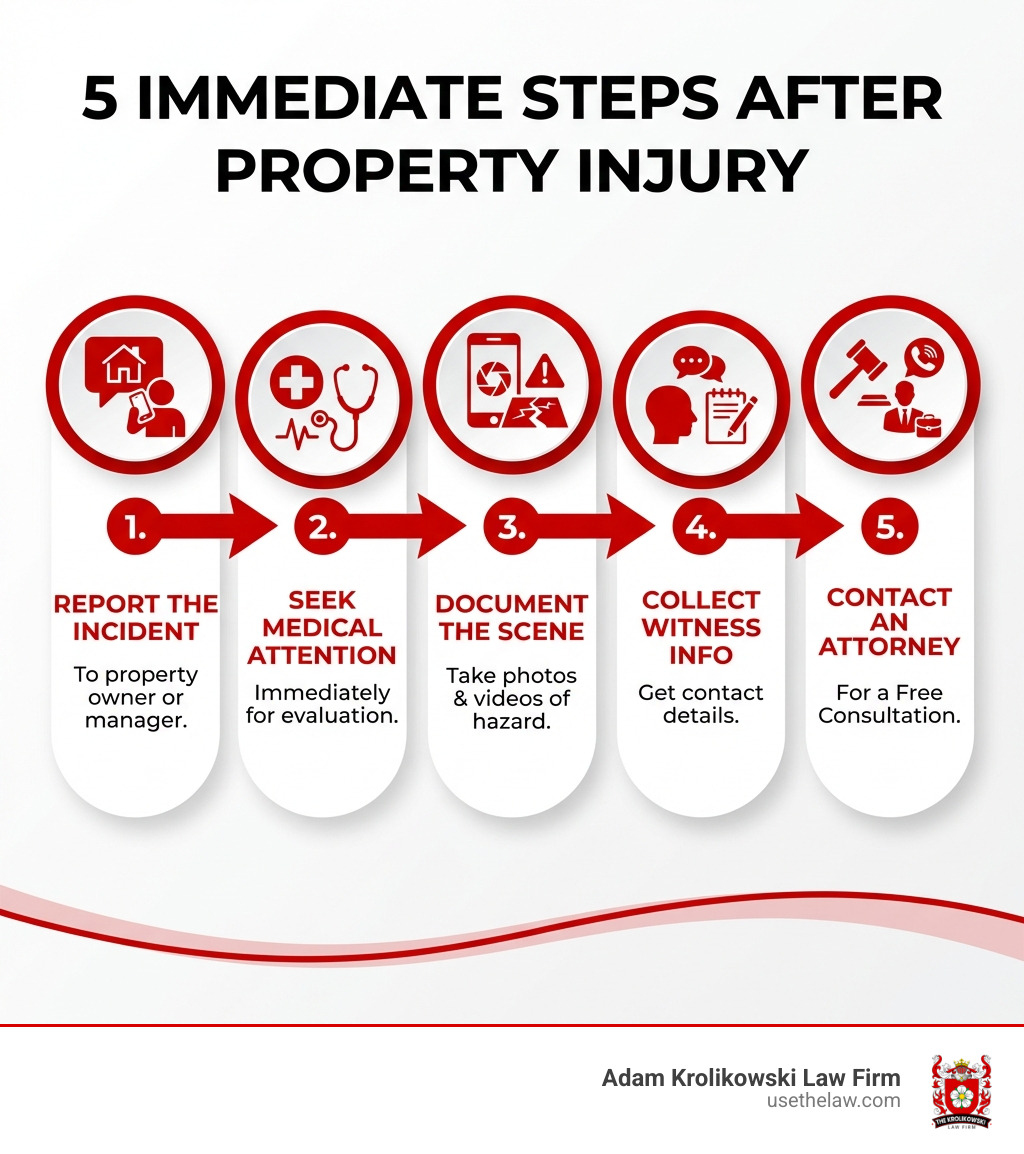
Here are the crucial immediate steps we recommend to anyone injured on property in Santa Ana:
- Report the incident: Inform the property owner, manager, or an employee of the accident as soon as possible. Ask for an incident report and get a copy if one is made.
- Seek medical attention: Even if you feel fine, some injuries, like concussions or soft tissue damage, may not be immediately apparent. Prompt medical evaluation is vital for your health and creates an official record linking your injuries to the accident.
- Document everything:
- Take photos and videos of the scene, the dangerous condition, and your injuries.
- Collect contact information from any witnesses.
- Note the date, time, and specific location of the incident.
- Avoid admitting fault: Do not make any statements about who was to blame, even if you feel partially responsible. Premises liability cases hinge on proving the property owner’s negligence, and any admission of fault could harm your claim.
- Contact a personal injury attorney: As soon as you are able, reach out to us. We can help you steer these complex situations, preserve evidence, and protect your rights.
Taking these steps helps preserve crucial evidence and ensures your well-being. For more detailed advice, read our guide on When to Contact a Personal Injury Law Attorney.
What Damages Can You Claim?
When you’ve been injured on property due to someone else’s negligence in Santa Ana, you are entitled to seek compensation for a wide range of losses, known as “damages.” These damages are generally categorized as economic and non-economic.
Economic Damages cover quantifiable financial losses and are often the most common form of recovery:
- Medical expenses: This includes emergency room visits, doctor’s appointments, surgeries, medications, physical therapy, rehabilitation, and future medical care related to your injury.
- Lost wages: If your injury prevents you from working, you can recover compensation for the earnings you lost while you were unable to earn income. This can also include loss of earning capacity if your injury affects your ability to work in the future.
- Property damage: If any personal property was damaged during the incident.
Non-Economic Damages compensate for intangible losses that are harder to quantify but significantly impact your life:
- Pain and suffering: This covers the physical discomfort and emotional distress caused by your injuries, both in the past and projected into the future.
- Emotional distress: Including anxiety, depression, fear, and PTSD resulting from the traumatic experience.
- Loss of enjoyment of life: Compensation for your inability to participate in hobbies, activities, or daily routines you once enjoyed.
- Loss of consortium: In some cases, a spouse may claim damages for the loss of companionship, affection, and support due to their partner’s injuries.
In rare instances where the property owner’s actions were particularly reckless or malicious, punitive damages may also be awarded. These are intended to punish the wrongdoer and deter similar conduct in the future.
We are dedicated to helping our clients in Santa Ana recover the full extent of damages they deserve. Learn more in our Compensation Available Los Angeles Personal Injury Guide.
The Role of Insurance in Your Claim
Insurance plays a critical role in most premises liability cases in Santa Ana when someone is injured on property. Whether the injury occurred at a private residence or a commercial establishment, there’s usually an insurance policy designed to cover such incidents.
- Homeowner’s insurance: For injuries on residential property, the owner’s homeowner’s insurance policy typically includes personal liability coverage. This coverage may pay for injuries sustained by others on your property, up to your policy’s limits. If an accident occurs on your property and you’re liable, your personal liability coverage may help with medical bills or death benefits. Property owners can check with their insurer to get customized coverage for personal liability.
- Commercial general liability (CGL) insurance: Businesses, landlords, and property management companies carry CGL policies to cover injuries that occur on their commercial premises.
When you file a claim, you’ll typically be dealing with the property owner’s insurance company. Insurance companies are businesses, and their primary goal is to minimize payouts. This is where having us on your side becomes invaluable. We can negotiate with adjusters, ensure all your damages are accounted for, and fight for a fair settlement. If a fair settlement cannot be reached, the case may go to trial.
It’s also worth noting that some policies may have restrictions or sublimits for certain incidents, such as dog bites. Understanding the nuances of these policies is part of our work. For more on this, see our Coverage Limits Personal Injury Lawyer in Santa Ana guide.
Conclusion: Protecting Your Rights in Santa Ana
Being injured on property in Santa Ana can be a challenging experience, but understanding your rights and the legal framework of premises liability is the first step toward recovery. Property owners in California have a clear duty to maintain safe premises and prevent foreseeable harm to visitors. When they fail in this duty, and their negligence leads to an injury, they should be held accountable.
The path to obtaining compensation involves establishing the property owner’s negligence, gathering compelling evidence, and navigating complex legal and insurance procedures. From documenting the scene and seeking medical attention to understanding the types of damages you can claim, each step is crucial.
For intricate cases in Santa Ana, the Adam Krolikowski Law Firm has over 25 years of experience helping clients who have been injured on property. We handle complex cases that others may not take, ensuring that accident victims and employees receive the dedicated legal representation they deserve.
If you’ve been injured due to a dangerous condition on someone else’s property, don’t face the insurance companies alone. Contact us for a Free Consultation to discuss your case. We are here to guide you through every step, protect your rights, and fight for the compensation you need to heal and move forward.
Learn more from our Slip and Fall Lawyer in Orange County, California guide.
Contact Us
Practice Areas
Recent Articles
- « Previous
- 1
- 2
- 3