

Why Workplace Racial Discrimination Still Happens in Los Angeles
Racial discrimination lawyers in Los Angeles help employees fight illegal treatment based on race, ethnicity, or national origin. If you’re facing discrimination at work, here’s what you need to know:
Key Legal Protections:
- Federal: Title VII (employers with 15+ employees)
- California: FEHA (employers with 5+ employees)
- Filing Deadlines: 300 days (EEOC) or 3 years (CRD)
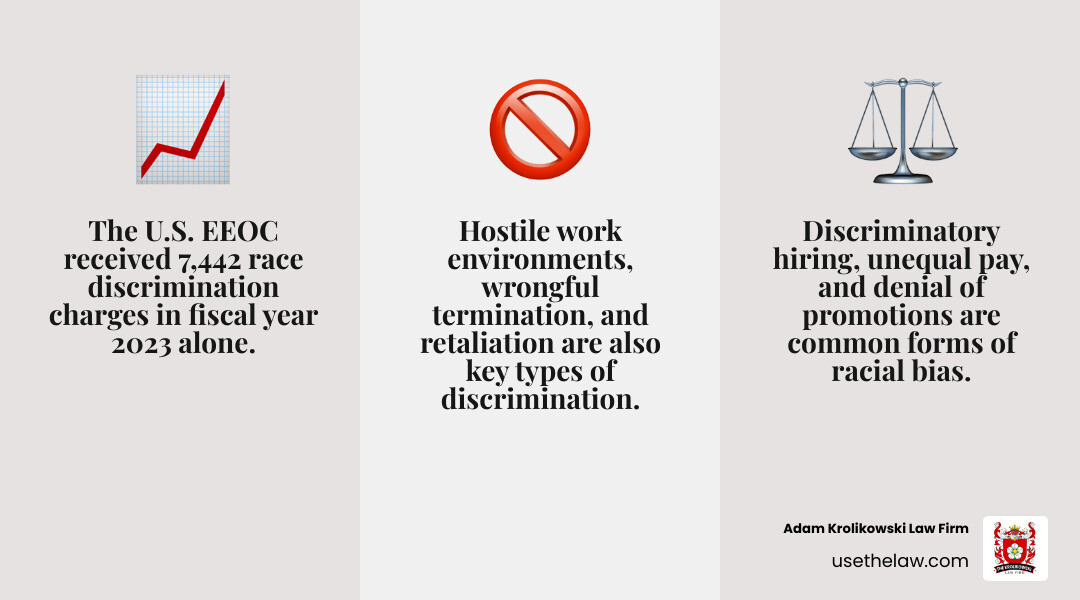
The U.S. Equal Employment Opportunity Commission received 7,442 charges of race discrimination in fiscal year 2023.
Real-world examples include being repeatedly passed over for promotion despite strong reviews or losing shifts and then being terminated after raising concerns.
Racial discrimination can be overt (slurs) or subtle (harsher reviews for certain groups). California’s Fair Employment and Housing Act provides stronger protections than federal law, covering smaller employers and offering broader remedies.
Understanding Racial Discrimination in the Los Angeles Workplace
Workplace racial discrimination may be blatant (racial slurs, “people like you” comments) or subtle (sudden nitpicking or exclusion after you speak up). It includes any unfair treatment or harassment based on actual or perceived race, ethnicity, national origin, skin color, or ancestry. These actions violate both federal and state laws designed to protect workers from discriminatory treatment.
Adverse employment actions include being denied promotions, unfair write-ups, demotions, transfers to dead-end roles, or wrongful termination when motivated by race. These actions can occur at any stage of employment, from hiring through termination. Sometimes discrimination appears as a pattern of smaller actions that collectively create significant harm to an employee’s career trajectory.
A hostile work environment arises when repeated offensive jokes, slurs, comments, or visual displays make work intimidating or abusive. The harassment must be severe or pervasive enough that a reasonable person would find the workplace hostile. In one matter involving warehouse workers, regular slurs led to a settlement over $100,000; another involving offensive references about African-Americans and Hispanics resolved in the $100,000–$200,000 range. These cases demonstrate that courts and juries take racial harassment seriously and will hold employers accountable for failing to maintain discrimination-free workplaces.

What Constitutes Racial Discrimination in LA?
Los Angeles law protects you from discrimination based on actual or perceived race, ethnicity, national origin, skin color, ancestry, and associated traits (including culturally specific hairstyles). California’s CROWN Act bars discrimination based on natural hair textures and protective styles, recognizing that hair discrimination is often a proxy for racial discrimination.
Examples: not being hired because your name sounds “too ethnic”; jokes about your accent or country of origin; or mistreatment based on what a boss assumes your race is. Retaliation for reporting discrimination—like worse assignments, reduced hours, or discipline after you complain—is also illegal. This protection extends to employees who support colleagues filing discrimination complaints or who participate as witnesses in investigations.
Disparate Treatment vs. Disparate Impact
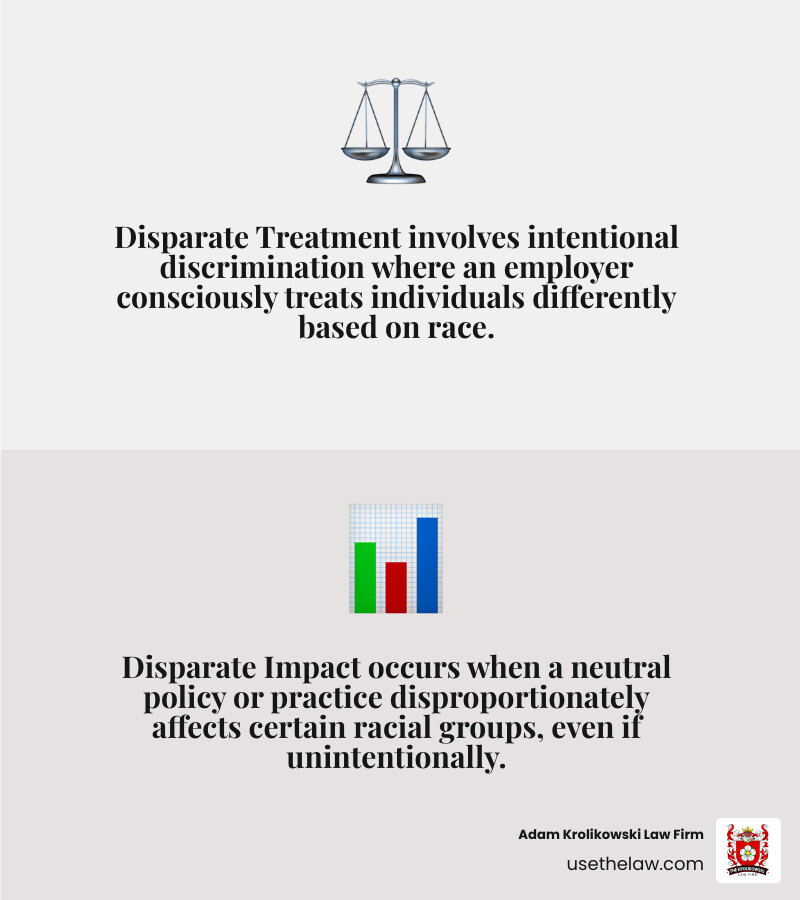
Disparate treatment is intentional unequal treatment based on race (e.g., harsher discipline or exclusion from training for certain racial groups). This direct discrimination occurs when decision-makers consciously treat employees differently because of their race or ethnicity.
Disparate impact involves neutral policies that disproportionately harm certain racial groups. In Griggs v. Duke Power Co., a high school diploma requirement appeared neutral but locked Black workers out of higher-paying roles due to historical barriers. Employers may argue business necessity, but that can be shown as pretext. These claims often rely on statistics and, at times, expert analysis. Courts examine whether less discriminatory alternatives could achieve the same business goals.
The Legal Framework Protecting LA Employees
Both federal and California laws protect LA workers from racial discrimination, and California often provides broader coverage. Racial discrimination lawyers in Los Angeles choose the best path—or both—based on your situation.
Federal Anti-Discrimination Laws
Title VII of the Civil Rights Act of 1964 prohibits discrimination based on race, color, religion, sex, or national origin for employers with 15+ employees. The EEOC enforces Title VII.
Another tool, 42 U.S.C. § 1981, protects the right to make and enforce contracts regardless of race, applies to employers of any size, and can allow broader damages in some cases.
California’s Fair Employment and Housing Act (FEHA)
FEHA, enforced by the California Civil Rights Department (CRD), covers employers with 5+ employees, bans discrimination and harassment, and strongly protects against retaliation. It also allows emotional distress damages. For related issues, see California workplace harassment.
Together, federal and state laws create a comprehensive safety net for LA employees—across both large corporations and small businesses.
Building Your Case: Steps to Take and Evidence to Gather
Experiencing discrimination is stressful, but careful action and documentation can strengthen your claim. Taking the right steps early can make the difference between a successful claim and one that cannot be proven. Many discrimination cases turn on the quality and quantity of evidence gathered by the employee.

What to Do if You Face Discrimination
- Document incidents: Record dates, times, people involved, quotes, your response, and impact. Be specific about exact words used and context. Note any witnesses present, even if they didn’t speak up.
- Report to HR or a supervisor: Create an official record and give the employer the chance to act. Follow your company’s complaint procedures and keep copies of all reports you file.
- Preserve evidence: Save emails/texts, performance reviews, relevant policies, and your notes. Forward work emails to a personal account if permitted by company policy. Take screenshots of relevant messages or posts.
- Track changes: Note any changes in treatment after you report discrimination, including schedule changes, assignment modifications, or shifts in supervisor behavior.
- Seek support: Consider contacting employee assistance programs or support groups while maintaining confidentiality about your potential legal claims.
You can Find an employment attorney for a free consultation to review options.
Evidence Needed for a Discrimination Case
- Direct evidence: Explicit statements or emails tying decisions to race. This might include written comments, recorded statements, or admissions that reference race in employment decisions.
- Circumstantial evidence: Patterns like sudden negative reviews after complaints or exclusion from opportunities. Document timing relationships between protected activity and adverse actions.
- Comparative evidence: Others outside your protected group treated better in similar situations. Track how similarly situated employees are treated differently in terms of discipline, opportunities, or benefits.
- Statistical evidence: Company-wide patterns (often key in disparate impact cases). This might show underrepresentation in promotions or overrepresentation in terminations for certain racial groups.
- Witness testimony: Colleagues or clients who observed conduct. Witnesses can corroborate your account and provide additional perspectives on discriminatory patterns.
- Company policies: Text or inconsistent application that harms certain groups. Document how policies are applied differently to different racial groups or how facially neutral policies create discriminatory outcomes.
Gathering and organizing this evidence is where racial discrimination lawyers in Los Angeles can help most. They understand what evidence courts find persuasive and can guide you in building the strongest possible case.
The Claims Process and Why You Need Racial Discrimination Lawyers in Los Angeles
Discrimination claims require specific steps and strict deadlines before any lawsuit can proceed. Having racial discrimination lawyers in Los Angeles helps you avoid missteps and meet every requirement. The process can be complex, with different agencies having different procedures and requirements.
Filing a Claim with the EEOC or CRD
You must first “exhaust administrative remedies” by filing with the EEOC (federal) or CRD (state). The agency may investigate, interview witnesses, review documents, and offer mediation. During this process, the employer will have an opportunity to respond to your allegations and present their position. If they do not take action, they issue a Right-to-Sue letter, which you generally need before filing in court. Some cases result in agency findings of discrimination, which can strengthen your position in settlement negotiations or court proceedings.
Critical Deadlines (Statutes of Limitation)
- EEOC: File within 300 days of the last discriminatory act.
- CRD: File within 3 years.
- After a Right-to-Sue: typically 90 days to file in federal court (EEOC) or 1 year to file in state court (CRD).
Missing these deadlines can bar your claim permanently. The clock starts running from the date of the discriminatory act, not when you realize it was discriminatory. For ongoing discrimination, the deadline may reset with each new incident, but determining what qualifies as a continuing violation requires legal analysis.
How a Los Angeles Racial Discrimination Lawyer Can Help
- Case evaluation: Assess facts, evidence, and strategy. Determine the strength of your claims and potential damages.
- Procedures: Choose the right agency, file correctly, and meet deadlines. Steer dual-filing requirements when pursuing both state and federal claims.
- Evidence: Request records, interview witnesses, and organize proof. Use findy tools to obtain employer documents and testimony.
- Negotiation and mediation: Pursue fair settlements. Leverage evidence and legal arguments to maximize recovery.
- Court representation: Present a clear, persuasive case. Handle depositions, motions, and trial proceedings.
- Retaliation: Act quickly if your employer punishes you for asserting your rights. File supplemental charges or amended complaints as needed.
Compensation and Damages You Can Seek
Potential recovery includes back pay for lost wages from the date of discrimination, front pay for future lost earnings if reinstatement isn’t feasible, lost benefits/bonuses including retirement contributions and stock options, compensatory damages for emotional distress, humiliation, and mental anguish, and in egregious cases punitive damages to punish the employer and deter future discrimination. Prevailing employees may recover attorney’s fees and costs, making it possible to pursue justice even when individual damages might be modest. The total recovery depends on factors including the severity of discrimination, duration of harm, and employer size.
Frequently Asked Questions about Racial Discrimination Claims
What’s the difference between illegal discrimination and a manager simply having favorites?
Favoritism based on personal preference is usually legal. Favoritism based on race, color, or national origin is illegal discrimination. We look at patterns and motives to tell the difference.
Can my employer fire me for reporting racial discrimination?
No. Retaliation is illegal under FEHA and federal law. Protected activity includes filing a complaint, helping with an investigation, or supporting a coworker. Retaliation can lead to a separate claim.
Do I have to pay a lawyer upfront for a discrimination case?
Usually no. Most employment cases are handled on a contingency fee—no fee unless there is a settlement or verdict. We explain the arrangement during a free consultation.
Conclusion
Racial discrimination is illegal and damaging. Deadlines are strict, and evidence can fade—acting promptly matters. The Adam Krolikowski Law Firm has over 25 years of experience handling complex matters that others may not take. Most racial discrimination lawyers in Los Angeles work on contingency, so you don’t pay unless there is a recovery.
Find a California Employment Law Firm to discuss your case. We’re ready to listen and pursue fair treatment and compensation.