

Why Rideshare Accidents in Santa Ana Demand Knowledgeable Legal Help
A rideshare accident lawyer Santa Ana can help you steer the complex web of insurance policies, corporate legal teams, and multi-party liability claims that make rideshare crashes fundamentally different from standard car accidents. Whether you were a passenger, another driver, or a pedestrian involved in an Uber or Lyft collision, understanding your rights is the first step toward fair compensation.
When to call a rideshare accident lawyer in Santa Ana:
- You were injured as a passenger in an Uber or Lyft and the insurance company is delaying your claim
- Another driver hit your rideshare vehicle and there’s confusion about which insurance applies
- You hit or were hit by a rideshare driver and you’re facing corporate attorneys
- You’re an Uber or Lyft driver injured on the job and unsure about occupational accident coverage
- You were a pedestrian or cyclist struck by a rideshare vehicle
- The rideshare company denies coverage claiming the driver wasn’t “active” at the time
- Your injuries are serious with medical bills exceeding $10,000 or permanent disability
- Multiple parties are involved and liability is disputed
Rideshare services have transformed transportation in Santa Ana and across Southern California. Uber and Lyft have made getting around more convenient, but they’ve also introduced new risks. According to research from the Becker Friedman Institute for Economics at the University of Chicago, rideshare services have increased traffic fatalities by 3%, resulting in nearly 1,000 additional deaths annually in the United States.
When a rideshare accident happens, victims often face a frustrating reality: the legal aftermath can be just as overwhelming as the physical injuries and financial losses. Unlike traditional car accidents where you’re dealing with one or two insurance companies, rideshare crashes involve multiple layers of coverage that shift based on whether the driver was logged into the app, en route to pick up a passenger, or actively transporting someone.
The confusion is real. Was the driver working for Uber at the moment of impact? Does their personal insurance apply, or does the company’s $1 million policy kick in? What if you’re partially at fault under California’s comparative negligence laws? These questions aren’t just technical—they directly impact whether you receive fair compensation for your medical bills, lost wages, and pain and suffering.
This is where having a rideshare accident lawyer in Santa Ana becomes essential. They understand California’s specific insurance requirements for rideshare companies, know how to access electronic data proving driver status, and can stand up to corporate legal teams that prioritize protecting company profits over injured victims.
In this guide, we’ll walk you through everything you need to know: the immediate steps to take after a crash, how liability works during different phases of a rideshare trip, what damages you can recover, and why California’s two-year statute of limitations means you can’t afford to wait. We’ll also explain when a Free Consultation with a lawyer can help you understand your rights without any financial risk.
First Steps After a Rideshare Crash in Santa Ana
The moments immediately following a rideshare accident in Santa Ana can be chaotic and frightening. However, the actions you take (or don’t take) during this critical time can significantly impact your ability to recover compensation later. Our priority is always your safety and well-being, but once you’re out of immediate danger, it’s crucial to start preserving evidence.

First and foremost, ensure your safety and the safety of others. If possible, move to a safe location away from traffic. Then, immediately call 911. This ensures that emergency services are dispatched to the scene and that law enforcement can create an official police report. This report is a vital piece of evidence for your future claim. Seek medical attention promptly, even if your injuries seem minor. Some injuries, like a concussion, might not be immediately apparent but can have serious long-term consequences. Delays in getting medical care can give insurance companies a reason to dispute the severity of your injuries later on.
When speaking with law enforcement, stick to the facts of what happened. Do not apologize or admit fault, even if you feel partially responsible. Any statement you make at the scene could be used against you. The accident scene is often confusing, and it’s easy to misinterpret what occurred.
Gathering information from the other parties involved and any witnesses is also critical. If you were a passenger in an Uber or Lyft, make sure to screenshot your ride details from the app, including the driver’s name, vehicle information, and the route taken. This digital evidence can be indispensable.
For more detailed guidance, you can explore our resources on what to do after a car accident while riding in Uber.
Documenting the Scene and Your Injuries
Your smartphone is one of your most powerful tools after an accident. Use it to thoroughly document the scene and any visible injuries. Take multiple photos and videos from different angles. Capture:
- Damage to all vehicles involved, including your own (if you were driving) and the rideshare vehicle.
- The position of the vehicles after the crash.
- Road conditions, traffic signs, signals, and any relevant environmental factors (e.g., skid marks, debris, weather).
- Visible injuries to yourself and any passengers. Even seemingly minor cuts or bruises should be photographed, as they can be evidence of impact.
- The license plates, driver’s licenses, and insurance cards of all drivers involved.
- The contact information for any witnesses.
Injuries like a concussion, neck or back injuries, broken bones, or internal injuries can lead to high medical expenses. Continuously document your medical journey by keeping all records, bills, and receipts related to your treatment. Note down your symptoms, how they affect your daily life, and any pain you experience. This comprehensive documentation helps establish the full extent of your damages.
Reporting the Accident to Uber or Lyft
After ensuring your safety and documenting the scene, you should report the accident through the rideshare app’s help section. This formalizes the incident with the company and helps preserve digital evidence of the trip. However, we strongly advise against giving any detailed statements to Uber or Lyft representatives, or any insurance adjusters, without first consulting with a rideshare accident lawyer in Santa Ana.
These companies and their insurers are primarily focused on minimizing their liability, not on ensuring you receive maximum compensation. They may try to get you to say something that could undermine your claim. Your lawyer can guide you through the process of reporting the incident and dealing with subsequent inquiries, protecting your rights every step of the way. Understanding the Uber Accident Claims process is a critical component of securing fair compensation.
Navigating Liability and Insurance in a Santa Ana Rideshare Accident
Rideshare accidents are inherently more complex than traditional car accidents due to the unique business model of companies like Uber and Lyft. Instead of a straightforward two-party claim, you often face a tangled web of liability involving multiple parties: the rideshare driver, the rideshare company, other motorists, and potentially even the city of Santa Ana if road conditions or specific ordinances (like rideshare loading zones per California Code of Ordinances §36-605(a)(4)) contributed to the crash. This complexity is precisely why a rideshare accident lawyer Santa Ana is so crucial.

To illustrate the difference, let’s look at a quick comparison:
| Feature | Standard Car Accident Claim | Rideshare Accident Claim in Santa Ana |
|---|---|---|
| Liable Parties | Typically 1-2 (at-fault driver, their insurance) | 3+ (rideshare driver, rideshare company, other drivers, city) |
| Insurance Layers | Usually one personal auto policy | Multiple layers depending on driver’s “status” at time of accident |
| Policy Limits | Minimum state requirements (e.g., $15k/$30k/$5k in CA) | Can range from personal policy to $1M corporate policy |
| Evidence Complexity | Police report, witness statements, photos | Plus rideshare app data, GPS logs, company records, driver status |
| Legal Opponent | Often a single insurance company | Large corporate legal teams + insurance companies |
| Driver Status | Not a factor | Crucial for determining applicable insurance and liability |
Who is Liable? The Three Periods of Rideshare Insurance
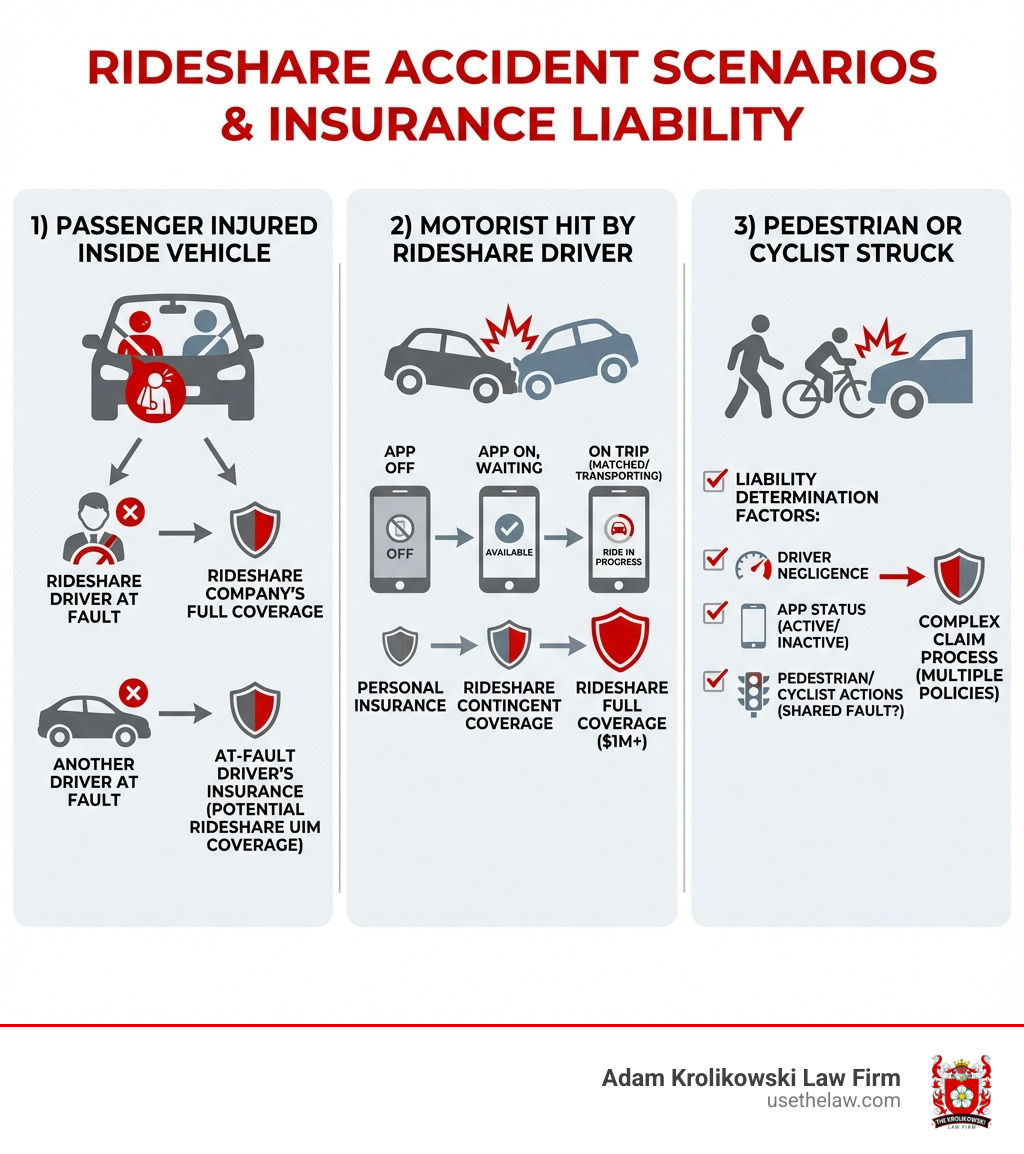
The key to understanding liability in a rideshare accident lies in the driver’s “status” at the time of the crash. Rideshare companies have tiered insurance policies that kick in based on whether the driver was offline, logged into the app and waiting for a request, or actively engaged in a ride.
-
Driver is Offline (App is Off): If the rideshare driver was not logged into the Uber or Lyft app at all, their personal auto insurance policy is the primary coverage. In California, all drivers must carry minimum liability insurance coverage: $15,000 for death or injury per person, $30,000 for death or injury to more than one person, and $5,000 for property damage, as mandated by the California Department of Motor Vehicles (DMV).
-
Period 1: App is On, Awaiting Request: When a driver is logged into the rideshare app and actively waiting for a ride request (but hasn’t accepted one yet), Uber and Lyft provide a contingent liability policy. This policy applies if the driver’s personal insurance denies coverage or is insufficient. For Uber, this typically covers up to $50,000 per person/$100,000 per accident in bodily injury liability, with Uber’s excess coverage of $200,000 also applying. Lyft has similar coverage. This phase is often referred to as Period 1.
-
Period 2 & 3: En Route to Passenger or During a Ride: This is where the big guns come out. If the rideshare driver has accepted a ride request and is en route to pick up a passenger (Period 2), or if they have a passenger in the car (Period 3), Uber and Lyft’s substantial commercial liability policy of up to $1 million per accident applies. This policy covers injury, death, and property damage for a passenger, as well as $1 million of uninsured/underinsured coverage. These rules are governed by California Public Utilities Code (PUC) §5433. This means that if an accident occurs during these periods in Santa Ana, you could be covered by a policy up to $1,000,000.
Determining which period applies is crucial and often requires access to the rideshare company’s data. This is a complex area where a rideshare accident lawyer Santa Ana can provide critical assistance.
How a Rideshare Accident Lawsuit Differs
Beyond the insurance complexities, a rideshare accident lawsuit in Santa Ana differs from a standard car accident claim in several key ways:
- Corporate Legal Teams: You’re not just up against an individual driver’s insurance company. You’ll likely be dealing with the sophisticated legal departments of multi-billion dollar corporations like Uber and Lyft. They have vast resources dedicated to minimizing payouts.
- Proving Driver Status: As discussed, the driver’s exact status at the moment of impact is paramount. This often requires subpoenas for electronic data, GPS logs, and internal communications, which only a lawyer can effectively obtain.
- Independent Contractor Status: Rideshare drivers are generally classified as independent contractors, not employees. While this distinction can impact certain aspects of liability, California laws have evolved to ensure rideshare companies carry significant insurance coverage when drivers are actively working.
- Complex Insurance Layers: The tiered insurance policies mean that multiple insurers might be involved, each trying to shift responsibility to another. Navigating this maze requires a deep understanding of California’s rideshare laws and insurance regulations.
These unique challenges highlight why having a knowledgeable legal team on your side is critical. For more in-depth information, you can explore our page on Rideshare Accident Lawsuits.
Your Legal Rights and Path to Compensation in Santa Ana, California
After a rideshare accident in Santa Ana, understanding your legal rights and the potential path to compensation is paramount. California law provides avenues for accident victims to recover damages, but navigating these without proper guidance can be overwhelming. Whether your case ends in a settlement or proceeds to a lawsuit, our goal is to secure fair compensation for your injuries and losses. We offer a Free Consultation to help you understand your options without any financial obligation upfront.
What Damages Can a Rideshare Accident Lawyer in Santa Ana Help You Recover?
When you’ve been injured in a rideshare accident, you may be entitled to compensation for a wide range of damages. A dedicated rideshare accident lawyer in Santa Ana can help calculate the true value of your claim, which often includes both economic and non-economic losses.
Economic Damages are quantifiable financial losses, such as:
- Medical Bills: This includes past, present, and future medical expenses, such as emergency room visits, hospital stays, surgeries, doctor appointments, prescription medications, physical therapy, rehabilitation, and even ambulance rides.
- Lost Wages: Compensation for income you’ve lost due to being unable to work after the accident.
- Loss of Earning Capacity: If your injuries prevent you from returning to your previous job or diminish your ability to earn a living in the future, we can seek compensation for this long-term financial impact.
- Property Damage: Costs to repair or replace your vehicle or other personal property damaged in the accident.
Non-Economic Damages are subjective and harder to quantify but are crucial for full compensation. These may include:
- Pain and Suffering: Physical pain and discomfort caused by your injuries.
- Emotional Distress: Psychological impacts such as anxiety, depression, PTSD, or fear resulting from the traumatic event.
- Loss of Enjoyment of Life: If your injuries prevent you from participating in hobbies, social activities, or daily routines you once enjoyed.
- Disability or Disfigurement: Compensation for permanent physical impairments or scarring.
We work diligently to ensure all your losses are accounted for when pursuing compensation. To learn more about claims involving specific injuries, you can refer to our resources on Uber Injury claims.
Understanding California’s Comparative Negligence and Deadlines
California operates under a “pure comparative negligence” standard. What does this mean for your rideshare accident claim in Santa Ana? It means that even if you were partially at fault for the accident, you can still recover damages. However, your compensation award will be reduced by your percentage of fault. For example, if your total damages are $100,000, but you are found to be 20% at fault, you would still be able to recover $80,000 from the other at-fault parties. This system ensures that all parties involved bear responsibility proportional to their contribution to the accident.
Another critical aspect of California law is the statute of limitations. For personal injury claims arising from a rideshare accident, you generally have two years from the date of the accident to file a lawsuit. This deadline is set by the California Code of Civil Procedure (CCP) §335.1. While two years might seem like a long time, investigating a rideshare accident, gathering evidence, and negotiating with insurance companies takes time. Missing this deadline almost certainly means losing your right to seek compensation. Therefore, acting quickly is crucial to preserve your legal rights.
Why You Need a Rideshare Accident Lawyer in Santa Ana
The complexities of rideshare accident claims make legal representation not just beneficial, but often essential. Here’s how a rideshare accident lawyer Santa Ana from our firm can help you:
- Navigating Complexity: We understand the intricate layers of rideshare insurance policies, California’s specific regulations, and how to apply them to your unique situation.
- Investigating the Crash: We conduct thorough investigations, gathering crucial evidence like police reports, medical records, witness statements, and, most importantly, the rideshare company’s digital data to establish driver status.
- Calculating True Damages: We work with medical and financial professionals to accurately assess both your current and future economic and non-economic damages, ensuring you don’t settle for less than your claim is worth.
- Negotiating with Insurers: Insurance companies, especially those representing large corporations, are notorious for offering low settlements or denying claims outright. We handle all communications and negotiations, advocating fiercely on your behalf.
- Representing You in Court: If a fair settlement cannot be reached, we are prepared to take your case to court, providing robust representation to fight for the justice you deserve.
- Leveling the Playing Field: Facing large rideshare companies and their legal teams alone can be intimidating. We act as your advocate, ensuring your rights are protected and that you have an equal footing in the legal process.
We are here to guide you every step of the way. To explore how we can assist you, please visit our page on how to Find an Uber Lyft Accident Lawyer in Santa Ana, California.
Frequently Asked Questions about Santa Ana Rideshare Accidents
We understand that rideshare accidents can leave you with many questions. Here are some of the most common inquiries we receive from individuals in Santa Ana:
Can I file a claim if I was a pedestrian or another driver hit by an Uber/Lyft?
Absolutely, yes. You can certainly pursue a claim if you were a pedestrian, a cyclist, or another driver involved in a collision with an Uber or Lyft vehicle in Santa Ana. Your rights as a third party are protected. The key factor, as always, will be determining the rideshare driver’s status at the time of the accident.
If the rideshare driver was offline, their personal insurance would be the primary source of coverage. If they were logged into the app and awaiting a request (Period 1), the rideshare company’s lower-tier contingent policy might apply. If they were en route to pick up a passenger or had a passenger in the vehicle (Periods 2 & 3), the rideshare company’s $1 million liability policy would likely cover your injuries and damages. Proving negligence on the part of the rideshare driver or another party is crucial, and we can help you steer which insurance policy is responsible for covering your losses.
What compensation is available for an injured Uber or Lyft driver?
If you are an Uber or Lyft driver in Santa Ana and were injured while on the job, you may be entitled to compensation through occupational accident insurance. California law requires Uber to provide this coverage, which typically covers medical expenses up to at least $1 million and provides disability payments equal to 66% of your average weekly earnings if the injury occurred while you were logged into the app and performing work-related activities.
However, the laws in California surrounding gig worker compensation are complex and continually evolving. There can be significant challenges in securing these benefits, and you might encounter resistance from insurance providers. Consulting with a rideshare accident lawyer Santa Ana is vital to understand your specific rights and options, especially given the ongoing legal challenges that could affect gig worker compensation. For more information regarding these types of claims, you can review our services as a Lyft Accident Lawyer.
How do rideshare company driver requirements affect my case?
Rideshare companies like Uber and Lyft have specific requirements for their drivers, which can indirectly affect your case. These requirements typically include:
- Background Checks: Drivers must pass criminal background checks.
- Driving History: Drivers must have a clean driving record, free from serious traffic violations.
- Vehicle Requirements: Vehicles must meet certain age, condition, and safety standards.
While these requirements aim to ensure passenger safety, a failure by the rideshare company to properly vet a driver or ensure their vehicle meets safety standards could potentially introduce an element of company negligence into your case. If, for instance, a driver with a known history of reckless driving was allowed to operate for the company and subsequently caused an accident, this could strengthen your claim against the rideshare company itself.
We can investigate whether the rideshare company adhered to its own driver requirements and local regulations. You can find detailed information on these requirements directly from the companies: Uber Driver Requirement Information and Lyft Driver Requirement Information.
Conclusion: Santa Ana Rideshare Accidents
Rideshare accidents in Santa Ana introduce a labyrinth of legal and insurance challenges that standard car accidents simply don’t have. From the immediate aftermath at the scene to navigating complex insurance policies and California’s comparative negligence laws, every step requires careful consideration and strategic action. The unique tiered insurance coverage of Uber and Lyft, coupled with the potential involvement of multiple parties, makes these cases particularly difficult to handle on your own.
We’ve seen how victims can be overwhelmed and taken advantage of by large corporate legal teams and insurance adjusters. That’s why prompt action is so important. Documenting the scene, seeking immediate medical attention, and understanding the statute of limitations are all critical components of protecting your rights.
At Adam Krolikowski Law Firm, we focus on personal injury cases, including the intricate world of rideshare accidents. With over 25 years of experience, we have a proven track record of handling complex cases that other attorneys might shy away from. We pride ourselves on providing dedicated legal representation to accident victims in Santa Ana, ensuring that your voice is heard and your rights are upheld.
Don’t let the complexities of a rideshare accident prevent you from seeking the compensation you deserve. We offer a Free Consultation to discuss your case, explain your options, and help you understand how we can fight for your future. There’s no obligation, just clear, warm guidance when you need it most.
To schedule your Free Consultation and start your path to recovery, please contact a personal injury lawyer in Santa Ana, California for help with your case. Let us help you steer these challenging waters.