

Why Scaffolding Accident Lawyers Are Essential for Your Recovery
Scaffolding accident lawyers help injured workers steer complex legal claims after serious construction site injuries. When scaffolding fails, collapses, or causes falls, victims often face mounting medical bills and lost wages while dealing with multiple insurance companies and potential lawsuits.
Key reasons you need scaffolding accident lawyers:
- Dual legal paths: Handle both workers’ compensation claims and third-party lawsuits
- Identify all liable parties: General contractors, equipment manufacturers, property owners, and safety inspectors
- Maximize compensation: Pursue full damages including pain and suffering, not just workers’ comp benefits
- Steer OSHA violations: Use safety regulation breaches to strengthen your case
- Investigate complex accidents: Determine if defective equipment, improper assembly, or negligent supervision caused your injury
Construction work puts millions at risk. Almost 65% of all construction workers – about 2.3 million people – perform tasks on scaffolds. One out of every five construction accidents involves scaffolding, making these incidents both common and devastating.
The legal landscape for scaffolding accidents is complex. While workers’ compensation provides some benefits, it often doesn’t cover your full losses. Third-party claims against negligent parties can provide additional compensation for medical expenses, lost wages, and pain and suffering that workers’ comp won’t pay.
Time is critical after a scaffolding accident. Evidence disappears, witnesses forget details, and legal deadlines approach quickly. The right legal representation can mean the difference between basic workers’ comp benefits and full compensation for your injuries.
Understanding Scaffolding Accidents: Common Causes and Severe Injuries
When scaffolding fails, lives change in an instant. These temporary structures can become dangerous traps, leaving workers with devastating injuries that affect them for life.

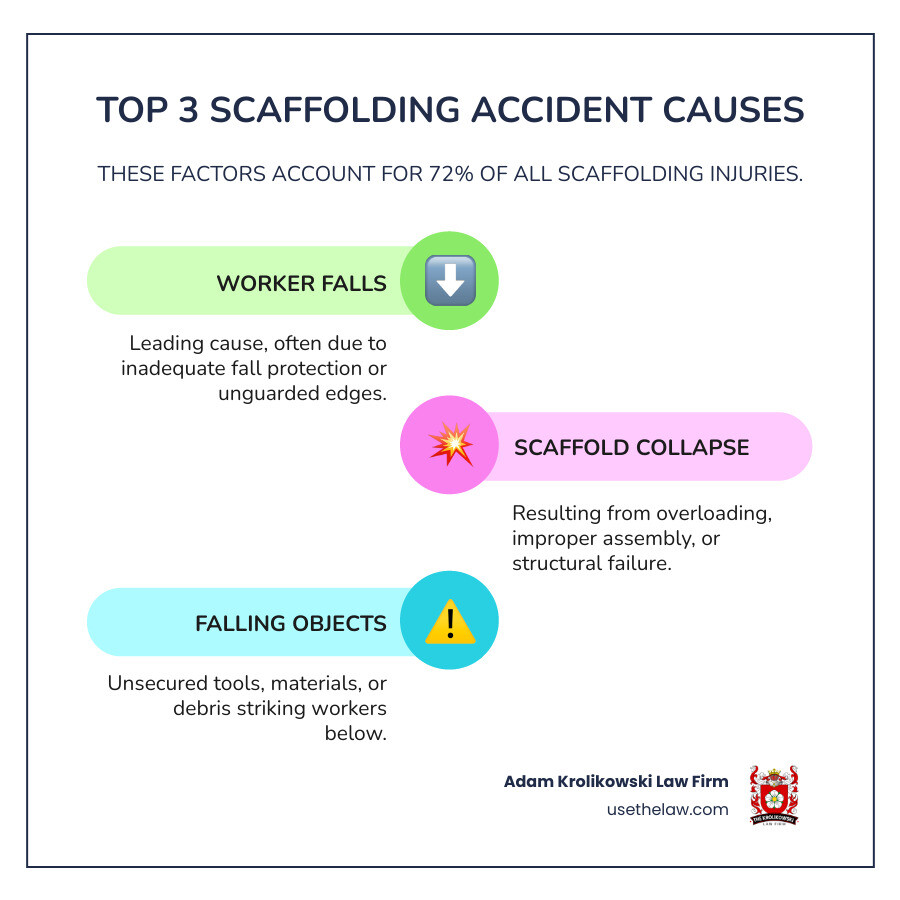
Common causes of these accidents often stem from multiple failures, including:
- Falls from elevation: The leading cause, often due to missing guardrails, unstable platforms, or failed fall protection. OSHA requires fall protection for scaffolds higher than 10 feet, but these rules are often ignored.
- Scaffold collapse: The entire structure gives way, typically from improper assembly, overloading with workers or materials, or using substandard components.
- Falling objects: Tools, materials, or scaffold parts fall and strike workers below, causing serious harm even with hard hats.
- Electrocution: Metal scaffolding becomes a deadly conductor when it contacts power lines.
These events are frequently rooted in inadequate worker training, failure to follow safety protocols to save time or money, and unsafe site conditions like unstable ground or poor lighting.
The resulting injuries are severe and life-altering. Victims may suffer from traumatic brain injuries (TBI), spinal cord injuries leading to paralysis, multiple fractures, or amputations. The internal damage can be just as severe, and many accidents are tragically fatal.
The Long-Term Impact on Victims
The consequences of a scaffolding accident extend far beyond the initial injury. Victims and their families often face a lifetime of challenges:
- Chronic pain and permanent disability: Many survivors live with constant pain from spinal injuries or severe fractures, making simple tasks difficult and sometimes preventing them from returning to work.
- Psychological trauma: PTSD, anxiety, and depression are common, and some survivors develop a fear of heights that prevents them from continuing their careers.
- Financial strain: Medical bills accumulate while income stops. A reduced earning capacity can affect a family’s long-term financial security.
- Loss of enjoyment of life: The inability to participate in hobbies, family activities, and social events diminishes a person’s quality of life.
- Ongoing medical needs: Years of rehabilitation, therapy, and medical care create lasting financial and emotional burdens for the entire family.
Determining Liability: OSHA Regulations and Responsible Parties
After a scaffolding accident, a critical question is who is responsible. These cases often involve multiple parties and complex safety regulations, making liability difficult to determine without legal guidance.
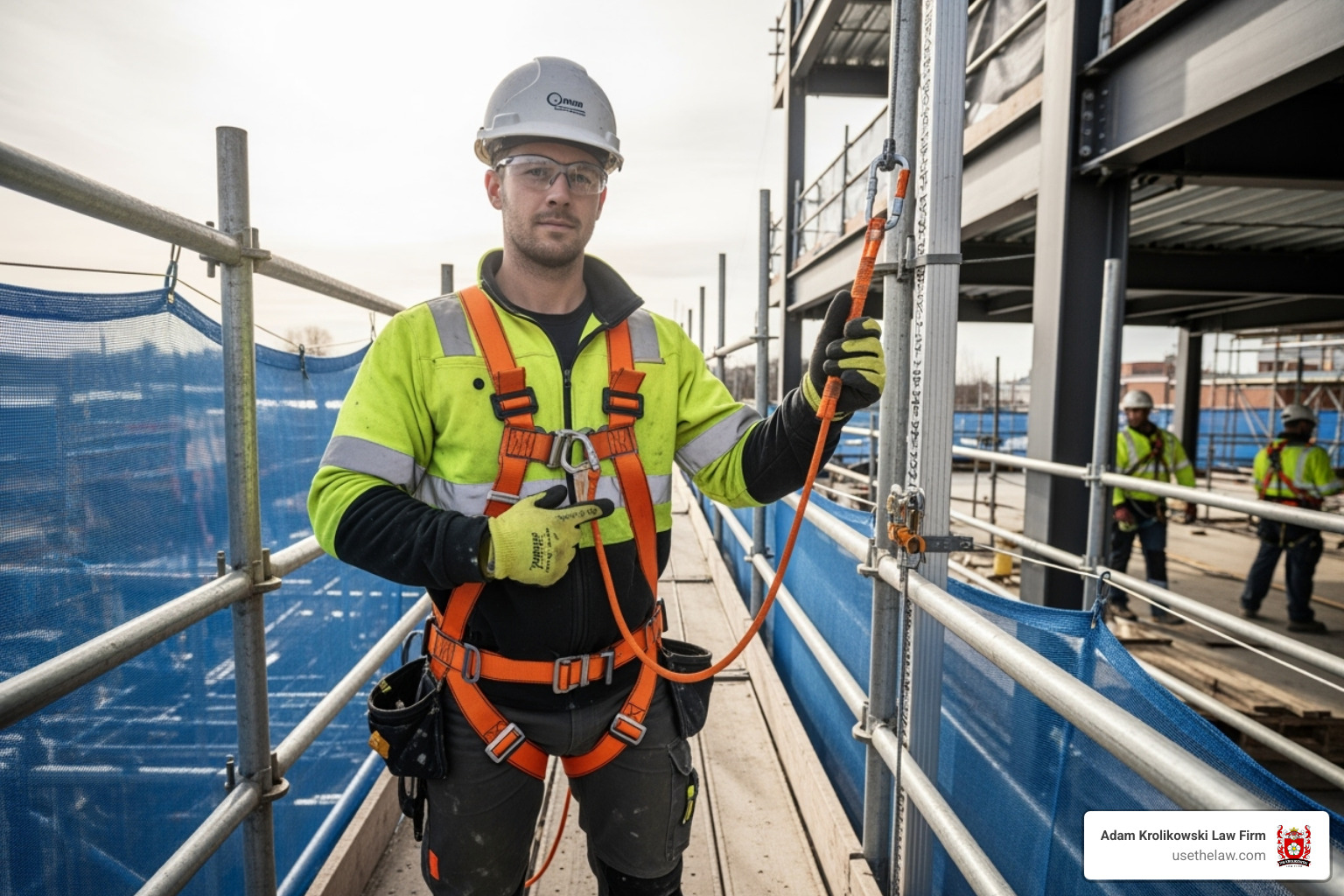
OSHA’s role is central to construction safety. The Occupational Safety and Health Administration sets legally binding standards to prevent scaffolding accidents. Violating these standards is often strong evidence of negligence. Key OSHA scaffolding standards include:
- Load Capacity: Scaffolds must support their own weight plus four times the maximum intended load.
- Fall Protection: Guardrails or personal fall arrest systems are mandatory for work performed over 10 feet high.
- Proper Decking: Platforms must be fully planked with minimal gaps to prevent falls and dropped objects.
- Competent Person Oversight: A qualified individual must supervise scaffold erection, use, and inspection.
Who Can Be Held Liable?
Construction sites involve many companies, and liability can extend beyond your employer. A thorough investigation may identify several responsible parties:
- General contractors: They have overall responsibility for site safety and ensuring all subcontractors follow the rules.
- Subcontractors: The company that erected, inspected, or maintained the scaffold can be liable for negligent work.
- Property owners: They may be responsible for failing to ensure safe conditions on their property.
- Scaffold manufacturers: If defective design or materials caused the accident, the manufacturer can be held liable under product liability laws.
- Equipment rental companies: They have a duty to provide safe, well-maintained scaffolding.
- Safety inspectors: Engineers or inspectors who fail to identify obvious hazards can be held accountable for their negligence.
- Other negligent parties: This could include another contractor’s employee or a delivery driver who damaged the scaffold.
Identifying every party who contributed to your accident is key to pursuing full compensation. An attorney can help untangle the complex relationships on a job site to hold all negligent parties accountable.
Your Legal Options: Workers’ Compensation vs. Third-Party Lawsuits
After a scaffolding accident, injured workers in California often have two main legal options: a workers’ compensation claim and a third-party personal injury lawsuit. Understanding the difference is key to your recovery.
Workers’ comp is a safety net, but it may not cover all your losses. A third-party lawsuit can help you pursue the full value of what the accident has cost you and your family. Many victims benefit from pursuing both options simultaneously.
| Feature | Workers’ Compensation Claim | Third-Party Lawsuit |
|---|---|---|
| Proof of Fault | Not required (no-fault system) | Required (must prove negligence of the third party) |
| Who You Can Sue | Generally, only your employer’s workers’ compensation insurance carrier. You cannot sue your employer directly for negligence in most cases (exclusive remedy rule). | Any negligent party other than your direct employer (e.g., general contractor, property owner, scaffold manufacturer, other subcontractors, equipment rental company). |
| Types of Compensation | Limited to specific benefits: medical expenses, temporary and permanent disability benefits, and supplemental job displacement benefits. Pain and suffering are not covered. Workers’ compensation benefits explained | Broader range of damages: medical expenses (past and future), lost wages (past and future), reduced earning capacity, pain and suffering, emotional distress, loss of enjoyment of life, and in some egregious cases, punitive damages. |
| Process | Administrative process handled through the Division of Workers’ Compensation (DWC). | Civil lawsuit filed in court, involving findy, negotiations, and potentially a trial. |
| Legal Deadlines | Strict reporting deadlines (e.g., injury must be reported to the employer within 30 days). | Statute of limitations (e.g., two years in California for personal injury lawsuits). It is crucial to act quickly. |
Filing a Workers’ Compensation Claim
Workers’ compensation is a no-fault system, meaning you can receive benefits regardless of who caused the accident. In exchange, the exclusive remedy rule prevents you from suing your direct employer for negligence.
Workers’ compensation benefits typically cover necessary medical treatment and temporary disability payments to replace a portion of your lost wages. If your injury causes permanent impairment, you may receive permanent disability benefits. However, workers’ comp does not provide compensation for pain and suffering, emotional distress, or the impact on your quality of life.
Pursuing a Third-Party Personal Injury Lawsuit
A third-party lawsuit allows you to seek full compensation from any negligent party other than your employer. This could be the general contractor, a scaffold manufacturer, or an equipment supplier who failed in their duty to keep you safe.
Proving negligence is required. You must show that another party’s carelessness directly caused your injuries. A successful lawsuit can help you recover damages for:
- Pain and suffering: Compensation for your physical pain and emotional trauma.
- Full wage loss: Covers both past lost income and your reduced future earning capacity.
- All related medical costs: Includes future surgeries, rehabilitation, and long-term care.
By holding all negligent parties accountable, your lawsuit can also encourage safer practices, helping to prevent future accidents. Pursuing both a workers’ comp claim and a third-party lawsuit often provides the most complete financial recovery.
The Role of Scaffolding Accident Lawyers in Maximizing Your Claim
After a scaffolding accident, you need to focus on healing, not wrestling with insurance companies and legal procedures. A scaffolding accident lawyer can shoulder the legal burden for you.

Our process begins with a thorough case investigation. We visit the accident scene, review safety logs and blueprints, and collect crucial evidence like photos, videos, and witness statements before it disappears. We also consult with industry professionals, such as forensic engineers and construction safety analysts, to determine exactly what went wrong.
One of our most important roles is identifying all sources of compensation. While workers’ comp may be your only option against your employer, we can pursue claims against other negligent parties like general contractors, equipment manufacturers, or property owners.
We handle all negotiations with insurance companies, protecting you from adjusters trained to minimize payouts. If a fair settlement isn’t offered, we are prepared for litigation and will take your case to trial to fight for the compensation you deserve.
How Scaffolding Accident Lawyers Secure Compensation
We work to secure compensation for all your losses, both current and future.
- Economic Damages: These are your calculable financial losses, including all past and future medical bills, lost wages, and your loss of future earning capacity if you cannot return to your previous job.
- Non-Economic Damages: This compensation addresses the non-financial impact on your quality of life, such as pain and suffering, emotional distress, and loss of enjoyment of life.
- Punitive Damages: In cases of extreme negligence, these may be awarded to punish the defendant and deter similar conduct.
What to Look for When Hiring Scaffolding Accident Lawyers
When choosing legal representation, look for a firm with:
- Experience in construction law: An understanding of OSHA regulations and the unique challenges of construction site cases is vital.
- Knowledge of both workers’ comp and personal injury law: Your attorney should be able to coordinate both types of claims for a comprehensive recovery.
- A contingency fee structure: You shouldn’t pay legal fees upfront. We only get paid if we win your case.
- A proven track record: Look for a history of successful outcomes in similar complex construction accident cases.
- Positive client testimonials: These show how a firm communicates with and treats its clients.
At Adam Krolikowski Law Firm, we have over 25 years of experience handling complex injury cases. We understand that scaffolding accidents involve multiple defendants and significant injuries, and we are committed to pursuing the substantial compensation needed for a full recovery.
Critical Steps to Take Immediately After a Scaffolding Accident
The moments after a scaffolding accident are chaotic, but the steps you take can protect your health and your legal rights.
-
Seek emergency medical attention. Your health is the priority. Some serious injuries, like head trauma or internal bleeding, aren’t immediately apparent. A medical evaluation creates an official record of your injuries.
-
Report the accident to your supervisor. In California, you must report your work injury to your employer within 30 days to be eligible for workers’ compensation benefits. Do it as soon as possible and ensure an official report is filed.
-
Document the scene. If you can, take photos and videos of the scaffolding, any broken parts, the surrounding area, and your injuries. This visual evidence is invaluable.
-
Get witness information. Collect names and contact information from anyone who saw the accident. Their accounts can help verify what happened.
-
Preserve evidence. Do not let anyone throw away damaged equipment, tools, or clothing related to the accident.
-
Avoid giving recorded statements to insurers. Be polite, but do not give a recorded statement or sign documents from any insurance company without first speaking to a lawyer. Adjusters may try to use your words against you.
-
Contact an attorney promptly. In California, you have two years to file a personal injury lawsuit, but you should not wait. Evidence disappears and witnesses’ memories fade. The sooner an attorney can investigate, the stronger your case will be.
Secure the Compensation You Deserve
Scaffolding accident cases are complex. What begins as a workplace injury often involves layers of negligence, creating multiple paths to recovery beyond a simple workers’ compensation claim. Third-party lawsuits against general contractors, equipment manufacturers, or property owners can provide the comprehensive compensation that truly reflects your losses.
Prompt action is critical. Evidence disappears from construction sites quickly, and witness memories fade. Every day you wait allows insurance companies to build their defense. You need an advocate on your side from the start.
At Adam Krolikowski Law Firm, we have over 25 years of experience handling the complex injury cases that other firms may avoid. We understand that behind every case is a person whose life has been turned upside down by concerns about their health, their job, and their family’s future.
You deserve compensation that accounts for your pain and suffering, lost future earnings, and the full impact this accident has had on your life. Don’t let the complexity of your case prevent you from seeking what you are owed.
Contact our Orange County scaffolding accident lawyers for a free consultation to understand what your case is worth. We are here to help you rebuild your life.
