

The Legal Roadmap to Suing Your Boss for Wrongful Termination
When “You’re Fired” Crosses the Line: What You Need to Know First
If you’re looking to sue for wrongful termination, here’s the core of what you need to know right away:
Can you sue your employer for wrongful termination in California?
- Yes — even in an at-will state like California, your employer cannot fire you for an illegal reason
- Common unlawful reasons include discrimination, retaliation, whistleblowing, or breach of contract
- First step — file a complaint with the EEOC or California Civil Rights Department (CRD) before going to court (for discrimination-based claims)
- Time limits apply — you generally have 300 days (federal) or up to 3 years (state FEHA) to file
- Damages available include back pay, emotional distress, and sometimes punitive damages
- Get a Free Consultation with an Orange County wrongful termination lawyer before doing anything else
Being let go from your job is stressful enough on its own. But when you suspect your termination wasn’t just unfair — when you believe it was actually illegal — the stakes get much higher, especially if you’re already dealing with mounting bills and lost income.
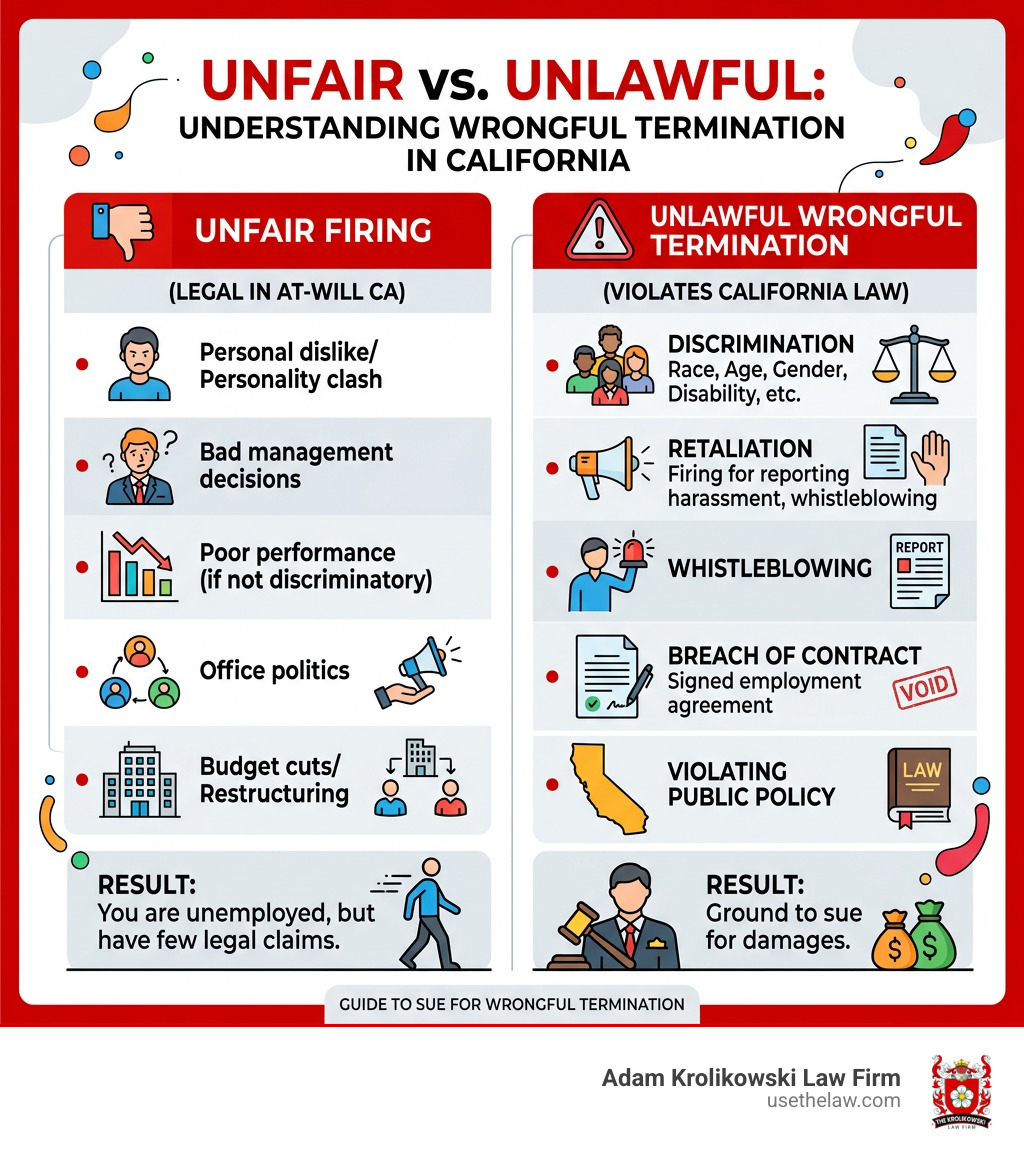
Here’s the thing most people in Orange County don’t realize: unfair and unlawful are not the same thing. Your boss can fire you because they don’t like your personality, because the company is restructuring, or even for no reason at all — and in most cases, that’s perfectly legal under California’s at-will employment rules. But the moment a termination crosses into discrimination, retaliation, or a violation of public policy, it becomes something the law takes seriously.
The California Civil Rights Department received 29,855 formal complaints in 2023 alone, recovering over $116 million in damages for workers — a sign that these cases are both common and winnable when handled correctly.
This guide walks you through the full legal roadmap, step by step, so you know exactly what to do, what to avoid, and when to call a lawyer.
Understanding Your Rights: Can You Sue for Wrongful Termination in an At-Will State?

One of the most common things we hear in Santa Ana and throughout Orange County is: “My boss said California is an ‘at-will’ state, so they can fire me for whatever they want. Is that true?”
Well, yes and no. Under California Labor Code 2922, employment is presumed to be “at-will.” This means an employer can generally terminate your employment at any time, with or without notice, and for any reason—or even no reason at all. However, “at-will” is not a “get out of jail free” card for employers.
There are several major exceptions that allow you to sue for wrongful termination:
- Public Policy Exceptions: You cannot be fired for doing something the law encourages (like serving on a jury or voting) or refusing to do something the law prohibits (like being told to lie to a government inspector).
- Implied Contracts: If your employer made specific promises—either in an employee handbook or verbally—that you would only be fired for “good cause,” they may have created an implied contract. Firing you without cause in this scenario could be a breach.
- Illegal Reasons: This is the big one. Federal and state laws override “at-will” status. You cannot be fired based on protected characteristics or for exercising your legal rights.
If you are feeling overwhelmed by the terminology, our Wrongful Termination Lawyer Ultimate Guide can help break down these nuances further. In Orange County, labor laws are strictly enforced to protect employees from “at-will” abuse.
Common Grounds for Unlawful Firing in California
To successfully sue for wrongful termination, you must identify the specific legal ground that was violated. In California, these grounds are often found in the Fair Employment and Housing Act (FEHA).
According to the California Civil Rights Department 2023 Report, retaliation and discrimination remain the top reasons for legal filings. Here are the most common grounds:
1. Discrimination
It is illegal to fire someone based on protected characteristics. This includes race, religious creed, color, national origin, ancestry, physical disability, mental disability, medical condition, genetic information, marital status, sex, gender, gender identity, gender expression, age, sexual orientation, or military and veteran status.
2. Retaliation
This is a massive category. In 2023, California averaged 796 claims of retaliatory actions per month—a 50% increase since 2019. Retaliation happens when an employer punishes you for engaging in “protected activity,” such as:
- Reporting sexual harassment.
- Filing a wage and hour dispute (e.g., unpaid overtime).
- Requesting a reasonable accommodation for a disability.
- Taking FMLA (Family and Medical Leave Act) leave to care for a sick loved one.
3. Whistleblower Protection
If you reported your company for unsafe work practices to OSHA or for financial fraud to the SEC, you are a whistleblower. Firing you as “payback” is a direct violation of public policy. If you suspect this has happened to you, consulting an Orange County Wrongful Termination Lawyer is vital to protecting your rights.
Step-by-Step Guide: How to File Your Claim
Filing a lawsuit isn’t as simple as walking into a courthouse and saying, “I want to sue.” There is a specific administrative process you must follow first, especially for discrimination claims.
The Administrative Exhaustion Process
For most discrimination and harassment cases, you must “exhaust your administrative remedies.” This means you have to give a government agency the chance to look at the case before you can head to the Superior Court.
| Feature | EEOC (Federal) | CRD (State/California) |
|---|---|---|
| Primary Law | Title VII, ADA, ADEA | FEHA |
| Deadline to File | Generally 300 days | Up to 3 years |
| Orange County Office | Los Angeles/Santa Ana Area | Multiple Regional Offices |
| Requirement | Must file before suing | Must file before suing |
Once you file with these agencies, you can request a “Right-to-Sue” letter. This letter is your “golden ticket” that allows a California Wrongful Termination Lawyer to take your case into the civil court system.
Filing in Superior Court
Once you have your Right-to-Sue letter, your attorney will file a formal complaint in the Orange County Superior Court. This document details the laws broken and the compensation you are seeking. Your employer must then be served with these papers, usually within 60 days of filing.
Filing with the EEOC or CRD to Sue for Wrongful Termination
You can initiate an inquiry through the EEOC Public Portal. It is important to remember that the statute of limitations (the deadline to file) is strict. If you miss the 300-day federal window or the 3-year state window, you may lose your right to sue for wrongful termination forever.
When to Hire a Lawyer to Sue for Wrongful Termination
Employment law is incredibly complex. Employers often have deep pockets and high-priced legal teams ready to defend their actions. Hiring a lawyer provides you with a strategist who understands how to counter employer defenses.
At our firm, we offer a Free Consultation to review the facts of your case. We typically work on a contingency fee basis, meaning we only get paid if we win your case. This levels the playing field, allowing you to get high-quality Orange County representation without paying thousands of dollars upfront.
Evidence and Documentation Needed to Prove Your Case
In a wrongful termination case, the “burden of proof” is on you. You have to show that it is more likely than not that the employer fired you for an illegal reason. This is where documentation becomes your best friend.
What to Gather:
- Performance Reviews: If your boss fired you for “poor performance,” but your last three reviews were “Exceeds Expectations,” that inconsistency is huge evidence.
- Emails and Texts: Look for messages that show bias, discriminatory language, or a change in tone after you reported an issue.
- Witness Testimony: Coworkers who saw the mistreatment or heard the manager make inappropriate comments can be powerful witnesses.
- Temporal Proximity: This is a fancy legal term for “timing.” If you were fired two days after reporting sexual harassment, the timing itself suggests retaliation.
To see how these pieces come together, you can read our Wrongful Termination Case Study. For more technical details on the types of proof required, check out How Do You Prove Wrongful Termination?.
Damages and Compensation: What is Your Case Worth?
When you sue for wrongful termination, you are looking for “remedies”—legal ways to make you “whole” again.
Types of Damages:
- Back Pay: The wages and benefits you lost from the date of termination until the date of the trial or settlement.
- Front Pay: If you haven’t found a new job yet, you might be awarded future lost wages.
- Emotional Distress: Compensation for the anxiety, depression, and loss of enjoyment of life caused by the illegal firing.
- Punitive Damages: In cases of especially malicious behavior, the court may award extra money to punish the employer and discourage them from doing it again.
- Attorney Fees: In many California employment cases, the losing employer has to pay your lawyer’s fees.
A common question is, “How Much Can You Get for Wrongful Termination?“. While every case is unique, statistics show that plaintiffs who document their job search costs often receive settlements up to three times higher than those who don’t. Our Los Angeles Wrongful Termination Attorneys can help you calculate the full value of your claim, including lost health insurance and retirement contributions.
Frequently Asked Questions about Wrongful Termination in Orange County
What is the statute of limitations for filing in California?
Deadlines vary significantly depending on the type of claim. For standard retaliation claims under the Labor Code, you generally have one year to report to the DLSE. For discrimination claims under FEHA, you have three years to file with the CRD. Because these deadlines are strict, you should never wait to seek legal advice. Missing an Orange County court deadline can result in your case being dismissed immediately.
Can I sue if I was forced to quit?
Yes. This is known as constructive discharge. To win, you must prove that the working conditions were so intolerable that any reasonable person would have felt they had no choice but to resign. It’s not enough that the job was “stressful”; the conditions must be egregious, and the employer must have known about them and failed to fix them. If you’re in this situation, see our guide on Wrongful Termination Lawyer Los Angeles for more on the resignation vs. termination distinction.
What should I avoid doing after being fired?
- Don’t Post on Social Media: Anything you say can and will be used against you. A “happy” vacation photo could be used to argue you aren’t suffering from emotional distress.
- Don’t Trash the Company: Avoid making disparaging remarks to former clients or on public forums like Glassdoor until you’ve consulted a lawyer.
- Don’t Sign Anything Immediately: Employers often offer a severance package in exchange for you waiving your right to sue. Always have an attorney review these documents first.
- Don’t Forget to Return Property: Keep a log of when you returned laptops, keys, and badges to avoid “theft” counterclaims.
For more tips on protecting your claim, we offer a Free Consultation Wrongful Termination Lawyer service to help you navigate those first critical days.
Conclusion
Navigating the legal roadmap to sue for wrongful termination is a daunting task, but you don’t have to walk it alone. At Adam Krolikowski Law Firm, we’ve spent over 25 years standing up for workers in Santa Ana and across Orange County. We specialize in complex employment law cases that other firms might find too difficult to handle.
Whether you were fired for reporting a safety violation, for your age, or for taking medical leave, we are here to help you hold your employer accountable. We understand the local courts, the state agencies, and the tactics employers use to avoid paying what they owe.
If you believe you were illegally fired, reach out to us today for a Free Consultation. Let us review your story, examine your evidence, and help you decide the best path forward. Visit our Wrongful Termination Lawyer in Orange County CA page to learn more about how we can fight for the justice—and the compensation—you deserve.
Contact Us
Practice Areas
Recent Articles
- « Previous
- 1
- 2
- 3
- Next »