

Understanding Your Rights When Facing Workplace Harassment
If you’re searching for workplace harassment lawyers near me, you’re likely facing unwelcome conduct that’s affecting your job. Here’s what you need to know:
Quick Action Steps:
- Document everything – Note dates, times, witnesses, and what happened.
- Save evidence – Keep all related emails, texts, and photos.
- Report internally – Use your company’s policy if it’s safe.
- Contact a lawyer – Especially if HR is unhelpful or you face retaliation.
Harassment becomes illegal when it targets protected traits (race, sex, age, etc.), is severe enough to create a hostile work environment, or involves quid pro quo demands. This is a violation of your civil rights, and you have legal protections under federal and California law. This guide explains what constitutes illegal harassment, your options, and how to find an attorney to fight for the compensation you deserve.
Understanding Workplace Harassment: What It Is and When It’s Illegal
Not all unpleasant workplace interactions are illegal harassment. The law distinguishes between general bad behavior and unlawful conduct.
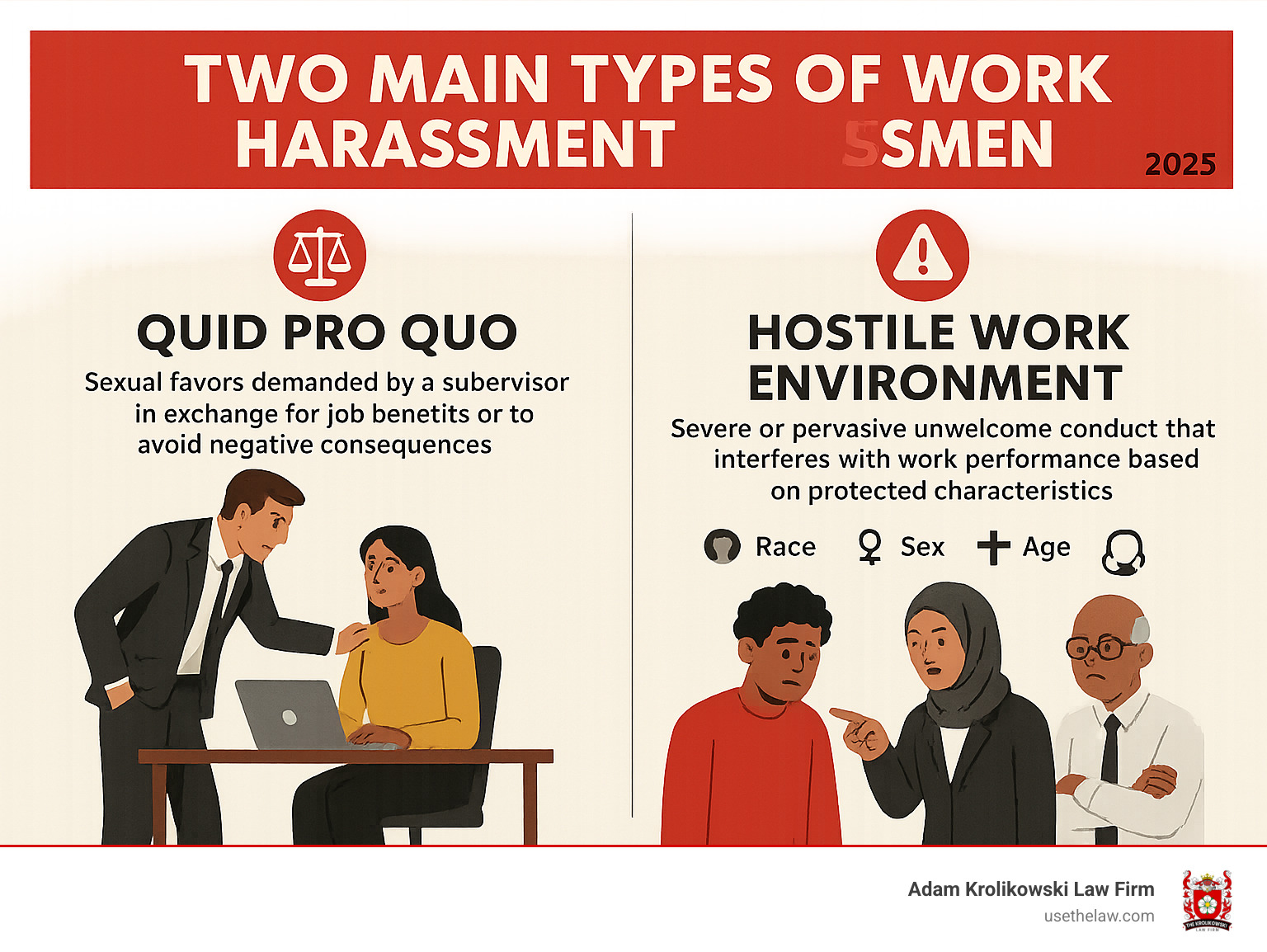
Illegal workplace harassment involves unwelcome conduct targeting protected characteristics, creating a hostile work environment, or involving quid pro quo demands. If someone targets you because of your race, gender, age, or another protected trait, the law can intervene.
These “protected characteristics” include race, color, religion, sex (including pregnancy, sexual orientation, and gender identity), national origin, age (40 or older), disability, and genetic information.
A key point of confusion is that bullying isn’t always illegal harassment. A manager who is equally unpleasant to everyone may create a toxic workplace, but it’s not necessarily unlawful. However, if that manager only targets women or makes derogatory comments about older employees, it becomes illegal harassment. The conduct must be severe or pervasive enough to alter your working conditions. This could be one serious incident or a pattern of smaller ones that interfere with your job.

What Constitutes a Hostile Work Environment?
A hostile work environment is created by unwelcome conduct so severe or pervasive that it makes doing your job nearly impossible.
- Offensive jokes and slurs: Racist jokes or derogatory terms about a protected group.
- Physical intimidation: Unwanted touching, threats, or deliberately invading personal space.
- Interference with work performance: Deliberately sabotaging your ability to do your job based on a protected characteristic, like assigning impossible deadlines only to employees of a certain race.
The conduct can come from coworkers, supervisors, or even customers. Your employer has a duty to protect you. For the environment to be legally hostile, a reasonable person must find it offensive, and you must actually find it offensive.
Types of Unlawful Harassment
- Quid pro quo harassment: Means “this for that.” A person in power demands something (often sexual favors) in exchange for job benefits or to avoid negative consequences.
- Sexual harassment: Includes any unwelcome conduct of a sexual nature, from inappropriate comments and jokes to unwanted advances and online harassment.
- Racial harassment: Conduct based on race, color, or national origin, including slurs, stereotypes, or displaying offensive symbols.
- Age-based harassment: Targets employees 40 or older with jokes about age, exclusion from training, or comments about retirement.
- Disability-based harassment: Targets people with physical or mental disabilities through mockery, intrusive questions, or refusing reasonable accommodations.
If you’re experiencing this and searching for workplace harassment lawyers near me, know that the law is on your side.
Your Legal Shield: Federal and State Protections
When facing workplace harassment, you are protected by a strong network of federal and state laws that hold employers accountable.
Federal Laws Protecting Employees
Several federal laws provide a baseline of protection for workers nationwide.
- Title VII of the Civil Rights Act of 1964: Enforced by the U.S. Equal Employment Opportunity Commission (EEOC), this law makes it illegal to harass someone based on race, color, religion, national origin, or sex (including sexual orientation and gender identity).
- The Age Discrimination in Employment Act of 1967 (ADEA): Protects workers 40 and older from age-based harassment.
- The Americans with Disabilities Act of 1990 (ADA): Prohibits harassment based on a physical or mental disability.
These federal laws generally apply to employers with 15 or more employees (20 for the ADEA).
Protections Under California Law
California provides some of the strongest employee protections in the country, often exceeding federal standards.
The Fair Employment and Housing Act (FEHA) is California’s main anti-harassment law, enforced by the California Civil Rights Department (CRD). FEHA offers broader protections, covering characteristics like marital status, gender expression, and military status, in addition to federal categories.
Key advantages of California law:
- FEHA applies to all employers for harassment claims, regardless of size.
- The standard for harassment is lower than federal law, meaning conduct may be illegal in California even if it doesn’t meet the federal “severe or pervasive” test.
- Individuals, like supervisors, can be held personally liable for harassment.
| Feature | Federal Law (e.g., Title VII, ADEA, ADA) | California Law (FEHA) |
|---|---|---|
| Protected Classes | Race, color, religion, sex (incl. sexual orientation, gender identity), national origin, age (40+), disability, genetic information. | Broader list including medical condition, marital status, military/veteran status, gender expression, sexual orientation, genetic information, and more, in addition to federal categories. |
| Employer Size | Generally 15 or more employees (20+ for ADEA). | Applies to all employers regardless of size for harassment claims (5+ for discrimination claims). |
| Standard for Hostile Environment | “Severe or pervasive” conduct that creates an objectively and subjectively hostile work environment. | Often a lower threshold; conduct does not need to be as severe or pervasive as under federal law to be considered unlawful. |
| Individual Liability | Generally, supervisors are not individually liable for harassment. | Individuals (supervisors, managers) can be held personally liable for harassment. |
| Damages | Caps on compensatory and punitive damages depending on employer size (for Title VII/ADA). | No caps on compensatory or punitive damages. |
| Enforcement Agency | U.S. Equal Employment Opportunity Commission (EEOC). | California Civil Rights Department (CRD, formerly DFEH). |
| Statute of Limitations | Generally 180 or 300 days to file with EEOC. | Generally 3 years to file with CRD. |
At the Adam Krolikowski Law Firm, we understand how federal and California laws protect employees. We use every available protection to fight for your rights.
Taking Action: A Step-by-Step Guide for Employees
Taking the right steps early can make all the difference in a workplace harassment case. Being methodical about gathering evidence and reporting is key.

Step 1: Document Every Incident
Detailed records are your proof. Memories fade, but written documentation provides a clear timeline. As soon as possible after an incident, write down:
- Date, time, and location.
- Who was involved: The harasser and any witnesses.
- What was said or done: Use exact words if possible. Note which protected characteristic was targeted (race, gender, age, etc.).
- Your reaction: Did you tell them to stop? How did you respond?
- The effect on you: Did it cause you stress, anxiety, or make it hard to work?
Keep this log in a safe place outside of work, like a personal journal or secure cloud document, not on your work computer.
Step 2: Gather and Preserve Evidence
Tangible evidence will help workplace harassment lawyers near me build a strong case. Collect the following:
- Electronic communications: Save offensive emails, texts, or messages. Screenshot texts and forward emails to a personal account.
- Voicemails: Preserve any harassing voicemails.
- Photos/Videos: Document any physical evidence or offensive displays.
- Performance reviews: These can show a pattern of retaliation if your reviews suddenly turn negative after a complaint.
- Company policies: Get copies of the employee handbook and anti-harassment policies.
- Witness information: Note who saw or heard the harassment.
- Medical records: If the harassment affected your health, records from a doctor or therapist can document your emotional distress.
- Financial records: Pay stubs can prove economic losses from a demotion or termination.
Step 3: Report the Harassment Internally
Reporting internally is often a necessary step that legally protects you. Employers are obligated to act once they are aware of harassment.
- Check your employee handbook for the company’s reporting procedure.
- Report to the right person, usually HR, your manager, or a designated contact. If your supervisor is the harasser, go to HR or a higher-level manager.
- Follow up verbal reports in writing. An email creates a paper trail. Clearly describe the harassment and state that you believe it is unlawful.
- Document all interactions with HR or management about your complaint.
If the company fails to act or you face retaliation (like poor reviews, exclusion, or hostility), this is a serious red flag and a separate legal violation. You have the right to a harassment-free workplace, and these steps help protect that right.
Finding Workplace Harassment Lawyers Near Me: When and How to Get Help
When harassment disrupts your career, you don’t have to steer the legal system alone. A knowledgeable employment attorney can be your strongest advocate.

When to Contact an Attorney for Workplace Harassment
If you’re wondering if your situation is “bad enough” for legal help, it’s probably time for a consultation. Strict filing deadlines mean waiting can hurt your case. Contact a lawyer if:
- HR isn’t helping. If your employer ignores your complaint or conducts a sham investigation, they are violating their legal duty.
- You’re facing retaliation. If you’ve been demoted, had hours cut, or received negative reviews after reporting harassment, you may have a retaliation claim.
- Your job is threatened. Being fired or forced to quit (“constructive dismissal”) after a complaint is a serious issue.
- The harassment is severe or you feel unsafe. If you fear for your safety or the harassment is affecting your health, seek legal help immediately.
- You’re confused about your rights. A consultation can provide clarity on your options.
How a Lawyer Can Help You Seek Remedies
Our firm handles the legal complexities so you can focus on moving forward.
- We handle paperwork and deadlines. We file complaints with agencies like the EEOC or California’s CRD, ensuring all requirements are met.
- We investigate your case. We gather evidence, interview witnesses, and analyze your employer’s policies to build a strong case.
- We negotiate from a position of strength. We know how to value your case and negotiate for fair compensation for lost wages, emotional distress, and other damages.
- We’re prepared for court. With over 25 years of experience, we are ready to present your case compellingly if a trial is necessary.
- We protect you from retaliation. We work to prevent further retaliation and take swift action if it occurs.
Working with a Labor Law Attorney for Employees means having someone in your corner who understands the law and the human impact of harassment.
What to Consider When Searching for Workplace Harassment Lawyers Near Me
When looking for workplace harassment lawyers near me, focus on what matters:
- Experience in employment law: This is a specialized field. Our firm has focused on employment law for over 25 years.
- Understanding of California law: California’s FEHA offers strong protections. We are well-versed in both state and federal law and the local courts in Orange County and Los Angeles.
- Contingency fee structure: We work on a contingency fee basis, meaning you don’t pay attorney’s fees unless we win your case.
- Local knowledge: With offices in Santa Ana, CA, we understand the local legal landscape.
- Track record and approach: Look for attorneys who have handled similar cases and treat clients with compassion.
Most employment attorneys offer free consultations. You can find more guidance at Harassment Lawyer Near Me and Attorney for Workplace Harassment.
Potential Outcomes: What to Expect from a Harassment Claim
If you pursue a claim with workplace harassment lawyers near me, you’re likely wondering about potential outcomes. Every case is unique, but most are resolved through negotiated settlements. Understanding what you might recover can help you set realistic expectations.
Types of Compensation You May Recover
Monetary compensation helps restore what you’ve lost and acknowledges the harm you’ve suffered.
- Lost wages and back pay: Covers income you missed due to wrongful termination or a missed promotion, including salary, bonuses, and benefits.
- Front pay: Compensates for future lost earnings if your career trajectory has been damaged.
- Emotional distress damages: Recognizes the personal harm of harassment, such as anxiety, depression, and sleepless nights. These damages can be substantial.
- Punitive damages: Awarded to punish employers for particularly outrageous conduct, such as ignoring known harassment or retaliating. California does not cap these damages.
- Attorney’s fees and costs: In successful cases, your employer is often required to pay for your legal representation.
Non-Financial Resolutions
Money isn’t always the only goal. Meaningful change can prevent others from suffering the same harm.
- Job reinstatement: An option if you were wrongfully fired, though many clients prefer to move on.
- Policy changes: We can negotiate for the company to revise its anti-harassment policies and procedures.
- Required anti-harassment training: Mandating training for all employees can help change the workplace culture.
- Removal of the harasser: Ensuring the person who harassed you faces consequences, such as termination or transfer, can bring a sense of justice.
These outcomes, combined with fair compensation, can help restore both your financial security and your sense of justice.
Frequently Asked Questions about Workplace Harassment Claims
It’s normal to have questions when facing workplace harassment. Here are answers to common concerns from clients searching for workplace harassment lawyers near me.
Can I be fired for reporting workplace harassment?
No. It is illegal for an employer to fire you for reporting harassment. This is called retaliation. Federal and California laws protect employees who engage in “protected activities,” which include reporting harassment, participating in an investigation, or filing a complaint with an agency like the EEOC or CRD. If your employer retaliates, you have a separate legal claim that is often easier to prove than the original harassment.
How much does a workplace harassment lawyer cost?
Cost should not prevent you from seeking justice. Most employment law firms, including ours, handle harassment cases on a contingency fee basis. This means you pay no upfront attorney’s fees. We only get paid if we recover compensation for you, as a percentage of the settlement or award. We also offer free initial consultations to review your case and explain your options without any financial commitment.
Is there a time limit to file a harassment claim?
Yes, and these deadlines, called statutes of limitations, are critical. Missing them can prevent you from filing a claim.
- In California, you generally have three years from the last act of harassment to file a complaint with the California Civil Rights Department (CRD).
- For federal claims with the EEOC, the deadline is shorter, typically 300 days in California.
The clock starts from the “last act” of harassment, which can be complex to determine. It is always best to act quickly. Evidence is fresher, and it shows the seriousness of your claim. If you are worried about a deadline, contact us immediately. Don’t let fear or time worries prevent you from getting the justice you deserve.
Conclusion
If you searched for workplace harassment lawyers near me, you’ve taken a vital step toward protecting your rights. Harassment is often illegal, and you have powerful protections under federal and California law.
Remember to document everything, save all evidence, and report the harassment internally if it’s safe. If your employer fails to act, or if you face retaliation, legal help is available. You do not have to face this alone.
Time is critical – California’s three-year deadline to file with the Civil Rights Department can pass quickly. Don’t wait for the situation to resolve itself.
With over 25 years of experience, the Adam Krolikowski Law Firm handles complex employment law cases that other firms may not take. We work on a contingency fee basis, meaning you typically don’t pay attorney’s fees unless we win your case. If you are facing harassment and need guidance, our team is here to help you understand your options and fight for the justice you deserve.
You deserve a workplace free from harassment. Don’t let fear or uncertainty prevent you from standing up for your rights.
Contact a sexual harassment lawyer in Orange County, CA, for a consultation.
