

Why a Pain and Suffering Lawyer is Essential for Your Orange County Injury Claim
A pain and suffering lawyer helps you recover compensation for the physical pain and emotional distress you’ve endured after an accident—losses that often dwarf your medical bills but are harder to prove and calculate.
What a Pain and Suffering Lawyer Does for You:
- Gathers Evidence – Medical records, pain journals, photos, witness statements, and psychological evaluations
- Calculates Your Damages – Uses multiplier or per diem methods to quantify your intangible losses
- Steers Legal Problems – Handles California’s comparative fault rules and damage cap exceptions
- Negotiates Aggressively – Counters lowball insurance offers with compelling evidence
- Maximizes Your Award – Builds a narrative that connects your suffering to fair compensation
When you’ve suffered physical and emotional harm due to someone else’s negligence, understanding how pain and suffering compensation works becomes crucial. As one personal injury guide notes, “Experiencing an accident can upend your entire world in an instant. Aside from the physical injuries, many victims face emotional and psychological aftershocks that linger long after their wounds have begun to heal.”
In Ontario, Canada, pain and suffering damages are capped and subject to specific thresholds for motor vehicle accidents. But here in California—and specifically Orange County—the rules work differently. Most personal injury victims face no caps on these damages, though you’ll still need to prove your suffering and steer California’s comparative fault system.
The challenge? Pain and suffering are non-economic damages—they don’t come with a receipt. Unlike medical bills or lost wages, there’s no invoice for sleepless nights, chronic pain, or the inability to play with your children. Between 2023 and 2024, there were 283,000 acute inpatient hospitalizations due to injury in Canada alone, a nearly 10% increase from the previous year. Many of these victims faced not just physical recovery, but profound impacts on their quality of life.
This guide explains what pain and suffering damages are under California law, how they’re calculated in Orange County, and why having a knowledgeable attorney dramatically increases your chances of securing fair compensation.
Find more about Pain and suffering lawyer:
Understanding “Pain and Suffering” Damages in California Law
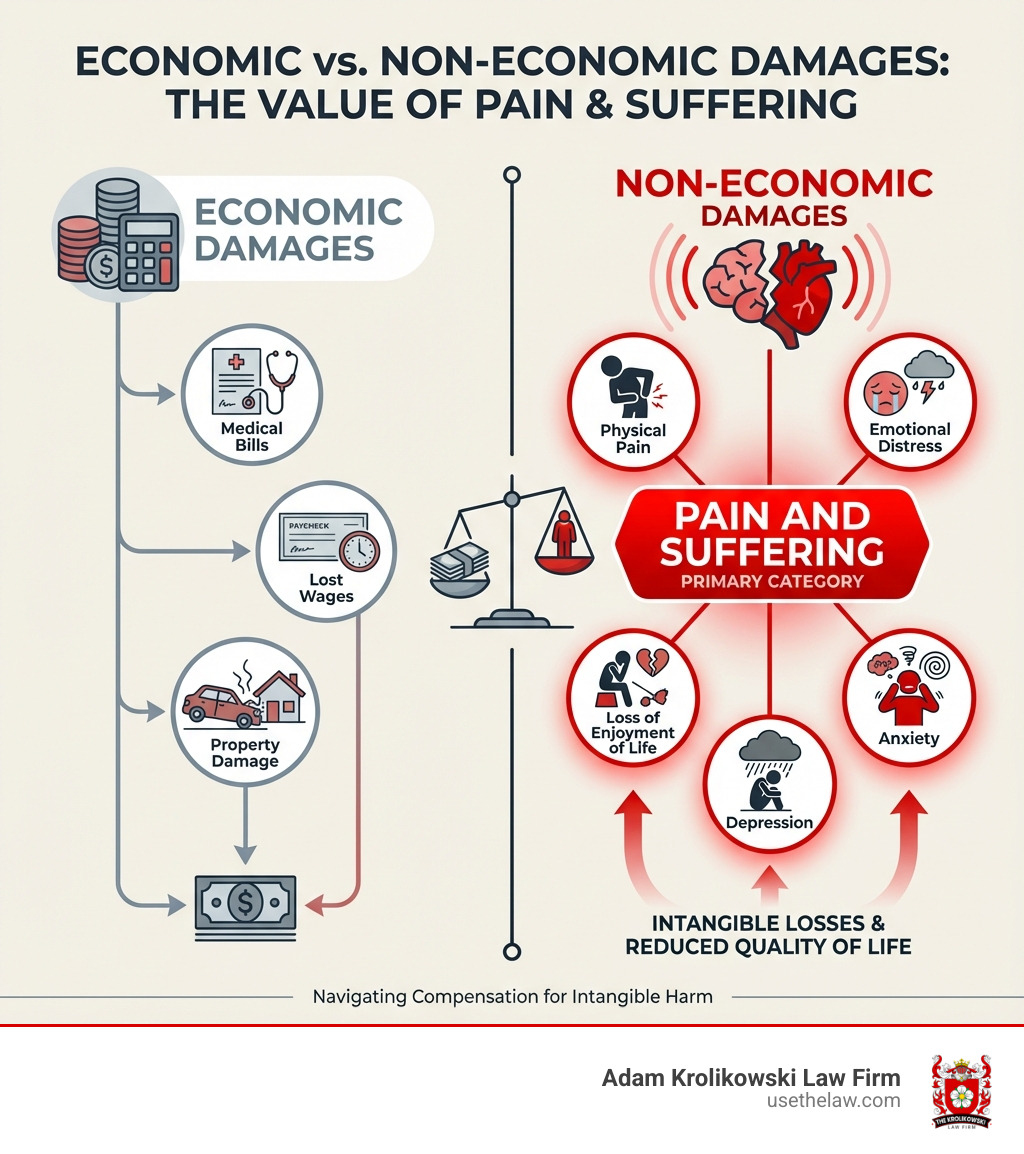
When we talk about “pain and suffering” in a personal injury lawsuit, we’re delving into the less tangible, but equally devastating, consequences of an accident. These are the human losses that don’t appear on a tangible bill, but profoundly affect your life. In California, these are generally referred to as non-economic damages, contrasting with economic damages (also called pecuniary or special damages) which cover measurable financial losses like medical bills, lost wages, and property damage.
Non-economic damages, or general damages, compensate you for the intangible losses resulting from your injury. These losses can include:
- Physical pain: The direct bodily discomfort and agony you endure.
- Mental anguish: The emotional and psychological distress caused by the incident.
- Emotional distress: Feelings of anxiety, fear, sadness, and anger.
- Loss of enjoyment of life: The inability to participate in hobbies, activities, or relationships that once brought you joy.
- Loss of consortium: The negative impact on your relationships with family members, particularly your spouse.
As one resource clearly states, “Pain and suffering is legally defined as the physical and mental anguish a person experiences after a traumatic incident.” It’s about recognizing that an injury doesn’t just cost money; it costs you your quality of life, your peace of mind, and your overall well-being.
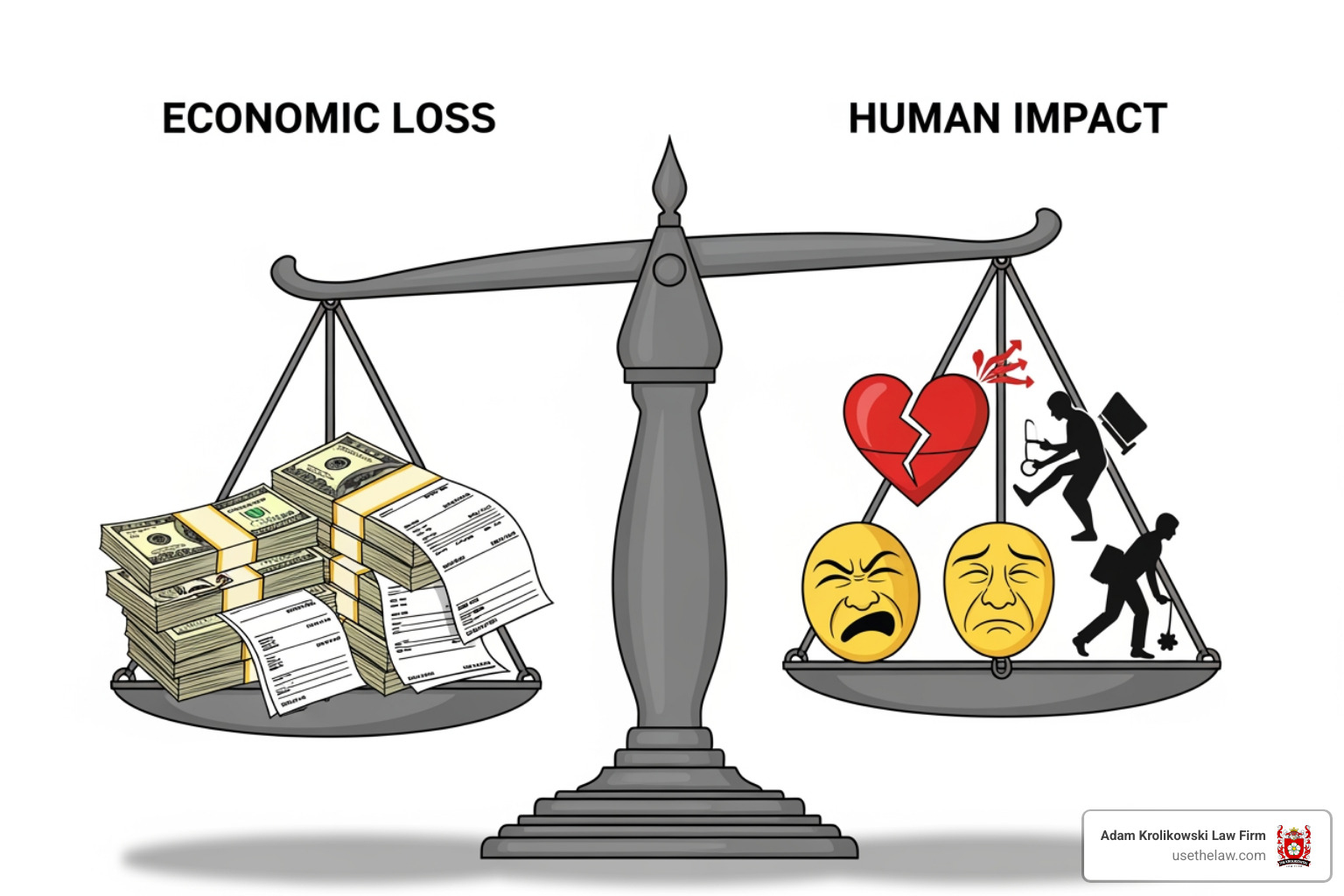
If you’ve suffered emotional distress due to another’s negligence, understanding your rights is crucial. Learn more about Distress Claims Personal Injury Law Attorney.
What Constitutes Physical Pain and Suffering?
Physical pain and suffering encompasses a wide range of bodily discomforts and limitations stemming from your injury. It’s not just the initial sharp pain of an accident, but the ongoing ache, the restricted movement, and the chronic discomfort that can persist for years. This includes:
- Injury severity: The immediate and intense pain from broken bones, burns, or internal injuries.
- Chronic pain: Long-term or persistent pain that can drastically reduce your quality of life, often requiring ongoing medical management.
- Discomfort from treatment: The pain associated with surgeries, physical therapy, injections, and other medical interventions aimed at recovery.
- Scarring and disfigurement: The physical and emotional pain caused by permanent marks or changes to your appearance.
- Future pain: The anticipated pain and discomfort you are likely to experience throughout your life due to a permanent injury.
- Physical limitations: The inability to perform daily tasks, work, or engage in recreational activities that you once enjoyed.
For instance, a sharp pain shooting down your leg each time you walk up the stairs, or the constant ache in your back that makes it impossible to lift your child, are all forms of physical pain and suffering.
What Constitutes Mental and Emotional Suffering?
Beyond the physical wounds, accidents often leave invisible scars. Mental and emotional suffering refers to the psychological impact of your injury. These are the internal battles that can be just as debilitating as physical pain. This can manifest as:
- Anxiety: Constant worry, nervousness, or unease about your health, finances, or future.
- Depression: Feelings of hopelessness, sadness, and a loss of interest in activities you once loved.
- PTSD (Post-Traumatic Stress Disorder): Flashbacks, nightmares, and severe anxiety after experiencing a traumatic event like a car accident.
- Insomnia: Difficulty sleeping or staying asleep due to pain, anxiety, or traumatic memories.
- Fear: A persistent apprehension about future incidents, driving, or engaging in activities that remind you of the accident.
- Humiliation: Feelings of embarrassment or shame, especially if your injuries affect your appearance or ability to care for yourself.
- Grief: Profound sadness or sorrow, particularly if the accident resulted in the loss of a loved one or a significant change in your life.
Friends, family members, or colleagues might describe how you’ve become withdrawn, lost interest in cherished activities, or seemed noticeably more irritable since the accident. These observations, combined with professional evaluations, are critical for proving emotional distress.
For those in Santa Ana dealing with mental health challenges due to workplace incidents, it’s important to understand your rights. Get More info about mental health claims.
How Pain and Suffering Compensation is Calculated in Orange County
Calculating pain and suffering damages in Orange County is less about a rigid formula and more about building a compelling case that demonstrates the profound impact an injury has had on your life. Unlike economic damages, which are calculated by adding up bills and lost wages, non-economic damages are subjective. There’s no exact price tag for a sleepless night or the inability to enjoy a walk on the beach.
Judges typically instruct juries to use their “good sense, background, and experience” to determine these values. However, insurance companies and legal teams use a few common methods to estimate these damages, which we’ll explore below. The goal of a pain and suffering lawyer is to quantify these intangible losses in a way that resonates with adjusters, judges, and juries, ensuring you receive fair compensation.

Common Calculation Methods Explained
While seemingly subjective, personal injury lawyers and insurance adjusters often use structured approaches to arrive at a pain and suffering value:
- Multiplier Method: This is perhaps the most common approach. It involves taking your total economic damages (medical bills, lost wages, etc.) and multiplying them by a factor, usually between 1.5 and 5.
- Economic Damages: These are your measurable financial losses.
- Severity Factor: This multiplier depends heavily on the severity, permanence, and impact of your injuries. A minor injury with a quick recovery might warrant a 1.5 multiplier, while a catastrophic, life-altering injury could justify a 5 or even higher. For example, if your economic damages are $50,000 and your injury is moderately severe (multiplier of 3), your pain and suffering could be estimated at $150,000.
- Per Diem Approach: “Per diem” is Latin for “per day.” This method assigns a specific dollar amount for each day you experienced pain and suffering, from the date of the injury until you reach maximum medical improvement or are expected to recover.
- Daily Rate: This daily rate often corresponds to your daily earnings before the accident, or a reasonable amount to compensate for a day of pain.
- Justifying the Rate: This method requires careful documentation of each day’s suffering. If you were suffering for 300 days and the daily rate is $200, your pain and suffering would be $60,000.
Insurance companies also use software programs, sometimes referred to as “Colossus,” to help them estimate pain and suffering values. These programs use various inputs and algorithms, but they are often designed to favor the insurer. This is why having a knowledgeable pain and suffering lawyer on your side is so important—they can challenge these estimates and advocate for a fair valuation based on the unique details of your case.
Key Factors That Influence Your Claim’s Value
The value of your pain and suffering claim isn’t determined by a single factor, but rather a combination of elements that paint a complete picture of your post-accident life. These include:
- Severity and permanency of injury: The more severe and long-lasting your injuries are, the higher the potential value of your claim. A permanent disability or chronic condition will command greater compensation than a temporary sprain.
- Medical evidence strength: Comprehensive and consistent medical records, diagnostic test results, and reports from treating physicians are crucial. They provide objective proof of your injuries and their impact.
- Impact on daily activities and work: How have your injuries affected your ability to perform daily tasks, engage in hobbies, care for your family, or earn a living? Documenting these changes is vital.
- Length of recovery: The longer your recovery period, the more pain and suffering you’ve endured. This includes time spent in hospitals, rehabilitation, or out of work.
- Plaintiff’s credibility and likeability: While subjective, your demeanor, consistency in your statements, and how you present your story can influence how a jury or adjuster perceives your suffering. Exaggeration can undermine your entire case.
- Nature of the accident: Accidents involving gross negligence or intentional harm may result in higher awards due to the egregious nature of the defendant’s actions.
- Your age: Younger individuals with permanent injuries may receive higher awards because they will live with the consequences for a longer period.
Navigating Legal Problems: Damage Caps and Fault Rules in California
Understanding the specific legal landscape of California is crucial for any personal injury claim, especially when it comes to pain and suffering. Unlike some states, and the specific rules we saw in Ontario, California has unique laws regarding how fault is assigned and when damages might be capped. Our firm, with over 25 years of experience handling complex cases in Orange County, understands these nuances deeply.
How California’s Comparative Fault Rule Affects Your Award
California follows a “pure comparative negligence” rule. This is a fancy legal term that simply means you can still recover damages even if you were partially at fault for the accident. However, your compensation will be reduced by your percentage of fault.
For example, imagine you were in a car accident in Santa Ana. A jury determines your total damages (economic and non-economic) are $100,000. However, they also find that you were 20% at fault for the collision (perhaps you were speeding slightly). Under pure comparative negligence, your award would be reduced by 20%, meaning you would receive $80,000.
This rule means that even if you bear significant responsibility for an accident, you aren’t entirely barred from seeking compensation. However, it also means the at-fault party’s insurance company will likely try to shift as much blame as possible onto you to reduce their payout. This is where a pain and suffering lawyer becomes invaluable, diligently working to protect your right to compensation.
Are There Caps on Pain and Suffering Damages in California?
This is a common question, and the answer is usually good news for accident victims in Orange County: In most personal injury cases, there is no cap on pain and suffering damages in California. This means that for typical cases like car accidents, slip and falls, or dog bites, the sky’s the limit (theoretically) when it comes to how much a jury can award for your non-economic losses.
However, there is one significant exception: medical malpractice cases. Under the Medical Injury Compensation Reform Act (MICRA), non-economic damages (which include pain and suffering) are limited. These limits can change over time, but it’s important to be aware of this specific cap if your injury stems from medical negligence.
This distinction is important. While Ontario has broad caps and deductibles for motor vehicle accidents, California generally allows juries to award the full extent of non-economic damages based on the evidence presented. This makes a strong, well-documented case for pain and suffering even more critical.
For more detailed information on pain and suffering in personal injury cases, you can visit What is “Pain and Suffering” In a Personal Injury Case?.
The Crucial Role of a Pain and Suffering Lawyer in Your Claim
You’ve been through enough. The last thing you need is to steer the complex legal system while also trying to recover from your injuries. This is precisely why a pain and suffering lawyer is indispensable. They are your advocate, your guide, and your champion, ensuring that your story is heard and your suffering is justly compensated. Our firm handles complex personal injury cases that other attorneys may not take, offering dedicated representation to accident victims in Orange County.
A lawyer helps you:
- Evidence Gathering: We know exactly what evidence is needed and how to obtain it to build a strong case for your pain and suffering.
- Negotiation Skills: Insurance companies are in the business of minimizing payouts. We know their tactics and negotiate fiercely on your behalf to counter lowball offers.
- Litigation: If a fair settlement cannot be reached, we are prepared to take your case to court and present a compelling argument to a judge and jury.
- Maximizing Compensation: Our goal is to ensure you receive the fullest compensation possible for all your losses, both economic and non-economic.
- Navigating Complexity: From understanding California’s unique laws to dealing with mountains of paperwork, we handle the intricate details so you can focus on healing.
Proving Your Case: Gathering Evidence for a Pain and Suffering Lawyer
Proving pain and suffering requires a meticulous and comprehensive approach to evidence gathering. Since these damages are subjective, we need to show how your injuries have objectively impacted your life. Here’s what we typically gather:
- Medical records: These are the backbone of your claim, documenting your injuries, diagnoses, treatments, medications, and prognoses. Doctor’s notes detailing your complaints of pain and limitations are especially important.
- Pain journals: A daily or weekly journal where you track your physical pain (location, intensity, duration), emotional state, and how your injuries affect your daily tasks, hobbies, and sleep. This provides a consistent, account of your suffering.
- Photographs of injuries: Visual evidence of visible injuries, such as bruises, cuts, scars, or disfigurement, captured regularly with date stamps, can be powerful.
- Witness testimony: Statements from individuals who witnessed the accident or, more importantly, have observed the changes in your life since the injury. This includes family, friends, and colleagues. They can describe how you’ve become withdrawn, lost interest in cherished activities, or seemed noticeably more irritable.
- Psychological evaluations: If you’re experiencing mental or emotional distress, reports from therapists, psychologists, or psychiatrists are crucial. These evaluations can diagnose conditions like PTSD, depression, or anxiety stemming from the accident.
For more information on the specifics of mental health claims in Santa Ana, you can refer to More info about mental health claims.
Maximizing Your Compensation with a Pain and Suffering Lawyer
Our role isn’t just to gather evidence; it’s to strategically use that evidence to build a powerful case that maximizes your compensation. We do this by:
- Building a compelling narrative: We weave together all the pieces of evidence—your medical history, personal journals, and witness statements—into a cohesive and persuasive story that illustrates the full extent of your suffering.
- Quantifying intangible losses: We take the subjective experiences of pain and suffering and translate them into a monetary value, using calculation methods that are defensible and persuasive to insurance adjusters and juries.
- Leveraging expert witnesses: For complex cases, we may bring in medical specialists, vocational experts, or economists to provide testimony on the severity of your injuries, your future medical needs, and the long-term impact on your earning capacity and quality of life.
- Negotiating with insurance adjusters: Insurance companies will try to settle for the lowest amount possible. We handle all communications, challenging lowball offers with strong evidence and legal arguments, ensuring you don’t accept less than you deserve.
- Court representation: If negotiations fail to produce a fair settlement, we are prepared to represent you in court, advocating fiercely for your rights before a judge and jury.
Pitfalls of Handling a Pain and Suffering Claim Alone
Trying to steer a pain and suffering claim without legal representation can be like trying to perform surgery on yourself—it’s risky and often leads to less-than-ideal outcomes. Here are some common pitfalls:
- Underestimating claim value: Without a deep understanding of legal precedents, calculation methods, and similar case outcomes, you might significantly undervalue your claim, leaving money on the table.
- Inadequate documentation: You might miss crucial evidence or fail to document your suffering consistently, weakening your case.
- Damaging statements to adjusters: Insurance adjusters are trained to get you to say things that can be used against your claim. Without legal guidance, you might inadvertently undermine your own case.
- Missing the statute of limitations: California has strict deadlines for filing personal injury lawsuits. Missing this window, typically two years from the date of injury, means you lose your right to pursue compensation forever.
- Legal procedure errors: Personal injury lawsuits involve complex rules of civil procedure and evidence. Mistakes can lead to delays, dismissal of your case, or unfavorable outcomes.
Frequently Asked Questions about Orange County Pain and Suffering Claims
We understand you have questions, and we’re here to provide clear answers based on California law and our experience in Orange County.
Is there a cap on pain and suffering damages in California?
In most personal injury cases, like car accidents or slip and falls, there is no cap on pain and suffering damages in California. This means that if a jury finds the at-fault party responsible, they can award an amount that they deem fair to compensate for your physical and emotional suffering. However, for medical malpractice cases, non-economic damages are limited by the Medical Injury Compensation Reform Act (MICRA). These caps can change over time, so it’s important to consult with a lawyer to understand the current limits if your case involves medical negligence.
How long do I have to file a pain and suffering claim in Orange County?
In California, the statute of limitations for most personal injury claims is two years from the date of the injury. This means you generally have two years from the day your accident occurred to file a lawsuit. It is crucial to act quickly, as failing to file a lawsuit within this timeframe will likely bar you from recovering any compensation. There are some exceptions to this rule, but they are rare and complex. Don’t delay—the sooner you seek legal advice, the better.
What if I was partially at fault for my accident?
California follows a “pure comparative negligence” rule. This means you can still recover damages even if you were partially at fault for the accident, but your compensation will be reduced by your percentage of fault. For example, if you are awarded $100,000 in total damages but found to be 20% at fault, you would receive $80,000. This system allows for a fair allocation of responsibility, but it also means the opposing side will work hard to assign more fault to you, which is why having a strong pain and suffering lawyer is essential.
Secure the Compensation You Deserve in Orange County
Suffering from an injury due to someone else’s negligence is a heavy burden, made even heavier by the physical pain and emotional distress that often accompany it. While economic damages are straightforward to calculate, the intangible losses of pain and suffering require a nuanced approach, meticulous evidence gathering, and skilled legal advocacy.
We’ve seen that understanding what constitutes pain and suffering, how it’s calculated, and the specific legal rules in California (like pure comparative negligence and the absence of caps in most personal injury cases) is vital. However, navigating these complexities alone can be overwhelming and lead to costly mistakes.
At Adam Krolikowski Law Firm, we are dedicated to helping accident victims in Orange County. With our experience and commitment to handling complex cases, we work tirelessly to ensure your pain and suffering are recognized and justly compensated. Don’t let your suffering go unaddressed.
If you or a loved one has been seriously injured and are experiencing pain and suffering due to another’s negligence, we are here to help.
Contact an Orange County personal injury lawyer for a consultation on your serious injury claim.