

Understanding the Life-Changing Impact of Spinal Cord Injuries
When someone else’s negligence causes a devastating spinal cord injury, a spinal cord injury claim provides crucial financial support. These claims help victims recover compensation for medical expenses, lost wages, and the profound changes to their daily lives, including loss of mobility and independence.
Key facts about spinal cord injury claims:
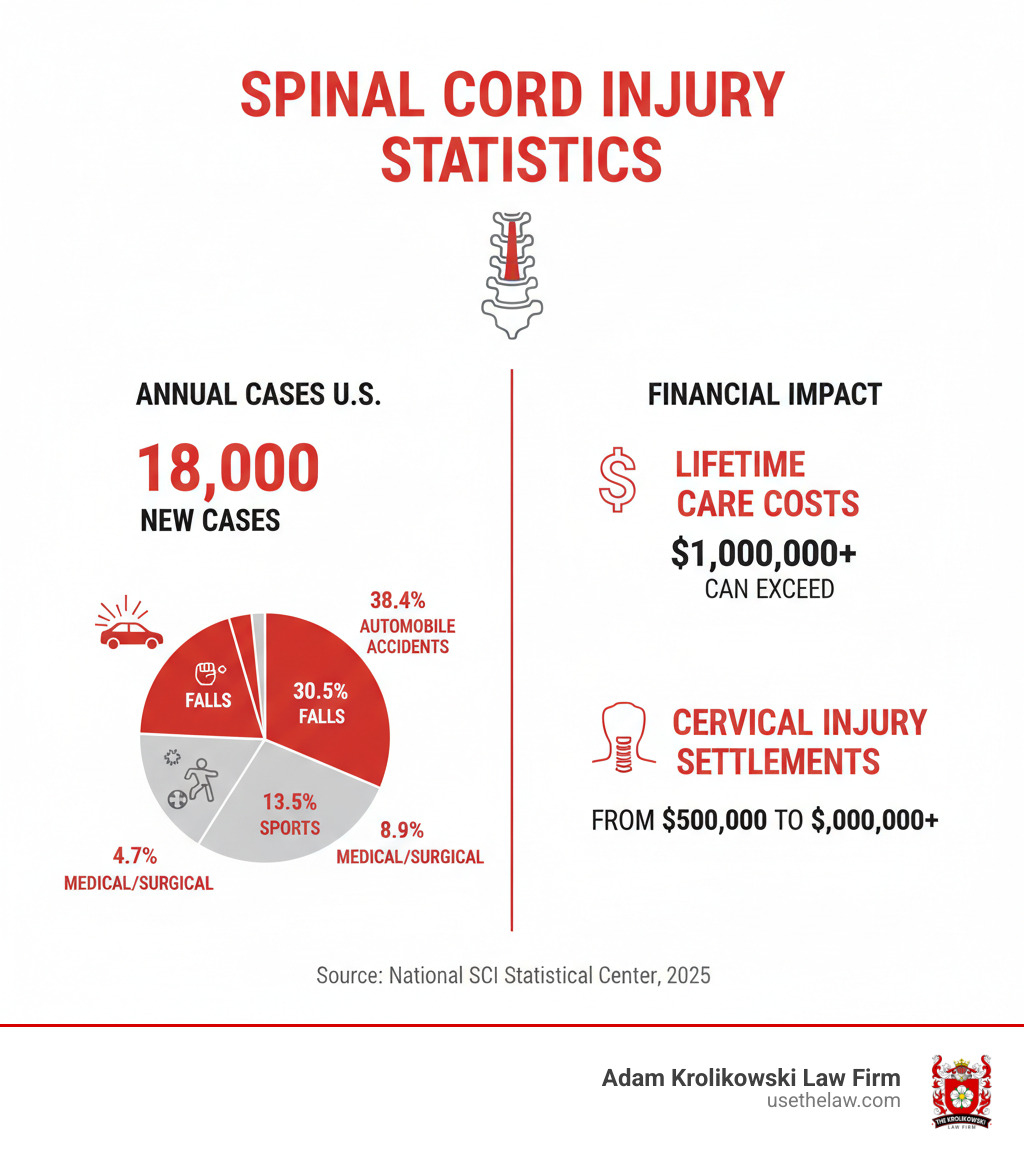
- Almost 18,000 new spinal cord injuries occur in the U.S. each year
- Lifetime care costs can easily reach millions of dollars
- Settlement ranges vary from $50,000 for minor injuries to over $5 million for severe cases
- Time limits apply – typically 2-3 years to file a claim
- Multiple types of compensation available: medical expenses, lost income, pain and suffering
The financial reality is staggering. Survivors with high tetraplegia can expect to spend more than $1.06 million in the first year alone, with an average of $184,891 every year after that. Nearly 1 in 3 people with a spinal cord injury will be re-hospitalized at some point.
These injuries most commonly result from automobile accidents (38.4%), falls (30.5%), violence (13.5%), and sports activities (8.9%). More than half occur in people between ages 16-30, often during their prime earning years.
Whether your injury happened at work, in a car accident, or due to medical malpractice, understanding your legal rights is critical to securing the compensation you need for your recovery and future care.
Understanding Spinal Cord Injuries and Their Causes
Your spinal cord is a delicate, 18-inch bundle of nerves running from your brain down your spine, controlling everything from movement to breathing. Unlike a typical back injury involving bones or muscles, a spinal cord injury means the nerve bundle itself is damaged, often with life-changing consequences.

The spine has three main sections: the cervical spine (neck, C1-C7), thoracic spine (upper/mid-back, T1-T12), and lumbar/sacral spine (lower back, L1-S5). The location of the injury determines its effect on your body.
According to the National Cord Injury Statistical Center, the leading causes of these injuries are automobile accidents (38.4%), falls (30.5%), violence (13.5%), sports injuries (8.9%), and medical errors (4.7%). The sudden, violent force in these incidents can crush or sever the delicate spinal cord.
Types and Classifications of Spinal Injuries
Spinal cord injuries are evaluated based on two key factors that directly impact a spinal cord injury claim: the completeness of the injury and its location.
- Complete injuries involve a total loss of feeling and movement below the injury site.
- Incomplete injuries leave some function or sensation intact.
The location of the injury determines the extent of paralysis and significantly affects settlement values:
- Cervical spine injuries (C1-C7) in the neck are the most severe, causing tetraplegia (quadriplegia)—paralysis of all four limbs and the torso. These can affect breathing and may result in settlements from $500,000 to over $5 million.
- Thoracic spine injuries (T1-T12) in the upper back typically cause paraplegia—paralysis of the lower body. Use of the arms and hands is usually retained.
- Lumbar and sacral injuries (L1-S5) in the lower back can cause lower body paralysis and loss of bowel, bladder, and sexual function.
Other serious spine injuries can also lead to claims. Herniated discs, where a disc presses on nerves, may settle for $50,000 to $350,000. Compression fractures, where vertebrae collapse, typically range from $75,000 to $250,000. It’s critical to seek immediate medical care after any spine injury, as swelling can cause delayed paralysis even if the cord isn’t immediately damaged.
The Lifelong Impact: Financial and Personal Costs
A spinal cord injury permanently alters every aspect of life. The consequences are not just physical but also financial and emotional, making a comprehensive spinal cord injury claim essential for your future.

The financial burden is immense. A person with high tetraplegia may face over $1.06 million in costs in the first year, followed by an average of $184,891 annually. These figures highlight why a thorough claim is so important.
Medical expenses are immediate and ongoing, including emergency care, surgeries, hospital stays, and therapy. Nearly 1 in 3 people with a spinal cord injury will be re-hospitalized, adding to the financial strain. You will also need specialized equipment like wheelchairs, braces, and ventilators, which require regular replacement.
Your home and vehicle will likely need significant and costly modifications, such as ramps, roll-in showers, and adapted controls. These are necessities for maintaining basic independence.
Lost income and earning capacity often represent the largest financial loss over a lifetime. Many individuals cannot return to their previous jobs, losing decades of future earnings and retirement savings. Depending on the injury’s severity, you may also need in-home assistance or full-time care, which can cost hundreds of thousands of dollars per year.
The emotional toll is just as profound. Depression, anxiety, and PTSD are common. The injury also affects family, leading to what is legally known as “loss of consortium”—the loss of companionship and intimacy in a marriage. The inability to participate in hobbies and social activities can lead to isolation, compounding the emotional challenges.
These injuries are catastrophic because they affect every part of life. The Christopher Reeve Foundation provides detailed information on the long-term financial impacts of a spinal cord injury. Understanding this full scope is essential when pursuing your spinal cord injury claim to ensure you have the resources needed for the decades ahead. For more information, you can learn more info about catastrophic injuries.
Navigating Your Spinal Cord Injury Claim: Compensation and Valuation
When pursuing a spinal cord injury claim, it’s important to understand what compensation is available and how its value is determined. Compensation is generally divided into two categories.

Economic damages are tangible, calculable losses. This includes all past and future medical expenses, lost wages, and loss of future earning capacity. It also covers the cost of home and vehicle modifications, medical equipment, and in-home care.
Non-economic damages compensate for intangible losses that don’t have a specific price tag. This includes pain and suffering, emotional distress, loss of enjoyment of life, and the impact on your family relationships (loss of consortium).
| Economic Damages | Non-Economic Damages |
|---|---|
| Medical bills (past & future) | Pain and suffering |
| Lost wages (past & future) | Emotional distress |
| Rehabilitation costs | Loss of enjoyment of life |
| Home/vehicle modifications | Loss of consortium |
| In-home care/assistance | Scarring and disfigurement |
| Property damage |
In rare cases of extreme misconduct, punitive damages may be awarded to punish the wrongdoer and deter similar behavior in the future. For more insights, you can explore our Personal Injury Claims resources.
Factors That Determine the Value of Your Spinal Cord Injury Claim
The value of a spinal cord injury claim depends on a unique mix of factors:
- Severity and level of your injury: A complete cervical injury causing tetraplegia will result in a much higher valuation (often over $5 million) than an incomplete lumbar injury ($500,000 or less) due to the vast difference in care needs.
- Medical diagnosis: Specific diagnoses like a herniated disc ($50,000-$350,000) or compression fracture ($75,000-$250,000) have typical settlement ranges, but complications can increase these values.
- Age: A younger person has more years of future medical costs and lost earning potential, which increases the claim’s value.
- Impact on daily life: The inability to perform daily tasks, work, or enjoy hobbies is a significant factor in compensation.
- Strength of evidence: Clear proof that someone else was at fault strengthens your position for a fair settlement.
- Past and future medical expenses: These form the foundation of your economic damages, often projected by life care planners.
- Location: State laws on damage caps and fault can influence claim value.
- Insurance policy limits: While these can create a ceiling, other sources of recovery may be available.
Immediate Steps to Protect Your Rights
After a spinal cord injury, taking these steps can protect your legal rights:
- Seek immediate medical care. This is vital for your health and creates an official record of your injuries.
- Document everything. Keep all medical records, bills, and receipts. A journal detailing your pain and daily challenges can be powerful evidence.
- Preserve evidence. Collect witness information, take photos of the scene and your injuries, and obtain official police or incident reports.
- Avoid speaking to insurance adjusters. They are trained to minimize payouts. Do not give a recorded statement without legal counsel.
- Consult with a lawyer early. An attorney can immediately begin investigating and protecting your rights while you focus on recovery.
- Be mindful of time limits. Personal injury claims have strict deadlines (statutes of limitations). Missing them can mean losing your right to compensation forever.
The Legal Process: Proving Fault and Building Your Case
To succeed in a spinal cord injury claim, the legal process focuses on proving another party was at fault and demonstrating the full extent of your damages. Most cases are built on the legal principle of negligence.
To prove negligence, we must establish four elements:
- Duty of Care: The other party had a legal obligation to act with reasonable care (e.g., a driver’s duty to obey traffic laws).
- Breach of Duty: The party failed to meet that obligation (e.g., they were texting while driving).
- Causation: This breach directly caused your spinal cord injury.
- Damages: You suffered real, measurable losses as a result.
In some cases, multiple parties may share responsibility. California uses a comparative negligence system, meaning your compensation is reduced by your percentage of fault. For example, if you are found 10% at fault in a $200,000 verdict, you would receive $180,000. We work to minimize any fault attributed to you. You can learn more by Understanding liability in personal injury cases.
The Role of Professional Witnesses and Evidence
Building a strong spinal cord injury claim requires assembling a team of qualified professionals to explain complex issues. These may include:
- Medical Professionals: Neurologists and surgeons testify about your injury, prognosis, and the cause.
- Life Care Planners: These individuals create detailed reports projecting your future medical and personal care needs and their costs.
- Vocational Rehabilitation Professionals: They assess how the injury impacts your ability to work and calculate your lost earning capacity.
- Economists: They translate future losses into a present-day dollar value.
- Accident Reconstructionists: In complex accidents, they can recreate the event to help establish fault.
Key evidence we gather includes medical records, police reports, financial documents (pay stubs, bills), photos/videos of the scene, and witness testimony. The testimony of friends and family about how the injury has changed your life can also be powerful, as detailed in our guide on the role of witnesses in personal injury cases. Our approach to working with these professionals is outlined in our resource on Using professional witnesses in personal injury law.
Timeline and Statute of Limitations for a Spinal Cord Injury Claim
A spinal cord injury claim can take one to three years to resolve, depending on its complexity. The process generally involves:
- Case Investigation: We gather records, reports, and witness statements.
- Findy Process: Both sides exchange information through depositions and written questions.
- Negotiation: We send a demand letter to the insurance company to begin settlement talks. Most cases are resolved at this stage.
- Trial: If a fair settlement cannot be reached, we file a lawsuit and prepare for trial.
In California, you generally have two years from the date of injury to file a lawsuit. This is known as the statute of limitations. Missing this deadline usually means you forfeit your right to compensation.
Exceptions exist. The findy rule may extend the deadline if your injury was not immediately apparent. For minors, the clock typically starts on their 18th birthday. However, claims against government entities have a much shorter deadline, often just six months to file an initial claim. Acting quickly is essential.
Frequently Asked Questions about Spinal Cord Injury Claims
When facing a spinal cord injury, you will naturally have many questions. Here are answers to some of the most common ones we hear.
Will my spinal cord injury case go to trial?
Most spinal cord injury claims settle out of court. We prepare every case for trial, as this readiness shows the insurance company we are serious and often leads to better settlement offers. A trial may become necessary if the insurance company denies liability or makes an unfair settlement offer that doesn’t cover your lifetime needs. Our willingness to go to court is a key part of our strategy to secure fair compensation for you.
How long do I have to file a lawsuit in California?
In California, the general statute of limitations is two years from the date of your injury. If you miss this deadline, you will likely lose your right to file a lawsuit forever.
There are exceptions. The findy rule may apply if your injury wasn’t immediately obvious, in which case the two-year period begins when you find or should have finded the injury. For minors, the deadline is typically extended until two years after they turn 18.
Crucially, claims against government entities have a much shorter deadline, often just six months to file an administrative claim. It is vital to act quickly to protect your rights.
How much does it cost to hire a lawyer for an SCI claim?
We handle all spinal cord injury claims on a contingency fee basis. This means you pay no upfront costs. We cover all expenses related to building your case, such as filing fees and costs for obtaining records and professional analysis.
We only get paid if we win your case. Our fee is a pre-agreed percentage of the compensation we recover for you. If we don’t secure a settlement or verdict in your favor, you owe us nothing. This structure allows you to access quality legal representation without any financial risk, so you can focus on your recovery.
Securing Your Future After a Catastrophic Injury
When a spinal cord injury changes your life, the path forward can seem uncertain. You are facing not just physical trauma but also a future with staggering financial costs and profound emotional challenges. When someone else’s negligence is to blame, a spinal cord injury claim is not just about justice—it’s about securing the resources you need to rebuild your life with dignity.
The legal process is complex, requiring careful proof of fault and a thorough accounting of lifetime damages. The stakes are incredibly high, as your future well-being depends on the outcome.
At the Adam Krolikowski Law Firm, we understand the weight you are carrying. For over 25 years, we have handled the complex personal injury and workers’ compensation cases that other firms may avoid. We know that behind every claim is a person and a family whose world has been turned upside down.
Our approach is to fight for every dollar you are entitled to. We work on a contingency fee basis, so you pay nothing unless we win your case. This allows you to focus on your recovery while we handle the legal battle.
Your injury may have changed your life, but it does not have to define your future. With the right legal support and fair compensation, you can build a meaningful life. Don’t wait to protect your rights. Contact us today for a free case evaluation and let us help you take the first step toward the peace of mind you deserve.
Contact a Brain Injury Lawyer in Orange County, CA for a free case evaluation
