

Why Construction Accident Victims Need Legal Representation
A construction accident lawyer helps injured workers steer complex legal claims and secure maximum compensation after workplace injuries. Construction sites are among the most dangerous work environments in America, with at least 150,000 construction workers suffering injuries on the job each year.
What a Construction Accident Lawyer Does:
- Investigates accident causes and gathers evidence
- Identifies all liable parties (employers, contractors, manufacturers)
- Handles workers’ compensation claims
- Pursues third-party personal injury lawsuits
- Negotiates with insurance companies
- Represents you in court if necessary
Types of Compensation Available:
- Medical expenses and ongoing treatment
- Lost wages and reduced earning capacity
- Pain and suffering (through third-party claims)
- Permanent disability benefits
- Vocational rehabilitation costs
When you’re injured on a construction site, you’re facing mounting medical bills and lost income while dealing with insurance companies that want to minimize payouts. The legal system offers multiple paths to recovery – from workers’ compensation to third-party lawsuits – but each has different rules, deadlines, and potential outcomes.
In up to half of all construction accidents, at least one party other than your employer can be held liable. This means you might be entitled to compensation beyond what workers’ comp provides. However, navigating these complex legal waters while recovering from serious injuries is nearly impossible without professional help.
This guide will walk you through everything you need to know about finding and working with a construction accident lawyer, understanding your legal options, and securing the compensation you deserve.
What a Construction Accident Lawyer Does and Why You Need One
When a construction injury derails your life, you’re suddenly juggling doctors, bills, and calls from insurers who want a quick, cheap settlement. A construction accident lawyer steps in so you can focus on healing, not paperwork.
We handle:
- Investigating the scene and preserving evidence
- Identifying every person or company that may owe you money
- Filing and managing your workers’ compensation claim
- Pursuing personal-injury or product-liability suits against third parties
- Negotiating with insurers and, when needed, trying your case in court
Workers represented by counsel routinely receive larger settlements because we know what each claim is worth and how insurers operate. Learn more about personal injury law or visit our Orange County Construction Accident Attorney page for local help.
The Investigation Process
Time is critical—sites can be cleaned up within hours. We quickly:
- Photograph and measure the area
- Collect incident reports, OSHA findings, and maintenance logs
- Interview witnesses while memories are fresh
- Work with engineers, safety experts, and doctors to explain how the accident happened and how it will affect your future
Fighting for Your Rights
Once the facts are locked down we:
- Handle all insurer communication so you don’t get pressured into a low offer
- Calculate medical costs, lost earnings, and future needs with help from economists and physicians
- File every required document on time
- Negotiate hard and, if a fair settlement isn’t offered, present your case to a jury
Common Construction Accidents and Determining Liability
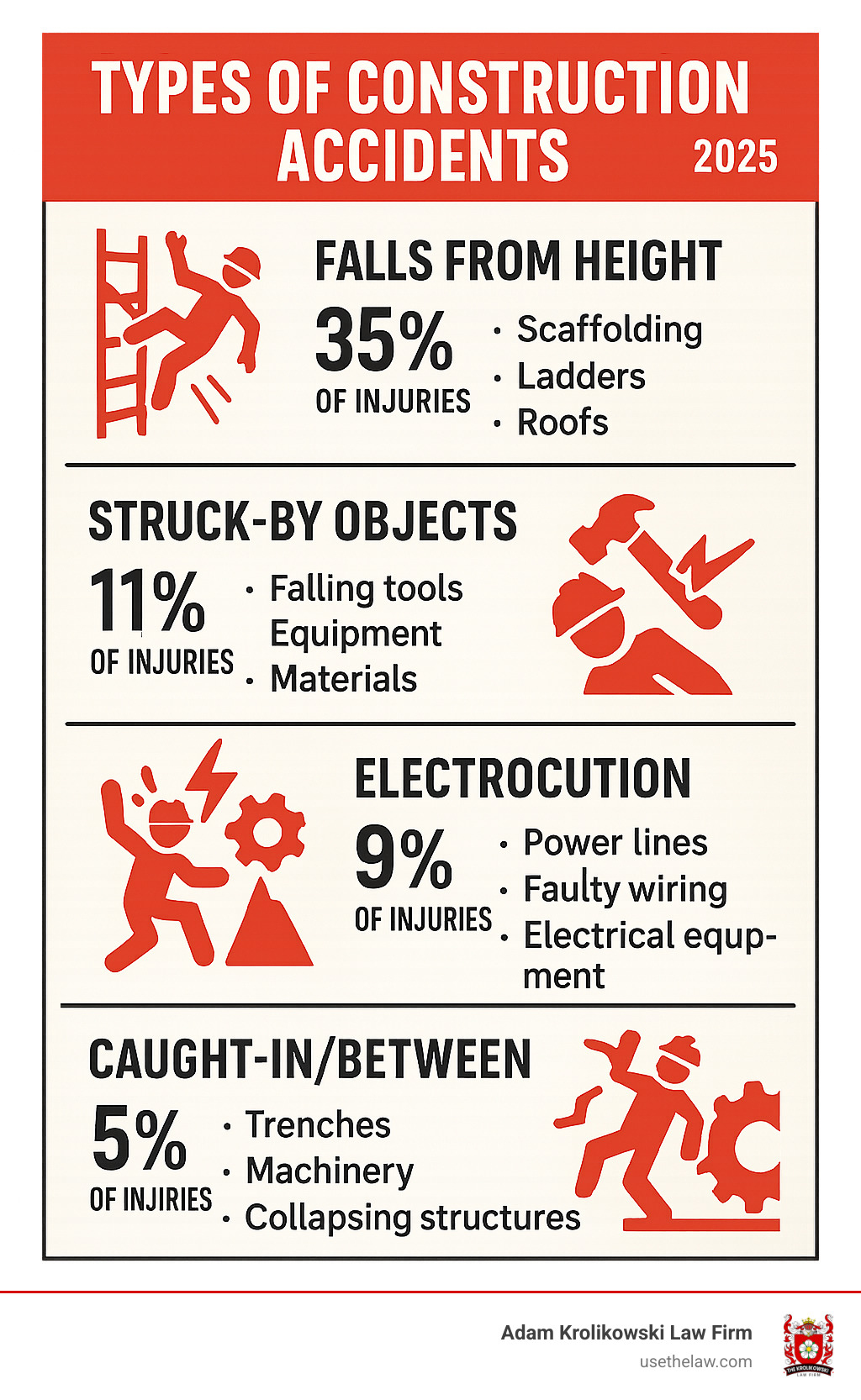
Construction sites change daily, so hazards change too. Most serious claims involve one of these events:
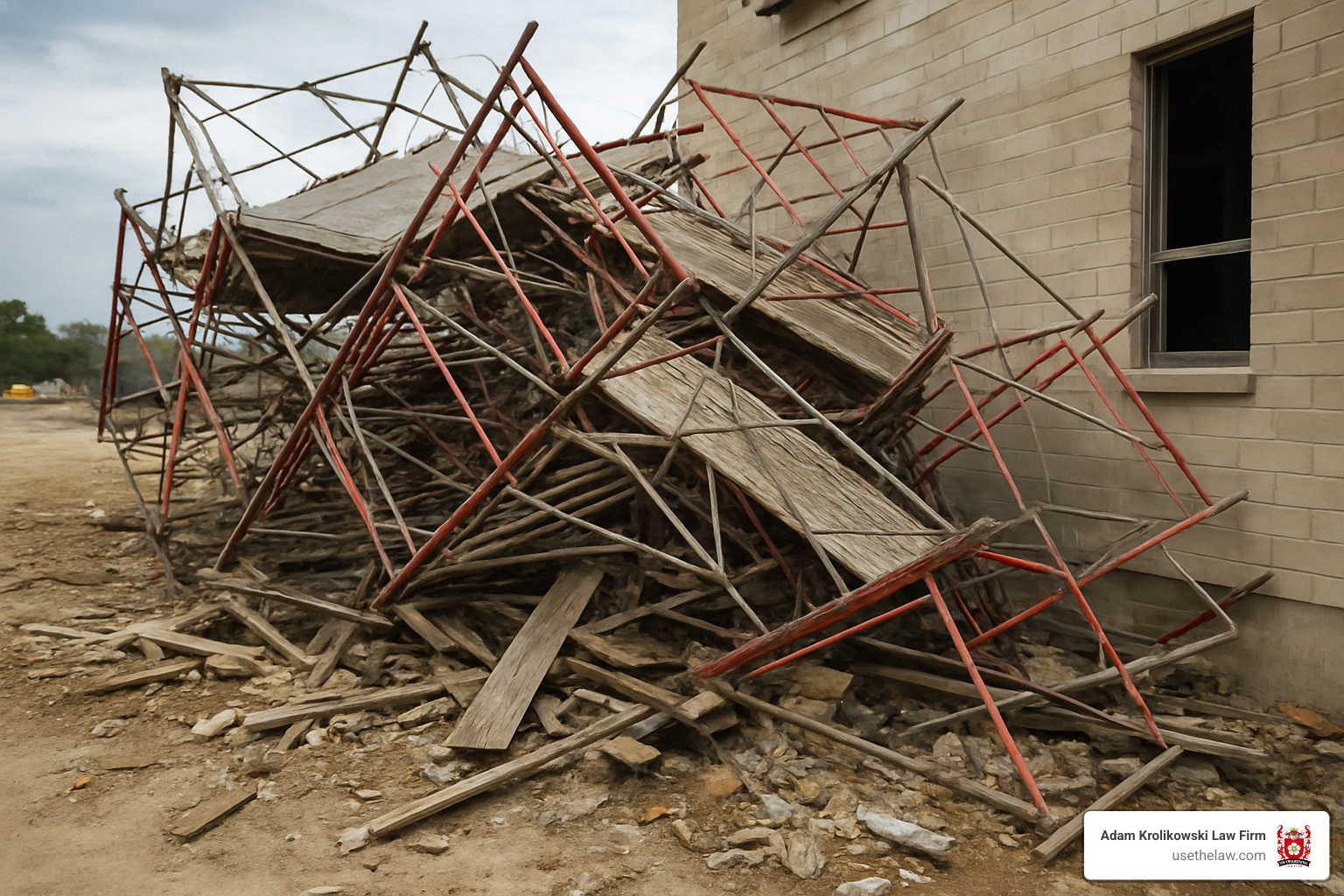
- Falls: from scaffolds, roofs, ladders, or unguarded openings
- Struck-by: tools, materials, or vehicles that weren’t properly secured
- Electrocution: contact with power lines or faulty wiring
- Caught-in/between: trench cave-ins or machinery mess
- Equipment failures: cranes, nail guns, or other gear that malfunctions
Each accident usually springs from broken safety rules—missing guardrails, poor training, or defective products. See more about electrical injury or, for local scaffold cases, our Scaffolding Accident Lawyer in Orange County CA.
Who Can Be Held Responsible?
Because several companies work on one site, multiple parties may share blame:
- Property owners who ignore dangers
- General contractors that fail to enforce safety plans
- Individual subcontractors whose crews cause the hazard
- Architects or engineers whose designs create risks
- Manufacturers that ship defective equipment
Joint liability lets you recover from any at-fault party, increasing the pool of insurance coverage. For premises cases in L.A., visit our Premises Liability Personal Injury Attorney in Los Angeles page.
Typical Injuries
We routinely see:
- Traumatic brain or spinal cord harm, including paralysis
- Complex fractures or amputations from machinery
- Severe burns and internal organ damage from fires or crush events
- Wrongful death, leaving families with lost income and support
These injuries can cost millions over a lifetime, which is why identifying every liable party matters.
Securing Compensation: Workers’ Comp vs. Third-Party Lawsuits

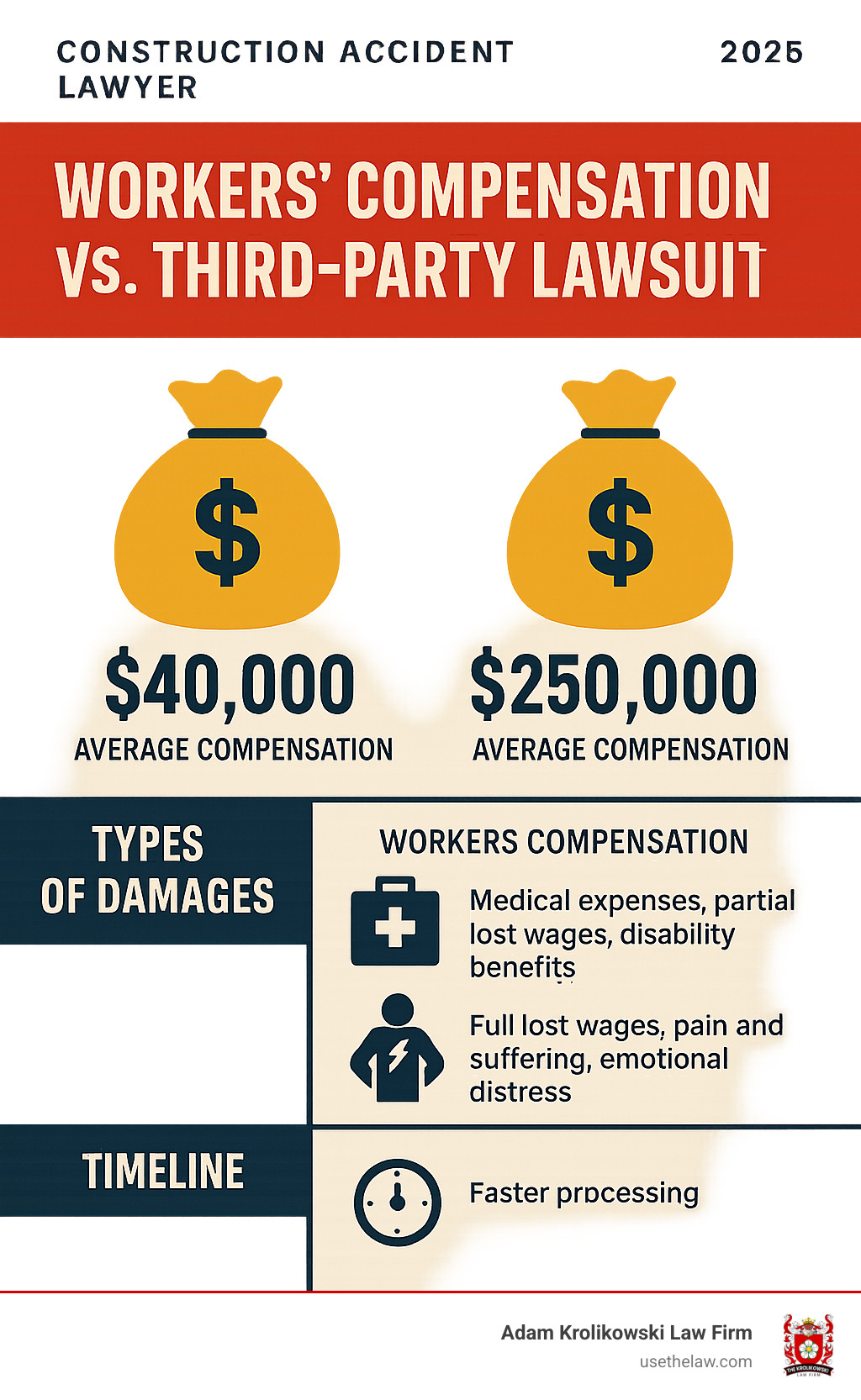
When you’re injured in a construction accident, you typically have two main paths to recovery: workers’ compensation and third-party lawsuits. Understanding both options is crucial because they offer different types of compensation and have different requirements. In many cases, you can pursue both simultaneously to maximize your financial recovery.
Our Workers Compensation Lawyer in Orange County California can help you steer both paths effectively.
How Workers’ Compensation Works
Workers’ compensation is a no-fault system designed to provide immediate benefits to injured workers regardless of who caused the accident. This system is mandatory for virtually all California employers and provides several key benefits.
No-Fault System: You can receive benefits even if the accident was partially your fault. This removes the need to prove negligence, which can speed up the claims process.
Medical Benefits: Workers’ compensation covers all necessary medical treatment related to your injury. This includes emergency care, ongoing treatment, surgeries, medications, and medical equipment.
Temporary Disability Benefits: If you can’t work while recovering, you can receive temporary disability payments. In California, workers injured on or after January 1, 1998, can receive 85% of their average earnings through workers’ compensation benefits.
Permanent Disability Benefits: If your injury results in permanent limitations, you may be entitled to permanent disability benefits based on the severity of your impairment.
Filing a Claim: You must report your injury to your employer within one working day. Your employer then has specific obligations to file the claim with their insurance company.
Employer’s Role: Your employer must provide you with the necessary claim forms and cannot retaliate against you for filing a workers’ compensation claim.
Understanding California workers’ compensation insurance requirements helps ensure you receive all benefits you’re entitled to.
Filing a Third-Party Lawsuit
While workers’ compensation provides important benefits, it doesn’t cover all your losses. Third-party lawsuits allow you to seek additional compensation from parties other than your employer who contributed to your accident.
Negligence of Another Party: If someone other than your employer was negligent and contributed to your accident, you can file a personal injury lawsuit against them. This might include subcontractors, equipment manufacturers, or property owners.
Suing Manufacturers: If defective equipment caused your accident, you can file a product liability lawsuit against the manufacturer. These cases don’t require proving negligence – only that the product was defective and caused your injury.
Suing Subcontractors: If a subcontractor’s negligent work contributed to your accident, you can sue them for damages. This is common in cases involving electrical work, scaffolding, or other specialized tasks.
Recovering Additional Damages: Third-party lawsuits allow you to recover compensation that workers’ compensation doesn’t provide, including full lost wages, pain and suffering, and emotional distress.
Pain and Suffering: Unlike workers’ compensation, third-party lawsuits allow you to recover damages for the physical pain and emotional suffering caused by your injuries.
Emotional Distress: Serious injuries can cause anxiety, depression, and other psychological impacts. Third-party lawsuits allow compensation for these non-economic damages.
| Aspect | Workers’ Compensation | Third-Party Lawsuit |
|---|---|---|
| Who You Can Sue | Your employer’s insurance company | Negligent third parties (contractors, manufacturers, property owners) |
| Types of Damages | Medical expenses, partial lost wages, disability benefits | Full lost wages, pain and suffering, emotional distress, punitive damages |
| Fault Requirements | No-fault system | Must prove negligence or defective product |
| Timeline | Faster processing | Longer legal process |
| Compensation Limits | Limited by workers’ comp schedules | No statutory limits |
Your Guide to the Construction Accident Claim Process

A few smart moves in the first hours after an accident can make or break your claim. For more detail, read our guide to Construction Site Injury Claims.
What to Do Immediately
- Tell a supervisor right away (California requires notice within one working day).
- Get medical care—even minor pain can mask serious trauma.
- Use your phone to photograph the scene, equipment, and your injuries before anything changes.
- Collect names and numbers of witnesses.
- Politely decline recorded statements from insurers; direct them to your lawyer.
- Keep every medical bill, pay stub, and letter in one folder.
Legal Fees
We work on contingency: no upfront fees, and we’re paid only if we win. Standard percentages range from 30–40% of the recovery, and we advance all case costs so injured workers can pursue justice without added financial stress.
Key Deadlines
- Workers’ compensation: report within 1 day, file within 1 year.
- Personal injury lawsuit: 2-year statute of limitations in California.
- Claims against public entities: as little as 6 months.
Evidence fades quickly, so contact a lawyer long before these limits expire.
Frequently Asked Questions about Construction Accident Claims
If I was partly at fault, can I still recover?
Yes. California’s comparative-fault rules simply reduce your award by your percentage of responsibility. Workers’ compensation is even simpler—it is paid regardless of fault.
Do undocumented workers have rights?
They do. State law forbids employers from denying workers’ compensation or personal-injury damages because of immigration status. Your claim focuses on the injury, not your paperwork.
How long will my case take?
Straightforward claims can settle in a few months; cases involving severe injuries, multiple defendants, or a trial can stretch past a year. Your lawyer should update you often and never rush you into a low settlement.
Conclusion
A single construction injury can release a flood of medical bills, lost wages, and insurer pressure. Add the web of contractors, property owners, and manufacturers who may share blame, and it’s clear why professional help matters.
Remember:
- Workers’ comp is only the starting point; third-party claims can pay pain, suffering, and full lost wages.
- Evidence and deadlines move fast—some as short as six months.
- While you heal, a construction accident lawyer can investigate, negotiate, and, when needed, take your case to trial.
Adam Krolikowski Law Firm has spent more than 25 years handling the tough cases other firms reject. If you were hurt on a site in Santa Ana, Los Angeles, or anywhere in California, see how a scaffolding accident lawyer can help and get the compensation you deserve.
Contact Us
Practice Areas
Recent Articles
- « Previous
- 1
- 2
- 3
- Next »