

Why Understanding Your Legal Rights After a Construction Injury Matters
A construction injury lawsuit can provide compensation beyond what workers’ compensation offers, but knowing which path to take is crucial for your financial recovery.
Key Legal Options After a Construction Injury:
- Workers’ Compensation Claims – No-fault system covering medical bills and partial wages
- Third-Party Lawsuits – Sue negligent parties (not your employer) for full damages
- Both Claims Simultaneously – Often possible to pursue workers’ comp AND sue third parties
- Damages Available – Medical expenses, lost wages, pain and suffering, future care costs
Construction sites are inherently dangerous. Falls cause over a third of fatal construction accidents, and with nearly 4,700 worker fatalities annually, construction accounts for over 20% of all private industry worker deaths.
If you’re injured on a construction site, you face mounting medical bills and lost wages. Fortunately, you may have more legal options than you realize. While workers’ compensation provides some coverage, it often falls short of covering all your losses.
The key is identifying who caused your accident. Your employer might be protected by workers’ compensation immunity, but other parties on the construction site may not be.
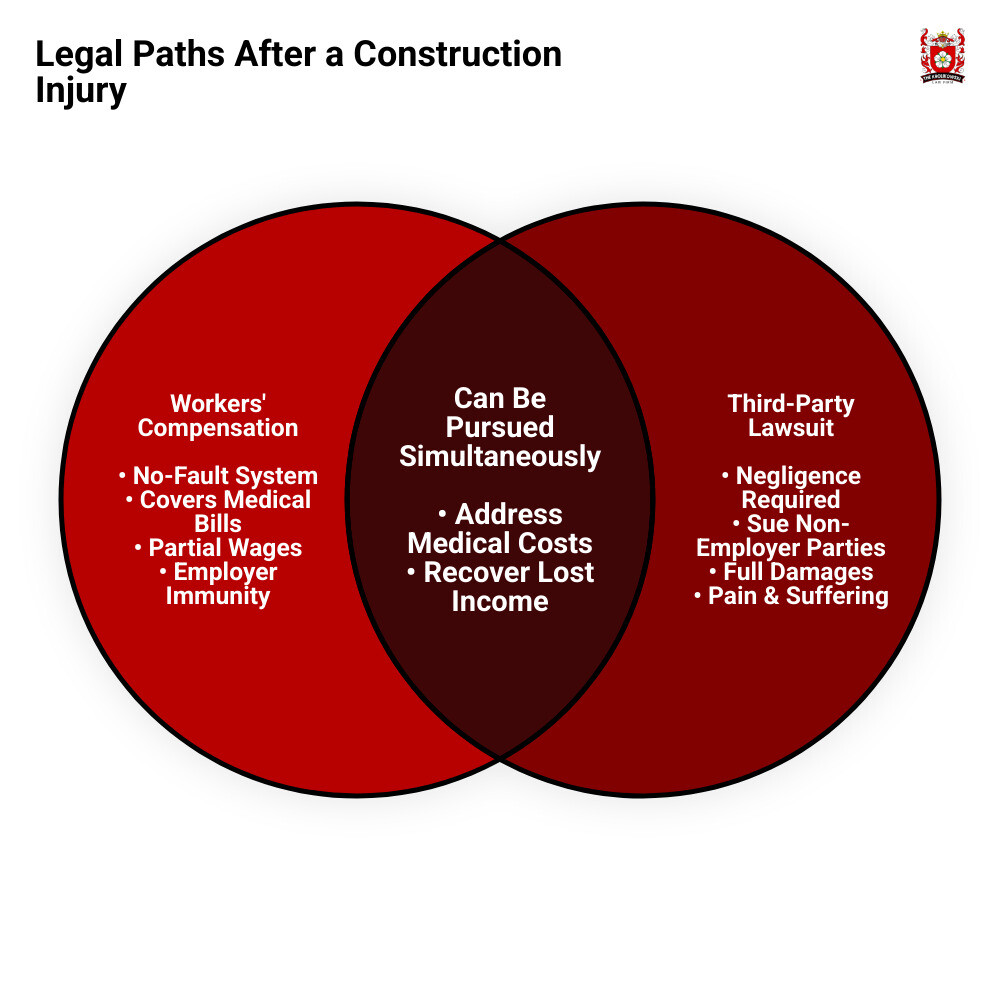
Workers’ Comp vs. Third-Party Claims: Understanding Your Options
After a construction site injury, you’ll likely encounter two main legal paths: workers’ compensation and third-party lawsuits. Understanding the difference is key to your financial recovery, as one offers immediate help while the other can provide more complete compensation.
| Aspect | Workers’ Compensation Claim | Third-Party Lawsuit |
|---|---|---|
| Basis for Claim | No-Fault: You don’t need to prove anyone was negligent. | Negligence: You must prove a third party’s carelessness caused your injury. |
| Who is Sued | Your Employer (or their insurance carrier) | A party other than your employer (e.g., another contractor, equipment manufacturer, property owner) |
| Types of Damages | Limited: Medical bills, a portion of lost wages, disability benefits, vocational rehabilitation. Typically no pain and suffering. | Full: Medical bills, all lost wages (past and future), pain and suffering, emotional distress, loss of enjoyment of life, punitive damages (in rare cases). |
What is a Workers’ Compensation Claim?
Workers’ compensation is a “no-fault” system, meaning you can receive benefits without proving anyone was negligent. You are covered even if you were partially at fault for your injury.
Workers’ comp typically covers all reasonable medical care for your injury, partial wage replacement while you’re unable to work, disability benefits for long-term injuries, and vocational rehabilitation if you need to train for a new job.
The trade-off for these no-fault benefits is that your employer receives immunity from lawsuits. This means you generally cannot sue your employer directly for the injury, even if their negligence was a factor.
If you’re dealing with a workers’ compensation claim, our Workers Compensation Lawyer in Santa Ana Guidance can help you understand the process. For more details on coverage, you can also check out what workers’ comp covers.
Key Differences: Workers’ Comp vs. a Third-Party Construction Injury Lawsuit
While workers’ compensation provides quick assistance, it has limits. A construction injury lawsuit against a third party can help you recover full compensation. Unlike workers’ comp, this requires proving that another party’s negligence caused your injury.
Crucially, you are suing non-employer parties. The immunity that protects your employer does not extend to other contractors, equipment manufacturers, or property owners on the site.
This is important because workers’ comp limits wage replacement (often to two-thirds) and does not cover pain and suffering damages—the personal and emotional toll of your injury.
A third-party lawsuit allows you to seek full compensation, including all past and future lost wages, as well as damages for pain and suffering, emotional distress, and loss of enjoyment of life.
You can often pursue both workers’ compensation and a third-party lawsuit at the same time. Our guide on Workers Compensation Vs Personal Injury Claims Decision Making in Santa Ana explains how these two paths can work together to maximize your recovery.
Identifying Liable Parties in a Construction Accident
A construction site involves many different companies and contractors working simultaneously. When an accident happens, identifying the responsible party can be complex. A thorough investigation is needed to determine everyone who may be liable for your injuries.

Who Can Be Held Responsible?
While workers’ compensation protects your direct employer, other parties on a construction site can be held accountable for negligence. These “third parties” are key to obtaining compensation beyond what workers’ comp offers.
General contractors are responsible for overall site safety, coordination, and ensuring a reasonably safe worksite. They can be held liable in a construction injury lawsuit if they fail to supervise subcontractors, provide proper safety equipment, or address known hazards.
Subcontractors are responsible for safety within their own operations. If another subcontractor’s negligence, such as leaving wires exposed or failing to secure a work area, causes your injury, they can be held liable.
Property owners have a duty to maintain safe conditions on their land. If they were aware of a dangerous condition and failed to address it, they may be liable for resulting injuries.
Architects and engineers can be held accountable if design flaws or engineering errors result in structural failures or unsafe conditions that cause an injury.
Equipment manufacturers create another avenue for recovery when their products fail. We’ll dive deeper into this important category below.
The key is leaving no stone unturned. Our team investigates every angle to identify all potentially liable parties, as detailed in our guide on Understanding Liability Personal Injury Cases.
Accidents Caused by Defective Products
Devastating accidents often occur when equipment fails. If a defective product causes an injury, you may have a product liability claim, which focuses on the dangerous nature of the product itself rather than a person’s carelessness.
Faulty heavy machinery, such as a crane with a failing hydraulic system or a bulldozer with defective brakes, can cause catastrophic accidents. These are often the result of design or manufacturing flaws.
Defective power tools, like a saw with a broken guard or a misfiring nail gun, pose significant risks. The manufacturer can be held responsible if the tool was poorly designed or made.
Malfunctioning safety equipment, such as a safety harness that snaps or a hard hat that cracks on impact, can lead to severe injuries. According to Princeton University’s safety guidelines, construction sites require various types of personal protective equipment. Manufacturers may be liable when the gear workers rely on fails.
Product liability claims can arise from design flaws, manufacturing defects, or a failure to provide adequate warnings about the product’s use.
Even if you didn’t buy the equipment yourself, you can still pursue a claim against the manufacturer if their defective product caused your injury. Our team has experience with Personal Injury Claims Defective Products and knows how to build strong cases against manufacturers.
Navigating the Construction Injury Lawsuit Process
The actions you take immediately after a construction accident are critical for protecting your health and your legal rights.

Immediate Steps to Protect Your Rights
Get medical help right away. Adrenaline can mask serious injuries, and seeking immediate care creates an official medical record linking your injuries to the accident, which is vital evidence.
Report the accident to your employer as soon as possible. States have strict reporting deadlines for workers’ compensation. Follow up in writing (email or text) to create a record.
If it’s safe, document the scene. Use your phone to take photos and videos of the hazard, any broken equipment, and your injuries. Visual evidence strengthens your case.
Get contact information from witnesses. Their testimony is valuable, so collect their details before memories fade. Our guide on The Role of Witnesses in Personal Injury Cases explains their importance.
Don’t give recorded statements to insurance adjusters before speaking with an attorney. They may use your words against you. It is reasonable to say, “I’d like to speak with an attorney first.”
For more detailed guidance, check out our resource on What to do if you are Injured At Work.
Evidence Needed for a Successful Construction Injury Lawsuit
A successful construction injury lawsuit requires a strong foundation of evidence to prove how the accident occurred and the extent of its impact on your life.
Accident reports from your employer, the general contractor, or OSHA provide an official record and can identify safety violations.
Medical records document your injuries and treatment, proving the link between the accident and your harm. They are also used to calculate current and future medical costs.
Photos and videos provide powerful visual evidence of the accident scene, unsafe conditions, and your injuries.
Witness statements corroborate your account of the accident and strengthen your case by confirming unsafe conditions or the sequence of events.
In complex cases, expert analysis from accident reconstructionists, engineers, or medical professionals can clarify technical details, establish fault, and project the long-term impact of your injuries.
The Role of OSHA and Safety Violations
The Occupational Safety and Health Administration (OSHA) sets mandatory safety rules for construction sites. A third party’s violation of these standards can serve as powerful evidence of negligence in your construction injury lawsuit.
OSHA’s “Fatal Four” are the leading causes of construction worker deaths, accounting for nearly 60% of fatalities in a recent year.
- Falls are the leading cause, accounting for over a third of deaths. They are often preventable and may result from inadequate fall protection or unstable surfaces.
- Struck-by injuries, caused by falling objects or moving equipment, account for over 8% of deaths and can involve multiple liable parties.
- Electrocutions from live wires or faulty equipment often point to liability for electrical contractors or manufacturers.
- Caught-in/between injuries involve workers being crushed or trapped and are typically preventable with correct safety protocols.
If your accident falls into one of these categories and was caused by a third party’s failure to follow OSHA standards, it significantly strengthens your claim. We understand how California Workplace Safety Violations Impact Workers Comp Claims and how these violations can be leveraged in a third-party lawsuit.
Maximizing Your Compensation: Damages and Legal Factors
Fair compensation in a construction injury lawsuit is about more than just covering immediate hospital bills; it’s about securing your financial future and ability to rebuild your life. Unlike the limited benefits of workers’ compensation, a third-party lawsuit allows you to recover damages that fully reflect your losses.
Types of Damages You Can Recover
Economic damages are tangible financial losses. This includes all past and future medical expenses, from ambulance rides and surgery to physical therapy and prescription medications.
Lost wages include not only the paychecks you’ve already missed but also your diminished future earning capacity. If your injury prevents you from returning to your previous job, we calculate the difference in your lifetime earnings. Other economic damages include costs for vocational retraining and long-term rehabilitation.
Non-economic damages compensate for the intangible, personal losses that affect your quality of life. Pain and suffering covers the physical pain and emotional distress caused by the injury, as defined by Cornell Law School’s legal resources. This category includes emotional distress, such as anxiety or depression, and loss of enjoyment of life, which compensates for your inability to participate in hobbies and activities you once loved.
For married individuals, loss of consortium compensates your spouse for the negative impact the injury has had on your relationship.
Our team understands how to calculate and pursue every type of damage available, as we detail in our guide on Compensation Available in Los Angeles Personal Injury Cases.
How Legal Rules Affect Your Claim
Certain legal rules can significantly impact your construction injury lawsuit. Understanding these is key to developing an effective strategy.
The statute of limitations is a critical deadline. In California, you generally have two years from the injury date to file a personal injury lawsuit, but this can be as short as six months if a government entity is involved. Missing this deadline can bar your claim entirely. Our breakdown of the California Statute of Limitations for Injury Claims explains these deadlines more thoroughly.
California’s comparative negligence rule means your compensation can be reduced by your percentage of fault. For example, if you were found 30% at fault for your injury, your total damage award would be reduced by 30%. However, you can still recover damages as long as you are not 100% at fault. We work to minimize any blame assigned to you while focusing on the negligence of third parties.
Frequently Asked Questions about Construction Accident Lawsuits
When you’re dealing with a construction injury, legal questions can feel overwhelming. Here are answers to some of the most common concerns.
How much does it cost to hire a construction accident lawyer?
You pay no upfront fees. We work on a contingency fee basis, which means we only get paid if we win your case. If we don’t recover compensation for you, you owe us no attorney fees.
When we do win your case, our fee is a percentage of the settlement or court award we secure for you. This arrangement allows you to focus on healing without financial stress.
How long does a construction injury lawsuit take to resolve?
The timeline for a construction injury lawsuit varies depending on several factors.
- Case complexity is a major factor. Simple cases with clear liability may settle in six months to a year, while complex cases with multiple parties or severe injuries take longer.
- The investigation period can take several months as we gather evidence, interview witnesses, and consult with professionals.
- Most cases settle during negotiations with insurance companies, a process that can last from a few months to over a year.
- If a fair settlement isn’t reached, a trial may be necessary, which can extend the timeline to two years or more. Our goal is to secure the full compensation you deserve, not just a quick settlement.
Can I sue if I was a visitor or passerby injured by a construction site?
Yes. Construction sites pose risks to workers and non-workers alike. If you were injured as a visitor or a passerby due to unsafe conditions like falling debris, you may have grounds for a lawsuit.
These cases are based on premises liability law, which requires property owners and contractors to maintain a safe environment for anyone reasonably expected to be in the area. This includes securing the site and providing adequate warnings.
If the construction team’s failure to take reasonable safety precautions led to your injury, you may have a valid construction injury lawsuit. Our team can evaluate your specific situation and help determine if you have a strong case.
How a “No Win, No Fee” Attorney Can Help
Navigating the legal system after a construction accident can be overwhelming. With over 25 years of experience helping injured workers, our firm understands what you’re facing and how to secure the compensation you deserve.
Our “no win, no fee” promise means we invest our own time and resources into your case. You pay no attorney fees unless we win compensation for you, removing any financial barrier to seeking justice.
Case Investigation: We conduct a thorough investigation of the accident, visiting the site, reviewing all documents, and identifying every potentially liable party to ensure no one is overlooked.
Evidence Gathering: We collect all necessary proof, including medical records, witness statements, and visual evidence. We also work with medical and accident reconstruction professionals to build a strong construction injury lawsuit that demonstrates negligence and the full impact on your life.
Negotiating with Insurance Companies: Insurance adjusters aim to minimize payouts. We handle all communications and negotiations, using our experience to counter their tactics and fight for a settlement that covers your true losses, not just a lowball offer.
Trial Representation: While most cases settle, we are always prepared to take your case to trial. If an insurance company refuses to offer fair compensation, we are ready to present your case to a jury. Our experience with complex cases means we are prepared to fight for you in court.
At Adam Krolikowski Law Firm, we’ve seen how construction accidents can turn lives upside down. We’re located in Santa Ana and serve clients throughout Orange County and Los Angeles. When you’re ready to take the next step, we offer free consultations to discuss your situation and explore your legal options.
Your focus should be on healing. Let us handle the legal complexities while you concentrate on your recovery.
Contact a Construction Accident Lawyer in Orange County, CA today for a free consultation.
