

Why Los Angeles Workers Need Strong Disability Rights Protection
If you’re looking for a disability discrimination attorney los angeles, here’s what you need to know:
Quick Answer:
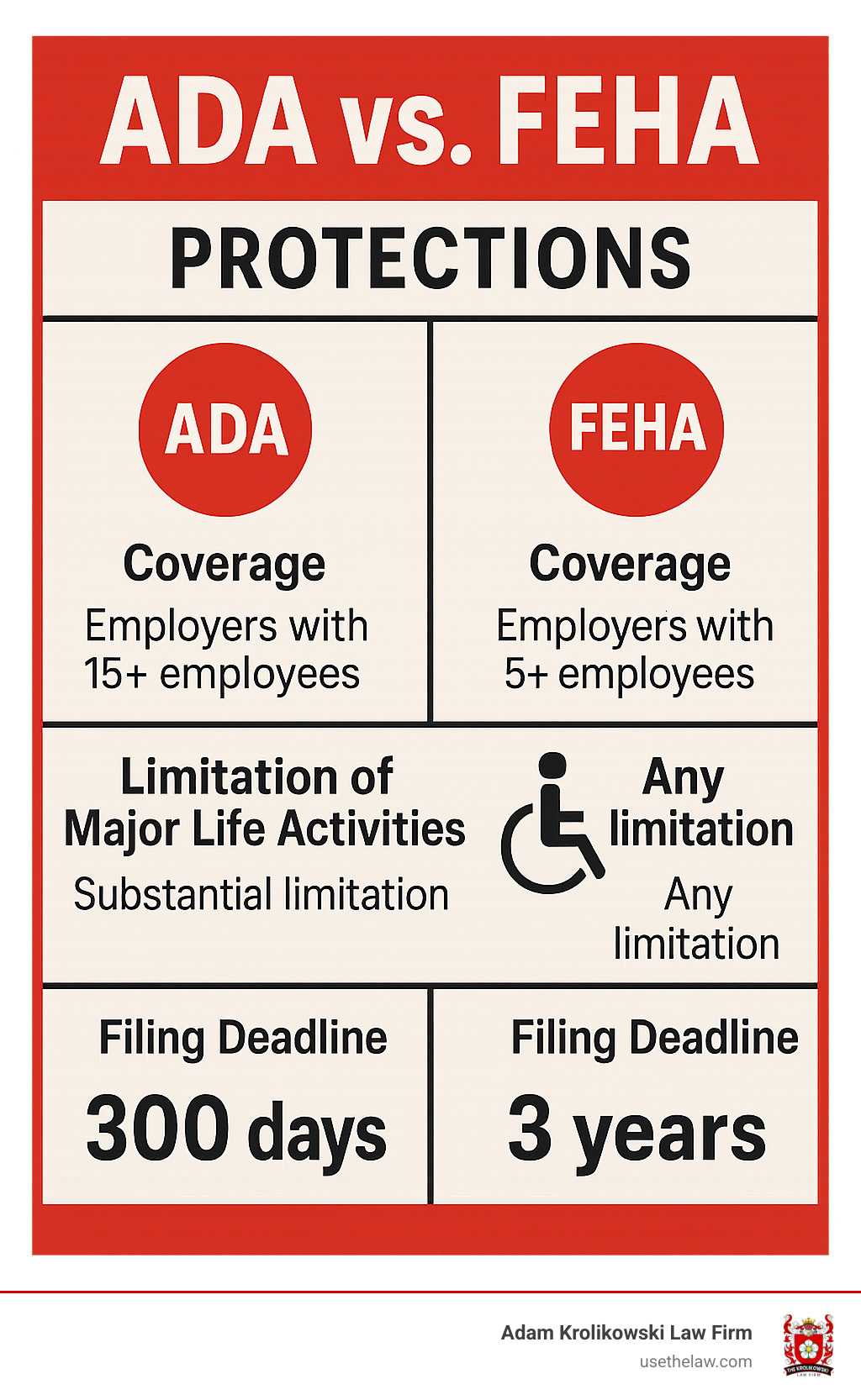
- Federal Law (ADA): Protects workers at companies with 15+ employees
- California Law (FEHA): Stronger protections for companies with 5+ employees
- Filing Deadlines: 300 days for ADA claims, 3 years for FEHA claims
- Common Issues: Failure to accommodate, wrongful termination, hiring discrimination
- Your Rights: Reasonable accommodations, protection from retaliation, potential damages
Workplace discrimination against people with disabilities remains a serious problem in Los Angeles. In 2022 alone, California employers faced 1,338 disability discrimination charges – that’s 5.4% of all disability discrimination cases nationwide. Even more telling, California’s Department of Fair Employment and Housing received nearly 15,000 complaints about employment disability discrimination in 2020.
The reality is stark: only about 60% of workers with disabilities receive the accommodations they need to do their jobs effectively. This means thousands of qualified workers face barriers that shouldn’t exist.
Whether you have a visible disability like mobility impairments or an “invisible” condition like ADHD, depression, or chronic illness, California law provides strong protections. You have the right to reasonable accommodations that help you perform your job – unless doing so would create an undue hardship for your employer.
But knowing your rights and enforcing them are two different things. That’s where experienced legal guidance becomes essential.
Disability discrimination attorney los angeles vocab to learn:
- employee attorney
- employment attorney los angeles free consultation
- pro bono employment lawyers los angeles
Understanding Your Rights: Key Disability Discrimination Laws in Los Angeles
When you’re facing unfair treatment at work because of a disability, understanding your legal protections is crucial. Disability discrimination is when an employer treats you unfavorably because of a physical or mental condition. This includes being passed over for promotions, facing harassment, or wrongful termination.
You’re protected by two powerful laws in Los Angeles: the federal Americans with Disabilities Act (ADA) and California’s stronger Fair Employment and Housing Act (FEHA). Both require employers to provide reasonable accommodations to help you do your job.
Here’s what makes these laws different – and why having both matters for your case:
| Feature | Americans with Disabilities Act (ADA) | California Fair Employment and Housing Act (FEHA) |
|---|---|---|
| Employer Size | 15 or more employees | 5 or more employees |
| Disability Definition | “Substantially limits” a major life activity | “Limits” a major life activity (broader) |
| Perceived Disability | Covered | Covered (even if condition doesn’t exist) |
| Filing Deadline | 300 days with EEOC | 3 years with California Civil Rights Department |
| Damage Limits | Yes (based on employer size) | No caps on damages |
The differences in this table can make or break your case. A disability discrimination attorney los angeles can help you understand which law offers the strongest protection for your situation.
The Americans with Disabilities Act (ADA): Federal Protections
The ADA, protecting workers since 1990, ensures your disability can’t be used against you in employment decisions. To qualify for ADA protection, you need to be a “qualified individual” – someone who can perform the essential functions of your job, with or without reasonable accommodations.
Under federal law, a disability must “substantially limit” one or more major life activities, like walking, seeing, hearing, or learning. The ADA also protects you if you have a history of such an impairment or if your employer perceives you as having one.
The catch? Your employer needs to have at least 15 employees for ADA protections to apply. If you’re working for a smaller company, you’ll need to rely on California’s stronger state protections.
For more information about your federal rights, visit The Americans with Disabilities Act.
California’s Fair Employment and Housing Act (FEHA): Broader Protections
FEHA goes much further than federal minimums to protect workers with disabilities, making it a stronger law for many employees in California.
First, FEHA covers employers with just 5 or more employees, extending protection to many smaller businesses that aren’t covered by federal law. Second, the definition of disability is much broader – your condition only needs to “limit” a major life activity, not “substantially limit” it like the ADA requires.
FEHA also offers unique protections, such as from associational discrimination (discrimination based on a family member’s disability) and covers perceived disabilities more broadly, protecting you even if your employer wrongly believes you have a condition that doesn’t actually exist.
Perhaps most importantly, FEHA gives you three full years to file a claim – that’s much longer than the 300-day federal deadline. There are also no caps on damages, meaning you can potentially recover more compensation for the harm you’ve suffered.
To learn more about your state-level protections, visit California’s Fair Employment and Housing Act.
Both laws create a strong safety net for workers in Los Angeles. Understanding how they complement each other is where legal guidance becomes invaluable.
Reasonable Accommodations and the Interactive Process
Your employer has a legal duty to work with you to find reasonable solutions that help you do your job. Reasonable accommodations are changes to your work environment that allow you to perform the essential functions of your position. However, an employer only needs to provide accommodations that don’t create an “undue hardship” on their business—meaning a significant difficulty or expense based on the company’s size and resources.
This process requires a good-faith dialogue between you and your employer, known as the “interactive process.” It’s a collaborative conversation to find a solution that works for everyone.

What Constitutes a “Reasonable Accommodation”?
A reasonable accommodation is any change to your work environment or processes that removes barriers, ensuring you have the same opportunities as your coworkers.
These accommodations can take many forms, such as modified work schedules for medical appointments, job restructuring to reallocate tasks, or providing assistive devices or equipment like ergonomic keyboards. Other common accommodations include a leave of absence for treatment, telework or remote work arrangements, physical changes like installing ramps, or reassignment to a vacant position.
Remember: employers generally aren’t required to provide accommodations unless you ask. Your request doesn’t need to be formal; simply communicating that you need help due to a medical condition can trigger your employer’s obligation to engage with you.
The Job Accommodation Network practical guide offers helpful resources for understanding what accommodations might work for your specific situation.
The “Interactive Process”: A Collaborative Dialogue
The interactive process is an ongoing, honest conversation between you and your employer about finding solutions. This dialogue begins when you request an accommodation or when your employer otherwise becomes aware of your condition.
Triggering the process can happen in various ways. You might directly tell your supervisor about your condition, submit a formal accommodation request to HR, or your employer might notice patterns that suggest you need help. The key is that someone needs to start the conversation.
Ongoing communication forms the heart of this process. You’ll discuss your limitations, how they affect your job performance, and brainstorm potential solutions together. Your employer might ask for medical documentation to understand your condition better, but they can’t pry into personal medical details or ask inappropriate questions during the hiring process.
Documentation becomes crucial throughout these discussions. Keep records of all conversations, requests, and decisions made. This protects both you and your employer and ensures everyone stays on the same page about what was agreed upon.
Finding a solution requires good faith from both sides. You need to be honest about your limitations and open to different accommodation options. Your employer needs to genuinely explore possibilities rather than immediately saying “no” to every suggestion.
When an employer fails to engage in this process properly or denies accommodations without a valid undue hardship defense, they could face liability for disability discrimination. If you’re dealing with an uncooperative employer, a disability discrimination attorney los angeles can help protect your rights.
Learn more about your rights from an Employment Attorney in Los Angeles if you need guidance navigating these important conversations.
Identifying and Proving a Disability Discrimination Claim
Disability discrimination isn’t always obvious. It often appears as subtle patterns, like being passed over for opportunities, facing stricter scrutiny, or being written up after requesting an accommodation. The key is recognizing when your disability is a factor in how you’re treated and documenting everything.
Building a strong case requires careful evidence gathering and understanding the strict legal deadlines.

Common Examples of Workplace Disability Discrimination
Discrimination takes many forms. Recognizing these patterns can help you understand if you have a case.
- Hiring discrimination: Rejecting qualified applicants because of their disability. Employers cannot ask about medical conditions during interviews until after a conditional job offer is made.
- Wrongful termination: Firing someone because of their disability, often after they request accommodations or take medical leave. The timing can be a red flag.
- Demotion or denial of promotion: Passing an employee over for advancement or demoting them after their employer learns about their disability.
- Unequal pay or benefits: Receiving less compensation than non-disabled colleagues for the same work.
- Harassment: Creating a hostile work environment through offensive comments or intimidation related to a person’s disability.
- Failure to accommodate: Refusing to provide reasonable accommodations without a valid undue hardship defense.
- Retaliation: Punishing an employee with demotion or termination after they request accommodations or file a complaint.
If you’re dealing with what might be wrongful termination, understanding your rights is crucial. Information on Wrongful Termination in Los Angeles can help clarify your situation.
How to Prove Your Case and Meet Filing Deadlines
Proving discrimination means showing your disability played a role in the negative treatment. Direct evidence is rare but powerful, like a manager’s recorded statement. Most cases rely on circumstantial evidence, such as patterns of disparate treatment or negative comments that started after you disclosed your condition.
Documentation is crucial. Save emails, text messages, and memos. Write down conversations with dates and witnesses. This paper trail can make the difference in your case.
An employer’s failure to engage in the interactive process can also be strong evidence if they refused to discuss accommodations or dismissed your requests without exploring options.
The statute of limitations creates strict deadlines. ADA claims must be filed with the EEOC within 300 days of the discrimination. FEHA claims give you three years to file with California’s Civil Rights Department. Missing these deadlines means losing your right to pursue legal action, so consulting with a disability discrimination attorney los angeles early is critical.
You can start the process by filing a complaint online with California’s Civil Rights Department. Taking action sooner rather than later gives you the best chance of protecting your rights and getting the justice you deserve.
The Role of a Disability Discrimination Attorney in Los Angeles
When you’re facing disability discrimination at work, it can feel like you’re fighting an uphill battle alone. The legal system seems complicated, your employer has lawyers, and you might be worried about making your situation worse. This is exactly when having a skilled disability discrimination attorney los angeles on your side can make all the difference.
Think of us as your advocate and guide through what can be a confusing and emotionally draining process. We’re not just there to file paperwork – we’re there to level the playing field and ensure your voice is heard.
A good attorney will start by carefully evaluating your case to understand exactly what happened and what laws might have been violated. We help you gather the evidence you need, handle all the tricky negotiations with your employer’s legal team, and if things can’t be resolved through discussion, we’re prepared to take your case to court.
One thing many people don’t realize is how important it is to have protection against retaliation. Unfortunately, some employers try to punish employees who stand up for their rights. Having legal representation helps shield you from these tactics and ensures any retaliation becomes additional evidence in your case.
How a Los Angeles Disability Discrimination Attorney Can Help
The legal process can feel overwhelming when you’re already dealing with workplace discrimination. Here’s how we make it manageable and give you the best chance at a successful outcome.
Legal guidance is often the first thing you need. Employment law involves both federal and state regulations, and understanding how they apply to your specific situation requires someone who knows the ins and outs of both the ADA and FEHA. We explain your rights in plain English and help you understand what options are available.
Evidence collection is crucial to building a strong case. We help you identify what documentation will be most helpful – things like emails, performance reviews, medical records, and witness statements. Sometimes the most important evidence is hiding in plain sight, and we know what to look for.
Communicating with your employer becomes much more effective when it comes from an attorney. We ensure that any requests for accommodations are properly documented and legally sound. This protects you and creates a clear paper trail of your employer’s responses.
Filing legal claims involves strict deadlines and specific procedures. Miss a deadline, and you might lose your right to pursue your case entirely. We handle all the paperwork and ensure everything is filed correctly and on time with the appropriate agencies.
When it comes to negotiation and court representation, having someone who understands the value of your case and knows how to present it effectively can mean the difference between a fair settlement and walking away with nothing. Many cases settle before going to trial, but knowing we’re prepared to go to court often leads to better settlement offers.
If you’re dealing with other workplace issues alongside discrimination, we can address those too. Find an Attorney for Workplace Harassment.
What Damages Can Be Recovered in a Lawsuit?
One of the first questions people ask is, “What can I actually get if I win my case?” The answer depends on your specific situation, but disability discrimination law provides several ways to compensate you for what you’ve been through.
Back pay covers the wages and benefits you lost from the time the discrimination occurred until your case is resolved. If you were wrongfully terminated, this could add up to a significant amount, especially if your case takes months or years to resolve.
Front pay comes into play when getting your old job back isn’t realistic or desirable. This compensates you for future lost earnings and helps bridge the gap while you find new employment.
Compensatory damages address the non-financial harm you’ve suffered. Discrimination doesn’t just hurt your wallet – it can cause emotional distress, damage your reputation, and affect your overall well-being. These damages recognize that impact.
Sometimes, when an employer’s behavior was particularly outrageous, punitive damages may be awarded. These are designed to punish the employer and send a message that this kind of conduct won’t be tolerated.
Reinstatement is an option if you want your job back and it’s feasible. The court can order your employer to restore you to your position.
One often overlooked but important aspect is attorney’s fees and costs. In many disability discrimination cases, if you win, your employer has to pay your legal fees. This means you can pursue justice without worrying about the financial burden of legal representation.
Here’s something important to know: while federal law caps some types of damages based on your employer’s size, California’s FEHA has no such limits. This is another reason why FEHA claims can be more favorable for employees seeking substantial compensation.
For detailed information about available remedies, the EEOC overview of remedies provides comprehensive guidance.
Frequently Asked Questions about Disability Rights in the Workplace
We know dealing with disability discrimination can leave you with countless questions racing through your mind. Over the years, we’ve helped many people steer these challenging situations, and certain questions come up again and again. Let’s address the most common concerns we hear from workers facing disability-related issues in Los Angeles workplaces.
Can an employer ask about my disability during the hiring process?
This is one of the most frequent questions we get, and the answer might surprise you. Generally, no – employers cannot ask about your disability during the hiring process. The ADA has strict rules about what employers can and cannot ask before making you a job offer.
Before extending a conditional job offer, employers can only ask whether you’re able to perform specific job functions, with or without reasonable accommodation. They cannot ask questions that might reveal information about a disability, such as “Do you have any medical conditions?” or “Have you ever been on workers’ compensation?”
However, once they make you a conditional job offer, the rules change. At that point, an employer can require a medical examination – but only if they require the same exam for all employees entering the same job category. Any medical information they gather must be kept confidential and stored separately from your personnel file.
The key takeaway? You have the right to keep your medical information private during the interview process, and employers who violate this rule may be setting themselves up for discrimination claims.
Is my condition (like ADHD or an “invisible” illness) considered a disability?
Absolutely, and this is something many people don’t realize. California’s disability laws are incredibly broad and protective, especially when it comes to conditions that aren’t immediately visible to others.
ADHD is explicitly recognized as a disability under California law. So are many other mental health conditions like clinical depression, bipolar disorder, PTSD, anxiety disorders, and OCD. Physical conditions don’t have to be obvious either – diabetes, epilepsy, multiple sclerosis, chronic pain conditions, and even temporary conditions that significantly impact your life can qualify for protection.
The beauty of California’s Fair Employment and Housing Act (FEHA) is that it only requires your condition to “limit” a major life activity – not “substantially limit” it like federal law requires. This means even if your ADHD, depression, or chronic illness doesn’t completely prevent you from working, you’re still protected if it affects how you concentrate, sleep, interact with others, or perform other major life activities.
Your employer cannot fire you, refuse to hire you, or treat you differently because of ADHD or any other protected disability. If they do, that’s unlawful discrimination, and you have every right to fight back.
What should I do if I’m retaliated against for requesting an accommodation?
Let’s be crystal clear about this: retaliation is illegal, period. If your employer punishes you in any way for requesting an accommodation, filing a complaint, or standing up for your rights, they’re breaking the law.
Retaliation can take many forms – demotion, disciplinary action, reduced hours, hostile treatment from supervisors, or even termination. Whatever form it takes, you need to act quickly to protect yourself.
Start documenting everything immediately. Write down dates, times, who was involved, and exactly what happened. Save emails, text messages, and any other communications. This documentation becomes crucial evidence if you need to file a legal claim.
If your company has internal reporting procedures, you can follow them, but you’re not legally required to do so before seeking outside help. Sometimes reporting internally can actually make the retaliation worse.
The most important step is to contact a disability discrimination attorney los angeles right away. Retaliation claims are serious, and they can actually strengthen your overall discrimination case. The sooner you get legal guidance, the better we can protect your rights and help you understand your options.
You have the right to speak up for yourself without fear of punishment. Connect with a Disability Discrimination Lawyer in Los Angeles to discuss your situation and learn how we can help you fight back against retaliation.
Conclusion
Understanding your rights as an employee with a disability in Los Angeles is the first step toward protecting yourself from unfair treatment. Throughout this guide, we’ve explored how both federal laws like the ADA and California’s more powerful FEHA provide strong protections against discrimination. These laws ensure your right to reasonable accommodations and guarantee you can work in an environment free from prejudice.
Documentation is absolutely crucial throughout this entire process. Whether you’re requesting an accommodation, participating in the interactive process, or building a case for discrimination, keeping detailed records of conversations, emails, and incidents can make or break your claim. The more evidence you have, the stronger your position becomes.
Facing discrimination because of a disability is genuinely challenging – both emotionally and practically. You might feel isolated, frustrated, or unsure about your next steps. The legal deadlines can feel overwhelming, especially when you’re already dealing with workplace stress and potential retaliation.
But here’s the important thing: you don’t have to steer this alone.
With over 25 years of experience, the Adam Krolikowski Law Firm handles complex employment law cases, providing dedicated guidance to those who have been wronged. We understand that every disability discrimination case is unique, and we take the time to listen to your specific situation and develop a strategy that makes sense for your circumstances.
If you believe your rights have been violated – whether through denied accommodations, wrongful termination, harassment, or retaliation – it’s important to seek legal counsel sooner rather than later. Those filing deadlines we discussed aren’t flexible, and the earlier you act, the more options you’ll have.
California’s laws are particularly strong when it comes to protecting employees with disabilities. You have real rights, and there are real consequences for employers who violate them.
Contact a dedicated California employment law firm to understand your options and protect your rights. We’re here to help you get the justice you deserve.
