

Understanding the Role of an Employee Attorney
When you’re facing tough times at work, an employee attorney can be your strongest advocate. They are lawyers who focus on protecting the rights of workers. If you’ve been treated unfairly, faced discrimination, or lost your job without good reason, these legal pros are here to help.
-
What is an Employee Attorney?
- An employee attorney is a lawyer who represents employees in disputes with their employers.
- Their main goal is to protect your rights and ensure fair treatment in the workplace.
- They help you understand complex employment laws at both state and federal levels.
-
Why Might You Need an Employee Attorney?
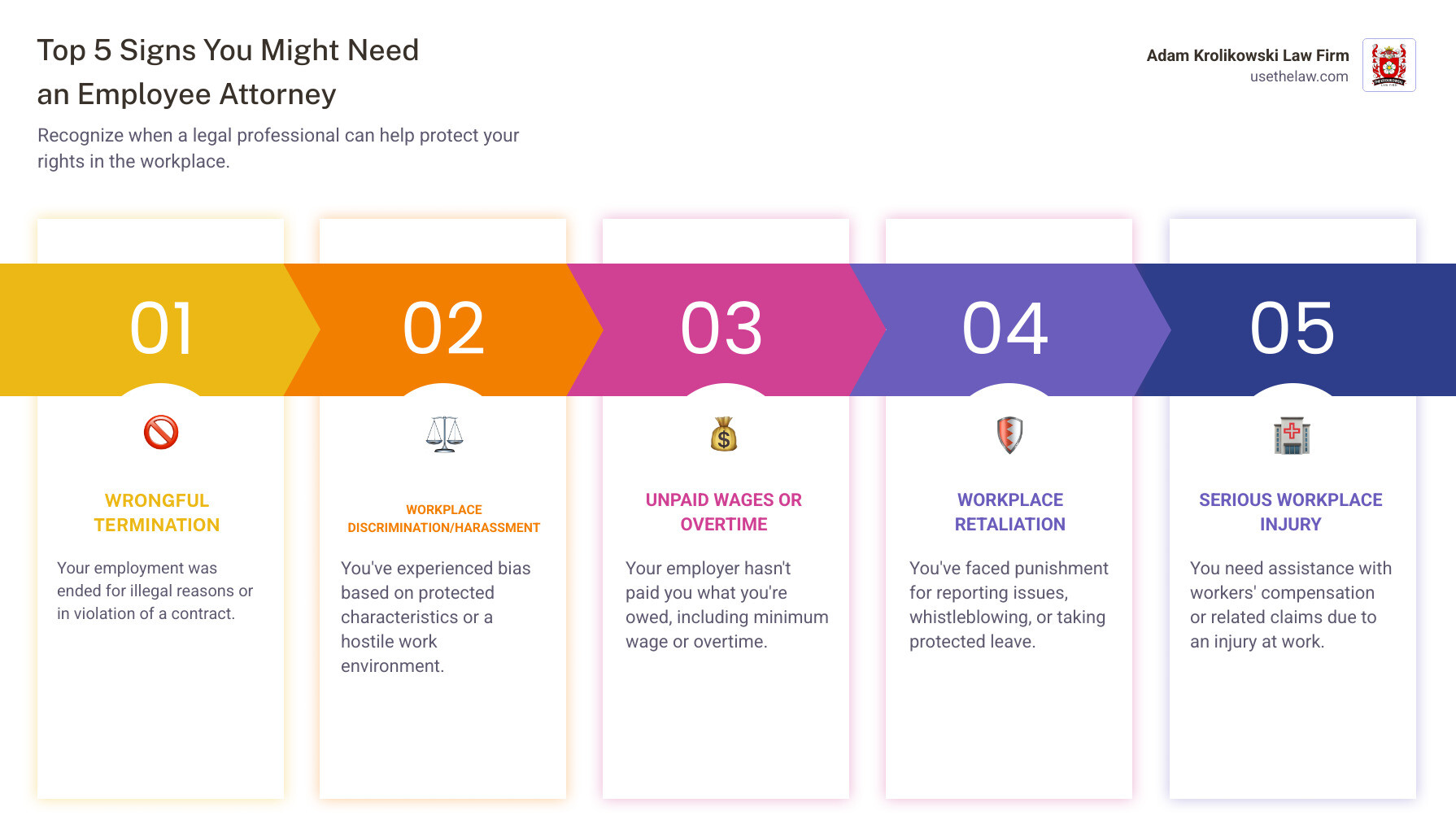
- You believe you were wrongfully terminated.
- You’ve experienced discrimination (based on age, gender, race, disability, etc.) or harassment at work.
- Your employer hasn’t paid you what you’re owed (like unpaid wages or overtime).
- You’ve faced retaliation for reporting workplace issues or taking protected leave.
- You’re dealing with a workplace injury and need help with workers’ compensation or related claims.
Workplace issues can be stressful. They can hit your finances hard and take a real emotional toll. An employee attorney helps level the playing field when you’re up against a company.
They make sure your voice is heard and work to get you the justice and compensation you deserve.
Easy employee attorney glossary:
Common Cases Handled by an Employee Attorney

When workplace problems arise, an employee attorney becomes your champion in fighting for what’s right. We see all kinds of situations where workers have been treated unfairly, and each case tells a story of someone who deserves better.
The workplace can be a tricky place to steer, especially when things go wrong. Maybe your boss fired you for what seems like a bogus reason, or perhaps your paycheck doesn’t match the hours you’ve put in. These aren’t just “bad luck” situations – they’re often violations of your legal rights.
Over the years, employment attorneys have successfully recovered millions of dollars for workers who faced wrongful discharge, discrimination, harassment, wage theft, retaliation, and whistleblowing cases. We’ve also handled class action lawsuits where multiple employees were affected by the same unfair practices.
Wrongful Termination Claims
You’ve probably heard that California is an “at-will” state, which sounds pretty scary for employees. People think it means your boss can fire you for absolutely any reason, but that’s not the whole story.
While it’s true that employers have broad power to terminate employees, they absolutely cannot fire you for illegal reasons. These include firing you because of your race, gender, age, disability, religion, or sexual orientation. They also can’t fire you for taking legally protected actions, like reporting safety violations or filing a workers’ compensation claim.
Public policy violations are another big category. If you were fired for doing something that the law says you should do – like serving jury duty or refusing to break the law – that’s wrongful termination. Breach of contract situations also count, even if it’s just an implied contract based on company policies or verbal promises.
Think about it this way: if your termination makes you think “this just isn’t right,” there’s a good chance the law agrees with you. That’s when you need to talk to a Wrongful Termination Lawyer Orange County or a California Wrongful Termination Lawyer who can help you figure out if your firing was legal or not.
Workplace Discrimination and Harassment
Nobody should dread going to work because of how they’re treated. Unfortunately, some employees face discrimination based on protected characteristics like race, gender, age, disability, religion, or sexual orientation.
Discrimination isn’t always obvious. It might be getting passed over for promotions repeatedly, receiving harsher discipline than your coworkers, or being excluded from important meetings. Sometimes it’s more direct – inappropriate comments, unfair treatment, or being treated differently because of who you are.
Harassment creates a hostile work environment where you feel uncomfortable, threatened, or humiliated. Sexual harassment can be quid pro quo (where job benefits depend on sexual favors) or involve unwelcome sexual conduct that makes work unbearable.
The thing about harassment is that it often escalates over time. What starts as “harmless” comments can grow into something much worse. You don’t have to put up with it, and you shouldn’t have to quit your job to escape it.
If you’re dealing with workplace harassment, an Attorney for Workplace Harassment can help you understand your options. For specific situations involving sexual misconduct, a Sexual Harassment Lawyer in Orange County, CA knows exactly how to handle these sensitive cases.
Wage and Hour Disputes
Your paycheck should reflect the work you’ve done – it’s that simple. Yet wage theft happens more often than you might think, and it takes many forms.
Unpaid overtime is a huge issue. If you’re working more than 40 hours a week (or in California, more than 8 hours a day), you should be getting overtime pay unless you’re truly exempt. Some employers try to avoid paying overtime by misclassifying employees as independent contractors or exempt workers when they’re really not.
Meal and rest break violations are especially common in California, where the law is very specific about when you should get breaks. If you’re working through lunch regularly or not getting your 10-minute breaks, your employer might owe you penalty payments.
Unpaid wages can include everything from your regular paycheck being short to not getting paid for training time or work you did from home. Minimum wage law violations happen when employers pay less than the legal minimum or don’t pay at all.
The Federal Labor Standards Act sets the baseline for many of these protections, but California often provides even stronger rights for workers. If you’re having Disputes with Employers and Insurance Companies Santa Ana Strategies can help you steer these complex situations.
Retaliation and Leave of Absence Violations
Standing up for yourself at work takes guts, and the law protects you when you do the right thing. Employer retaliation happens when your boss punishes you for exercising your legal rights – like filing a complaint, taking protected leave, or reporting problems.
Whistleblower protection covers employees who report illegal activities, fraud, or safety violations. You might face retaliation for reporting these issues, but that retaliation itself is illegal and can result in significant compensation.
FMLA violations occur when employers don’t respect your rights under the Family and Medical Leave Act. Maybe they denied your request for leave to care for a sick family member, or they fired you while you were on medical leave. CFRA rights (California Family Rights Act) often provide even broader protections than federal law.
Reporting safety violations is another protected activity. If you reported unsafe working conditions and then faced negative consequences, that’s likely retaliation.
The key thing to remember is that retaliation often happens quickly after you exercise your rights. If you notice sudden changes in how you’re treated at work after filing a complaint or taking leave, that’s a red flag.
A Retaliation Attorney Orange County can help you document these patterns and build a strong case. For more information about your leave rights, check out the Family and Medical Leave Act (FMLA) information to understand what protections you have.
Understanding Your Legal Rights: California and Federal Protections

Feeling like you’re trying to find your way through a giant legal maze when it comes to your rights at work? You’re not alone! Luckily, both California and federal laws are like a strong safety net, offering important legal protections against unfair treatment in the workplace. These laws cover a lot of ground, from stopping discrimination and harassment to making sure you get paid fairly and can take needed time off.
However, these laws can sometimes differ, and how they apply often depends on how many people your employer has on staff. There are also strict time limits, called “statutes of limitations,” for bringing a claim, so acting quickly is always a good idea.
Key California Employment Laws
California is famous for having some of the strongest employee protections in the country, often going above and beyond what federal laws require. Here are a few of the most important state laws protecting you:
The California Fair Employment and Housing Act (FEHA) is a huge part of California’s anti-discrimination efforts. It makes it illegal for employers to discriminate against or harass you based on a long list of protected characteristics. This includes your race, religion, color, national origin, ancestry, physical or mental disability, medical condition, genetic information, marital status, sex (including pregnancy), gender, gender identity, gender expression, age, sexual orientation, and even your military or veteran status. Generally, FEHA applies to employers who have 5 or more employees.
Then there’s the California Family Rights Act (CFRA). This law is quite similar to the federal FMLA. It allows eligible employees to take up to 12 weeks of unpaid, job-protected time off for certain family and medical reasons.
And don’t forget the California Labor Code! This massive set of laws covers just about everything else. It sets rules for minimum wage, overtime pay, meal and rest breaks, how and when you get paid, and even how employees are classified. It also has strong protections against your employer retaliating against you for simply exercising your rights.
For even more details, the California Department of Fair Employment and Housing (DFEH) is the state agency that helps enforce many of these civil rights laws.
Major Federal Employment Laws
While California has a lot of protections, federal laws are also super important, especially if you work for a larger company or outside of California.
Title VII of the Civil Rights Act of 1964 is a federal law that prohibits job discrimination based on your race, color, religion, sex (which includes pregnancy, sexual orientation, and gender identity), and national origin. This law usually applies to employers with 15 or more employees.
The Americans with Disabilities Act (ADA) makes it illegal to discriminate against individuals with disabilities in all parts of public life, including when it comes to jobs. Like Title VII, it generally applies to employers with 15 or more employees.
If you’re age 40 or older, the Age Discrimination in Employment Act (ADEA) protects you from age discrimination. This law typically applies to private employers with 20 or more employees.
The Fair Labor Standards Act (FLSA) is a federal law that sets the rules for minimum wage, overtime pay, keeping records, and youth employment standards for most private and government jobs.
Lastly, the Family and Medical Leave Act (FMLA) is a federal law that allows certain employees to take up to 12 weeks of unpaid, job-protected leave each year for specific family and medical reasons.
The U.S. Equal Employment Opportunity Commission (EEOC) is the federal agency that enforces many of these important federal civil rights laws.
When Do These Protections Apply?
Figuring out which laws apply to your specific situation can feel like piecing together a puzzle, especially because it often depends on how many employees your company has. Here’s a quick overview to help clear things up:
| Law | Applies to Employers with: | Key Protection |
|---|---|---|
| California FEHA | 5+ employees | Discrimination, Harassment, Retaliation |
| Federal Title VII / ADA | 15+ employees | Discrimination (Race, Sex, Religion, Nat. Origin) / Disability Discrimination |
| Federal ADEA | 20+ employees | Age Discrimination (40+) |
| Federal FMLA | 50+ employees (within 75 miles) | 12 weeks unpaid, job-protected leave |
| California Labor Code | All employers (generally) | Wages, Breaks, Retaliation, etc. |
It’s also important to remember that many of these laws have specific rules about who is eligible to be protected. For instance, to qualify for FMLA leave, you generally need to have worked for your employer for at least 12 months, and for at least 1,250 hours during the past 12 months.
Understanding exactly which laws apply to your unique situation can be quite complex. And that, my friend, is precisely where an employee attorney truly shines! We can help you sort through these details and understand your rights based on your specific circumstances and your employer’s size.
The Legal Journey: How an Attorney Guides Your Case

When you’re facing a tough situation at work, the idea of a legal battle can feel like trying to find your way through a giant maze. It’s confusing, stressful, and you might not know where to even begin. But here’s the good news: you don’t have to steer it alone. With an employee attorney by your side, you get a seasoned guide who knows exactly how to light the path. We’re here to help you steer the legal process, from our very first chat all the way to finding a resolution.
Step 1: Initial Consultation and Case Evaluation
Your journey with an employee attorney typically starts with a free, no-obligation consultation. Think of this as your chance to simply share your story. You’ll explain what happened, what your concerns are, and how it’s impacted you. We listen carefully because we understand that your job isn’t just about money; it’s about your livelihood and peace of mind. Workplace issues can cause real financial and emotional distress, and we get that.
During our conversation, we’ll talk about any documents you might have. These could be emails, text messages, performance reviews, pay stubs, or anything else related to your employment. Gathering these details is really important because it helps us understand the strengths of your claim. We’ll give you an honest and clear assessment of your legal rights, explain the law in plain language, and help you look at all your options. Our main goal is to give you clarity and direction, so you can decide if taking legal action is the right step for you.
Step 2: Filing a Claim and Building Your Case
If we determine you have a strong case, the next phase is about formally starting the legal process. This often means filing a complaint with the right government agency. In California, that might be the Department of Fair Employment and Housing (DFEH). On a federal level, it could be the U.S. Equal Employment Opportunity Commission (EEOC). These agencies can investigate claims. Sometimes, they’ll give you a “right-to-sue” notice, which you often need before you can file a lawsuit in court.
While that’s happening, we’ll be busy building your case. This involves something called the “findy process.” It’s where we gather information from your employer. This might mean asking for documents, sending written questions (called interrogatories), and taking depositions. During a deposition, witnesses—including your former employer or colleagues—answer questions under oath. We’ll also talk to anyone who can support your side of the story. Your employer’s HR team, while they might seem helpful, is truly there to protect the company. Having an employee attorney ensures your side is heard and taken seriously. We might also send demand letters to your employer, formally outlining your claims and what you seek as a resolution.
Step 3: Seeking Remedies and Potential Outcomes
Throughout this whole process, there are often chances to resolve things without a trial. Mediation is one common step, where a neutral third person helps both sides try to reach a settlement. In fact, most employment law cases (around 95-98%) settle before ever going to court. However, if we can’t reach a fair agreement, don’t worry. We’re fully prepared to fight for your rights in court.
The goal of an employment lawsuit is usually to make things right for you. This means seeking “remedies” or ways to compensate you for what you’ve been through. These can include:
- Lost wages and benefits: Money you would have earned if the unfair situation hadn’t happened. This can also include interest on any unpaid wages.
- Emotional distress damages: Compensation for the pain, anxiety, and humiliation you’ve experienced because of your employer’s actions.
- Punitive damages: In cases where an employer acted especially badly, these damages are meant to punish them and stop similar behavior from happening again.
- Unpaid wage penalties: If your employer broke wage and hour laws, you might be owed extra penalties on top of any unpaid wages.
- Attorneys’ fees: In many employment law cases, if you win, your employer might have to pay your legal fees.
- Reinstatement: Sometimes, an employee might ask to get their old job back, though this is less common.
Our aim is always to get you the best possible outcome, whether that’s through skillful negotiation or by vigorously representing you in court.
Choosing and Paying for Your Legal Representation

When you’re dealing with a tough situation at work, finding the right legal help can make all the difference. It’s a lot like finding a good doctor or a skilled mechanic – you want someone who truly understands your problem, talks to you clearly, and helps you get things fixed. Just as important as finding the right employee attorney is understanding how they get paid for their valuable work.
What to Look for When Choosing an Employee Attorney
Picking the right employee attorney might seem a bit overwhelming at first, but focusing on a few key things can really help.
First, look for someone with experience handling cases like yours. Whether your concern is about wrongful termination, discrimination, or a wage dispute, you want an attorney who knows the ins and outs of that specific type of claim. They should understand the tricky parts and what to expect. Sometimes, attorneys who used to represent companies even bring a special understanding of how employers think, which can be a real advantage for you!
Next, pay close attention to client testimonials and their communication style. Will they keep you in the loop? Do they respond quickly? You’ll be sharing a lot of personal and sensitive information, so it’s important to feel comfortable and heard. A good employee attorney gives you personalized attention and keeps you updated on important steps in your case. We believe in being there for our clients, providing our cell numbers, and promising a response within 24 hours.
It’s also a good idea to find an employee attorney who focuses on representing employees, not employers. While some law firms work for both sides, those dedicated to employee rights often have a deeper understanding of the laws designed to protect workers like you. This focus helps them champion your interests.
Even though most workplace cases settle outside of court, it’s comforting to know your attorney has a strong trial record. This means they’re ready and able to go to court if that’s what it takes. Attorneys who are known for being ready to fight often get better settlements because the other side knows they mean business.
Finally, consider your personal connection with the attorney. You’ll be trusting them with a very important part of your life. Choose someone who takes the time to listen, truly understands your story, and makes you feel at ease.
How an Employee Attorney Gets Paid: The Contingency Fee Basis
One of the biggest worries for anyone thinking about legal action is the cost. But here’s some good news: most employee attorneys work on a contingency fee basis. This makes legal help affordable for nearly everyone, no matter their financial situation.
It’s often called a “no recovery, no fee” model. This means you won’t pay any upfront legal fees or costs while your case is ongoing. You literally don’t pay your attorney unless they successfully get you compensation, whether through a settlement or a court decision. It’s that simple!
So, how does it work? If your case is successful, the attorney’s fee is a percentage of the total amount you recover. This percentage is agreed upon right at the start and is clearly written in the agreement you sign. This way, there are no out-of-pocket costs for you.
This fee structure is a game-changer. It ensures you have access to justice even if you don’t have a lot of money saved up. It helps level the playing field when you’re up against a larger company with deep pockets. Plus, it means your employee attorney is fully invested in your success, because their payment depends on getting you a positive result.
This arrangement is very common in employment and class action cases, making sure that money worries don’t stop you from standing up for your rights.
Conclusion: Taking the Next Step to Protect Your Workplace Rights
Feeling overwhelmed by a workplace issue? You’re not alone, and you certainly don’t have to face it by yourself. Throughout this guide, we’ve talked about the important rights and protections you have as an employee, thanks to both California and federal laws. These laws cover a lot, from unfair firings (wrongful termination) and being treated differently because of who you are (discrimination), to not getting paid what you’re owed (wage violations) or being punished for speaking up (retaliation).
Here’s the most important thing to remember: if you think your rights have been overlooked or if you’ve been unfairly treated at work, please don’t wait. A simple, yet powerful, first step is to document everything. Jot down notes, save emails, texts, or any other records of what happened. Think of it like gathering pieces of a puzzle – every detail can be important.
Once you have your thoughts together, reach out for legal advice. An employee attorney can be your trusted guide. They’ll help you understand your unique situation, explain your options clearly, and walk you through what can feel like a complicated legal process.
At Adam Krolikowski Law Firm, we truly get how much a workplace problem can affect your entire life. It’s not just about a job; it’s about your financial stability, your dignity, and your peace of mind. That’s why we’re committed to standing up for employees in Orange County, Los Angeles, and all across California. With over 25 years of experience, we’re particularly skilled at handling those tough, complex cases that some other attorneys might pass on. Our goal is always to help level the playing field, making sure your voice is heard and that you get the justice and fair compensation you deserve.
Protecting your workplace rights is a crucial step. If you’re ready to explore your options and take that next step, we’re here and ready to help.
