

Why Family Medical Leave Matters for Working Americans
Family medical leave is a federally protected right allowing eligible employees to take unpaid, job-protected time off for specific family and medical reasons. Under the Family and Medical Leave Act (FMLA), you can take up to 12 weeks of leave per year while keeping your job and health benefits.
Key Family Medical Leave Facts:
- Eligibility: Work for a covered employer for 12+ months and 1,250+ hours.
- Duration: Up to 12 weeks unpaid leave (26 for military caregivers).
- Job Protection: Right to return to the same or an equivalent position.
- Health Benefits: Coverage continues during leave.
- Qualifying Reasons: Your serious health condition, caring for family, a new child, or military family needs.
Life doesn’t pause for work. Whether you’re recovering from an injury, welcoming a baby, or caring for a parent, family medical leave provides crucial protection.
The federal FMLA covers most workers, but it’s unpaid. Some states like California, Colorado, and Washington offer paid family leave programs funded through small payroll deductions, providing partial wage replacement. Understanding your options before a crisis hits can save stress, protect your income, and preserve your career.
Understanding the Basics of the Family and Medical Leave Act (FMLA)
The Family and Medical Leave Act (FMLA) was enacted in 1993 to help working Americans handle major life events without losing their jobs. This federal law provides up to 12 weeks of unpaid, job-protected leave each year. During your leave, your health insurance stays active, so you don’t have to choose between your family’s needs and your job security. The Department of Labor oversees and enforces the FMLA.
The Family and Medical Leave Act (FMLA) | USAGov
Who is Eligible for FMLA?
To get family medical leave, both you and your employer must meet specific requirements.
Covered employers include:
- All government agencies (federal, state, local).
- All public and private schools.
- Private companies with 50 or more employees for at least 20 weeks in the current or previous year.
You are eligible if you meet all three of these conditions:
- You have worked for your employer for at least 12 months (they don’t need to be consecutive).
- You have worked at least 1,250 hours in the 12 months before taking leave (about 24 hours per week).
- You work at a location where the employer has 50 or more employees within 75 miles.
If all these conditions are met, you are eligible for FMLA protection.
What Are the Qualifying Reasons for Taking Leave?
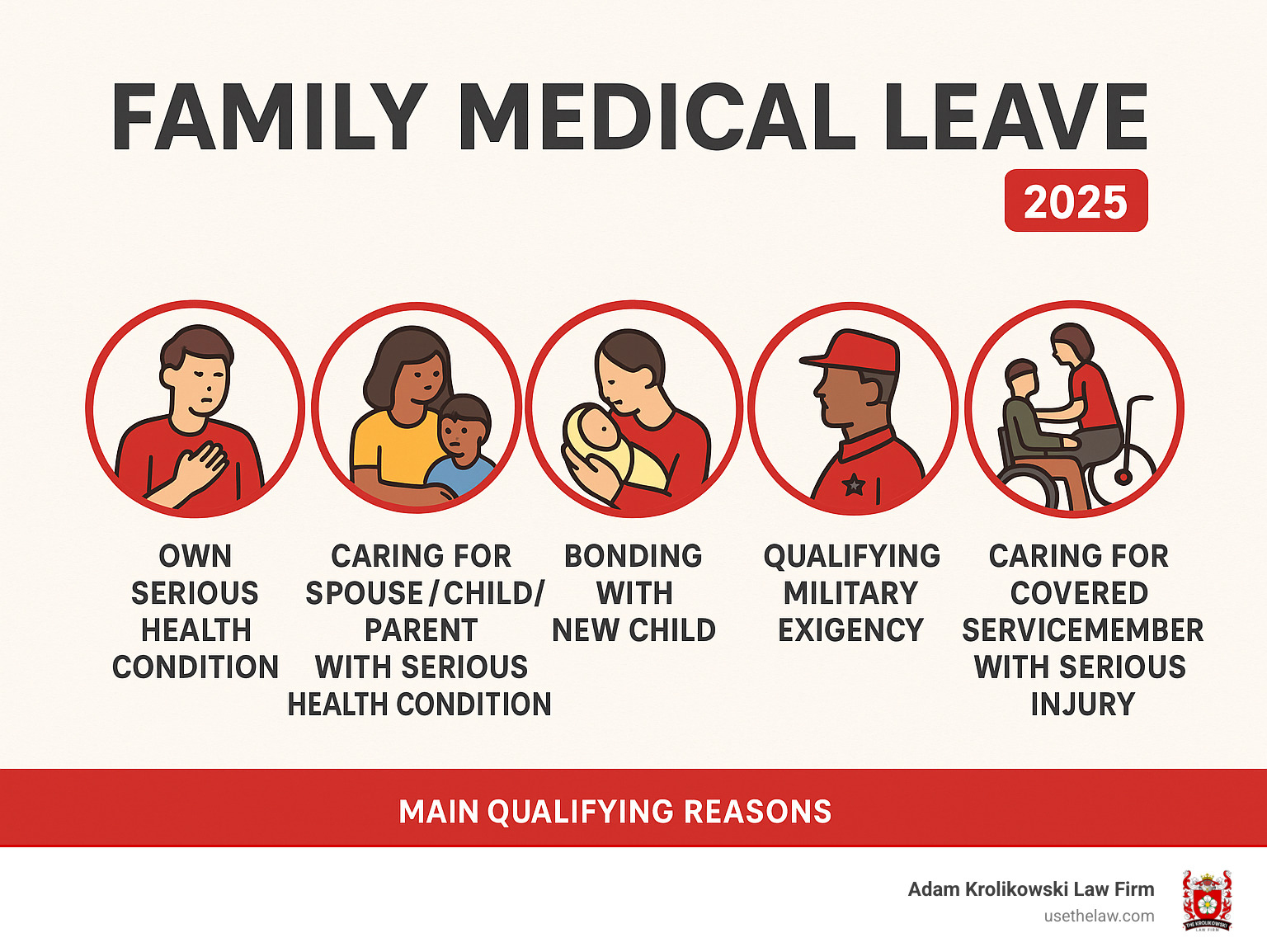
The FMLA covers five major life events that warrant job-protected time off:
- Bonding with a new child: Up to 12 weeks to bond with a newborn, adopted, or foster child within the first year.
- Caring for a family member: For a spouse, child, or parent with a serious health condition, defined as an illness or injury requiring hospital care or ongoing medical treatment.
- Your own serious health condition: When you are unable to work due to an illness, injury, or chronic condition requiring treatment.
- Military family needs (“qualifying exigencies”): For issues arising from a family member’s military deployment, such as attending ceremonies or making legal arrangements.
- Caring for an injured servicemember: Up to 26 weeks of leave in a single year to care for a covered servicemember or recent veteran with a serious injury or illness from their military service.
How Much Leave Can You Take?
For most situations, you can take 12 weeks of unpaid leave during a 12-month period. Your employer defines how this period is measured (e.g., calendar year, rolling 12 months).
The exception is military caregiver leave, which provides up to 26 weeks in a single 12-month period.
You don’t have to take all your leave at once. You can use it in two flexible ways:
- Intermittent leave: Taking time off in separate blocks, such as for weekly medical appointments.
- Reduced schedule leave: Working fewer hours per day or week while you recover.
Only the time you are actually away from work counts against your 12-week FMLA total. For bonding with a new child, intermittent or reduced leave requires your employer’s approval. For medical reasons, you can use this flexible scheduling whenever it’s medically necessary.
State-Specific Programs: Paid vs. Unpaid Leave

While the federal FMLA provides critical job protection, it is entirely unpaid. This can create a financial dilemma for families needing to take time off. To address this, several states have created their own paid family and medical leave programs.
These state programs work with federal law: FMLA protects your job, while state programs provide partial wage replacement. They are typically funded through small payroll deductions from employees, creating a safety net for when it’s needed. When you take family medical leave, you may be eligible for both federal job protection and state wage benefits simultaneously.
California’s FMLA (CFRA) vs. Federal FMLA
California’s Family Rights Act (CFRA) works with the federal FMLA but often provides more generous coverage for workers in the state.
| Feature | Federal FMLA | California CFRA |
|---|---|---|
| Employer Coverage | 50+ employees within 75 miles | 5+ employees |
| Family Member Definition | Spouse, child, parent | Spouse, child, parent, registered domestic partner, grandparent, grandchild, sibling, “designated person” (as of 2023) |
| Reasons for Leave | Own serious health condition, family serious health condition, bonding, military exigency/caregiver | Own serious health condition, family serious health condition, bonding, military exigency |
| Pregnancy Disability | Counts against FMLA | Separate leave (Pregnancy Disability Leave – PDL), does not count against CFRA |
| Job Protection | Yes | Yes |
| Paid Leave | Unpaid | Unpaid (but can run concurrently with CA PFL/SDI) |
Note: This table provides a simplified overview. Complex situations may vary.
CFRA’s key advantages include covering much smaller employers (5+ employees) and a broader definition of family that includes grandparents, siblings, and a “designated person.” While CFRA itself is unpaid, it integrates with California’s Paid Family Leave (PFL) and State Disability Insurance (SDI) programs, allowing you to receive partial income while on job-protected leave. For pregnancy, California’s separate Pregnancy Disability Leave (PDL) allows you to take time for recovery without using up your CFRA bonding leave.
If an employer violates your CFRA rights, especially in cases of wrongful termination, it’s important to understand your legal options.
Wrongful Termination Lawyer Orange County
A Look at Other State Programs: Colorado and Washington
California is not alone. Colorado and Washington also have comprehensive paid family medical leave programs.
Colorado’s FAMLI Program, launched in 2024, provides up to 12 weeks of paid leave per year. It offers an additional 4 weeks for pregnancy or childbirth complications, for a total of 16 weeks. The program also covers leave for reasons like military deployment arrangements or dealing with domestic violence, funded by premiums shared by employers and employees.
Washington’s Paid Family and Medical Leave (PFML) program has been active since 2020. It provides paid leave for an employee’s own serious health condition, caring for a family member, bonding with a new child, or certain military-related events. Both programs show a growing trend of states providing financial support to complement federal job protection, ensuring workers don’t have to choose between their health and their financial security.
The Process of Taking Family Medical Leave

Taking family medical leave involves a specific process that protects both you and your employer. The main steps are giving notice, providing documentation, and coordinating your leave with other available time off. Your employer also has responsibilities, such as informing you of your rights and maintaining your health benefits.
How to Notify Your Employer
Your notification timing depends on whether your need for leave is foreseeable.
- For foreseeable leave, like a planned surgery or a baby’s due date, you must give your employer at least 30 days’ notice.
- For unforeseeable leave, such as a sudden illness or accident, you must notify your employer as soon as practicable, typically within one or two business days of learning you need leave.
You should follow your company’s usual process for requesting leave. While you don’t have to say “FMLA,” you must provide enough information for your employer to understand the reason for your absence. It is always wise to put your request in writing to create a clear record.
What Documentation is Needed for a Family Medical Leave Claim?
Your employer will likely require a medical certification from a healthcare provider to support your leave for a serious health condition. The Department of Labor provides official forms for this purpose.
FMLA Medical Certification Form for Employee’s Serious Health Condition – WH-380-E
The form requires the healthcare provider to state when the condition began, its expected duration, and enough medical facts to confirm it’s a “serious health condition” under FMLA. It will also specify if you cannot perform your job functions or if a family member requires your care.
You generally have 15 calendar days to provide the certification. If your employer has doubts, they can require a second opinion at their expense. If the opinions differ, a third, binding opinion may be sought. Your employer may also request recertification periodically, usually no more than every 30 days.
How FML Interacts with Other Leave
FMLA leave is unpaid, but you can often use your accrued paid time off to receive income. Your employer may require you to use paid leave concurrently with your FMLA leave.
- Sick leave can typically be used for your own health condition or to care for a family member, per your company’s policy.
- Vacation or PTO can generally be used for any FMLA-qualifying reason.
This means the time off counts against both your paid leave balance and your 12-week FMLA entitlement. State programs like California’s SDI and PFL provide wage replacement while FMLA provides job protection, and these benefits typically run concurrently. Planning how to use your available paid leave and state benefits is key to managing your finances during your time away.
Your Rights and Protections During and After Leave
Taking Family medical leave comes with strong FMLA protections for your job and career, giving you peace of mind during challenging times.
Your most important right is job restoration. When you return, your employer must place you in your original job or an “equivalent position.” An equivalent position must have the same pay, benefits, status, responsibilities, and similar working conditions. You should be able to resume your career without professional setbacks.
The FMLA also strictly prohibits retaliation. Your employer cannot punish, demote, or fire you for taking Family medical leave. They also cannot interfere with your right to take leave or discriminate against you for it. If you believe your employer has retaliated against you, understanding your legal options is crucial. The Adam Krolikowski Law Firm handles cases involving wrongful termination and employment law violations.
Wrongful Termination Lawyer Los Angeles
Maintaining Your Benefits While on Leave
The FMLA requires your employer to maintain your group health benefits during your leave under the same terms as if you were working. Your employer continues to pay their share of the premium, and you remain responsible for your portion. You must make arrangements to continue your payments.
Other benefits are handled differently. During unpaid leave, employer contributions to retirement plans like a 401(k) typically pause. You can usually resume contributions upon your return. For benefits like life insurance or disability plans, check with your HR department to understand the specific rules.
If you decide not to return to work after your leave, you may be required to repay the health insurance premiums your employer paid during your absence, unless you cannot return due to circumstances beyond your control.
Returning to Work After Your Leave
The FMLA’s reinstatement rights are designed to make your transition back to work smooth. You have the right to return to your original or an equivalent job.
There are rare exceptions to reinstatement. If you are a “key employee” (among the highest-paid 10% of employees within 75 miles), an employer can deny reinstatement if bringing you back would cause substantial economic harm to the business, but they must notify you first. Additionally, FMLA does not protect you from a legitimate layoff that would have occurred regardless of your leave.
If your leave was for your own serious health condition, your employer may require a fitness-for-duty certification from your doctor confirming you can resume your duties. Upon your return, review your pay and benefits to ensure everything has been correctly reinstated. If you face problems with reinstatement or suspect your rights were violated, it’s important to know where to turn for guidance.
Frequently Asked Questions about Leave Policies
How do FML policies differ for federal employees?
Federal employees’ Family medical leave rights fall under Title II of the FMLA, which is administered by the Office of Personnel Management (OPM). There are a few key differences. Federal employees must have 12 months of service, but there is no 1,250-hour work requirement, making it easier for part-time employees to qualify.
A major benefit is the Paid Parental Leave (PPL) program, which provides up to 12 weeks of paid leave for bonding with a new child. This can be substituted for unpaid FMLA leave. Additionally, any federal holidays that occur during FMLA leave do not count against the 12-week entitlement. For questions, federal employees should consult their agency’s HR office.
How can I determine my eligibility and calculate potential benefits?
Several tools can help you determine if you qualify for Family medical leave and estimate potential benefits. The Department of Labor’s free and confidential elaws FMLA Advisor is an interactive tool that can help determine your eligibility for federal FMLA.
If you live in a state with a paid leave program, visit the program’s official website. States like California, Colorado, and Washington have benefit calculators to estimate your weekly payments based on your earnings. For California’s PFL, check your paystubs for “CASDI” deductions, which show you’ve been contributing to the system. Federal FMLA protects your job, while financial support comes from state programs or your own accrued paid time off.
What can I do if my FMLA request is denied or I face retaliation?
If your Family medical leave request is denied or you face retaliation, the FMLA provides strong protections. It is illegal for an employer to interfere with your FMLA rights (e.g., by refusing a valid request) or retaliate against you for taking leave (e.g., by demoting or firing you).
If you believe your rights have been violated, you have two main options:
- File a complaint with the Department of Labor’s Wage and Hour Division. They investigate FMLA violations for most workers. You can call them at 1-866-487-9243 or visit dol.gov/fmla.
- File a private lawsuit in court. This allows you to seek damages for lost wages, benefits, and other harm.
These situations can be legally complex, especially when they involve wrongful termination. Understanding the strength of your case is crucial before deciding how to proceed.
Wrongful Termination Case Study
Conclusion
Family medical leave laws exist to provide a safety net during life’s most challenging and important moments. The federal FMLA protects your job and health benefits for up to 12 weeks of unpaid leave (or 26 weeks for military caregivers), allowing you to focus on family without fearing job loss.
While federal leave is unpaid, state laws are increasingly filling the financial gap. Programs in states like California, Colorado, and Washington offer paid benefits, recognizing that most families cannot afford to go without income. Understanding the process is key: give proper notice, provide necessary documentation, and keep good records.
Your rights are protected during and after leave. You should be reinstated to the same or an equivalent job. If an employer demotes you, cuts your pay, or otherwise retaliates against you for taking protected leave, their actions are illegal. Document everything—every conversation, email, and form—to create a paper trail in case problems arise.
If you believe your employer has violated your rights by denying a valid request, retaliating against you, or failing to restore your job, you do not have to face it alone. The Adam Krolikowski Law Firm can help you understand your options. We have experience handling complex employment law cases for clients in Orange County and Los Angeles.
Learn more about protecting your rights in complex situations
Family medical leave is a crucial protection that acknowledges we are human beings first and employees second. Knowing and exercising your rights ensures you can care for yourself and your loved ones when it matters most.
Contact Us
Practice Areas
Recent Articles
- « Previous
- 1
- 2
- 3
- Next »