

Legal rights dog bite victims: 5 Essential Steps
Why Understanding Your Legal Rights as a Dog Bite Victim in Santa Ana Matters
The legal rights dog bite victims have are critical to securing proper compensation after an attack, yet they are often misunderstood. If a dog has bitten you, it’s important to know that in states like California, you can pursue compensation from the dog owner. This can cover medical bills, lost wages, pain and suffering, and more.
Your immediate legal rights include:
- The right to file a claim against the dog owner, even if the dog has never bitten anyone before (in strict liability states)
- The right to compensation for medical expenses, lost income, pain and suffering, and emotional trauma
- The right to hold liable parties accountable – including owners, landlords, pet sitters, or property managers
- Protection under state law – California Civil Code 3342 provides strict liability protection for victims
- Time to file a claim – typically 2 years from the date of the incident (statute of limitations varies by state)
Each year, about 4.5 million people are bitten by dogs in the United States, with children being the primary victims. These attacks cause not only physical wounds but also lasting emotional trauma and significant financial burdens from medical bills and lost work. Many victims don’t realize they have legal options to recover these losses.
This guide explains your legal rights as a dog bite victim, from the immediate steps to take after an attack to understanding liability and the compensation you may be entitled to receive.
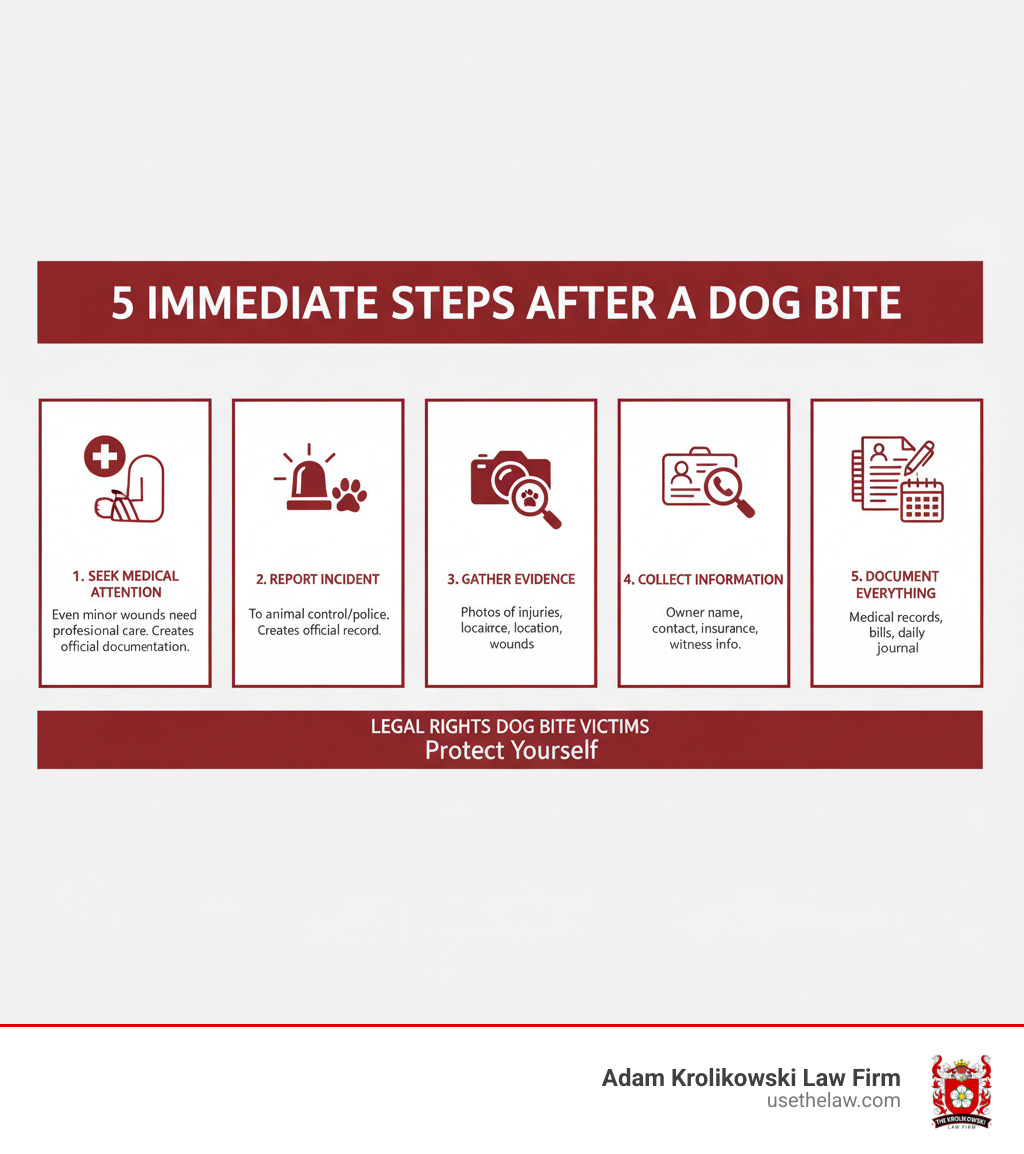
Simple guide to Legal rights dog bite victims terms:
Immediate Steps to Protect Your Health and Legal Rights
The moments after a dog bite are chaotic, but the actions you take are crucial for both your health and your legal case. Following these steps helps build the foundation for protecting the legal rights dog bite victims have under California law.
Seek Medical Attention Immediately
Even minor dog bites require a doctor’s attention. Dog mouths contain bacteria that can cause serious infections like Pasteurella or MRSA in 10-15% of bites. A medical professional can properly clean the wound, provide antibiotics or a tetanus shot, and assess for deeper nerve or muscle damage.
Crucially, a medical visit creates an official record of your injuries. This documentation is vital evidence for your claim, preventing an insurance company from downplaying the severity of the bite. Keep copies of all medical records, bills, and receipts.
Reporting the Incident
Official reports are essential for protecting your legal rights.
First, contact your local animal control department. They will create an official record of the attack, identify the dog and owner, and may quarantine the dog to check for rabies. This report helps establish the facts and protects the community.
Second, file a police report if the bite was severe or the owner was uncooperative. This adds another layer of official documentation that can be invaluable if the owner disputes your account.
Gathering Evidence
The more evidence you collect, the stronger your case.
- Owner’s Information: Get the dog owner’s full name, address, phone number, and homeowner’s or renter’s insurance information.
- Witnesses: Collect contact details from anyone who saw the attack. Independent witnesses can be very valuable.
- Photographs: Take photos of your injuries immediately and as they heal. Also, photograph the location of the bite, any torn clothing, and the dog, if it’s safe.
- Journal: Document your pain levels, symptoms, and how the injury affects your daily life. Record any anxiety, fear, or trouble sleeping. This journal provides powerful evidence of your pain and suffering.
These steps are essential for building a strong claim. For guidance on how we can help, visit our page on Dog Bite Accident Attorney.
Understanding Dog Bite Liability: Who is Responsible?
After a dog bite, a key question is who is legally responsible. Liability laws vary by state, but they generally fall into three categories: strict liability, the “one-bite” rule, and negligence.
- Strict liability holds the owner responsible for a bite, regardless of the dog’s past behavior. States like California use this rule, offering strong protection for victims.
- The “one-bite” rule requires the victim to prove the owner knew or should have known their dog was dangerous, often because of a prior incident.
- Negligence applies if the owner failed to use reasonable care to control their dog, such as violating a leash law. Negligence per se occurs when that failure violates a specific safety law.
| Feature | Strict Liability | The “One-Bite” Rule (Scienter) |
|---|---|---|
| Owner Knowledge | Owner is liable regardless of whether they knew the dog was dangerous or had a history of aggression. | Owner is liable only if they knew (or should have known) the dog had a propensity to bite or act viciously. |
| Prior Bites | Not required. A dog does not get “one free bite.” | Typically required. The owner is given “one free bite” (or evidence of prior vicious behavior) before liability is established. |
| Proof Needed | Victim primarily needs to prove they were bitten by the dog and were lawfully present. | Victim must prove the dog had a history of aggression and the owner was aware of it. |
| Common States | California, Michigan, Pennsylvania, Florida (with some nuances), and many others. | Some states still follow this, or it acts as an alternative theory of liability in strict liability states for non-bite injuries. |
| Focus | The act of biting. | The owner’s knowledge of the dog’s dangerousness. |
| Defense | Often limited to provocation or trespassing. | Owner can argue they had no knowledge of the dog’s aggressive tendencies. |
The Foundation of Your Legal Rights: Dog Bite Victims and Liability Laws
California offers strong protections for dog bite victims through its strict liability law, California Civil Code 3342. This statute makes a dog owner liable for damages if their dog bites someone in a public place or lawfully on private property. It doesn’t matter if the dog had never been aggressive before; there is no “one free bite” in California.
However, there are exceptions. An owner’s liability may be reduced or eliminated if:
- Trespassing: The victim was on the property without permission.
- Provocation: The victim provoked the dog by hitting, teasing, or abusing it. Innocent actions, especially by children, are generally not considered provocation.
- Assumption of Risk: The victim knowingly accepted the risk of being bitten, such as a veterinarian treating an aggressive dog.
Insurance companies often use these defenses to deny claims. For more information, you can review the official resource on Understanding California’s Strict Liability Rule for Dog Bites or visit our page on Santa Ana Dog Bite.
Beyond the Owner: Who Else Can Be Held Liable?
While the owner is the primary responsible party, others may also be liable, which is an important aspect of the legal rights dog bite victims have.
- Landlords and property managers can be liable if they knew a tenant’s dog was dangerous and failed to act.
- Dog keepers, pet sitters, or dog walkers with temporary custody of the dog when the bite occurred may be held responsible.
- Parents of minor owners are typically liable for a dog owned by their child.
- Employers may be liable if the bite was related to work activities, such as an attack by a security dog.
Identifying all potentially liable parties is crucial for ensuring you can recover full compensation. For additional guidance, visit our page on Dog Bite Victim Support.
What Are the Legal Rights of Dog Bite Victims to Compensation?
After a dog bite, victims need to know what compensation they can recover. Asserting your legal rights dog bite victims are entitled to means understanding the full scope of available damages.

California law allows victims to be made whole by recovering both economic and non-economic damages.
- Economic damages are tangible financial losses. This includes all past and future medical bills, from emergency care to physical therapy or reconstructive surgery. It also covers lost wages from missed work and loss of future earning capacity if your injuries are disabling.
- Non-economic damages compensate for intangible harm. This includes pain and suffering, emotional distress, anxiety, and PTSD. Scarring and disfigurement are also a significant component, compensating for the emotional toll of permanent marks, especially on visible areas.
In most cases, compensation is paid by the dog owner’s homeowner’s or renter’s insurance policy. However, insurance companies may try to minimize or deny your claim. In rare cases of extreme owner recklessness, punitive damages may be awarded to punish the wrongdoer, though these are not covered by insurance.
Your Legal Rights: Dog Bite Victims and Recoverable Damages
Our goal is to ensure you receive full compensation for all your losses. Recoverable damages include:
- Medical bills: All costs for past and future medical treatment, including ER visits, surgery, medication, and therapy.
- Lost wages: Income lost while you were unable to work.
- Loss of earning capacity: Compensation for a reduced ability to earn income in the future due to your injuries.
- Pain and suffering: Compensation for the physical pain and emotional distress caused by the attack and your injuries.
- PTSD: Damages for the psychological trauma, which may require extensive therapy.
- Scarring and disfigurement: Compensation for the impact of permanent scars on your quality of life and self-esteem.
Navigating these claims can be complex. For a comprehensive overview, see our Orange County Dog Bite Complete Guide. Our Dog Bite Lawyer Orange County team is also available to discuss your case.
The Role of a Dog Bite Attorney in Your Case
Navigating a dog bite claim while recovering from your injuries can be overwhelming. An attorney’s role is to protect the legal rights dog bite victims have and manage the legal process so you can focus on healing. With over 25 years of experience, we handle the complexities of each unique case.
An attorney can help in several key ways:
- Navigating Legal Complexities: We manage all legal requirements, from understanding state and local laws to ensuring paperwork is filed correctly. This includes meeting the statute of limitations, which in California is typically two years from the date of the bite. Missing this deadline can bar you from compensation.
- Evidence Collection: We gather and preserve all crucial evidence, including medical records, official reports, witness statements, and photographs, to build a strong case.
- Dealing with Insurance Companies: We act as your shield, handling all communication with insurance adjusters. They are trained to minimize payouts, and we know how to counter their tactics to protect you from a lowball settlement offer.
- Calculating and Negotiating Damages: We assess the full value of your claim, including future medical costs and non-economic damages like pain and suffering. We then leverage this evidence to negotiate a fair settlement.
- Litigation: While most cases settle, we are always prepared to take your case to court if the insurance company refuses to offer fair compensation. We are not intimidated by complex cases or the prospect of a trial.
By partnering with us, you get an advocate who will fight for the compensation you need to move forward. For more information, see our Dog Bite Attorney Santa Ana Guide.
Frequently Asked Questions about the Legal Rights of Dog Bite Victims
After a dog bite, it’s normal to have many questions. Here are answers to some of the most common concerns regarding the legal rights dog bite victims have.
What if the dog had never bitten anyone before?
In a strict liability state like California, it doesn’t matter. An owner is typically liable for the first bite, regardless of the dog’s history, as long as you were in a public place or lawfully on private property. You do not need to prove the owner knew the dog was dangerous. This is a powerful protection for victims, as there is no “one free bite.” In other states that use a “one-bite” rule, you might need to prove the owner was aware of the dog’s aggressive tendencies.
Can I still file a claim if I was trespassing or provoked the dog?
These are common defenses, but they are not always successful.
- Trespassing: California’s strict liability law protects people who are lawfully on property. If you were trespassing, your ability to recover compensation may be limited. However, if you had permission to be there (even implied permission, like a delivery person), you are protected.
- Provocation: If you intentionally harmed or teased the dog, the owner may have a defense. However, innocent actions, like a child trying to pet a dog, are generally not considered legal provocation.
These situations are fact-specific. It’s important to discuss the details with an attorney rather than assuming you don’t have a case.
What happens to the dog after it bites someone?
This is handled by animal control and is separate from your civil claim for damages. The goal of animal control is public safety. After a report, the dog may be quarantined for 10 days to check for rabies. Depending on the attack’s severity and the dog’s history, it might be designated as “potentially dangerous,” which imposes strict rules on the owner (e.g., muzzling in public). In the most severe cases, a court may order the dog to be humanely euthanized, but this is a last resort. The findings of the animal control investigation can serve as useful evidence in your personal injury case.
Conclusion
A dog attack is a traumatic event with lasting physical, emotional, and financial consequences. We want you to know that you have rights, and you do not have to steer the aftermath alone.
This guide has covered the essential steps to protect your legal rights dog bite victims are guaranteed. This includes seeking immediate medical care, reporting the incident, and understanding California’s strict liability law, which holds dog owners responsible. We’ve also discussed the types of compensation available, from medical bills and lost wages to pain, suffering, and emotional trauma.

The legal system is complex, and insurance companies are focused on minimizing payouts. At Adam Krolikowski Law Firm, we have spent over 25 years fighting for the injured. We handle the legal details, negotiations, and paperwork so you can focus on your recovery. We investigate your case, calculate the full extent of your damages, and fight for the compensation you deserve. We serve clients throughout Orange County, Santa Ana, and Los Angeles.
Time is critical in these cases. Evidence can be lost, and the two-year deadline to file a claim in California passes quickly. You don’t have to figure this out on your own. If you’ve been injured, contact us to understand your options and protect your rights. We offer honest answers about your situation and how we can help. Let us handle the legal battle while you focus on getting better.
Contact Us
Practice Areas
Recent Articles
- « Previous
- 1
- 2
- 3