
Los Angeles sexual harassment: Your 2025 Guide
Why Santa Ana Sexual Harassment Laws Matter More Than Ever
Los Angeles sexual harassment affects thousands of workers annually. If you face unwelcome advances, inappropriate comments, or a hostile work environment, you have strong legal protections under California law.
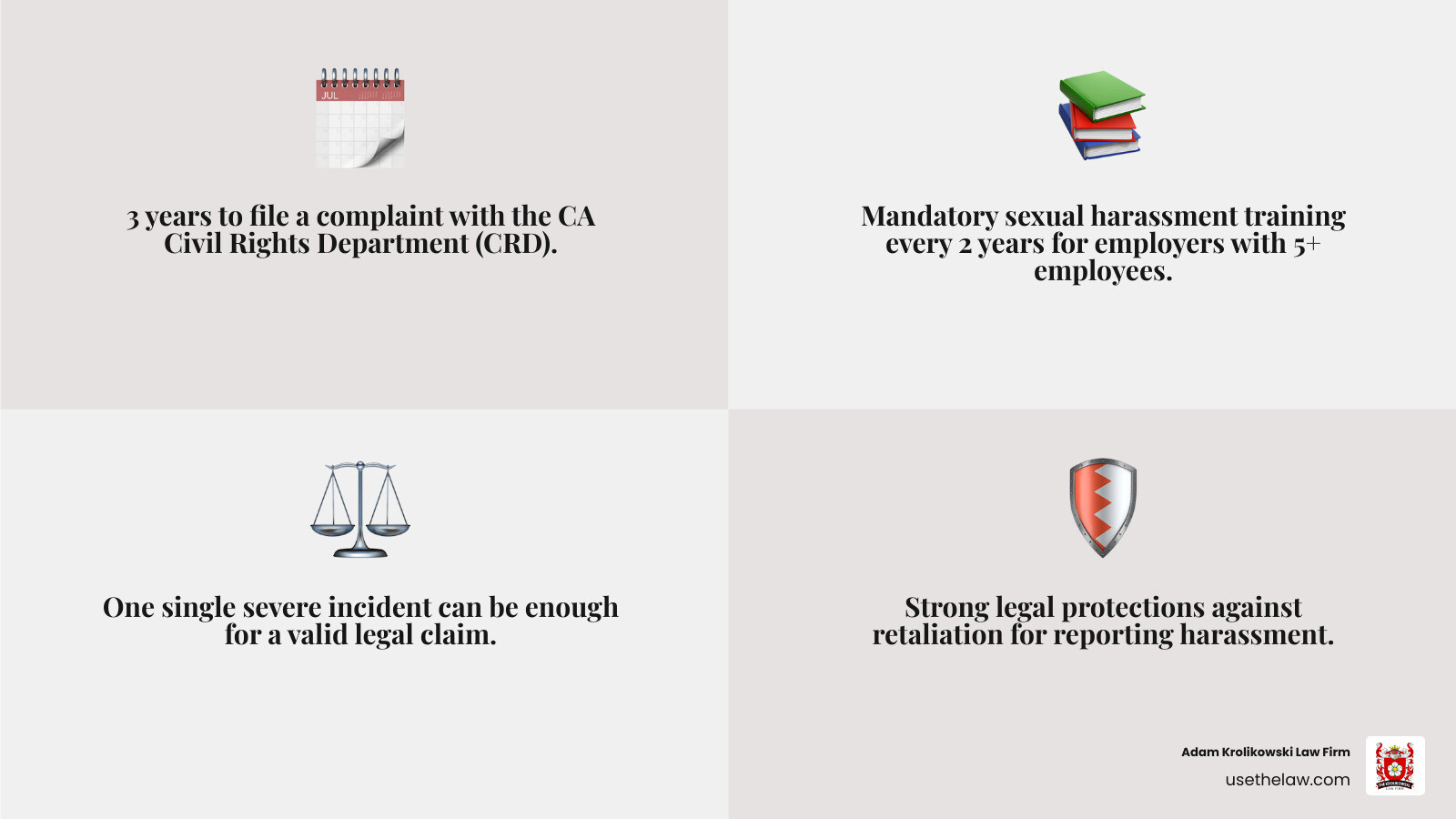
Quick Facts About LA Sexual Harassment Laws:
- Protection Coverage: All employees, contractors, interns, and volunteers
- Filing Deadline: 3 years to file with California Civil Rights Department (extended from 1 year in 2019)
- Employer Requirements: Mandatory training every 2 years for companies with 5+ employees
- Single Incident Rule: One severe incident can be enough for a legal claim
- Retaliation Protection: It’s illegal for employers to punish you for reporting harassment
The workplace should be safe, but research shows nearly 40% of women have experienced sexual harassment. In Los Angeles County, home to over 10 million people, many workers face behavior that creates toxic work environments.
California leads the nation in worker protections. The state’s Fair Employment and Housing Act (FEHA) covers workplaces of all sizes, unlike federal laws. Recent legislation like AB 9 has also made it easier for victims to seek justice by tripling the time limit for filing complaints.
The #MeToo movement brought these issues to light, but the legal framework is long-standing. Now, more people understand their rights and feel empowered to speak up.
You don’t have to endure harassment in silence. Whether it’s unwanted touching, sexual jokes, explicit images, or threats that tie your job to sexual favors – these behaviors violate California law.
Defining Sexual Harassment Under California Law
Los Angeles sexual harassment takes many forms, and California law offers broad protection. Understanding what qualifies as harassment is your first line of defense.
The California Fair Employment and Housing Act (FEHA) defines sexual harassment as unwelcome conduct of a sexual nature. Under California law, the harasser doesn’t need to be motivated by sexual desire; they could be targeting you based on your gender, sexual orientation, or pregnancy.
For example, a male coworker can harass another male, or a supervisor can harass someone based on their gender identity. The law recognizes harassment comes in many forms.
Verbal harassment includes sexually suggestive jokes, comments about your body, or spreading rumors about your personal life.
Physical harassment ranges from unwanted touching and hugging to assault. Even purposely brushing against you or blocking your path can cross the line.
Visual harassment covers displaying explicit materials, leering, or making suggestive gestures.
Gender-based harassment includes undermining someone’s work because of their gender or making derogatory comments about their identity.
The key is that the conduct is unwelcome. You have the right to tell someone to stop, even if you previously participated in banter. If the behavior continues after you’ve made it clear it’s unwelcome, it could be harassment.
Quid Pro Quo vs. Hostile Work Environment
Sexual harassment typically falls into two buckets, and both are serious violations of your rights.
Quid pro quo (Latin for “this for that”) occurs when a person in a position of power, like a supervisor, demands sexual favors in exchange for job benefits (a promotion, a raise) or to avoid negative consequences (being fired, demoted).
The key element is the employment decision being tied to sexual conduct. This almost always involves the supervisor-employee dynamic.
A Hostile Work Environment is created when unwelcome sexual conduct is so severe or pervasive that it results in an intimidating or offensive atmosphere that interferes with your work.
Unlike quid pro quo, anyone can create a hostile environment—coworkers, clients, or customers. The law uses a reasonable person standard, meaning an objective observer would also find the conduct offensive.
Think persistent sexual jokes, offensive emails, or displaying explicit images. The behavior doesn’t need to come from your boss to make your work life miserable.
Can a Single Incident Be Enough?
Many people mistakenly believe you must endure months of harassment for a valid claim. This is untrue.
California Government Code Section 12923 makes it clear that severe single incidents can be enough for a harassment claim. One serious incident—like assault, explicit threats, or a blatant quid pro quo demand—can cross the legal threshold.
California specifically rejected the “extremely severe” standard used by some courts, finding it set too high a bar for victims.
The focus now is on the impact on work performance. Did the incident interfere with your ability to do your job or create fear and distress? If so, that single incident might be enough for a legal claim.

This doesn’t mean minor incidents automatically qualify, but you shouldn’t dismiss serious harassment just because it happened once. California law recognizes that some behaviors are so inappropriate that one time is one time too many.
Your Rights and Employer Responsibilities in Los Angeles
If you’re facing Los Angeles sexual harassment, know that California law provides some of the nation’s strongest worker protections. You have fundamental rights regardless of your job title or employment status.
California’s Fair Employment and Housing Act (FEHA) is comprehensive, covering workplaces of any size, unlike federal laws. It protects full-time employees, independent contractors, interns, and volunteers from sexual harassment.
Your most fundamental right is the right to work in an environment free from harassment. This includes protection from intimidating comments, unwelcome advances, and any conduct that makes you uncomfortable because of your sex or gender.
Protection from retaliation is equally important. Your employer cannot punish you for speaking up about harassment by firing you, demoting you, or cutting your hours. If this happens, it’s a separate legal violation. Our Los Angeles Workplace Retaliation Lawyer resources can help you understand your options.
Employer Duties to Prevent Los Angeles Sexual Harassment
Employers have a legal duty to prevent harassment, not just react to it.
Every employer must have a written anti-harassment policy. This policy must be easy to understand, accessible, and clearly explain what constitutes harassment, how to report it, and that retaliation is prohibited.
Multiple reporting options are required, as your direct supervisor might be the problem. The policy should provide several contacts, such as HR or another manager.
When a report is made, your employer must conduct a prompt and thorough investigation. This is a legal requirement. The investigation should include interviews, evidence gathering, and maintaining confidentiality as much as possible.
If harassment occurred, your employer must take corrective action to stop it and prevent it from happening again. This might mean disciplining the harasser, providing training, or termination.
Here are the key employer obligations under FEHA:
- Maintain clear written anti-harassment policies
- Provide mandatory training
- Offer multiple reporting channels
- Conduct prompt, thorough investigations
- Take appropriate corrective action
- Protect employees from retaliation
Required Sexual Harassment Prevention Training
California requires employers with five or more employees to provide sexual harassment prevention training every two years. This is designed to create workplaces where everyone understands boundaries.
Supervisors must receive two hours of training, while all other employees need one hour. New hires or newly promoted supervisors must be trained within six months.
These sessions cover recognizing harassment, reporting procedures, and bystander intervention. Bystander intervention is valuable because it teaches people how to step in safely when they witness inappropriate behavior.
The state provides free training modules that employers can use. You can access free state-provided training modules directly through the California Civil Rights Department.
A Step-by-Step Guide for Victims of Workplace Harassment
Experiencing sexual harassment is distressing and disorienting. It’s easy to feel overwhelmed, but you are not alone. Taking concrete steps can help you protect your rights, regain control, and move toward a resolution.

1. Document Everything
This is a critical first step. Detailed documentation is your strongest ally, even if it’s uncomfortable to create. It serves as your personal record of events.
- Detailed Notes: Write down every instance of harassment, including dates, times, and locations.
- Witnesses: Note anyone who was present or might have seen the harassment.
- Specific Words or Actions: Write down exactly what was said or done.
- Your Reaction: Document how you felt and how you responded.
- Save Evidence: Preserve any related emails, text messages, or photos. Try to save copies to a personal device.
- Create a Personal Record: Keep this information in a secure place outside of work, like a personal journal or a password-protected document on your home computer.
This record-keeping will be invaluable if you decide to file a formal complaint or pursue legal action.
2. Report the Harassment
After documenting the incidents, the next step is to report the harassment internally.
- Review Company Policy: Start by reviewing your employer’s sexual harassment policy to find the official reporting procedures.
- Report to HR or Supervisor: Most policies direct you to report to your supervisor, a manager, or the Human Resources department.
- Written Complaint: Always follow up a verbal report with a written complaint to create an official record. State that you are reporting sexual harassment, provide key details, and request immediate action. Keep a copy for your records.
- Follow Up in Writing: If you don’t hear back or the harassment continues, follow up in writing to reiterate your concerns.
- What if the Harasser is Your Supervisor? If your supervisor is the harasser, bypass them and report to their supervisor or directly to HR, as outlined in your company’s policy.
3. File an Official Complaint
If your employer fails to act or you’re uncomfortable reporting internally, you can file a complaint with a government agency. These agencies investigate and enforce anti-harassment laws.
- California Civil Rights Department (CRD): This is the state agency that enforces FEHA. You can file a complaint directly with the California Civil Rights Department (CRD). They investigate complaints and can pursue damages on your behalf. Find details on how to file a complaint with the CRD.
- Equal Employment Opportunity Commission (EEOC): The EEOC is the federal agency enforcing federal anti-discrimination laws. You can find information on filing complaints on their website.
- Cross-Filing: Complaints filed with either the CRD or the EEOC are automatically cross-filed with the other agency, so you generally only need to file once.
There are strict deadlines for filing these complaints, which we will discuss next.
Navigating the Legal Process for Los Angeles Sexual Harassment
Pursuing a legal claim for Los Angeles sexual harassment can feel overwhelming. The process may seem intimidating, but understanding it can help you feel more confident.
A successful harassment claim can result in several types of compensation. Lost wages are a significant component, including back pay (money you already lost) and front pay (future income you may lose).
California law recognizes the real emotional toll of harassment. Emotional distress damages compensate for pain, suffering, anxiety, and other psychological impacts. For many, legal acknowledgment of this harm is as important as financial recovery.
Medical expenses for therapy, counseling, or medication related to the harassment are also recoverable.
In cases of outrageous employer conduct, courts may award punitive damages. These are meant to punish the employer and deter future misconduct.
If you win your case, you can often recover your attorney fees and legal costs.
These potential consequences highlight why employers should take harassment seriously.
Understanding the Statute of Limitations
Time limits, or statutes of limitations, are crucial in harassment cases. Missing a deadline can mean losing your right to file a claim.
Previously, California victims had only one year to file a complaint, which was often not enough time to process the experience and decide to act.
AB 9, the “Stop Harassment and Reporting Extension Act,” took effect on January 1, 2020. This law tripled the filing window, giving you three years from the date of the last harassment incident to file with the California Civil Rights Department (CRD).
If you file with the federal Equal Employment Opportunity Commission (EEOC), you typically have six months from the last incident. However, complaints are automatically cross-filed between the agencies.
After filing an administrative complaint, you will eventually receive a “right to sue” letter. Once you receive it, you have one year to file a lawsuit in California Superior Court.
These timelines can be complex, so it’s important not to wait indefinitely.
How Recent Laws (AB 9, SB 331) Strengthen Your Protections
California continues to lead the nation in protecting workers from harassment.

We’ve already discussed how AB 9 extended the filing deadline to three years, a game-changer for many survivors.
SB 331, the “Silenced No More Act,” became law on January 1, 2022. For years, employers used non-disclosure agreements (NDAs) in settlements to silence employees. This practice hid misconduct and prevented others from learning about patterns of abuse.
SB 331 changed that. Now, employers can’t enforce clauses that prevent you from discussing factual information about harassment, discrimination, or retaliation. Even if you settle your case, you can still talk about what happened. You are no longer forced into silence.
This law recognizes that speaking out helps create safer workplaces for everyone and holds employers accountable.
Frequently Asked Questions about Los Angeles Sexual Harassment
Dealing with workplace harassment brings uncertainty about your rights, potential retaliation, and what happens next. These concerns are normal.
Can I be fired for reporting sexual harassment?
The short answer is no. California law is clear: firing someone for reporting Los Angeles sexual harassment is illegal retaliation.
When you report harassment, you’re engaging in “protected activity.” Your employer cannot punish you for it. Unfortunately, some employers still try to get back at employees who report.
Retaliation isn’t always being fired. It can be more subtle, like getting worse assignments, being excluded from meetings, or receiving a sudden negative performance review. All of these actions could be illegal retaliation.
If you believe you’ve been wrongfully terminated or punished after reporting harassment, you may have a strong legal claim. Document everything that changes after your report. Our Wrongful Termination Lawyer Los Angeles resources can help you understand your options.
What if the harasser is a client, customer, or vendor?
Many people don’t realize the law covers this situation. Your employer has a legal duty to protect you from harassment by non-employees like clients or vendors.
If your employer knew or should have known about the harassment and failed to take immediate action, they can be held liable. They can’t just say “not our problem.”
For example, if a server reports a customer’s sexual comments and the manager does nothing, the employer is failing their duty. They should take action, such as speaking to the customer or having someone else serve them.
The key is to report the harassment to your employer so they have a chance to address it. Once they know, they are legally obligated to take corrective action.
Does harassment have to be physical or happen at the office?
Not at all. Sexual harassment comes in many forms and can happen anywhere work-related activities occur.
Verbal harassment (suggestive jokes, crude language) and visual harassment (explicit images, leering) are just as illegal as unwanted touching.
Harassment often happens online through inappropriate emails, text messages, or posts on work communication platforms.
Work-related events like company parties, business trips, and client dinners are also covered by harassment laws.

Even remote work situations are covered. Inappropriate comments during a video call or explicit messages while working from home still constitute workplace harassment.
The bottom line: if the conduct is unwelcome, sexual, and work-related, it could be harassment, regardless of where or how it occurs.
Taking the Next Step
Dealing with Los Angeles sexual harassment isn’t a journey you must take alone. Understanding your rights is a powerful first step toward a workplace where you can focus on your job without fear of harassment.
You have key protections: a three-year filing deadline with the CRD, protection from retaliation, and the right to seek compensation. Documenting, reporting, and filing an official complaint all help build a stronger case.
At Adam Krolikowski Law Firm, we have over 25 years of experience with complex employment law cases in Southern California. We understand these cases involve sensitive details and emotional trauma, which is why we take on challenging situations that others may avoid. Everyone deserves justice.
Every harassment case is unique. Whether it involves quid pro quo demands, a hostile environment created by coworkers, or an employer’s failure to protect you from a client, California law provides strong protections. We’re here to help you understand how they apply to your circumstances.
The legal process can be intimidating, but you don’t have to face it alone. Knowledgeable legal guidance is crucial, from understanding deadlines to building a case for damages. We offer confidential consultations to discuss your story and options.
Don’t let fear or uncertainty keep you from standing up for your rights. Recent changes in California law, like AB 9 and SB 331, show the system is designed to support people who have the courage to speak up.
Find out how a sexual harassment lawyer can help your case and take that next step toward reclaiming your right to a safe, respectful workplace. Your voice matters, and your rights are worth defending.
Contact Us
Practice Areas
Recent Articles
- « Previous
- 1
- 2
- 3
- Next »