

Why You Need a Los Angeles Workplace Retaliation Lawyer
If you’re searching for a los angeles workplace retaliation lawyer, you may have been punished at work after reporting illegal activities, discrimination, or harassment. Here’s what you need to know:
Quick Actions to Take:
- Document everything immediately (emails, texts, performance reviews).
- File complaints with the California Civil Rights Department within 3 years.
- Contact the EEOC within 180-300 days for federal claims.
- Seek legal counsel to protect your rights.
Common Retaliation Examples:
- Termination after reporting harassment.
- Demotion following discrimination complaints.
- Pay cuts after requesting disability accommodations.
- Negative reviews after participating in investigations.
Workplace retaliation is surprisingly common. More than a third of discrimination charges filed with the EEOC include a retaliation claim, making it the most frequently reported basis for such complaints.
When Los Angeles employees report illegal activities, they should be protected, not punished. Unfortunately, employers often engage in retaliatory behavior, creating a “chilling effect” that discourages others from speaking out.
California law provides stronger protections than federal law, with more time to file claims and broader definitions of retaliation. The Fair Employment and Housing Act (FEHA) prohibits employers from retaliating against workers who oppose discrimination or participate in investigations.
This guide explains workplace retaliation in Los Angeles, from your rights to building a strong case with the right legal team.
Los angeles workplace retaliation lawyer vocab to learn:
- employment attorney los angeles free consultation
- los angeles gender discrimination lawyer
- pro bono employment lawyers los angeles
Understanding Workplace Retaliation in California
Workplace retaliation occurs when your employer punishes you for standing up for your rights or reporting illegal behavior. This is illegal under both California and federal law because it creates a “chilling effect” that discourages employees from speaking up about discrimination, harassment, and other violations.

California’s Fair Employment and Housing Act (FEHA) and federal laws make employer retaliation illegal, and companies can face serious legal consequences. A los angeles workplace retaliation lawyer can help you hold them accountable.
What Are Legally Protected Activities?
A protected activity is any action you take to exercise your workplace rights or oppose illegal practices. The scope is broader than many people realize.
- Reporting discrimination or harassment: This includes speaking up about unfair treatment based on race, gender, age, religion, sexual orientation, medical conditions, and more. Reporting to a supervisor, HR, or a government agency is protected.
- Filing complaints or participating in investigations: You are protected when you file a complaint with an agency like the EEOC or California’s Civil Rights Department, or if you participate in a workplace investigation.
- Refusing to break the law: Saying “no” to illegal requests, such as falsifying records or ignoring safety rules, is a protected activity. This also includes resisting sexual advances or discriminatory orders.
- Requesting accommodations or inquiring about pay: Asking for reasonable accommodations for a disability or religious practice is protected. Inquiring about salary information to investigate potential wage discrimination is also often your right.
Essentially, your employer cannot legally punish you for standing up for what’s right.
Learn about your rights from the EEOC.
Common Examples of Retaliatory Adverse Actions
Retaliation isn’t always as obvious as being fired. It can be subtle but equally harmful.
- Termination or demotion: The most direct forms of retaliation.
- Pay cuts or being passed over for promotions: Financial penalties for speaking up.
- Sudden negative performance reviews: A sharp decline in your reviews after a complaint is a red flag.
- Increased scrutiny or micromanaging: Your boss suddenly watching your every move.
- Unfavorable job transfers or shift changes: Making your work life difficult on purpose.
- Exclusion from meetings or training: Denying you opportunities for growth.
- Altered workloads or spreading rumors: Setting you up for failure or creating a hostile environment.
Any employer action that might discourage a reasonable person from exercising their rights could be considered retaliation.
California vs. Federal Law: Why State Protections Matter for a Los Angeles Workplace Retaliation Lawyer
If you work in Los Angeles, California law often provides stronger protections than federal law. California’s Fair Employment and Housing Act (FEHA) is generally more employee-friendly than federal laws like Title VII.
| Feature | Federal Law (Title VII) | California Law (FEHA) |
|---|---|---|
| Scope of Protection | Covers race, color, religion, sex, national origin, age, disability | Much broader – includes sexual orientation, gender identity, marital status, medical conditions, genetic information, military status, and more |
| Definition of Adverse Action | Must be “materially adverse” to discourage protected activity | Interpreted more broadly – covers actions that might not be “materially adverse” but still deter you from speaking up |
| Burden of Proof | Standard three-part test with employer defenses | Similar but often easier to prove certain elements under FEHA |
| Time Limits | 180-300 days to file EEOC charge | Up to 3 years to file CRD complaint – this is huge! |
| Damages Available | Back pay, front pay, emotional distress, punitive damages (with caps), attorney fees | Similar damages often without caps – potentially much higher awards |
The three-year statute of limitations under FEHA is a significant advantage, giving you more time to seek legal help. A los angeles workplace retaliation lawyer who understands these state-specific nuances can use them to your advantage.
More on California workplace harassment law.
Building Your Case: How to Prove Retaliation
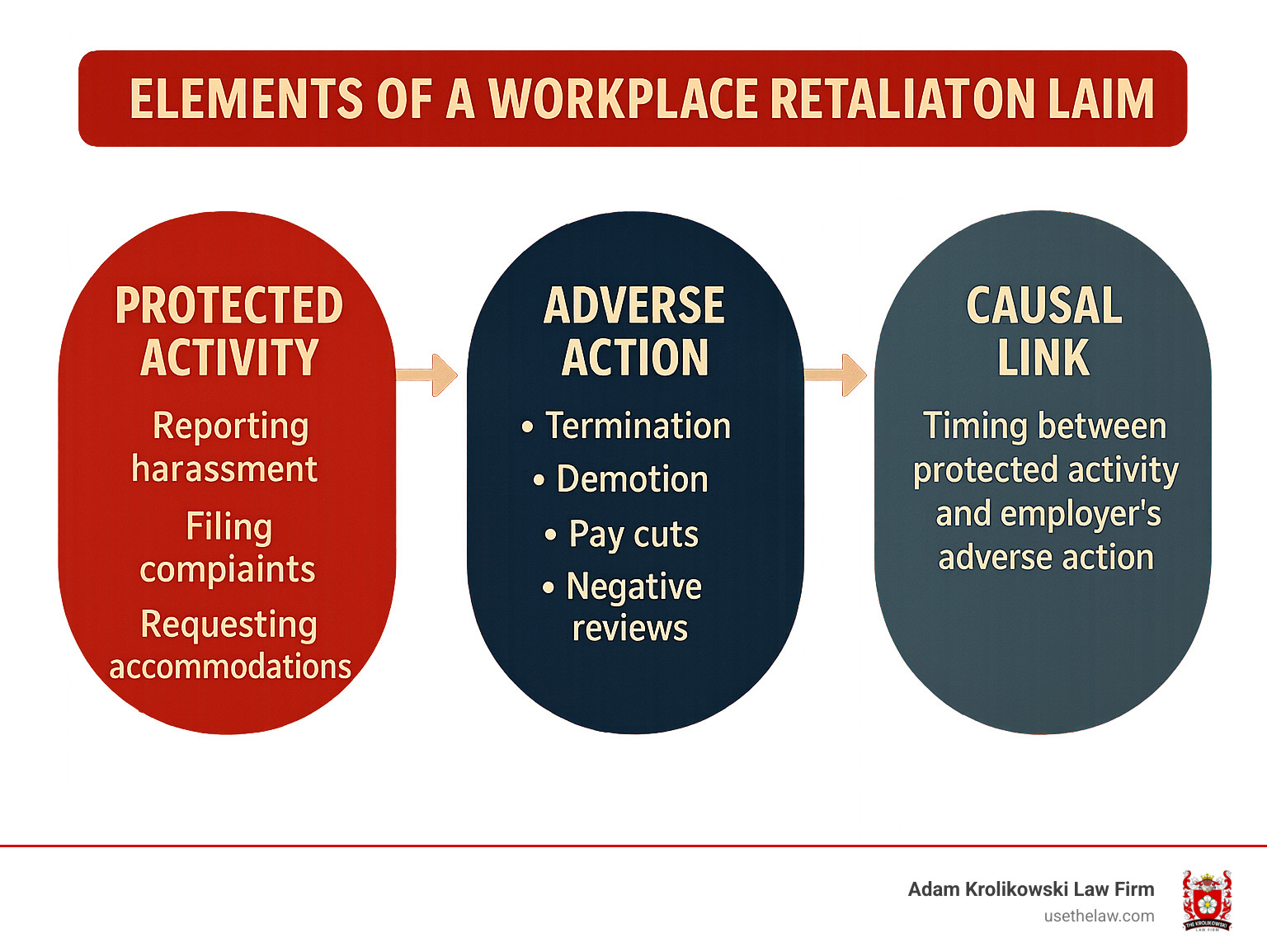
Proving retaliation follows a clear legal framework. You must demonstrate three key elements:
- You engaged in a protected activity (e.g., reporting harassment).
- Your employer took an adverse action against you (e.g., termination or demotion).
- A causal link exists between the protected activity and the adverse action.
Establishing the causal link is often the most challenging part. This means proving the negative action happened because you spoke up. Temporal proximity (the timing between your complaint and the adverse action) and employer knowledge (proving decision-makers knew about your activity) are crucial for building your case.

Steps to Take if You Suspect Retaliation
How you respond in the moments after suspecting retaliation can impact your case. Here are critical steps to take:
- Remain calm and professional: Avoid emotional reactions like angry emails or confrontations, which can be used against you. Keep all communications professional.
- Document everything: Start a detailed log of every incident, including dates, times, people involved, and what was said or done. This log is a vital piece of evidence.
- Preserve all communications: Save every email, text, and memo related to your work and the incidents.
- Avoid social media: Do not vent about your job or boss online. Social media posts can be used by your employer’s defense.
- Follow internal procedures carefully: While you may need to use HR channels, HR’s primary role is to protect the company. Document all interactions.
- Contact a lawyer: Seek legal guidance from a los angeles workplace retaliation lawyer as soon as possible to preserve evidence and protect your rights.
Find out what to do if you are injured at work.
The Critical Role of Evidence and Documentation
A strong retaliation case is built on a solid foundation of evidence. Without it, your claim may not succeed.
- Emails and text messages: These provide a real-time record of communications and can be powerful evidence.
- Performance reviews: A sudden shift from positive to negative reviews after a complaint is a strong indicator of retaliation.
- Witness statements: Testimony from colleagues who observed the retaliation can independently verify your claims.
- Official documents: Memos, company policies, pay stubs, and employment records create a paper trail and help quantify your damages.
- Personal log: A detailed, contemporaneous log of events serves as your record and carries significant weight.
Every piece of evidence helps build a comprehensive story, making it harder for your employer to justify their actions.
The Role of a Los Angeles Workplace Retaliation Lawyer
Facing workplace retaliation can feel like a David vs. Goliath battle. A los angeles workplace retaliation lawyer can level the playing field and protect your rights.
Our role involves:
- Case Evaluation: We listen to your story, review your documentation, and provide an honest assessment of your claim’s strengths and weaknesses.
- Evidence Gathering: We go beyond your records to interview witnesses, request documents from your employer, and build a clear timeline connecting your protected activity to the retaliation.
- Navigating Deadlines: Missing a deadline with the California Civil Rights Department (CRD) or the EEOC can end your case. We ensure everything is filed correctly and on time.
- Filing Agency Complaints: We handle all the paperwork and procedures for complaints with the CRD and EEOC, which investigate and may try to resolve the matter.
- Negotiating Settlements: Many cases are resolved without a trial. We negotiate for compensation that reflects the harm you’ve suffered and won’t let employers lowball you.
- Court Representation: If a settlement isn’t reached, we are prepared for court. With over 25 years of experience, we handle complex cases against large corporations. We often work on a contingency fee basis, meaning you don’t pay unless we win.

Distinguishing Retaliation from Wrongful Termination and Discrimination
Employment law claims like retaliation, wrongful termination, and discrimination are related and often overlap.
- Discrimination is about who you are. It’s unfair treatment based on a protected characteristic like race, gender, or age.
- Wrongful termination is about why you were fired. It’s a firing that violates public policy, such as for refusing to break the law.
- Retaliation is about the reaction. It’s punishment for engaging in a legally protected activity, like reporting discrimination.
A single situation can involve multiple claims. For example, being fired after reporting sexual harassment could be both a discrimination and a retaliation claim. As your los angeles workplace retaliation lawyer, we identify every applicable legal theory to build the strongest case.
Learn more about wrongful termination in Los Angeles; Find an employment attorney in Los Angeles.
What Compensation Can You Recover in a Retaliation Claim?
If you win a retaliation case, you can recover damages to compensate for the harm you’ve suffered.
- Lost Wages (Back Pay): Covers salary, bonuses, and commissions you would have earned.
- Future Lost Wages (Front Pay): Compensates for long-term damage to your earning potential.
- Lost Benefits: The value of health insurance, retirement contributions, and other perks.
- Emotional Distress Damages: Compensation for the anxiety, humiliation, and stress caused by the retaliation.
- Punitive Damages: Awarded in cases of outrageous conduct to punish the employer and deter future wrongdoing.
- Attorney’s Fees and Costs: In most successful cases, the employer is required to pay your legal fees.
- Reinstatement: Returning to your old job is a possible remedy, though often impractical.
The amount you can recover depends on the specifics of your case. Our goal is to secure the full compensation you deserve.
Read about a record-setting retaliation verdict.
Frequently Asked Questions about Los Angeles Retaliation Claims
Here are answers to some common questions about workplace retaliation claims in Los Angeles.
What are the time limits for filing a retaliation claim in California?
Missing filing deadlines can prevent you from seeking justice. In California, you generally have three years from the date of the retaliation to file a complaint with the California Civil Rights Department (CRD).
For federal claims with the Equal Employment Opportunity Commission (EEOC), the deadline is much shorter: typically 180 days, though it can extend to 300 days in California.
Even with these timeframes, it is crucial to act quickly. Evidence can disappear, memories fade, and witnesses may leave the company. Contacting a los angeles workplace retaliation lawyer early is the best way to protect your rights.
Can I be retaliated against for an informal complaint?
Yes. You do not need to file a formal, written complaint to be protected. The law protects you for many forms of speaking up.
Voicing concerns about harassment to a supervisor, opposing discriminatory practices in a meeting, or even telling a manager you are uncomfortable with certain actions can all be protected activities. The key is that you opposed what you reasonably believed to be an unlawful practice, and your employer was aware of it. The substance of your complaint matters more than the format.
What if my employer claims I was fired for poor performance?
This is a common defense used to cover up retaliation. While employers can fire employees for legitimate performance issues, we look for red flags that suggest the claim is a pretext.
- Timing: Did the performance issues suddenly appear only after you made a complaint?
- Previous Reviews: Were your performance reviews positive before you spoke up?
- Inconsistent Treatment: Are other employees with similar performance issues treated less harshly?
- Lack of Warning: Were you disciplined without the warnings or documentation that company policy requires?
A los angeles workplace retaliation lawyer can investigate these factors to expose the true motive behind your employer’s actions. We know this playbook and how to counter it.
Conclusion: Taking the Next Step to Protect Your Rights
If you spoke up about wrongdoing at work and are now facing the consequences, know that your actions were courageous and legally protected. Workplace retaliation is illegal, and California law is on your side.
Remember these key takeaways:
- You are protected when you speak up: Reporting harassment, filing a complaint, or opposing illegal acts are protected activities.
- Document everything: Emails, texts, and performance reviews are critical evidence. A detailed log can make or break your case.
- Act quickly: While California gives you three years to file a claim, waiting can weaken your position as evidence and memories fade.
- Don’t go it alone: Employment law is complex. You need guidance from someone who understands California’s specific protections.
At Adam Krolikowski Law Firm, we have over 25 years of experience fighting for employees. We handle the complex cases that other firms may avoid because we believe every worker deserves a strong advocate. We have seen the damage retaliation can cause, and we know how to build a strategy to make things right.
You don’t have to face this by yourself. As your los angeles workplace retaliation lawyer, we can guide you through every step of the process. You showed courage by speaking up; let us help you see it through.
Contact a California employment law firm for a consultation.
Contact Us
Practice Areas
Recent Articles
- « Previous
- 1
- 2
- 3
- Next »