

When Property Owners Fail to Protect: Your Legal Rights After a Crime
A negligent security lawsuit is a legal claim against property owners who failed to provide adequate security measures, resulting in harm to visitors from preventable crimes. These cases fall under premises liability law and allow victims to seek compensation when property owners breach their duty of care.
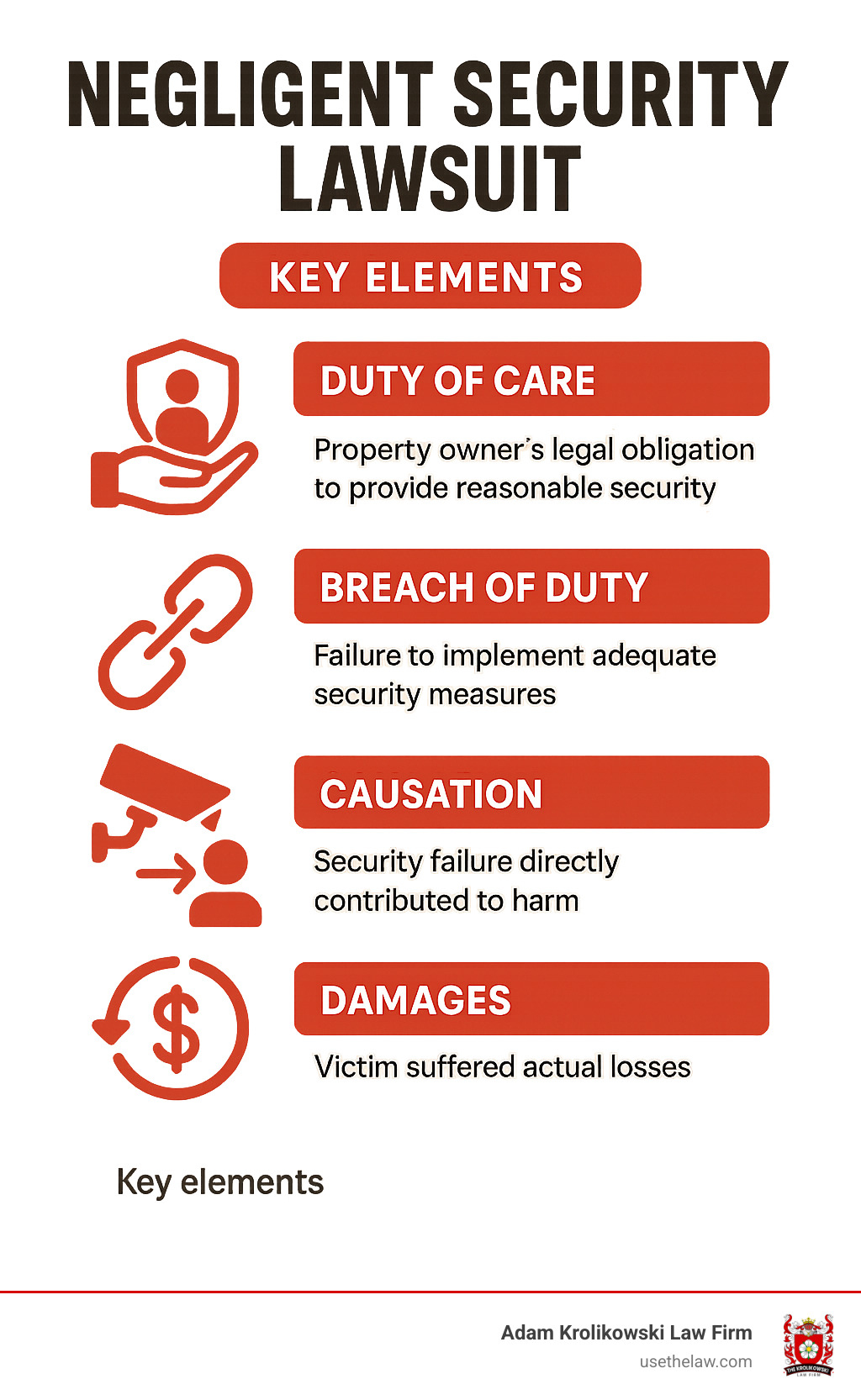
Key Elements of a Negligent Security Lawsuit:
- Duty of Care – Property owner had a legal obligation to provide reasonable security
- Breach of Duty – Owner failed to implement adequate security measures
- Foreseeability – The crime was reasonably predictable based on location or prior incidents
- Causation – The security failure directly contributed to the victim’s harm
- Damages – Victim suffered actual physical, emotional, or financial losses
Property owners must take reasonable steps to prevent foreseeable criminal acts. If they fail to address issues like poor lighting, broken locks, or inadequate security, they can be held liable for any resulting harm.
Common locations for negligent security claims include:
- Apartment complexes with broken entry systems
- Shopping centers lacking proper lighting
- Hotels without adequate security staff
- Parking garages with faulty surveillance systems
- Bars and nightclubs with untrained security
While the criminal justice system punishes the perpetrator, it doesn’t compensate the victim. Criminals often lack the funds to pay for damages, which is why a claim against the property owner—who usually has liability insurance—is often the most practical path to financial recovery.
Victims can recover compensation for medical bills, lost wages, pain and suffering, and emotional trauma like PTSD. In cases involving egregious negligence, punitive damages may also be awarded.
Negligent security lawsuit word roundup:
Understanding the Grounds for a Claim: What is Negligent Security?
A negligent security lawsuit holds property owners accountable when their failure to provide a safe environment leads to a visitor being harmed by a crime. As a type of premises liability claim, it’s based on the owner’s duty to ensure their property is reasonably safe for legal visitors, whether it’s a store, apartment complex, or parking garage. When they fail to take reasonable security measures and a crime occurs, a lawsuit may be necessary.
To win a negligent security lawsuit, several key elements must be proven:
-
Duty of Care: The property owner had a legal duty to provide reasonable security for people legally on their property. The level of care depends on the visitor’s status (e.g., a customer is owed a higher duty than a trespasser).
-
Foreseeability: The crime was reasonably foreseeable. This means a sensible property owner should have anticipated the risk of such a crime, often due to prior incidents or the nature of the location.
-
Breach of Duty: The owner breached their duty by failing to provide adequate security measures to prevent the foreseeable crime, such as by not fixing a broken gate or installing necessary cameras.
-
Causation: The owner’s failure to provide security was a direct cause of the victim’s injuries. The harm would likely have been prevented if proper security had been in place.
-
Damages: The victim suffered actual damages, including physical injuries, emotional trauma, and financial losses, as a result of the security breach.
Understanding these points is crucial for building a strong case. For more information on how these elements apply specifically here in California, you might find our insights on a California Negligent Security Attorney helpful.
Common Examples of Inadequate Security
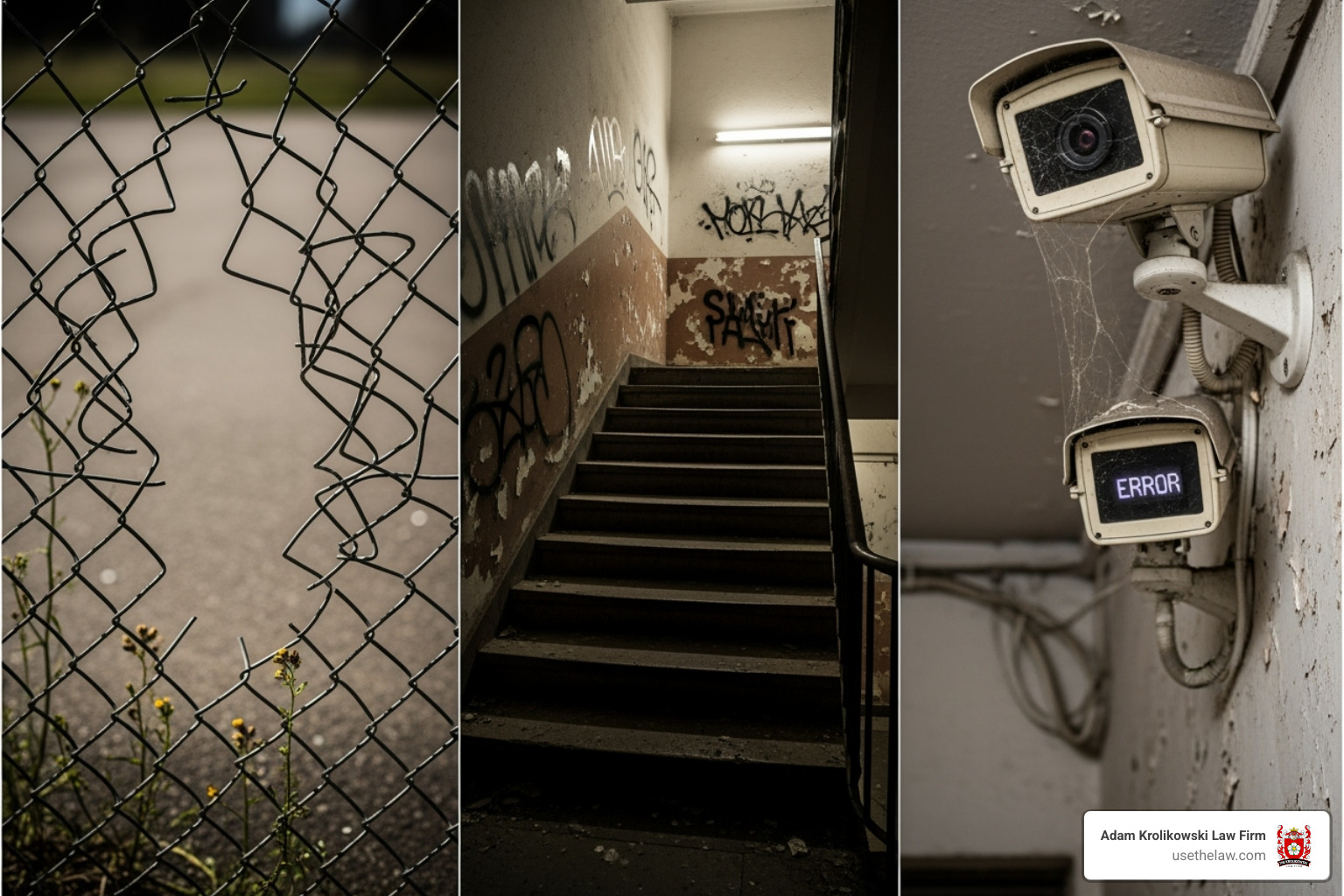
Negligent security often involves specific failures that create opportunities for criminals. Common examples that can lead to a negligent security lawsuit include:
- Inadequate lighting in parking lots, stairwells, or hallways, which can conceal criminals.
- Broken locks or gates that allow unauthorized individuals easy access to buildings.
- Malfunctioning or missing security systems, such as non-working cameras in high-risk areas.
- Inadequate fencing around a property that makes it easy for intruders to enter.
- Untrained or insufficient security personnel, meaning there are not enough guards or they are not properly equipped to keep people safe.
- Failure to address known risks or prior incidents, such as ignoring a history of crime on the property without improving security.
These failures show a disregard for the safety of visitors and can lead to preventable tragedies.
How Foreseeability of Crime is Determined
Foreseeability is a key element in a negligent security lawsuit. It asks whether a property owner could have reasonably anticipated that a crime might occur and should have taken preventative measures. Foreseeability is determined by several factors, including:
- Prior similar incidents on or near the property. A history of crime can make future incidents foreseeable.
- The property’s location in a high-crime area. This increases an owner’s duty to provide adequate security, which can be established with police reports and crime statistics. The Bureau of Justice Statistics (BJS) provides data that can show patterns of criminal activity.
- The property type. Certain locations, like nightclubs or 24-hour convenience stores, have a naturally higher risk of crime and thus a higher duty to provide security.
- Industry standards. If a property owner’s security measures fall short of what is common practice for similar businesses, it can indicate negligence.
Property owners are expected to be proactive in assessing and preventing reasonable risks. Legal precedent, such as discussions found in resources like this one on foreseeability, highlights this important point.
Identifying Liable Parties: Who Can Be Sued?
In a negligent security lawsuit, several parties may be held accountable for failing to keep a property safe. Identifying all responsible parties is a key step. Depending on the situation, liable parties can include:
- Property owners and landlords: Individuals or corporations owning residential or commercial properties are often primarily responsible, especially for common areas.
- Property management companies: If a separate company is hired to manage the property, they may share responsibility for security failures.
- Commercial businesses: A business operating within a larger property (like a store in a mall) can be liable for incidents that occur due to its own lack of security.
- Security companies: Third-party security firms can be held liable if their negligence contributed to the harm.
- Government entities: Public bodies can be sued if the incident occurred on public property like a park or school, though these cases have special rules and shorter deadlines.
Identifying all potentially liable parties helps ensure you can pursue the full compensation you deserve. For more insights, you can check our information on finding a Premises Liability Lawyer Near Me.

Why Sue the Property Owner and Not Just the Criminal?
While the criminal is directly responsible for the act, a negligent security lawsuit targets the property owner for practical reasons. The goal of a civil case is different from a criminal case.
- Civil vs. Criminal Case: A criminal case punishes the offender but does not compensate the victim for their losses. A civil lawsuit is designed to provide financial recovery for medical bills, lost wages, and other damages.
- Judgment-Proof Criminals: Criminals are often “judgment-proof,” meaning they lack the financial assets to pay for the victim’s damages, even if a court orders them to. Often, the perpetrator is never even identified.
- Property Owner’s Insurance: Property owners typically carry liability insurance. This insurance provides a source of funds for compensation, making a lawsuit against the owner the most viable path to recovery.
Can a Third-Party Security Company Be Held Liable?
Yes, if a property owner hires a third-party security company, that company can also be held liable in a negligent security lawsuit if their negligence contributes to an incident. Liability can arise from:
- Failure to meet contractual obligations, such as not providing the agreed-upon number of guards or patrols.
- Negligent hiring of unqualified guards or providing inadequate training to handle security situations effectively.
- A failure to patrol designated areas or properly monitor surveillance equipment as required.
- Direct security guard negligence or misconduct, where a guard’s actions or inaction contributes to the harm.
In every negligent security lawsuit, we investigate to understand who was responsible for security and how they failed.
The Negligent Security Lawsuit Process: From Incident to Resolution
The legal process following a crime can seem daunting. A negligent security lawsuit generally follows a clear path, allowing you to focus on recovery while we handle the legal work. The key stages include filing a claim, a thorough investigation and evidence gathering, settlement negotiations, and, if necessary, a trial. Adhering to the statute of limitations is critical throughout this process.

Evidence Needed to Support Your Claim
A strong negligent security lawsuit is built on compelling evidence. We gather various types of proof to build a comprehensive case, including:
- Police reports: Official records of the criminal incident, detailing the crime, injuries, and initial observations of the scene.
- Medical records: Documentation of your injuries, treatments, diagnoses, and recovery, including hospital stays, therapy, and counseling records.
- Photos and videos of the scene: Visual proof of inadequate security, such as poor lighting, broken locks, or non-working cameras, taken after the incident.
- Witness statements: Testimony from people who saw the incident, knew about the security conditions, or were aware of prior crimes on the property.
- Maintenance logs and security records: Internal documents from the property owner that can reveal a pattern of neglect, such as missed repairs or understaffing of security personnel.
- Prior incident reports or the property’s crime history: Proof of previous crimes on or near the property, which helps establish that the risk was foreseeable.
- Expert testimony: Analysis from security professionals who can assess the property’s security failures and explain how they fell below reasonable standards.
Gathering this evidence is a complex process we handle for you to build the strongest possible case.
Understanding the Statute of Limitations
Filing a negligent security lawsuit is time-sensitive. States have strict deadlines, called statutes of limitations, for personal injury claims. Missing this deadline can permanently bar you from seeking compensation.
- Personal injury deadlines: In California, you generally have two years from the date of the injury to file a lawsuit.
- Wrongful death claims: For a wrongful death claim, the deadline is also typically two years from the date of death.
- Exceptions for minors: For victims under 18, the deadline is usually paused (“tolled”) until they turn 18.
- Claims against government entities: These claims have much shorter deadlines, sometimes as little as six months to file a formal “notice of claim.” Missing this first step can prevent you from filing a lawsuit.
Given these strict timelines, it is important to contact an attorney as soon as possible to protect your right to seek justice.
Recovering Damages: What Compensation Can You Receive?
When a property owner’s negligence results in a preventable crime, the impact on the victim is profound, affecting them physically, emotionally, and financially. A negligent security lawsuit seeks to recover compensation for all these harms.
Injuries can include obvious physical injuries like bruising, bone fractures, and cuts, as well as severe emotional trauma such as anxiety, depression, and Post-Traumatic Stress Disorder (PTSD). The resulting financial losses from medical bills and lost work add to the burden. Understanding the full scope of these injuries is crucial, and it’s why seeking fair compensation is so important. You can find more detail on the physical impact of assaults through data from the CDC, and our information on Premises Liability Injury Cases can offer a broader view of how these situations are handled legally.
Compensation in a Negligent Security Lawsuit
In a negligent security lawsuit, we seek compensation for all the ways the incident has harmed you. Damages generally fall into three categories: economic, non-economic, and, in rare cases, punitive.
| Type of Damage | Description | Examples |
|---|---|---|
| Economic Damages | These are the clear, measurable financial losses that can be calculated with bills and receipts. | – Medical Expenses: All past and future medical care, including hospital stays, surgery, therapy, and medication. – Lost Wages: Income lost due to the inability to work, including future lost earning capacity. – Property Damage: Costs to repair or replace damaged personal property. |
| Non-Economic Damages | These are the non-financial losses that deeply affect your quality of life and well-being. | – Pain and Suffering: Compensation for physical pain and emotional distress, including anxiety, depression, and PTSD. – Disfigurement: For permanent scarring or other lasting physical alterations. – Loss of Enjoyment of Life: For the inability to participate in hobbies and daily activities. |
| Punitive Damages | These are awarded in rare cases to punish the property owner for extreme or malicious negligence and to deter similar misconduct. | – Awarded when the property owner’s actions showed a conscious disregard for the safety of others. |
Our team works to ensure every loss is fully accounted for when pursuing a negligent security lawsuit. Our goal is to secure comprehensive compensation to help you heal and move forward.
Frequently Asked Questions about Negligent Security Lawsuits
Here are answers to some common questions about pursuing a negligent security lawsuit.
What is the average settlement for a negligent security case?
There is no “average” settlement for a negligent security lawsuit, as each case’s value is unique. The final amount depends on several specific factors, including:
- The severity of your physical and emotional injuries.
- The strength of the evidence proving negligence.
- The defendant’s insurance policy limits.
- The amount of lost wages and impact on future earning capacity.
- The laws and jury tendencies in the case’s jurisdiction.
Our goal is to calculate the full value of your specific damages and pursue the maximum possible compensation.
Do I have to go to court to resolve my claim?
Not necessarily. The vast majority of personal injury claims, including a negligent security lawsuit, are resolved through a settlement rather than a trial. A settlement is a negotiated agreement for compensation reached outside of court. After filing a lawsuit, we engage in negotiations with the defendant’s insurance company, often with the help of a mediator. Because trials can be costly and unpredictable, insurers often prefer to settle. However, we prepare every case as if it will go to trial to ensure we are ready to fight for a fair outcome in court if a reasonable settlement cannot be reached.
How long does a negligent security lawsuit take?
The timeline for a negligent security lawsuit can range from several months to a few years. The duration is influenced by:
- Case Complexity: Cases with multiple defendants or complex legal questions take longer.
- Evidence Gathering: Collecting all necessary records, reports, and testimony takes time.
- Defendant’s Cooperation: An uncooperative defendant can cause delays.
- Court Schedules: Busy court dockets can slow down the process.
- Settlement vs. Trial: Cases that settle are resolved much faster than those that go to trial.
We work to resolve your case as efficiently as possible while ensuring we build a strong claim for full compensation.
Conclusion
Being the victim of a crime is a frightening experience, made worse when it could have been prevented by a property owner. A negligent security lawsuit is a powerful tool for holding negligent parties accountable and securing the compensation needed to rebuild your life.
At Adam Krolikowski Law Firm, we firmly believe that property owners have a responsibility to provide safe environments. When they fail, and someone gets hurt, we’re here to help you stand up for your rights. We have over 25 years of experience guiding people through complex personal injury cases, including those involving negligent security. We’re not afraid to take on challenging situations that other law firms might avoid. We fight tirelessly for victims right here in Orange County and the surrounding areas.
If you or someone you care about has suffered harm due to inadequate security, please know you don’t have to face this difficult journey alone. We’re ready to listen, help you understand your legal options, and support you every step of the way.
We invite you to reach out and Contact a Negligent Security Attorney in Orange County, CA today. Let’s discuss your case and explore how we can advocate for your right to heal and move forward.
Contact Us
Practice Areas
Recent Articles
- « Previous
- 1
- 2
- 3