

What is Negligent Security?
Negligent security occurs when a property owner fails to provide reasonable safety measures, leading to harm from a preventable crime. As a part of premises liability law, it means a property owner may be held responsible for injuries that occur because of their inadequate security.
Here’s a quick overview:
- Definition: A property owner or manager fails to provide reasonable security, leading to harm or injury to a person.
- Legal Basis: It falls under premises liability law.
- Core Idea: The owner knew, or should have known, about potential dangers but didn’t act to prevent them.
- Outcome: People suffer injuries or financial losses as a result of this failure.
Property owners have a duty to keep their premises reasonably safe. When they fail, and someone is injured as a result, a negligent security claim may arise. These cases focus on proving the owner’s inaction directly caused the injury.
Simple negligent security glossary:
Understanding a Property Owner’s Duty
The core of a negligent security claim is the property owner’s “duty of care”—a legal responsibility to ensure the safety of lawful visitors. This duty extends beyond physical maintenance to include minimizing the risk of criminal acts. The standard for this duty is what a “reasonable person” would do in a similar situation. If an owner fails to act as a reasonably prudent person would, and this failure leads to injury, they may have breached their duty of care. In California, this is outlined in laws like California Civil Code Section 1714, which requires owners to maintain safe premises and guard against foreseeable criminal acts.
For more information, you can learn about our work as a Premises Liability Attorney in Orange County, CA and explore the legal definition of a reasonable person.
The Legal Duty of Care
The level of duty owed depends on the visitor’s status:
- Invitees: These are individuals on the property for the owner’s benefit, like customers or tenants. They are owed the highest duty of care. Owners must inspect for dangers, fix them, or warn invitees, including taking steps to prevent foreseeable crimes.
- Licensees: These are social guests on the property for their own benefit. Owners must warn them of known dangers but generally do not have to inspect for unknown hazards.
- Trespassers: Individuals on the property without permission. Owners generally owe no duty of care, except to not intentionally harm them. Exceptions exist, especially for children.
Negligent security cases primarily focus on invitees, who receive the greatest legal protection. Owners must take reasonable measures like ensuring proper lighting, functional locks, or providing security personnel to prevent foreseeable harm.
When Does a Property Owner’s Duty Apply?
The duty to provide adequate security applies to a wide variety of settings:
- Commercial Properties: Shopping centers, stores, restaurants, bars, and gas stations.
- Residential Buildings: Apartment complexes, condos, and rental homes.
- Public Spaces: Parks, event venues, and government buildings (though claims against government entities have special rules).
- Workplaces: Employers must provide a safe environment, which can include protection from foreseeable third-party crimes.
- Educational Institutions: College campuses, dorms, and schools.
Essentially, a duty of care exists wherever a property owner has control and people are lawfully present. If a crime occurs due to inadequate security that should have been prevented, the owner may be liable. For more examples, see our insights on Premises Liability Injury Cases.
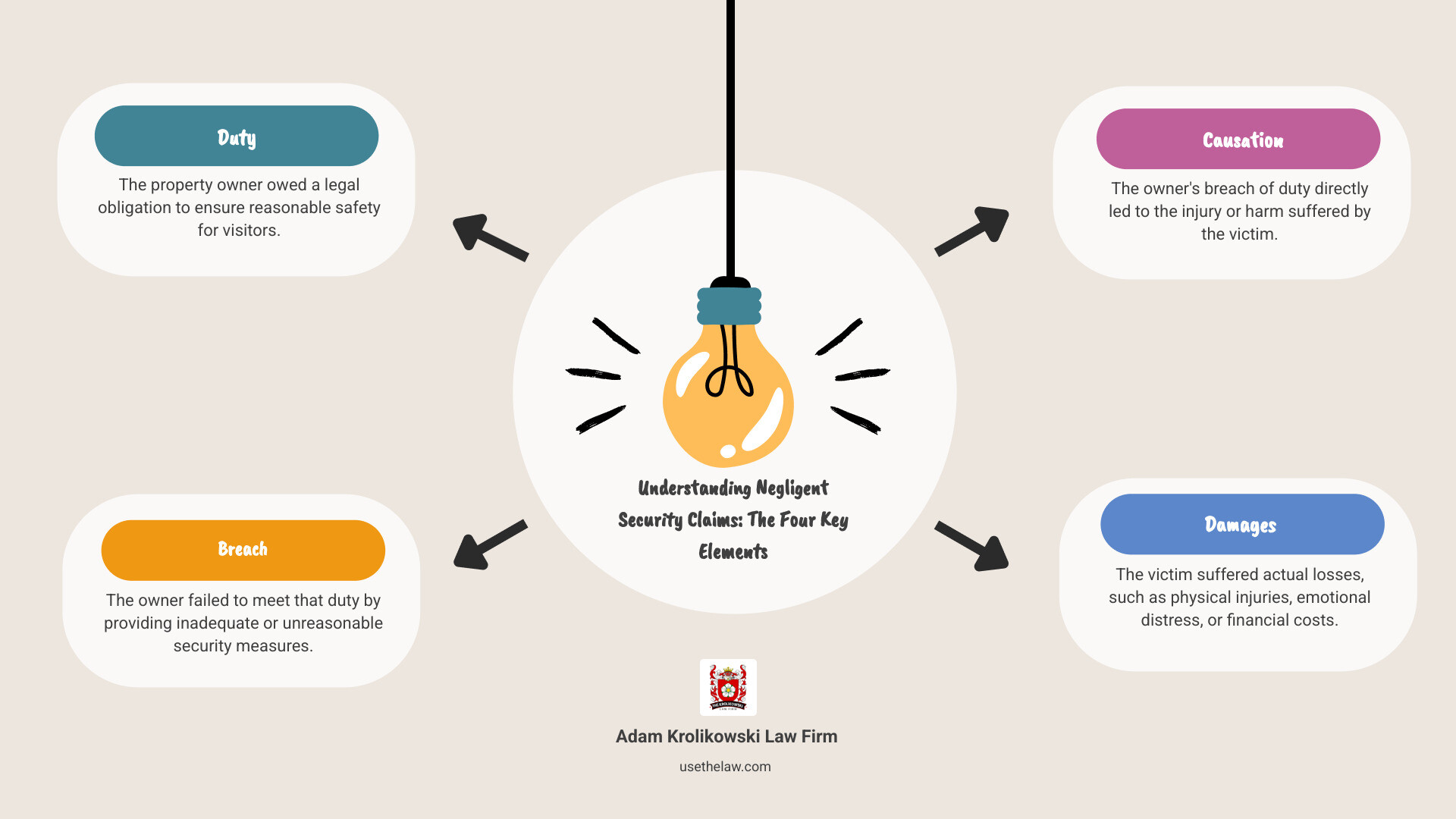
The Four Legal Elements of a Negligent Security Claim
A successful negligent security claim requires proving four key elements. This legal framework establishes the property owner’s liability and is the basis for a personal injury claim.

1. Duty of Care Was Owed
First, we must establish that the property owner owed you a legal duty of care. This obligation exists when you are lawfully on the property, such as a customer in a store, a tenant in an apartment, or a guest at a hotel. When property owners invite people onto their premises, they accept a responsibility to provide a reasonably safe environment. Without this duty, a negligent security claim cannot proceed.
2. Breach of Duty Occurred
Next, we must prove the property owner “breached” their duty by failing to act as a reasonable property owner would have under similar circumstances. A breach can be an action or, more often, a failure to act.
Examples of a breach include failing to install adequate lighting in a dark parking lot, not repairing broken locks or gates, neglecting to install or maintain security cameras, or failing to hire sufficient security personnel despite a known history of crime. Ignoring previous reports of criminal activity without taking corrective action is also a breach. The key is showing their conduct fell below the standard of a reasonably careful property owner. You can learn more about what constitutes legal negligence to better understand this concept.
3. Causation Linked the Breach to the Injury
We must then prove that the owner’s breach directly caused your injuries. This element, known as “causation” or “proximate cause,” requires showing that “but for” the owner’s failure, the injury would not have occurred.
For instance, if an attacker entered a building through a broken gate that the owner failed to fix, we can argue the breach directly caused the assault. Proving causation involves establishing a clear link between the owner’s negligence and your harm, without any “intervening acts” breaking that chain.
4. The Victim Suffered Actual Damages
Finally, a valid negligent security claim requires that you suffered actual harm or losses. These damages are categorized as economic and non-economic.
Economic damages are your quantifiable financial losses. This includes medical expenses (hospital stays, therapy, medication), lost wages from time off work, and loss of future earning capacity if your ability to work is permanently affected. It may also include property damage.
Non-economic damages compensate for non-financial impacts. This includes pain and suffering, emotional distress, and mental anguish from the traumatic event. Victims often experience significant emotional trauma, such as Post-Traumatic Stress Disorder (PTSD). These damages also cover loss of enjoyment of life or permanent scarring or disfigurement. In wrongful death cases, damages can include funeral expenses and loss of companionship for surviving family members.
Proving a Claim: The Crucial Roles of Evidence and Foreseeability
Building a strong negligent security claim requires a thorough investigation to gather evidence and demonstrate that the property owner should have foreseen the danger. The goal is to create a clear legal strategy that shows how the owner’s inaction led to the injury.
What Evidence is Needed to Prove a Claim?
To prove a negligent security claim, we gather evidence to establish the four key elements: duty, breach, causation, and damages. Key evidence includes:
- Police and Incident Reports: These provide an official account of the event and initial observations.
- Surveillance Footage: This can be powerful direct evidence of the incident or the lack of security measures.
- Eyewitness Statements: Testimony from those who saw the incident or noticed poor security can provide vital details.
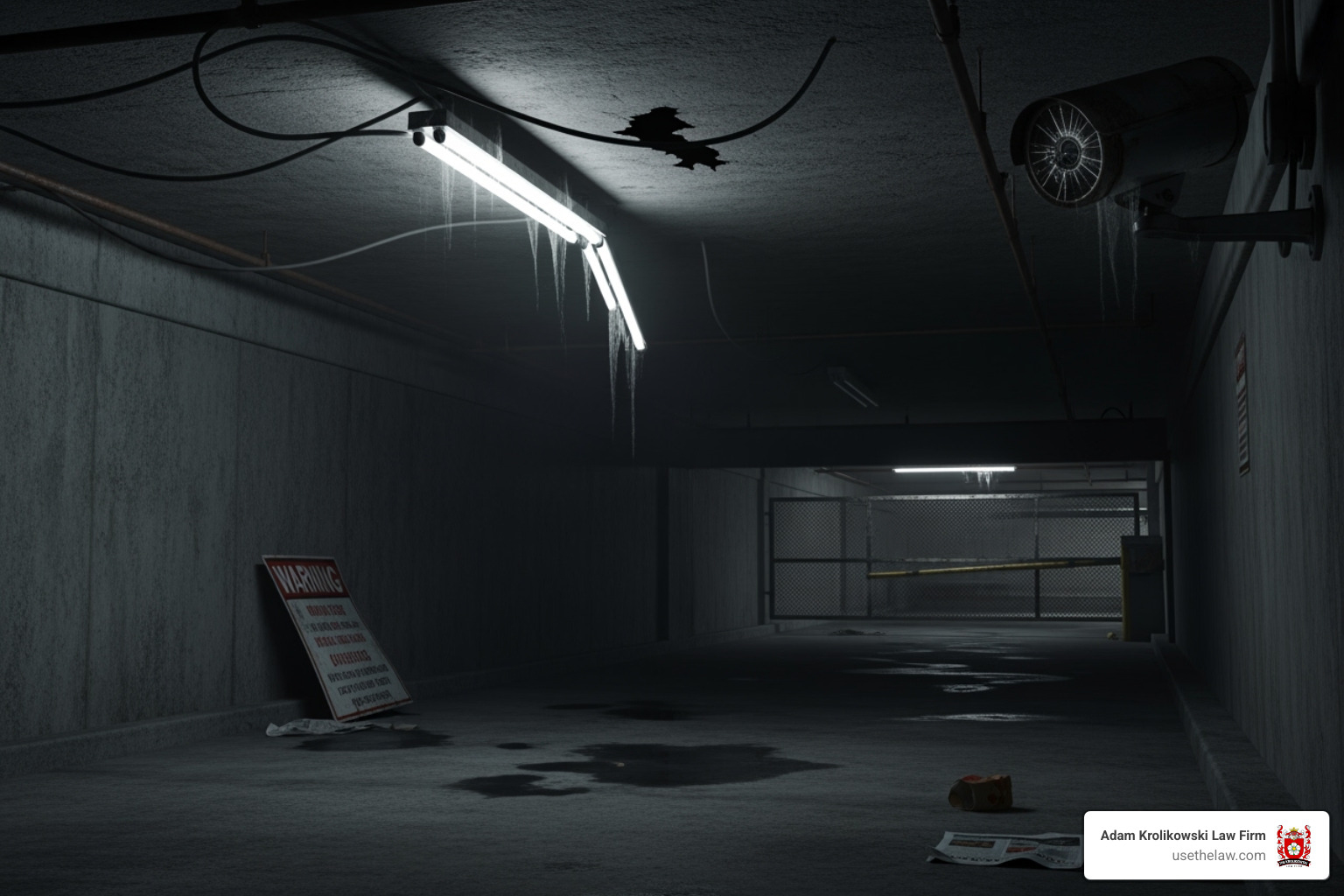
- Photographs and Videos of the Scene: Visuals can clearly document security flaws like poor lighting, broken locks, or overgrown landscaping.
- Property Records: We examine owner/manager training records and inspection/maintenance logs to see if security issues were known and ignored.
- Previous Incident Reports: Evidence of prior police calls or incidents at the property is crucial for showing the owner knew or should have known about crime risks.
- Medical Records and Bills: These document the physical, emotional, and financial costs of the injuries.
- Lost Wage Statements: This evidence proves income lost due to the injury.
Collecting this evidence quickly is critical, as some items, like video footage, may be deleted or lost over time.
How Foreseeability Plays a Critical Role
Foreseeability is a central concept in negligent security cases. It asks whether the property owner knew, or reasonably should have known, that a crime was likely to occur. If a crime was not foreseeable, it is difficult to hold an owner responsible for failing to prevent it.
We prove foreseeability by examining several factors:
- Prior Similar Incidents: A history of similar crimes on or near the property is the strongest evidence that future incidents were foreseeable.
- High-Crime Area: If the property is in a neighborhood with a high crime rate, the risk of criminal activity is more foreseeable.
- Known Threats: Specific warnings or threats made to the property owner make their duty to act even clearer.
- Type of Property: Some businesses, like bars, nightclubs, or convenience stores, are inherently more prone to crime, increasing the foreseeability of risk. Florida Statute Section 812.173, for example, sets specific security requirements for convenience stores.
- Totality of the Circumstances: Courts look at all factors together—the property’s history, location, and nature—to determine if the owner should have anticipated the risk and taken steps to prevent it.
Common Scenarios: Where Negligent Security Occurs Most Often
Negligent security can occur anywhere, but certain locations are more prone to these issues. Understanding common security failures and high-risk areas helps establish why a property owner should be held responsible for preventable harm.
Common Examples of Negligent Security
Negligent security often involves inadequate or poorly maintained safety measures. Common examples include:
- Inadequate or Broken Lighting: Dimly lit parking lots, walkways, and entrances create hiding spots for criminals. Failure to maintain lighting is a common security lapse.
- Broken Locks or Gates: Faulty locks on apartment doors or broken security gates provide easy access for unauthorized individuals.
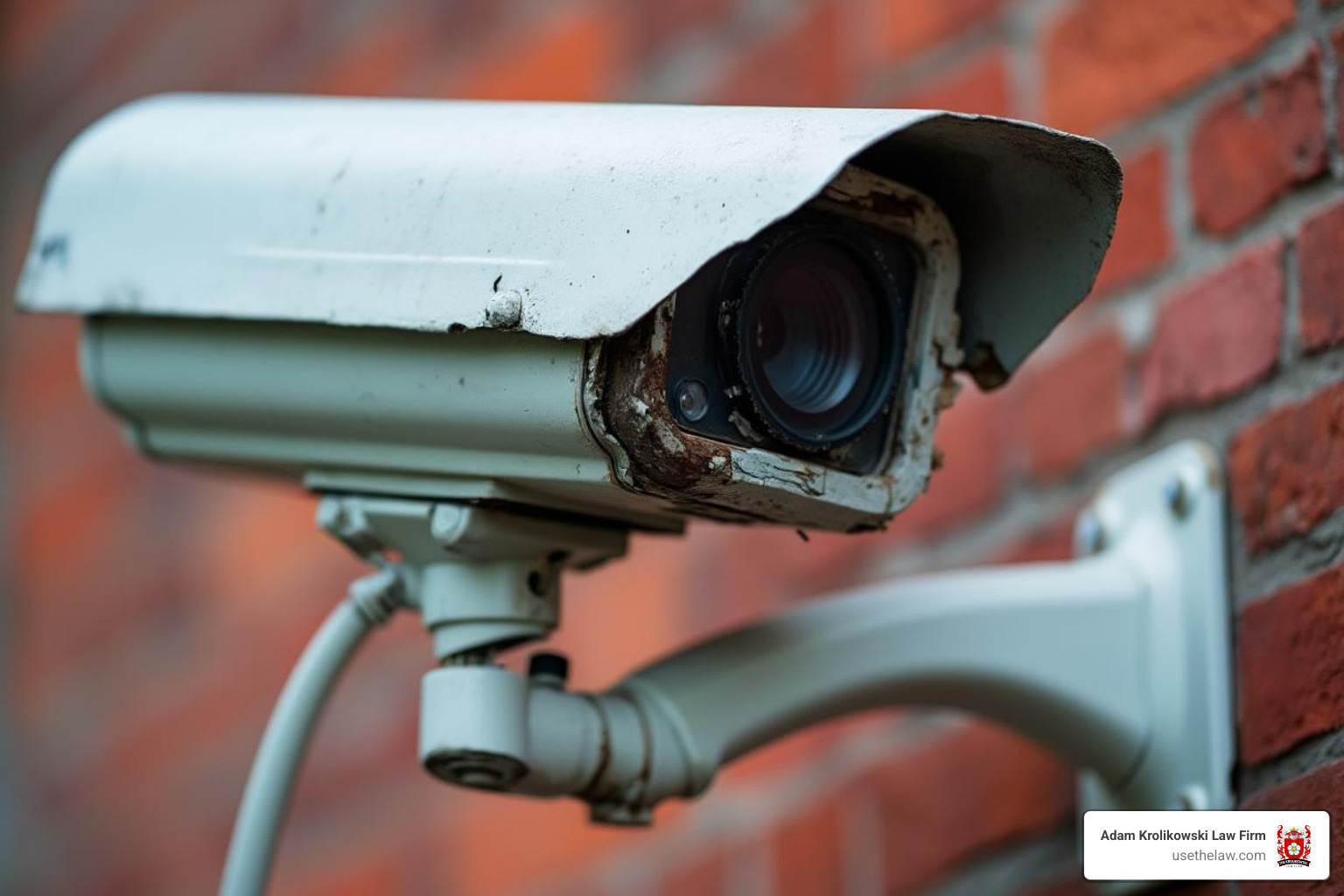
- Lack of Security Cameras or Malfunctioning Systems: The absence of cameras in high-risk areas, or systems that are broken or unmonitored, removes a key deterrent and source of evidence.
- No Security Guards or Untrained Personnel: For properties with known risks, a lack of trained security personnel can lead to preventable incidents. Staff not trained to spot suspicious behavior can also compromise safety.
- Failure to Respond to Prior Incidents: Ignoring repeated break-ins, assaults, or vandalism without improving security is a clear sign of negligence.
- Poor Environmental Design: Overgrown landscaping can create blind spots, while blocked emergency exits can trap individuals during a criminal event.
These examples often stem from a property owner’s lack of attention, maintenance, or proper planning.
High-Risk Properties and Venues
Some properties have a higher likelihood of negligent security incidents due to their nature, location, or history, placing a greater responsibility on their owners:
- Apartment Complexes: Common issues include broken gates, faulty door locks, and poor lighting in common areas.
- Parking Lots and Garages: These secluded areas are frequent sites for robberies, assaults, and thefts.
- Hotels and Motels: Insecure key card systems, unmonitored hallways, or inadequate security staff can lead to crimes. If you were harmed at a hotel, consider contacting a Hotel Negligent Security Lawyer.
- Bars and Nightclubs: The presence of alcohol and large crowds increases the risk of assaults, requiring robust security.
- Shopping Malls and Retail Stores: High foot traffic and valuable goods can attract crime, making security patrols and monitoring essential.
- Hospitals: Parking garages and busy emergency rooms can be vulnerable to crime, requiring a balance of access and safety.
- College Campuses: Universities have a duty to protect students, especially in dorms and on campus at night.
- ATMs: Isolated ATMs require good lighting and visibility to deter criminals.
If an owner of such a property fails to implement reasonable security, they may be held liable in a negligent security claim.
Navigating a Claim: Damages, Defenses, and Legal Deadlines
Navigating a negligent security claim after an injury can be overwhelming. The legal process involves seeking financial recovery, countering the property owner’s defenses, and adhering to strict deadlines. Understanding what to expect is the first step.
What Types of Damages Can Be Recovered?
In a successful negligent security claim, you can recover damages to compensate for your losses. These are divided into two categories:
- Economic Damages: These are calculable financial losses, including all medical expenses (ER visits, surgery, therapy, counseling), lost wages from being unable to work, and property damage.
- Non-Economic Damages: These compensate for intangible, personal losses. This includes pain and suffering, accounting for both physical pain and emotional distress like anxiety, depression, or post-traumatic stress disorder (PTSD). It also covers loss of enjoyment of life and compensation for scarring and disfigurement. Assaults often cause both physical injuries and devastating emotional trauma, as noted in studies on the physical and emotional impact of assault.
In fatal cases, surviving family members may seek wrongful death damages for funeral costs and loss of companionship.
Common Defenses Against Claims
Property owners and their insurance companies will raise defenses to avoid liability. We anticipate and counter these common arguments:
- Unforeseeable Crime: They may argue the criminal act was a random, unpredictable event they could not have reasonably prevented.
- Adequate Security Measures: The owner might claim their security (e.g., lights, cameras) was sufficient, even if it failed.
- Comparative Negligence: This defense suggests your own actions contributed to the harm. In California, this can reduce your compensation by your percentage of fault but does not bar recovery entirely.
- Intervening Cause: They may argue the criminal’s actions were an independent event that broke the chain of causation, relieving the owner of responsibility. Our task is to show the clear link between the owner’s failure and your injury.
Statute of Limitations for a Negligent Security Claim
The statute of limitations is a strict legal deadline for filing a lawsuit. Missing this deadline will likely bar you from recovering compensation, regardless of your case’s merits.
In California, the statute of limitations for most personal injury claims, including negligent security, is two years from the date of the incident. While this may seem like a long time, thoroughly investigating a claim and gathering evidence takes time.
The statute of limitations varies by state. Furthermore, claims against public or government entities often have much shorter deadlines, sometimes only a few months. It is crucial to act quickly to preserve your rights.
Due to these strict deadlines, it is best to contact an attorney as soon as possible after an incident. For more details, you can learn from a Premises Liability Accident Lawyer.
Conclusion: Taking Action After an Injury
An injury from inadequate security can be devastating. Taking legal action through a negligent security claim is a step toward justice and recovery. It provides the support you need to move forward and holds property owners accountable, encouraging safer environments for everyone.
Adam Krolikowski Law Firm represents victims of negligent security in Orange County and Los Angeles, CA. We handle complex cases that other firms may not, drawing on over two decades of experience to fight for your rights.
If you or a loved one was harmed due to a property owner’s failure to provide adequate security, please contact us for a free consultation. We can discuss your situation and explain your legal options, making the process as clear as possible so you can focus on your recovery while we seek the compensation you deserve.
Prevention for Property Owners
For property owners, proactive security is not just about avoiding lawsuits—it is about protecting people. Taking preventative steps can make a significant difference.
Key preventative measures include:
- Conduct regular risk assessments to identify security weaknesses.
- Install and maintain adequate lighting in all common areas, especially parking lots, walkways, and entrances.
- Implement and monitor functional security systems, including cameras, alarms, and access controls.
- Hire trained security personnel for high-risk properties.
- Respond promptly to reports of criminal activity or dangerous conditions.
- Ensure all locks and gates are in good working order.
- Develop and practice an emergency response plan with staff.
- Address all tenant and visitor complaints about security.
By taking these steps, property owners fulfill their legal duties and create safer environments for everyone.
If you believe you have a negligent security claim, do not hesitate to Contact a Negligent Security Attorney in Orange County, CA for a free consultation. We are here to help.
Contact Us
Practice Areas
Recent Articles
- « Previous
- 1
- 2
- 3
- Next »