

Product Liability Lawyer: Maximize Compensation 2025
Why You Might Need a Product Liability Lawyer
When a product harms you, a product liability lawyer can help you understand your rights.
Why you might need a product liability lawyer:
- You were injured by a product that didn’t work as expected.
- The product had a design or manufacturing flaw.
- The product’s label or instructions failed to warn you about dangers.
- You have medical bills, lost wages, or other costs from the injury.
- You want to hold the company that made or sold the product responsible.
- You need help getting fair compensation for your harm.
If a faulty item has hurt you, a product liability lawyer can help you pursue your legal rights. We trust the products we use daily to be safe, but when they aren’t, this guide will show you how to seek fair compensation.
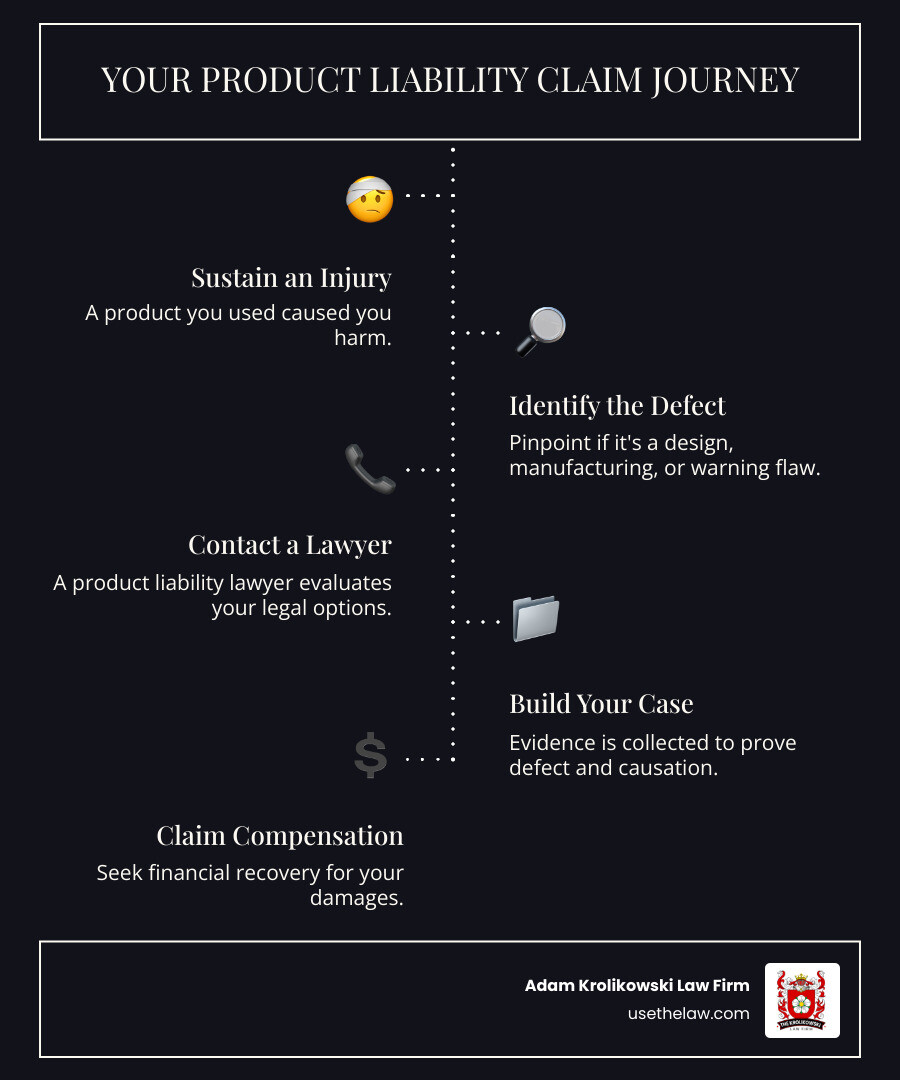
Must-know product liability lawyer terms:
Understanding Product Liability: Your Rights When Products Cause Harm
When you buy a product, you trust it will work safely. Product liability law holds companies accountable when their defective products cause harm. It covers everyone in the supply chain, from manufacturers and designers to retailers.
Product liability law combines principles from negligence, contract law, and safety standards. A product liability lawyer must steer these areas to build a strong case. The core idea is that you have a right to safe products. When that trust is broken and you are injured, the law provides a path to seek compensation.
These cases can involve physical injuries, property damage like a house fire from a faulty appliance, or financial losses from medical bills and lost wages. Understanding your legal rights is the first step toward recovery. For more on how these claims work, see: Personal Injury Claims: Defective Products.
Legal Grounds for a Claim
We build your case on one or more legal theories, which are different ways to prove who is responsible for your injuries.
Strict liability is often a powerful approach. We don’t need to prove the company was careless. We only need to show that the product was defective, the defect made it unreasonably dangerous, and the defect caused your injury. The focus is on the product, not the company’s intent.
Negligence requires us to prove the manufacturer or seller acted carelessly. This could mean they rushed safety testing, ignored production warnings, or knew about a flaw and didn’t fix it. We must show they failed to use reasonable care.
Breach of warranty involves a broken promise. An express warranty is a specific, stated promise (“This ladder holds 300 pounds”). An implied warranty is an unwritten guarantee that a product is fit for its normal purpose. A toaster shouldn’t catch fire. When a product fails these basic expectations and causes injury, it’s a breach of warranty.
We may also use the consumer expectation test, which asks: was the product more dangerous than an ordinary person would expect? A coffee maker exploding during normal use clearly fails this test. By reviewing your case, we determine which legal theory gives us a strong chance to win.
Who is Responsible? The Chain of Distribution
Many parties can be held accountable for a defective product. Legal responsibility extends throughout the chain of distribution.
- Manufacturers are the primary target, as they designed and built the product.
- Designers can be liable if the product’s design was inherently flawed.
- Component part suppliers are responsible for defective individual parts, like faulty brakes in a car.
- Distributors and wholesalers can be liable if they knew of a defect or damaged the product.
- Retailers are also part of the chain. The store that sold you the item can be held responsible.
This approach encourages everyone in the supply chain to ensure product safety. It also provides multiple potential sources for compensation. A product liability lawyer investigates everyone involved to identify all liable parties and maximize your chances of a fair recovery.
Identifying a Defective Product: The Three Core Claim Types
In product liability law, a “defective product” usually falls into one of three categories. Understanding these is key to building an effective case.
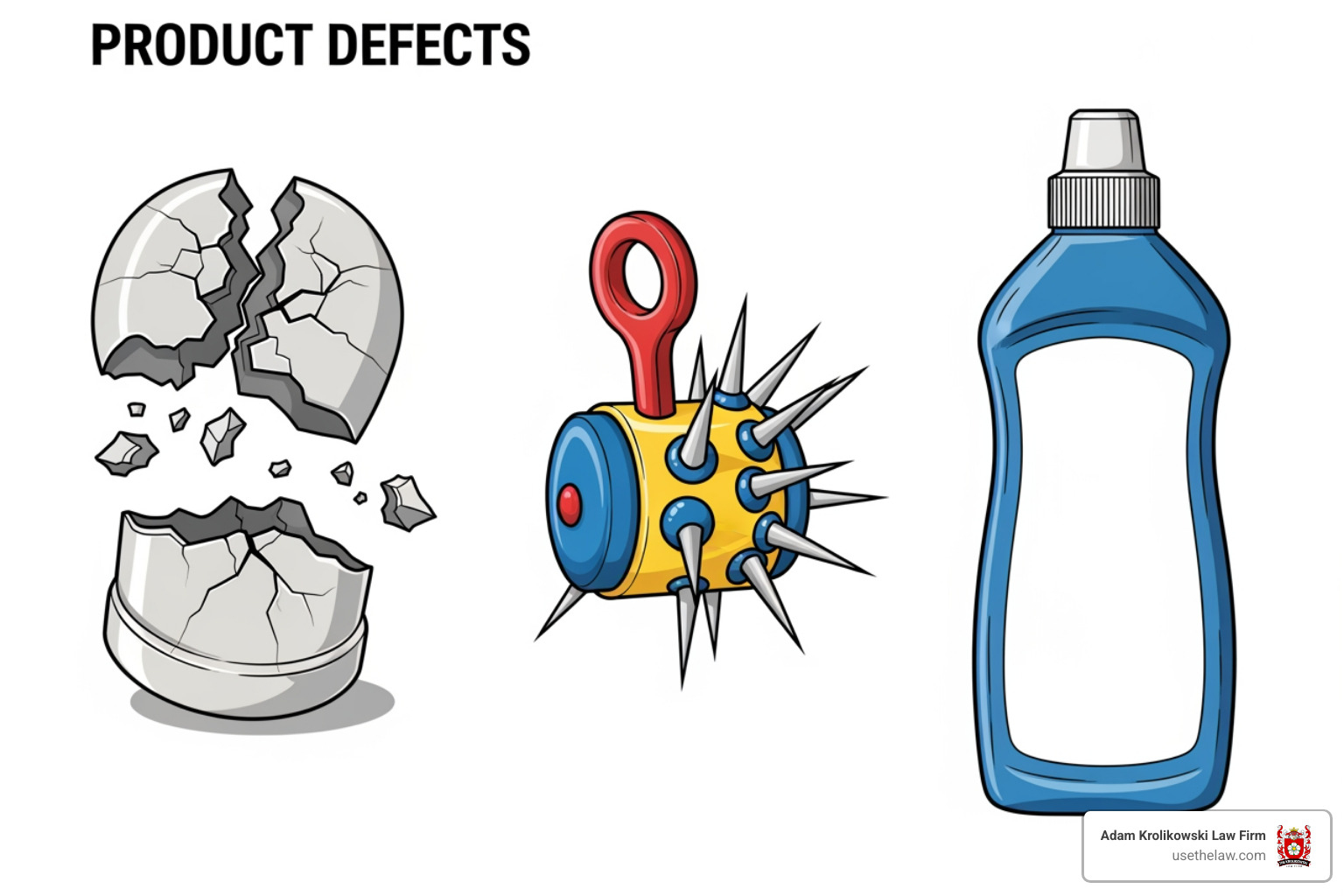
Claims can arise from many everyday items, including:
- Vehicles and their parts, like airbags or brakes.
- Medical Devices, such as surgical tools or implants. Learn more about specific claims here: Breast Implant Product Liability.
- Pharmaceuticals with undisclosed side effects.
- Children’s Toys and Products with choking hazards or unsafe designs.
- Household Appliances that could cause fires or shocks.
- Tools and Machinery, from power drills to industrial equipment.
- Food and Agricultural Products, like contaminated food.
- Chemical Products that lack proper warnings.
A product liability lawyer can help determine which type of defect is relevant to your case.
Design Defects
A design defect means a product is inherently unsafe due to its blueprint. The flaw exists in the entire product line, even if it was manufactured perfectly.
To prove a design defect, we typically show:
- The product’s design is unreasonably dangerous. It fails to perform as safely as an ordinary consumer would expect.
- A safer, economically feasible alternative design was available. This is the “risk-utility test,” showing the injury could have been prevented without making the product useless or too expensive.
Examples include a top-heavy car prone to rollovers or a power tool designed without a necessary safety guard.
Manufacturing Defects
A manufacturing defect occurs when something goes wrong during production. Unlike a design defect, it affects only a specific product or batch, causing it to deviate from the intended safe design.
These defects can result from:
- Assembly line errors.
- Use of substandard materials.
- Poor quality control.
- Contamination of food or medical products.
For instance, a single car with an improperly installed brake line has a manufacturing defect. The product is flawed due to an error in its creation.
Marketing Defects (Failure to Warn)
A marketing defect, or “failure to warn,” occurs when a product lacks adequate instructions or warnings about non-obvious dangers. The product itself may be well-designed and manufactured, but the information provided to the consumer is flawed.
A product can be defective if:
- Instructions are unclear or misleading.
- It lacks proper warnings about hidden dangers, including those from foreseeable misuse.
- Labels are inaccurate.
- The company made false claims about its safety.
For example, a powerful cleaning chemical must have clear warnings about skin contact. A medicine must list known side effects. Companies have a duty to warn consumers about risks they wouldn’t normally be aware of, as seen in cases like the AFFF Lawsuits and Fighting for Your Health.
How a Product Liability Lawyer Builds Your Case
Building a strong product liability case is a strategic process. It moves from initial investigation to potential litigation, always focused on advocating for our clients.
Proving the Key Elements of Your Claim
To succeed, we must prove four key elements:
- The Product Was Defective: We must show a design, manufacturing, or marketing defect.
- You Suffered an Injury or Damages: We document your physical, emotional, or financial harm through medical records, bills, and lost wage statements.
- The Defect Caused Your Injury: We must establish a direct causal link between the product’s defect and the harm you suffered.
- You Used the Product as Intended: We demonstrate you were using the product as it was meant to be used or in a way that the manufacturer should have anticipated.
The burden of proof is on us to present sufficient evidence for these elements.
The Crucial Role of Key Witnesses
Product liability cases are often technical, requiring particular knowledge to explain complex issues. Key witnesses are indispensable.
- Engineers: They can analyze a product’s design or manufacturing process to identify flaws, reconstruct accidents, and testify about safer alternatives.
- Medical Professionals: Doctors and other medical providers offer testimony on the extent of your injuries, treatment needs, and long-term prognosis.
- Manufacturing Professionals: These individuals can testify about industry standards and quality control procedures.
- Accident Reconstructionists: They use physics and engineering to show how a defective product led to an accident.
These witnesses help translate complex information into clear evidence for a jury.
The Significance of Product Recalls and Class Actions
Product recalls and class actions can provide powerful evidence and a path to compensation for many victims.
-
Product Recalls: A recall can be a strong indicator that a company knew its product was defective or posed a safety risk. While not automatic proof of liability, it is compelling evidence.
-
Class Actions: When a product harms many people, claims are often handled on a mass basis by lawyers who handle class proceedings. A class action suit allows individuals with similar claims to join forces, sharing resources and strengthening their collective bargaining power. This can be an effective way to hold large corporations accountable, though we also handle individual lawsuits.
Whether your case is individual or part of a class action, our commitment is to thorough investigation and advocacy.
Recovering Damages and Meeting Critical Deadlines
When a defective product causes harm, we work to help you recover financially and hold the responsible companies accountable. This is about justice and preventing future harm.

What Compensation Can You Receive?
Compensation, or damages, is meant to cover all your losses.
Economic damages are measurable financial costs. This includes all past and future medical bills, lost wages from missed work, and lost future earning capacity if you cannot return to your job. It also covers property damage and other out-of-pocket expenses.
Non-economic damages compensate for intangible losses. This includes pain and suffering for your physical and emotional distress, and loss of enjoyment of life if you can no longer participate in activities you once loved.
In rare cases involving extreme recklessness, a court may award punitive damages. These are intended to punish the company and deter similar behavior. You can learn more about how compensation works here: Compensation Damages Breast Implant Lawyer.
State Deadlines: The Statute of Limitations
You cannot wait forever to file a lawsuit. Every state has a deadline called the statute of limitations. If you miss it, you lose your right to sue.
In California, you generally have two years from the date of your injury to file a product liability claim. This deadline can pass quickly while you are focused on recovery.
An important exception is the “findy rule.” If you didn’t immediately know you were injured or what caused it, the two-year clock may start when you finded (or reasonably should have finded) the injury and its link to the product. This is common in cases involving medical devices or drugs.
The bottom line is to act quickly. Contacting a product liability lawyer soon after your injury allows time to investigate and file your claim before the deadline expires. We can help you steer these time limits, and you can find attorneys familiar with state laws through resources like California.
Frequently Asked Questions about Product Liability Claims
When you’re dealing with an injury from a defective product, you naturally have questions. Here are answers to some of the most common concerns we receive.
How much does it cost to hire a product liability lawyer?
Most product liability lawyers, including our firm, work on a contingency fee basis. This means you pay no upfront costs. We only get paid if we successfully recover compensation for you, and our fee is a percentage of that recovery. We also offer risk-free consultations to evaluate your case. This approach ensures everyone has access to legal representation. If we don’t win, you owe us no attorney fees.
What if I was partially at fault for my injury?
Even if you were partially at fault, you can still recover damages. California uses a “pure comparative negligence” system. This means your compensation is simply reduced by your percentage of fault. For example, if you were found 20% at fault for an accident with $100,000 in damages, you could still receive $80,000. Our job is to protect you from unfair blame and show the product defect was the primary cause of your injury.
How long will my product liability case take to resolve?
The timeline for a product liability case varies. Some cases settle in months, while others can take years. Factors that affect the timeline include:
- Case complexity: Cases with multiple defendants or technical defects take longer.
- Severity of your injuries: We won’t rush a settlement before we know the full extent of your long-term medical needs and financial losses.
- Defendant cooperation: A defendant willing to negotiate can speed up the process. A defendant who disputes everything will extend it.
- Settlement versus trial: Most cases settle, which is faster. However, we are always prepared to go to trial if a fair settlement isn’t offered.
We will keep you informed at every stage and work efficiently to resolve your case while protecting your interests.
Get the Legal Guidance You Deserve
When a defective product injures you, you deserve an advocate who understands what you’re going through. Taking legal action is not just about your recovery; it’s about holding companies accountable and promoting safety.
Time is critical. California’s statute of limitations is strict, and evidence can be lost over time. Reaching out now, while the details are fresh, gives us a strong chance to build your case and fight for the compensation you deserve.
At Adam Krolikowski Law Firm, we have seen the impact a defective product can have on a family. With over 25 years of experience in personal injury law in Orange County and Los Angeles, we are prepared to handle the complex cases that demand thorough investigation and unwavering commitment.
We don’t shy away from difficult claims. When other attorneys might pass, we get to work. We will investigate your case, identify all responsible parties, and build a compelling argument for your right to fair compensation.
You shouldn’t face this alone. The companies that market defective products have legal teams protecting their interests. You need someone equally dedicated to protecting yours. A product liability lawyer will listen, answer your questions, and fight on your behalf.
We offer free consultations so you can understand your legal options without financial pressure. Let’s discuss what happened and figure out the right path forward for you and your family.
Contact Us
Practice Areas
Recent Articles
- « Previous
- 1
- 2
- 3