

Why Trench Collapse Victims Need Legal Protection
A trench collapse attorney helps construction workers and their families pursue compensation when dangerous excavation accidents cause serious injury or death. They steer the complex web of workplace safety laws, workers’ compensation rules, and third-party liability surrounding these devastating incidents.
What a trench collapse attorney can do for you:
- Investigate safety violations that caused your accident
- Identify all liable parties beyond your employer
- Steer workers’ compensation and personal injury claims
- Negotiate maximum compensation for medical bills and lost wages
- Handle OSHA violations and regulatory compliance issues
- Pursue wrongful death claims for families who lost loved ones
The numbers tell a sobering story. Between 2000 and 2006, 271 workers died in trench accidents across the United States. More recently, OSHA recorded 35 fatalities in excavation and trenching work by the end of November 2022—more than double the previous year.
These accidents happen fast. One cubic yard of soil weighs approximately 3,000 pounds, equivalent to a small car crushing trapped workers. Victims often suffer suffocation, crushing injuries, traumatic brain injuries, or worse.
Construction companies have a clear legal duty to protect workers with proper safety systems and inspections. When they ignore regulations, workers pay the price.
If you or a loved one was injured in a trench collapse, understanding your legal rights is critical. Workers’ compensation may cover some costs, but claims against negligent third parties can provide the full compensation you deserve.
Trench collapse attorney word guide:
Understanding the Dangers: What is a Trench Collapse and Why Do They Happen?
A trench is a narrow excavation deeper than it is wide, essential for construction but also one of the most dangerous parts of a job site. OSHA defines a trench as an excavation where the depth is greater than the width, but the width does not exceed 15 feet.
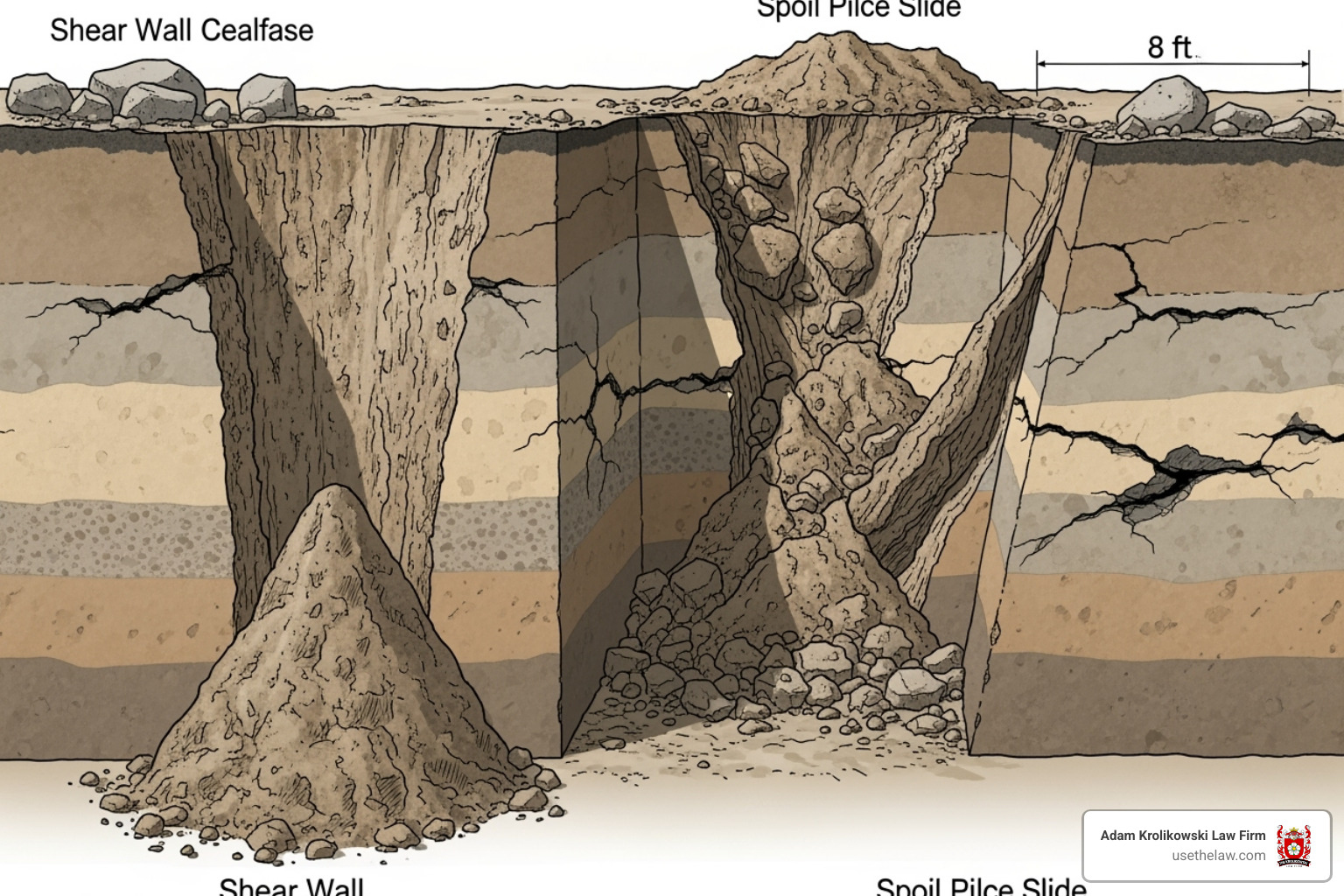
Trench collapses, or “cave-ins,” occur when the walls suddenly give way, burying workers under soil that can weigh up to 3,000 pounds per cubic yard. The speed of a collapse leaves no time to escape, making these accidents incredibly lethal. In fact, the fatality rate for trenching is 112% higher than in general construction.
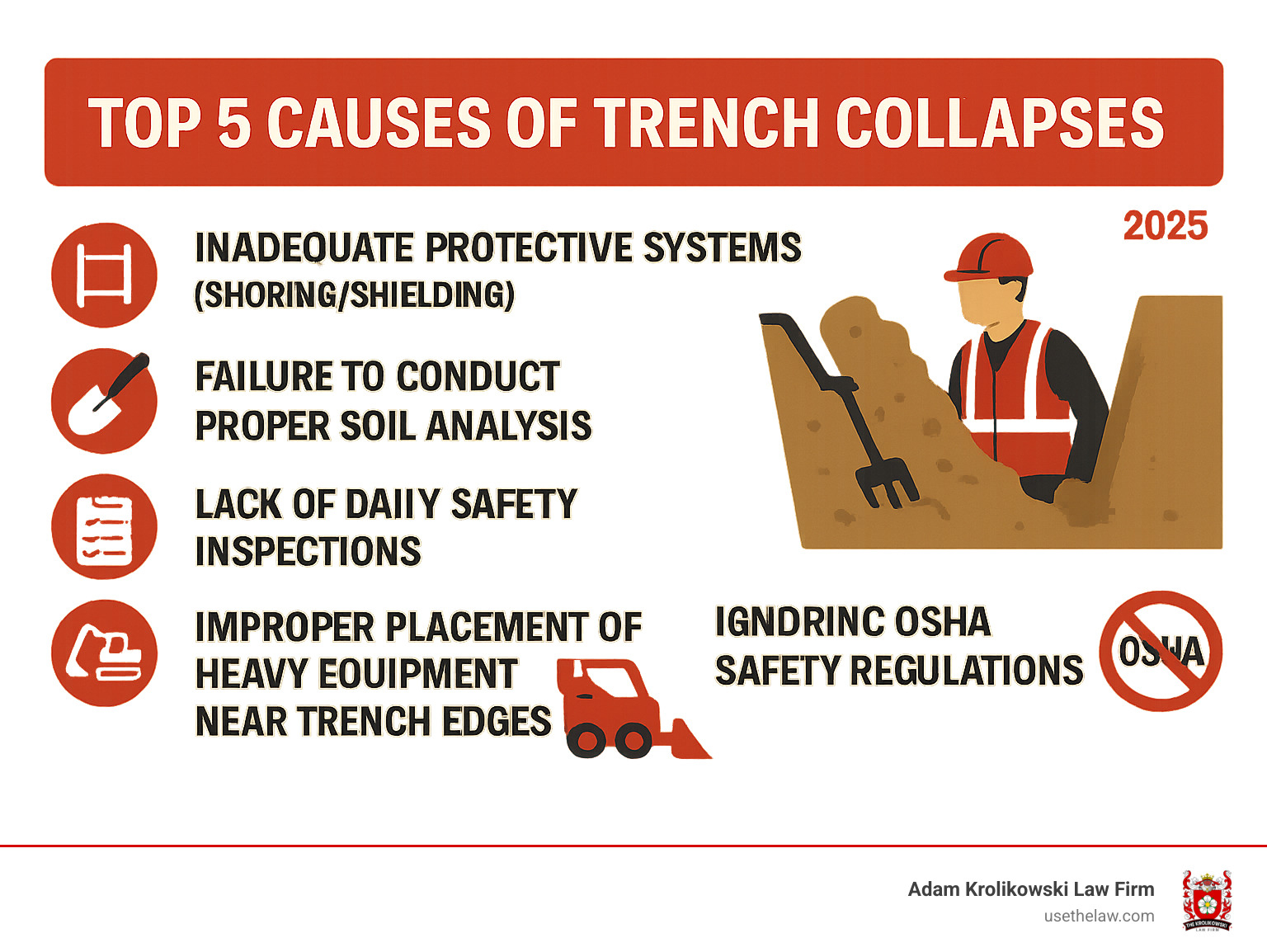
Common causes of these preventable accidents include:
- Inadequate Protective Systems: OSHA mandates protective systems like sloping, shoring, or shielding for trenches deeper than five feet. Failure to use these correctly is a primary cause of collapse.
- Poor Site Management: This includes failing to analyze soil conditions, not inspecting the trench daily, placing heavy equipment or excavated soil (spoil piles) too close to the edge, and allowing water to accumulate, which weakens the soil.
- Lack of Training and Supervision: Workers and supervisors must be trained to recognize hazards. A designated “competent person” must be on-site to identify risks and has the authority to take corrective action.
- Cutting Corners: Rushing to meet deadlines or save money by ignoring safety protocols, like failing to locate underground utilities before digging, directly leads to accidents.
Understanding these causes is key to preventing tragedies and holding negligent parties accountable. For more details, refer to OSHA’s definition of a trench.
Common Injuries from Trench Accidents
The force of a trench collapse often causes catastrophic or fatal injuries. Common injuries include:
- Suffocation or Asphyxiation: The leading cause of death, as workers are buried and their lungs are compressed.
- Crush Injuries: The immense pressure crushes limbs, organs, and bones, sometimes requiring amputation.
- Traumatic Brain Injuries (TBI): Caused by falling debris or oxygen deprivation, leading to permanent cognitive or physical disabilities.
- Spinal Cord Injuries: The force can damage the spinal cord, resulting in paralysis.
- Broken Bones and Internal Injuries: Blunt force trauma often causes multiple fractures and severe internal bleeding.
- Electrocution: Striking underground power lines during a collapse can cause severe electrical shock.
- Psychological Trauma: Survivors often suffer from Post-Traumatic Stress Disorder (PTSD), anxiety, and other mental health challenges.
These injuries require extensive medical treatment and can lead to permanent disability. For more on construction injuries, see More on construction site injuries.
Key OSHA Regulations and Prevention
Preventing trench collapses means following established safety protocols. OSHA’s regulations in 29 CFR 1926 Subpart P are designed to save lives. Key requirements include:
- Protective Systems: Mandatory for trenches 5 feet or deeper. Options include Sloping (angling walls), Shoring (bracing walls), or Shielding (using trench boxes). Trenches over 20 feet deep require a design by a registered professional engineer.
- Daily Inspections: A “competent person” must inspect trenches daily, before each shift, and after any event like a rainstorm to identify new hazards.
- Safe Entry and Egress: Ladders, ramps, or stairs must be located within 25 feet of workers in any trench 4 feet or deeper.
- Keep Edges Clear: Excavated soil (spoil piles) and heavy equipment must be kept at least two feet from the trench edge to prevent instability.
- Test for Hazardous Atmospheres: In trenches deeper than four feet, the air must be tested for low oxygen or toxic gases before entry.
- Locate Underground Utilities: All utility lines must be located and marked before digging begins.
- Worker Training: All workers must be trained to identify hazards and follow safe work procedures.
A collapse often indicates that one or more of these critical safety measures were ignored. Find more details on OSHA’s excavation regulations.
How a Trench Collapse Attorney Can Help You Secure Compensation
After a trench collapse, you face serious injuries, mounting medical bills, and financial uncertainty. A dedicated trench collapse attorney can lift that burden and fight for the compensation you deserve.

We understand that these cases are complex, often involving multiple responsible parties and insurance companies focused on minimizing payouts. Our approach includes:
- Thorough Investigation: We dig into every detail of the accident, reviewing safety logs, maintenance records, and company communications to find evidence of negligence.
- Evidence Collection: We gather photos, videos, witness statements, and independent analysis to build a strong case. You can learn more about evidence in a strong personal injury case.
- Identifying All Liable Parties: Beyond your employer, we look at the general contractor, subcontractors, property owners, or equipment manufacturers who may share responsibility.
- Aggressive Negotiation: We handle all communications with insurance companies to protect you from lowball settlement offers and fight for a fair outcome.
- Litigation: If a fair settlement cannot be reached, we are prepared to take your case to court and present a compelling argument to a judge and jury.
With over 25 years of experience in complex cases, we are prepared to stand up to large corporate legal teams on your behalf.
Determining Liability: Beyond Workers’ Compensation
Many injured workers don’t realize that parties other than their employer can be held liable for their injuries. While workers’ compensation provides important benefits, it is often not enough to cover the full extent of your losses and does not include damages for pain and suffering.
This is where third-party liability claims are crucial. A third party is anyone other than your direct employer whose negligence contributed to the accident. Potential third parties include:
- General Contractors: Responsible for overall site safety, they can be held liable for failing to enforce safety protocols.
- Subcontractors: Another company’s crew may have created the dangerous condition that led to the collapse.
- Property Owners: If they knew about a hazard on their site, such as unstable soil, and failed to warn workers, they may be liable.
- Equipment Manufacturers: If defective safety equipment, like a faulty trench box or shoring system, failed, the manufacturer can be held responsible.
Identifying all responsible parties is key to maximizing your compensation. Learn more by reading our guide on understanding liability in personal injury cases.
What to Expect When Working with a Trench Collapse Attorney
Choosing legal representation shouldn’t add to your stress. We provide clear communication and dedicated support throughout the legal process.
- Free Case Evaluation: We’ll listen to your story and provide an honest assessment of your case with no obligation.
- Contingency Fee: You pay no upfront fees. We only get paid if we successfully recover compensation for you.
- Clear Guidance: We explain each stage of the legal process, so you always know what’s happening and why.
- Dedicated Communication: We return calls promptly and provide regular updates, so you never feel left in the dark.
Our goal is to handle the legal complexities so you can focus on your recovery. For more information, read about hiring a personal injury attorney.
Types of Compensation You Can Pursue
Fair compensation should reflect the full impact of a trench collapse on your life. We pursue damages for all your losses, including:
- Medical Expenses: All past and future medical care, including hospital stays, surgeries, rehabilitation, and medication.
- Lost Wages: Compensation for the income you’ve lost while unable to work.
- Future Earning Capacity: Damages for the reduction in your ability to earn a living over your lifetime.
- Pain and Suffering: Compensation for the physical pain and emotional distress caused by the accident and your injuries.
- Loss of Enjoyment of Life: Acknowledges the loss of your ability to participate in hobbies and activities you once enjoyed.
- Wrongful Death Damages: For families who have lost a loved one, this can include funeral expenses, lost financial support, and loss of companionship.
We work to ensure your compensation reflects the full scope of how this accident has changed your life. For an overview, see our guide to compensation in Los Angeles.
Steps to Take Immediately After a Trench Collapse
The actions you take in the first hours after a trench collapse can significantly impact your health and any future legal claim. Amid the chaos, try to focus on these critical steps.
-
Seek Immediate Medical Attention. This is your top priority. Adrenaline can mask serious internal injuries. Go to a hospital or see a doctor right away. Following all medical advice creates a vital record that links your injuries to the accident.
-
Report the Accident. Inform your supervisor about the collapse as soon as possible, following your company’s official procedure. Make sure the report is in writing and keep a copy for your records.
-
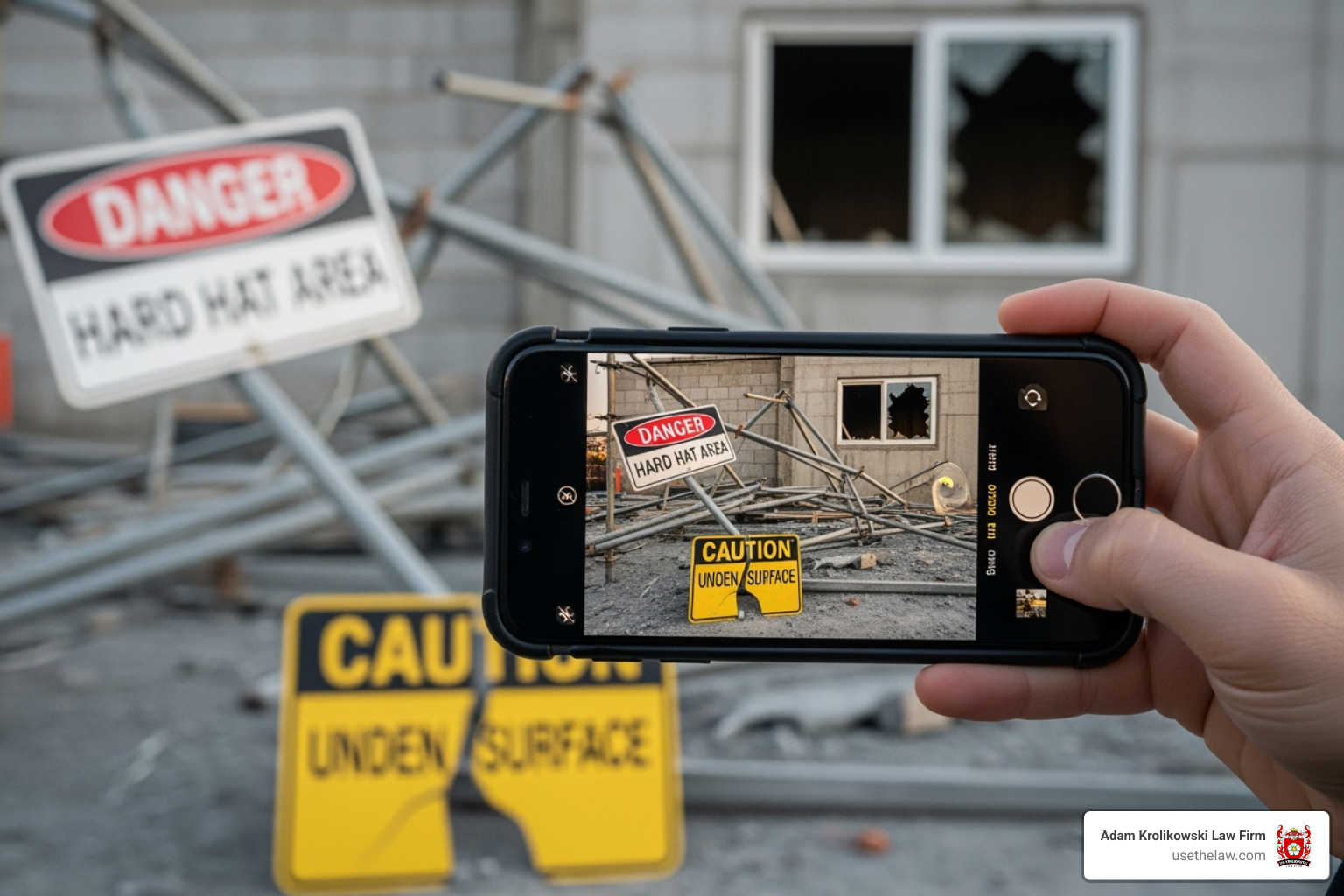
Document the Scene. If you are able, use your phone to take photos and videos of the collapse site, any unsafe conditions, and your injuries. Ask a coworker to help if you can’t. Note the time, weather, and any nearby machinery.
-
Get Witness Information. Collect names, phone numbers, and email addresses from anyone who saw what happened. Their testimony can be invaluable later.
-
Do Not Give a Recorded Statement. Politely decline to give a recorded statement to any insurance company representative until you have spoken with an attorney. Insurers look for ways to minimize payouts, and anything you say can be used against you.
-
Preserve Evidence. Keep any damaged personal items or safety equipment related to the incident. Do not allow the accident scene to be altered until it has been properly documented.
These steps are crucial for protecting your health and your legal rights.
Filing a Claim: Deadlines and Procedures
Legal deadlines, or statutes of limitations, are strict. Missing them can mean losing your right to seek compensation forever.
In California, the deadlines are generally:
- Personal Injury Lawsuit: You have two years from the date of injury to file a lawsuit against negligent third parties.
- Government Claims: If a government entity is involved, you may have as little as six months to file a formal notice of claim.
- Workers’ Compensation Claim: You must report your injury to your employer within 30 days. You then have one year from the injury date to file a formal claim.
The legal process involves investigation, sending demand letters, negotiating with insurers, and, if necessary, filing a lawsuit. This process can be lengthy, and evidence can disappear over time. Contacting a trench collapse attorney quickly is the best way to ensure all deadlines are met and crucial evidence is preserved while you focus on healing. For more details, you can read More on workers’ comp claims.
Frequently Asked Questions about Trench Collapse Claims
After a devastating accident, it’s normal to have questions. Here are answers to some of the most common concerns we hear from trench collapse victims.
Can I sue my employer for a trench collapse accident?
In most cases, no. The workers’ compensation system is typically the “exclusive remedy,” meaning you receive benefits for medical bills and lost wages regardless of fault, but you cannot sue your employer for personal injury damages like pain and suffering.
However, there are two key things to remember:
- Exceptions Exist: In rare cases, such as when an employer acts intentionally to cause harm or fails to carry workers’ compensation insurance, you may be able to sue them directly.
- Third-Party Claims are Key: You can, and often should, file a personal injury lawsuit against any negligent third parties who contributed to the collapse. This can include the general contractor, other subcontractors, or equipment manufacturers. These claims allow you to pursue full compensation, including for pain and suffering.
A trench collapse attorney can determine if you have a valid third-party claim. For more information, see More on worker rights.
How much does it cost to hire a trench collapse attorney?
We understand the financial strain an injury causes. That’s why we work on a contingency fee basis. This means:
- No Upfront Costs: You pay nothing out of pocket to hire us.
- We Cover Case Expenses: We advance the costs for investigation, qualified witnesses, and filing fees.
- You Only Pay If We Win: Our fee is a percentage of the compensation we recover for you. If we don’t win your case, you owe us nothing.
We offer a free, no-obligation consultation to discuss your case and explain your options.
How long do I have to file a trench collapse claim in California?
Time is critical, and legal deadlines are strict. Missing them will bar you from recovering compensation.
Key deadlines in California include:
- Personal Injury Lawsuit: Two years from the date of the injury.
- Claim Against a Government Entity: As little as six months to file a notice of claim.
- Workers’ Compensation: You must report the injury to your employer within 30 days and file a formal claim within one year.
The findy rule can sometimes extend these deadlines if an injury isn’t immediately apparent, but it’s risky to rely on exceptions. The best course of action is to contact a trench collapse attorney immediately to protect your rights and ensure all deadlines are met.
Protecting Your Rights and Future
Trench collapses are among the most dangerous construction accidents, often caused by companies cutting corners on safety. The statistics are grim, with 271 workers killed in just six years and recent numbers on the rise. Each incident leaves a worker’s life forever changed and a family devastated by a preventable tragedy.
The aftermath brings not just physical pain but overwhelming medical bills, lost income, and an uncertain future. Many victims face permanent disabilities that prevent them from ever returning to their trade.
You don’t have to face this alone. As a trench collapse attorney with over 25 years of experience, we understand the unique challenges of these cases. We take on complex claims that others may avoid, digging deep to uncover evidence and identify every party responsible for your injuries—from negligent contractors to manufacturers of faulty equipment.
We manage the entire legal process, including workers’ compensation claims, third-party lawsuits, and OSHA investigations, so you can focus on healing. We work on a contingency fee basis, meaning you pay nothing unless we win compensation for you.
Taking action now is crucial. Evidence disappears, witness memories fade, and legal deadlines are unforgiving. The sooner you contact us, the stronger your case will be. We offer free consultations to listen to your story and explain your legal options.
Your rights and your future matter. If you or a loved one has been affected by a trench collapse, we are here to fight for the justice and compensation you deserve.
Contact a Trench Excavation Accident Lawyer in Orange County, CA. We have locations in Santa Ana, CA, and Los Angeles, CA, and we’re ready to put our experience to work for you.
