

Understanding Your Rights After a Tragic Loss
A wrongful death attorney helps families seek justice and compensation when a loved one dies due to someone else’s negligence or wrongful actions. These legal professionals guide grieving families through complex civil lawsuits while they focus on healing.
What a wrongful death attorney does for you:
- Investigates the incident to determine who is legally responsible
- Gathers evidence including medical records, police reports, and witness statements
- Calculates damages for lost income, medical bills, and funeral expenses
- Negotiates with insurance companies to secure fair compensation
- Represents you in court if a settlement cannot be reached
- Handles all legal paperwork and meets critical filing deadlines
As one grieving family member shared: “Struggling through the loss of a loved one is hard in itself, but it gets tougher when you know that there’s someone responsible for your loss.” This captures the emotional weight families face when dealing with a preventable death.
Common causes of wrongful death include:
- Motor vehicle accidents (4,285 fatalities in California in 2022)
- Medical malpractice and hospital errors
- Workplace accidents (504 in California in 2022)
- Defective products
- Premises liability incidents
The legal process can feel overwhelming during such a difficult time. Most wrongful death attorneys work on contingency fees, meaning you pay nothing unless they win your case. In California, wrongful death claims must typically be filed within two years of the death, making prompt action crucial.
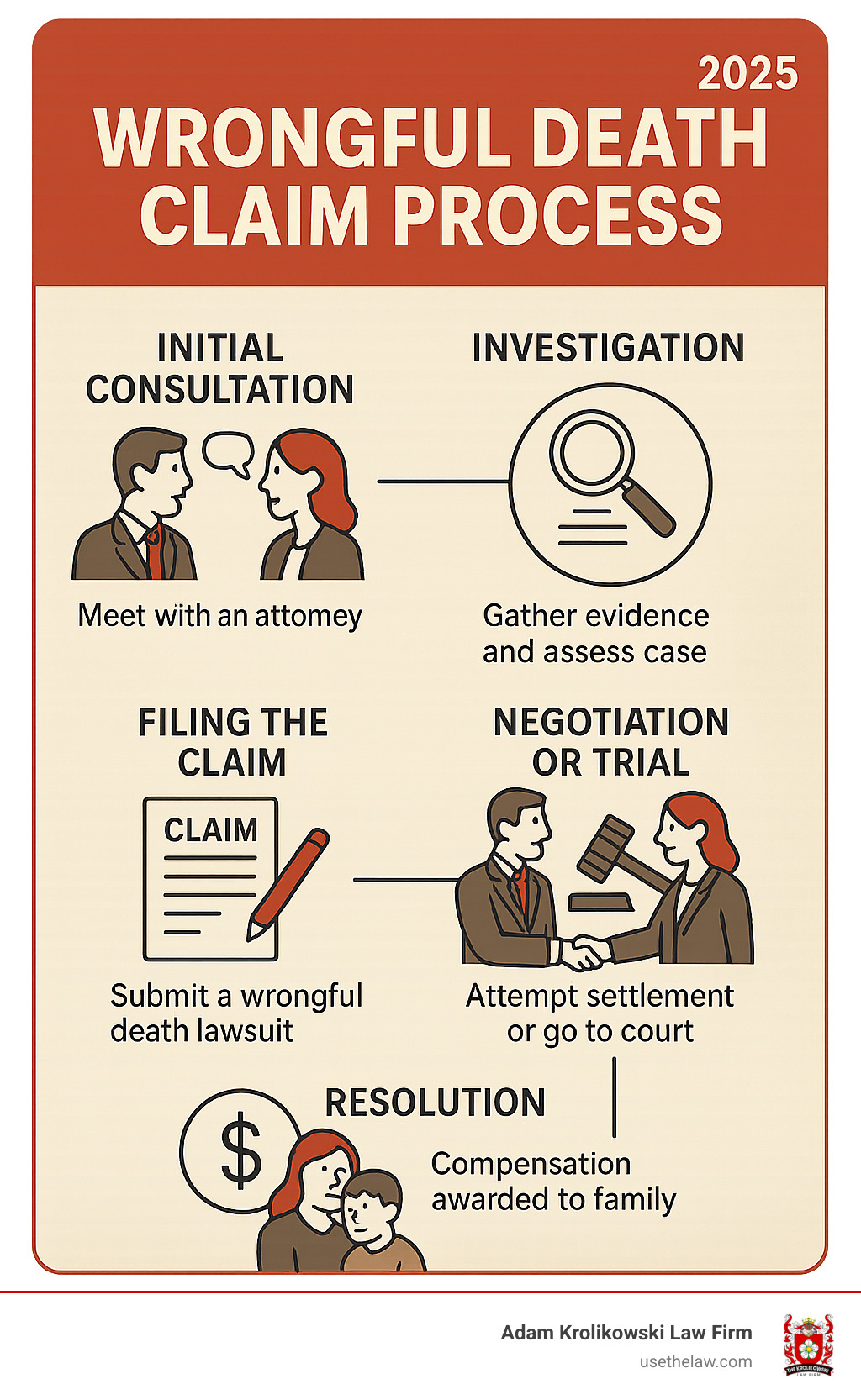
Simple guide to Wrongful death attorney:
Understanding the Foundations of a Wrongful Death Claim

When a family loses someone they love due to another person’s actions, the pain feels overwhelming. Beyond the grief, there’s often a sense that something must be done – that someone should be held accountable. This is where a wrongful death claim comes into play.
A wrongful death attorney helps families pursue what’s called a civil lawsuit. This is completely separate from any criminal case that might happen. While criminal courts focus on punishment, a civil wrongful death claim focuses on getting your family the financial support and sense of justice you deserve.
Think of it this way: even if someone goes to jail for causing your loved one’s death, that doesn’t help pay for funeral costs, lost income, or the many other ways your family has been affected. A wrongful death claim is about seeking that financial stability and holding the responsible party accountable in a different way.
What Constitutes a Wrongful Death?
For a wrongful death claim to succeed, four key pieces must fall into place. It’s like building a case one block at a time.
First, there’s duty of care. This means the person or company had a responsibility to act safely around your loved one. Doctors have a duty to provide proper medical care. Drivers have a duty to follow traffic laws. Employers have a duty to maintain safe workplaces.
Next comes breach of duty. This is when someone fails to meet that responsibility. Maybe a surgeon made a preventable error. Perhaps a driver was texting instead of watching the road. Or an employer ignored safety regulations.
Then we need causation – the direct link between that failure and your loved one’s death. It’s not enough that someone acted carelessly; that carelessness must have directly caused the fatal outcome.
Finally, there must be resulting damages. Your family has suffered real losses – both financial and emotional – because of this death.
The important thing to understand is that civil proceedings work differently than criminal ones. You can win a wrongful death case even if no criminal charges were filed, or even if a criminal case didn’t result in a conviction. The standards are different, and the focus is on helping your family rather than punishing the wrongdoer.
Common Causes of Wrongful Death
Wrongful deaths happen in heartbreakingly predictable ways. Motor vehicle accidents top the list, claiming 4,285 lives in California in 2022 alone. These crashes often involve distracted driving, speeding, or impaired drivers who made choices that cost innocent people their lives. For context, see NHTSA’s Fatality Analysis Reporting System (FARS).
Medical malpractice represents another tragic category. When healthcare providers make preventable errors – whether through misdiagnosis, surgical mistakes, or medication errors – the results can be fatal. These cases are often complex, but they’re pursued to ensure medical professionals are held accountable for serious lapses in care.
Workplace accidents claimed 504 lives in California in 2022. Construction sites, industrial settings, and jobs involving heavy machinery can become deadly when employers cut corners on safety training or ignore established safety protocols.
Defective products can also cause wrongful deaths. When manufacturers release dangerous items – from faulty car parts to unsafe medical devices – the consequences can be fatal. The U.S. Food and Drug Administration (FDA) requires reporting when medical devices contribute to patient deaths, highlighting how serious these issues are.
Premises liability incidents, including slip and fall accidents, occur when property owners fail to maintain safe conditions. Poor lighting, wet floors, or structural problems can lead to fatal accidents, particularly among elderly visitors.
Who Is Eligible to File a Claim?
Not everyone can file a wrongful death claim – the law limits who has legal standing based on their relationship with the deceased and how the death affected them.
Spouses are typically first in line, including both legally married partners and, in many areas, common-law or domestic partners who shared a life together.
Children of the deceased – both biological and adopted – usually have the right to file claims. When children are minors, a legal guardian represents their interests throughout the process.
Parents can often file claims when they’ve lost a child, or sometimes when the deceased had no spouse or children of their own.
Financial dependents may also have rights to file claims, even if they weren’t related by blood or marriage. The key factor is whether they relied on the deceased for financial support.
Some jurisdictions also recognize grandparents and siblings as eligible claimants, particularly if they were financially dependent on the deceased or in special circumstances.
The law recognizes that wrongful death affects people differently. Some family members suffer primarily financial losses, while others experience profound emotional trauma. State-specific laws determine exactly who can seek compensation, which is why working with a knowledgeable attorney is so important for understanding your family’s specific rights and options.
The Role of a Wrongful Death Attorney in Seeking Justice

When you’re struggling with the overwhelming grief of losing someone you love, the thought of dealing with legal matters can feel impossible. You’re trying to process what happened, comfort other family members, and somehow get through each day. This is exactly when having a compassionate wrongful death attorney becomes so important – we handle the legal complexities while you focus on healing.
Think of us as your legal shield and advocate. We take care of the investigation, gather all the necessary evidence, and identify everyone who might be responsible for what happened to your loved one. We also handle all those difficult conversations with insurance companies, who unfortunately often try to minimize what they pay out to grieving families.
If we can’t reach a fair settlement through negotiations, we’re fully prepared to represent you in court. Throughout this entire process, our goal is simple: to seek justice for your family and secure the financial compensation you need to move forward.
How a Wrongful Death Attorney Proves Negligence
Proving that someone else’s negligence caused your loved one’s death requires careful investigation and strong evidence. We start by establishing that the at-fault party had a duty of care – for example, drivers must operate their vehicles safely, and doctors must provide competent medical treatment.
Next, we prove they breached that duty. This might mean showing that a driver was texting while driving or that a doctor failed to diagnose a serious condition that should have been caught.
When accidents involve complex scenarios like vehicle crashes, we often work with accident reconstruction professionals who can recreate exactly what happened. These reconstructions help demonstrate how the negligence directly led to the fatal outcome.
Medical records analysis becomes crucial in cases involving potential medical malpractice. We carefully review all medical documentation to identify errors, missed diagnoses, or substandard care that contributed to the death.
We also bring in medical professionals, economists, and other qualified witnesses whose testimony helps establish both the cause of death and the full extent of your family’s financial losses. Their insights can be the difference between a weak case and a compelling one.
The final piece is proving the direct link between the negligent act and your loved one’s passing. This causation element is often the most challenging part of these cases, but it’s absolutely essential for a successful claim.
Building Your Case: Evidence and Documentation
A strong wrongful death case relies on thorough documentation, and we handle all the detailed work of gathering and organizing this evidence. Police reports and official incident reports provide the foundational details of what happened, while medical records and bills show the care your loved one received before their passing.
The death certificate officially documents the cause of death, and witness statements can provide crucial perspectives that official reports might miss. We also collect employment records, tax returns, and financial documents that help us calculate your loved one’s lost income and future earning capacity.
Funeral and burial expenses are documented as part of the economic damages, and we also consider the broader impact on your family’s life. This might include counseling bills, changes in your work situation, or other ways the loss has affected your daily life.
For families dealing with complex cases, particularly in areas like Los Angeles, you can find more info about seeking compensation in Los Angeles for truck accidents and similar incidents.
Your Advocate in and Out of Court
Many families worry about having to go through a lengthy trial, but the truth is that most wrongful death cases are resolved through out-of-court settlements. We’re skilled negotiators who understand how to present your case in a way that encourages fair settlement offers. We handle all the back-and-forth communications with the other party’s insurance company and legal team, protecting you from stressful interactions during an already difficult time.
Mediation can also be an effective way to reach resolution without the uncertainty of a trial. In mediation, both sides work with a neutral third party to find a mutually acceptable agreement.
However, if the at-fault party or their insurance company refuses to offer fair compensation, we’re always prepared for trial representation. We present your case to a judge and jury, making sure they understand both the facts of what happened and the real impact this loss has had on your family.
Throughout every step of this process, our priority is protecting your family’s rights and making sure your voice is heard. We understand that no amount of money can bring back your loved one, but fair compensation can provide financial security and a sense that justice has been served. Most importantly, we work to alleviate the legal burdens so you can focus on grieving and healing with your family.
Navigating the Legal Process: From Claim to Compensation

Once we’ve built the foundation of your case and gathered the necessary evidence, it’s time to steer the formal legal process. Think of this phase as charting a course through sometimes choppy waters – but you won’t be sailing alone. We’ll be right there with you, steering toward the goal of securing fair compensation and a sense of justice for your family.
This journey can feel overwhelming when you’re already dealing with grief, but understanding what lies ahead can bring some peace of mind. Every case is unique, but there are common milestones we’ll encounter together on the path from filing your claim to reaching a resolution.
The Critical Importance of the Statute of Limitations
Here’s something that might surprise you: the law puts a strict time limit on when you can file a wrongful death lawsuit. Miss this deadline, and you could lose your right to seek compensation forever – even if your case is rock-solid.
Time is not on your side when it comes to wrongful death claims. In most places, you have two years from the date of death to file your lawsuit, though some states allow three years. California generally requires claims to be filed within two years (see Cal. Code Civ. Proc. § 335.1), but some exceptions can change this timeline.
But here’s where it gets tricky – these deadlines aren’t suggestions. Courts take them seriously, and there are very few exceptions. We’ve seen heartbreaking situations where families waited too long, thinking they had more time to grieve before dealing with legal matters.
Acting promptly isn’t just about meeting deadlines – it’s about preserving evidence, finding witnesses while memories are fresh, and ensuring we can build the strongest possible case for your family. Medical records can disappear, security footage gets deleted, and witnesses’ recollections fade over time.
That’s why we always tell families: don’t wait. Even if you’re not sure whether you want to pursue a claim, talking to a wrongful death attorney early gives you options and protects your rights.
What Types of Damages Can Be Recovered?
Let’s be honest – no amount of money can bring back your loved one or truly heal the pain of loss. But a wrongful death claim isn’t about putting a price tag on someone’s life. It’s about providing financial stability for the future and acknowledging the very real losses your family has suffered.
Economic damages are the easier ones to calculate because they involve actual dollar amounts. These include lost income and future earnings – essentially, the financial support your loved one would have provided throughout their expected lifetime. We also recover medical expenses from the time of injury until death, funeral and burial costs, and the monetary value of household services your loved one provided, like childcare or home maintenance.
Non-economic damages recognize the emotional and personal losses that are harder to quantify but just as real. The loss of companionship, love, and guidance your loved one provided can’t be measured in dollars, but the law recognizes these losses deserve compensation. This includes the pain and suffering your family experiences due to the loss.
In California, specific laws govern the amount that can be recovered for non-economic losses in certain types of cases, such as medical malpractice.
Punitive damages are reserved for cases where the at-fault party’s conduct was particularly reckless or intentional. These aren’t meant to compensate your family but rather to punish the wrongdoer and prevent similar behavior in the future.
We work carefully to properly value your claim, considering both immediate needs and long-term financial security. This might include costs for psychological counseling, changes in your family’s living situation, or educational expenses for children who’ve lost a parent.
Settlement vs. Trial: Understanding Potential Outcomes
As we move through your case, we’ll eventually reach a fork in the road: accept a settlement offer or take your case to trial. Both paths have their merits, and the right choice depends on your specific situation and goals.
Settlement negotiations often begin early and can happen at any point during the process. Think of it as both sides coming to the table to find a mutually acceptable resolution without the uncertainty of a trial. Most wrongful death cases actually end in settlement because it offers several advantages.
When we negotiate a settlement, you have more control over the outcome. We can discuss terms, timing, and even confidentiality agreements if that’s important to your family. The process is typically faster and less expensive than going to trial, which means you receive compensation sooner with lower legal costs.
Perhaps most importantly for grieving families, settlements are emotionally less taxing. You won’t need to testify in open court, relive traumatic details in front of strangers, or endure cross-examination from the other side’s attorneys.
Going to trial is sometimes necessary when the other party won’t offer fair compensation or refuses to accept responsibility. While trials involve more risk – you could potentially receive nothing if you lose – they also offer the possibility of higher compensation than what’s offered in settlement negotiations.
Trials are public proceedings, which means your case becomes part of the court record. This can be important for families seeking public accountability, especially in cases involving corporate negligence or systemic safety issues.
The timeline for trials can stretch from several months to a few years, depending on court schedules and case complexity. Appeals can extend this even further, though they’re not always successful.
When it comes to receiving your compensation, you’ll have choices regardless of whether you settle or win at trial. Some families prefer a lump-sum payment that provides immediate financial security. Others choose structured settlements that provide regular payments over time, which can be particularly helpful for ongoing expenses or when minor children are involved.
We’ll discuss both options thoroughly with you, weighing factors like the strength of your case, the other party’s willingness to negotiate fairly, your family’s immediate financial needs, and your emotional readiness for what each path involves. Whatever route we take, our goal remains the same: securing the justice and financial stability your family deserves.
Frequently Asked Questions about Wrongful Death Lawsuits
When you’re dealing with the loss of a loved one, it’s natural to have questions about your legal options. During our years of practice, we’ve heard many of the same concerns from grieving families. Let us address some of the most common questions we receive about wrongful death lawsuits.
How is a wrongful death claim different from a personal injury claim?
The key difference comes down to who files the claim and what they’re seeking compensation for. When someone gets injured in an accident, they file a personal injury claim themselves. They’re asking for money to cover their medical bills, lost wages, and the pain they’ve experienced.
A wrongful death claim is different because the injured person can’t speak for themselves anymore. Instead, their surviving family members must step forward to seek justice. The focus shifts from what the victim suffered to what the family has lost.
While both types of cases often involve proving someone else’s negligence caused harm, the damages are quite different. In a wrongful death case, families seek compensation for lost income the deceased would have earned, funeral expenses, and the profound loss of companionship and guidance. It’s about the financial and emotional hole left in the family’s life.
How much does it cost to hire a lawyer for a wrongful death case?
We know that worrying about legal fees is the last thing you need when you’re grieving. That’s why most wrongful death attorneys, including our firm, work on what’s called a contingency fee basis.
Here’s what that means for your family: You pay nothing upfront. We don’t ask for any money when we take your case. Our payment comes only if we win your case, either through a settlement or court award. If we don’t recover compensation for you, you don’t owe us anything for our legal services.
When we do win, our fee is a percentage of what we recover for your family. This arrangement means we’re invested in getting you the best possible outcome. We only succeed when you do.
There may be some additional costs during the case, like court filing fees or fees for medical records. We’ll discuss all potential expenses with you clearly from the beginning, so there are no surprises.
How long does a wrongful death lawsuit take to resolve?
This is one of the most common questions we hear, and honestly, the answer varies quite a bit. Some cases settle in a few months, while others can take a couple of years. It really depends on several factors.
Straightforward cases with clear fault might resolve quickly, especially if the other side’s insurance company is willing to negotiate fairly. Complex cases involving multiple parties, difficult evidence, or disputed liability naturally take longer to investigate and resolve.
The court’s schedule also plays a role. If we need to go to trial, we’re working within the court system’s timeline, which can add months to the process. Some opposing parties are ready to settle reasonably, while others fight every step of the way.
We also recognize that every family grieves differently. Some are ready to move forward with legal action quickly, while others need more time to process their loss before diving into the legal details.
While we work efficiently to resolve your case, our priority is always achieving the best possible outcome for your family. We’ll keep you informed throughout the process and help you understand what to expect at each stage. Sometimes patience leads to better results, and we’re prepared to take whatever time is necessary to get you the justice you deserve.
Helping Your Family Move Forward
The path forward after losing a loved one to someone else’s negligence feels overwhelming. Grief and healing take time, and there’s no rushing through the pain. While nothing can bring your loved one back, pursuing accountability through legal action can provide something important – a sense that justice has been served and your family’s future is more secure.
Many families find that taking legal action helps them process their loss. It’s not about the money alone, though financial security for the future matters deeply when you’re dealing with lost income, medical bills, and funeral costs. It’s about making sure the responsible party faces consequences for their actions. It’s about preventing similar tragedies from happening to other families.
Seeking accountability through a wrongful death claim sends a clear message that negligent behavior has serious consequences. Whether it’s a careless driver, a negligent doctor, or a company that cut corners on safety, holding them responsible can lead to changes that protect others.
The legal process itself can feel daunting when you’re grieving. That’s where having the right wrongful death attorney makes all the difference. You need someone who understands both the legal complexities and the emotional weight of what you’re going through.
At Adam Krolikowski Law Firm, we’ve walked this difficult path with families for over 25 years. We know that every case is unique, just like every family’s loss is unique. We take on complex cases that other attorneys might avoid – the challenging ones that require thorough investigation, multiple defendants, or unusual circumstances.
Our approach is straightforward. We handle the legal burden so you can focus on healing. We fight for fair compensation while treating your family with the compassion and respect you deserve during this difficult time. Our offices in Santa Ana and Los Angeles are here to serve families throughout Southern California.
You don’t have to face this alone. We’re here to help you steer this challenging time and work toward a resolution that honors your loved one’s memory while securing your family’s future.
Contact Us
Practice Areas
Recent Articles
- « Previous
- 1
- 2
- 3
- Next »