

Understanding Workplace Discrimination in Los Angeles
Discrimination lawyers in Los Angeles help employees fight illegal workplace treatment based on protected characteristics like race, age, gender, disability, and sexual orientation. These attorneys use California’s Fair Employment and Housing Act (FEHA) and federal anti-discrimination laws to secure justice for workers facing unfair treatment.
If you’re experiencing workplace discrimination in Los Angeles, here’s what you need to know:
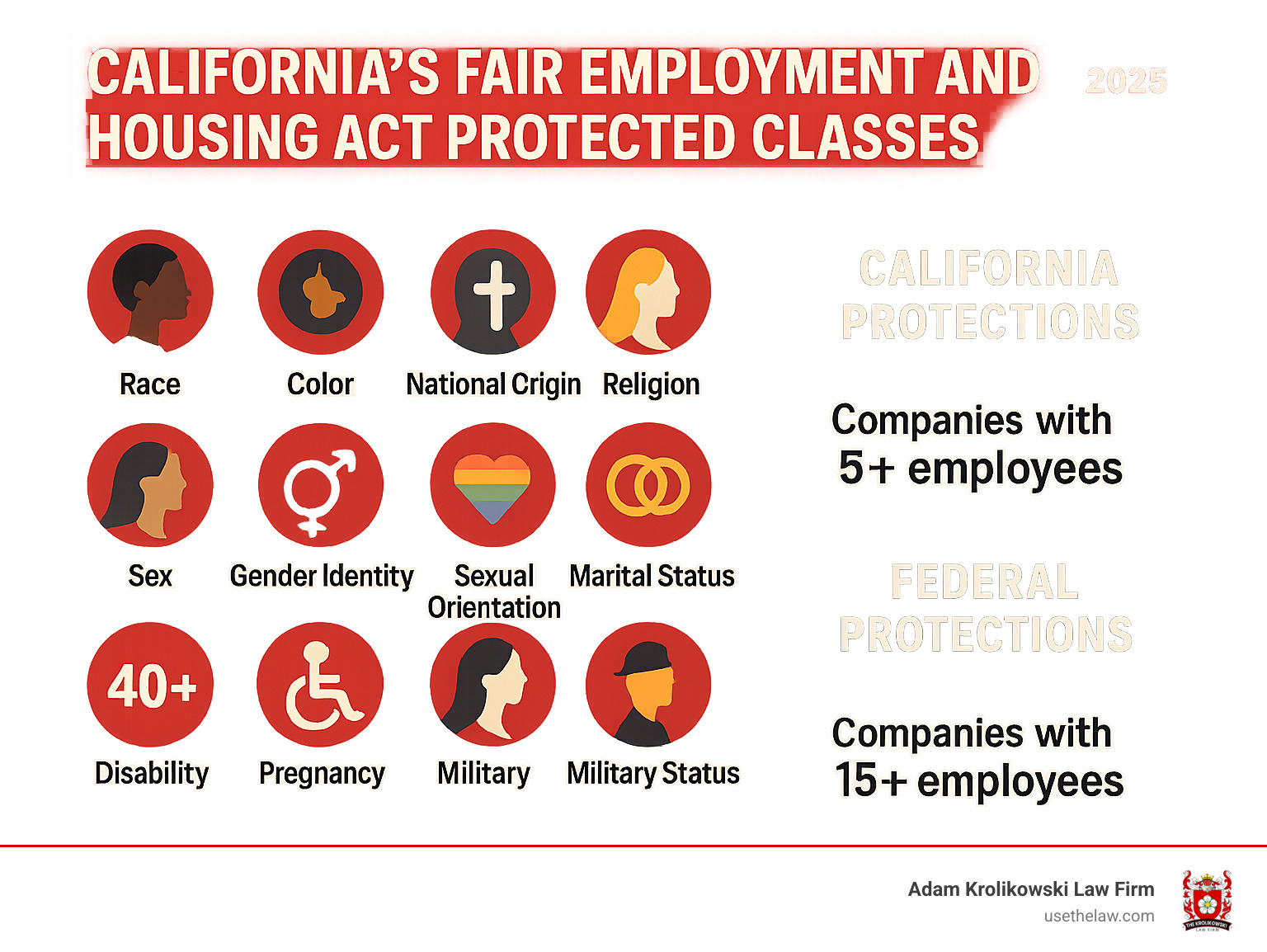
- Legal Protection: California law protects employees at companies with 5+ workers (vs. 15+ for federal law).
- Protected Classes: Race, gender, age (40+), disability, religion, national origin, sexual orientation, pregnancy.
- Common Violations: Wrongful termination, denied promotions, unequal pay, harassment, retaliation.
- Filing Deadlines: 1 year with California Civil Rights Department, 180-300 days with EEOC.
- Available Remedies: Back pay, emotional distress damages, job reinstatement, punitive damages.
Workplace discrimination affects thousands of employees across Los Angeles County. California offers stronger protections than federal law. While federal laws like Title VII require employers to have 15 or more employees, California’s FEHA applies to workplaces with just 5 employees, meaning more workers have legal recourse.
Discrimination often hides behind “business decisions” like layoffs or performance issues. Many employees suffer in silence, unaware that their treatment violates the law. Whether you’re dealing with racial slurs, being passed over for promotions due to your age, or facing retaliation for reporting harassment, you have legal rights. Understanding these rights is the first step toward obtaining justice.
Important discrimination lawyers los angeles terms:
- los angeles gender discrimination lawyer
- los angeles workplace retaliation lawyer
- employment attorney los angeles free consultation
What Types of Workplace Discrimination Are Illegal?
Workplace discrimination occurs when an employer treats an employee unfavorably because of legally protected personal characteristics. In Los Angeles, these protected classes include:
- Age: The Age Discrimination in Employment Act (ADEA) protects individuals who are 40 or older from less favorable treatment.
- Race & National Origin: Unfair treatment because of race, skin color, ethnicity, or country of origin is prohibited by Title VII and FEHA.
- Gender & Sex: This includes unfavorable treatment due to a person’s sex, gender identity, or gender expression, as well as pregnancy discrimination.
- Disability: The Americans with Disabilities Act (ADA) and FEHA prohibit discrimination and require employers to provide reasonable accommodations for qualified individuals with disabilities.
- Religion: Employers must reasonably accommodate an employee’s religious beliefs or practices unless it causes an undue hardship.
- Sexual Orientation & Gender Identity: California law provides robust protections against discrimination based on sexual orientation and gender identity.
- Pregnancy: The Pregnancy Discrimination Act (PDA) and FEHA prohibit discrimination based on pregnancy, childbirth, or related medical conditions.
- Marital Status: In California, it is illegal to discriminate against an employee based on their marital status.
Common Examples of Unlawful Discrimination
Discrimination can be subtle. Here are common examples:
- Unfair Hiring Practices: Refusing to hire someone based on a protected characteristic.
- Wrongful Termination: Being fired for an illegal reason, such as your age, race, or for complaining about discrimination. This includes “constructive termination,” where conditions become so intolerable an employee is forced to resign.
- Demotion or Adverse Job Assignments: Being demoted or given less desirable tasks due to a protected characteristic.
- Unequal Pay or Benefits: Receiving lower wages or fewer benefits than colleagues with similar qualifications who are not in a protected class.
- Denied Promotions or Training: Being passed over for promotions or training because of your protected characteristic.
- Harassment (Hostile Work Environment): Unwelcome conduct based on a protected characteristic that is so severe or pervasive it creates an intimidating or offensive work environment.
- Retaliation for Complaints: An employer taking adverse action against an employee for complaining about discrimination or participating in an investigation.
It’s important to distinguish between illegal discrimination and simple favoritism. While a manager may show preferential treatment, it only becomes illegal if it’s based on a protected characteristic like age, race, or gender.
More info about wrongful termination
Key Anti-Discrimination Laws Protecting LA Employees

Employees in Los Angeles benefit from two sets of anti-discrimination laws. Federal laws provide a foundation, while California’s laws add an extra layer of protection that’s often stronger. This dual system is important because discrimination lawyers Los Angeles can use whichever law offers stronger protection for your case.
Federal Protections for Employees
Federal laws established the groundwork for fighting workplace discrimination. They typically cover employers with 15 or more employees.
- Title VII of the Civil Rights Act of 1964 is the cornerstone, making it illegal to discriminate based on race, color, religion, sex, and national origin. Courts have interpreted “sex” to include pregnancy, sexual orientation, and gender identity.
- The Americans with Disabilities Act (ADA) prohibits discrimination and requires employers to make reasonable accommodations for qualified workers with disabilities.
- The Age Discrimination in Employment Act (ADEA) protects workers who are 40 years or older and applies to employers with 20 or more employees.
- The Equal Pay Act (EPA) requires equal pay for equal work, regardless of sex.
California’s Broader Employee Protections
California has consistently led the nation in expanding worker protections.
- The Fair Employment and Housing Act (FEHA) is California’s main anti-discrimination law. It protects workers at companies with just 5 or more employees.
- FEHA’s list of protected characteristics is extensive, including race, religious creed, color, national origin, ancestry, physical or mental disability, medical condition, genetic information, marital status, sex, gender, gender identity, gender expression, age (40 and over), sexual orientation, and military and veteran status.
- The Bane Act makes it illegal to use threats or intimidation to interfere with someone’s civil rights, which can lead to additional damages in a discrimination case.
- California has been a pioneer in protecting LGBTQ+ workers, explicitly stating in FEHA that you cannot be discriminated against because of your sexual orientation, gender identity, or gender expression.
More info about gender discrimination
Comparing Disability Laws: ADA vs. FEHA
For disability discrimination, FEHA often provides broader protection than the ADA, making it easier to prove a case.
| Feature | Americans with Disabilities Act (ADA) | California Fair Employment and Housing Act (FEHA) |
|---|---|---|
| Definition of Disability | Must “substantially” limit a major life activity | Only needs to “limit” a major life activity (easier standard) |
| Major Life Activities | Specific list; “working” not explicitly included | Broader range including “working” as a major life activity |
| Perceived Disabilities | Limited protection for perceived disabilities | Strong protection even if the perceived disability doesn’t exist |
| Employee Threshold | Employers with 15+ employees | Employers with 5+ employees |
| Reasonable Accommodations | Required unless “undue hardship” | Required unless “undue hardship” (higher standard for employers) |
The practical difference is significant. Under FEHA, you only need to show a condition “limits” a major life activity, a much lower bar to clear than the ADA’s “substantially limits” standard.
Both laws require employers to engage in an “interactive process” when an accommodation is requested. This means your employer must discuss reasonable solutions with you and cannot simply ignore your request.
Building Your Case: Steps to Take and Evidence to Gather

When you’re dealing with workplace discrimination, the employees who take action early and document everything are the ones who build strong cases. Each piece of evidence helps create a clearer picture of what happened.
Initial Steps if You Suspect Discrimination
What you do next can affect your ability to seek justice. Here are key steps:
- Document immediately. Write down every incident with details: date, time, who was there, and what was said. Facts are crucial.
- Save everything. Keep copies of emails, text messages, and performance reviews that could be relevant.
- Follow company rules. Report discrimination to HR or your supervisor in writing. This puts the company on notice and is often a required step before filing a formal complaint.
- Look for patterns. Note if others in your protected class are facing similar treatment. This can help show that the issue is discrimination, not a personal conflict.
More info about workplace harassment
What Evidence Do You Need for a Strong Case?
Discrimination cases are often built on circumstantial evidence that tells a compelling story.
- Written communications: Emails, texts, and internal messages can reveal bias, even with subtle language.
- Witness testimony: Coworkers or former employees may have witnessed discriminatory behavior or experienced it themselves.
- Employment records: Performance reviews that suddenly turn negative, records showing you were passed over for a promotion, or pay stubs revealing wage gaps can be powerful evidence of disparate treatment.
- Company policies: Sometimes, a seemingly neutral policy has a disparate impact, meaning it unfairly harms a protected group. For example, a physical requirement might exclude more women than men without being essential for the job.
Understanding Hostile Work Environments and Retaliation
Two common areas of discrimination law are hostile work environments and retaliation.
- A hostile work environment is more than just a difficult boss. The unwelcome conduct must be based on a protected characteristic (like race or gender) and be severe or pervasive enough to alter your working conditions. A single offensive joke is likely not enough, but constant slurs or threats could be.
- Retaliation occurs when your employer punishes you for a protected activity, like complaining about discrimination or participating in an investigation. The punishment doesn’t have to be firing; it can be a demotion, a negative review, or exclusion from meetings. If an adverse action happens soon after you complain, the timing can be strong evidence of retaliation.
You have the right to speak up about discrimination without fear of punishment. If your employer retaliates, you may have an even stronger case than your original claim.
More info about sexual harassment
The Role of Government Agencies and Discrimination Lawyers in Los Angeles

When facing workplace discrimination, you don’t have to fight alone. A system of government agencies and discrimination lawyers Los Angeles exists to protect your rights. Understanding how this system works is key to a successful claim.
Filing a Complaint with the EEOC or CRD
Before filing a lawsuit, you must typically file a complaint with a government agency. In Los Angeles, your main options are the federal Equal Employment Opportunity Commission (EEOC) and California’s Civil Rights Department (CRD).
- The EEOC handles federal discrimination laws (Title VII, ADA, etc.).
- The CRD enforces California’s FEHA, which often provides broader protections and covers smaller companies (5+ employees vs. the federal 15+).
After you file a complaint (a “charge”), the agency may investigate and offer mediation. Timing is critical. You generally have 180-300 days to file with the EEOC and one year to file with the CRD from the date of the discriminatory act. Miss these deadlines, and you may lose your right to sue.
Once the agency finishes its process, it will issue a “right-to-sue” letter. You then have a limited time—usually 90 days for an EEOC letter or one year for a CRD letter—to file a lawsuit.
How Discrimination Lawyers in Los Angeles Can Protect Your Rights
While you can file a complaint alone, an attorney can provide significant advantages.
- Case Evaluation: A lawyer can assess whether you have a valid claim under federal or California law.
- Evidence Gathering: They know what documents and witness testimony are needed to build a strong case.
- Navigating the Process: An attorney can ensure your complaint is filed correctly and on time, and represent you during investigations and mediations.
- Negotiation and Litigation: Lawyers can negotiate a fair settlement with your employer or, if necessary, file a lawsuit and represent you in court.
- Protection from Retaliation: If your employer punishes you for filing a claim, your lawyer can take immediate legal action.
More info about employment attorneys
What to Expect When Working with Discrimination Lawyers in Los Angeles
When you work with our firm, we aim to make the process clear and accessible.
- Initial Consultation: We offer a free consultation to discuss your story and legal options without financial risk.
- Contingency Fees: Most discrimination cases are handled on a contingency fee basis, meaning you don’t pay attorney’s fees unless we win your case.
- Attorney-Client Relationship: We believe in direct communication. We’ll explain legal concepts in plain English and keep you informed at every stage.
- Strategic Planning: We develop a legal strategy custom to your situation, whether it involves filing with the EEOC, CRD, or both, to build the strongest possible claim.
The legal process can be overwhelming, but you don’t have to face it alone. With the right legal team, you can fight back and seek the justice you deserve.
Seeking Justice: Remedies and Compensation
When you’ve faced workplace discrimination, a legal claim is about making things right. The legal system offers several ways to achieve justice, through both practical workplace changes and financial compensation for your suffering.
Legal Remedies Available to Victims
Beyond money, discrimination cases can lead to lasting changes. These “equitable remedies” are designed to fix the problem and prevent future harm.
- Reinstatement: A court can order your employer to give you your job back.
- Policy Changes: Employers may be required to update their anti-discrimination policies and reporting procedures.
- Required Training: Management and staff might be ordered to complete training on discrimination laws.
- Reasonable Accommodations: For disability cases, a court can order an employer to provide accommodations that were previously denied.
- Promotion: You might receive a promotion you were unfairly denied, along with the associated pay and benefits.
These remedies are important because they can create a fairer workplace culture.
What Compensation Can You Recover?
The financial impact of discrimination can be severe. Discrimination lawyers Los Angeles can help you recover various types of compensation for these losses.
- Back Pay: This covers lost wages, bonuses, and benefits from the time of the discrimination until the case is resolved.
- Front Pay: This compensates you for future lost earnings if getting your job back isn’t an option.
- Emotional Distress Damages: This compensates you for the psychological harm—such as anxiety, depression, and humiliation—caused by discrimination.
- Punitive Damages: In cases of particularly malicious conduct, these damages are awarded to punish the employer and deter similar behavior in the future. California law allows for punitive damages when an employer acts with malice, oppression, or fraud.
- Attorney’s Fees and Costs: If you win, the employer is typically required to pay your legal fees and court costs.
While every case is different, these recoveries can provide financial security and help you move forward. An experienced lawyer can help you properly value your case and fight for the compensation you deserve.
Frequently Asked Questions about Los Angeles Discrimination Claims
When facing potential workplace discrimination, you likely have many questions. As discrimination lawyers Los Angeles, we regularly address these concerns.
How long do I have to file a discrimination claim in California?
Time is critical. Missing a deadline can prevent you from seeking justice.
- With the CRD: You have one year from the last discriminatory act to file with the California Civil Rights Department.
- With the EEOC: You generally have 180 days to file with the Equal Employment Opportunity Commission, though this can extend to 300 days in California.
After the agency issues a “right-to-sue” notice, another deadline begins. You typically have 90 days after an EEOC letter or one year after a CRD letter to file a lawsuit. It is wise to contact an attorney as soon as you suspect discrimination.
What is a “reasonable accommodation” for a disability?
A reasonable accommodation is a change to your job or workplace that allows you to perform your duties despite a disability. Employers must provide these unless it would cause them “undue hardship” (significant difficulty or expense).
Once you request an accommodation, your employer must engage in an interactive process to find a workable solution. Common accommodations include modified schedules, assistive technology, or restructured job duties. The accommodation must be effective, but it doesn’t have to be your first choice if the employer offers a viable alternative.
Can I be fired for filing a discrimination complaint?
No. Retaliation for filing a discrimination complaint is illegal. You have a right to engage in “protected activities”—like complaining to HR, filing a charge with the EEOC or CRD, or participating in an investigation—without fear of punishment.
Retaliation isn’t just firing. It can include demotions, pay cuts, sudden negative performance reviews, or other adverse actions. To prove retaliation, you must show a link between your protected activity and the employer’s adverse action. Suspicious timing is often key evidence—for example, being fired shortly after you filed a complaint.
If you fear retaliation, document everything. Your right to complain is fundamental, and the law is on your side.
Conclusion: Take the Next Step to Protect Your Rights
Facing workplace discrimination can feel isolating, but you are not alone. Discrimination is illegal, and in Los Angeles, you have powerful legal protections. Whether you’ve been passed over for a promotion, harassed, or wrongfully terminated, you have rights.
Building a strong case requires understanding complex laws, gathering evidence, and meeting strict deadlines. This is why seeking legal guidance is crucial. You shouldn’t have to steer this process alone while dealing with the stress of discrimination.
At Adam Krolikowski Law Firm, we understand what you’re going through. We have spent over 25 years representing employees in Los Angeles and Orange County. Our firm is committed to handling complex employment cases that other attorneys might turn away, because we believe everyone deserves a fair chance at justice.
We’ve seen how discrimination affects not just your career, but your well-being and your family. We approach every case with legal skill and compassion. We will listen to your story, explain your options clearly, and fight to get you the compensation and workplace changes you deserve.
Don’t let discrimination define your career. Taking action protects your rights and helps create fairer workplaces for others. The first step is often the hardest, but you don’t have to take it by yourself.
Learn more about how a California employment law firm can help
