

Santa Ana Premises Liability Attorney: 4 Critical Answers
When Property Owners Fail to Keep You Safe in Santa Ana
A santa ana premises liability attorney helps injured visitors hold negligent property owners accountable when unsafe conditions on their property cause harm. If you’re injured on someone else’s property in Santa Ana due to their negligence, you typically have two years to file a claim and may recover compensation for medical bills, lost wages, and pain and suffering—even if you were partially at fault.
Quick Overview: What You Need to Know
- Premises liability means property owners are legally responsible for keeping their property reasonably safe for visitors
- Common cases include slip and falls, inadequate security leading to assault, dog bites, and swimming pool accidents
- To win your claim, you must prove the owner owed you a duty of care, breached that duty, and caused your injury
- Time limit: You generally have two years from the date of injury to file a claim in California
- Comparative negligence: You can still recover damages even if you were partially at fault, though your compensation will be reduced proportionally
Living in Orange County offers seemingly endless opportunities to visit interesting places—from retail stores and restaurants to theme parks and public venues. Unfortunately, not all of these properties are maintained safely. When property owners fail to clean up spills, fix broken handrails, provide adequate lighting, or address other hazardous conditions, visitors can suffer serious injuries.
In 2020 alone, falls caused 36,000 deaths among adults aged 65 or older, with approximately 95 percent of hip fractures resulting from falls. The National Floor Safety Institute reports that over one million Americans require emergency medical care annually due to slip and fall incidents. Medical costs for falls exceeded $50 billion in 2015, with 75 percent covered through Medicare and Medicaid.
California law requires property owners to take reasonable steps to protect visitors from hazards they know about or should know about. When they fail to do so, injured visitors have the right to pursue compensation through a premises liability claim.
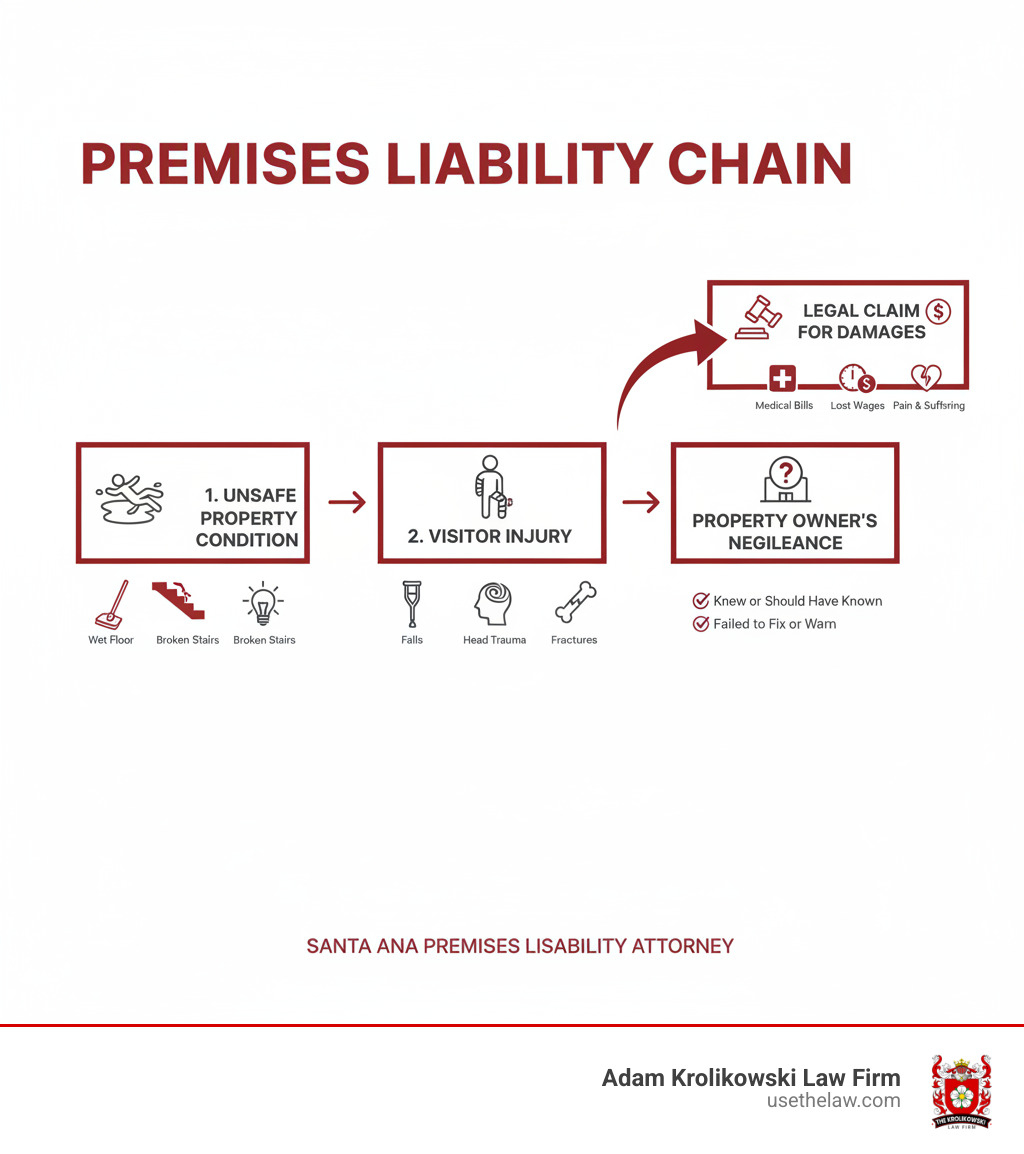
Simple guide to santa ana premises liability attorney:
Understanding a Property Owner’s Legal Duty in Santa Ana
When you step onto someone else’s property in Santa Ana—whether it’s a grocery store, an apartment building, or a neighbor’s backyard—the owner has a legal responsibility to keep you reasonably safe. This isn’t just common courtesy; it’s the law. We call this property owner negligence prevention, and it’s based on a fundamental principle called the “duty of care.”
Think of duty of care as the basic standard of safety we all expect when we visit a place. Property owners must act like a reasonably careful person would to prevent foreseeable harm. If there’s a spill in an aisle, a broken step, or a dangerous condition they know about (or should know about), they need to either fix it or warn visitors about it.
California Civil Code 1714 spells this out clearly: everyone is responsible not just for intentional harmful acts, but also for injuries caused by their lack of ordinary care in managing their property. So if a property owner is negligent in maintaining their space and someone gets hurt as a result, they can be held accountable. This is the foundation of understanding liability personal injury cases. For a deeper look at how courts define this responsibility, check out More on the legal duty of care.
The key word here is “reasonable.” Property owners aren’t expected to prevent every possible accident or make their property absolutely risk-free. But they do need to take reasonable safety precautions that a careful property owner would take in similar circumstances.
Visitor Status and Duty of Care
Here’s where things used to be more complicated. Historical classifications divided visitors into three categories: invitees (like customers in a store), licensees (like social guests at a party), and trespassers (people on the property without permission). Property owners owed the highest duty of care to invitees, a lesser duty to licensees, and almost no duty to trespassers except to avoid intentionally harming them.
Fortunately, California’s modern approach has simplified things considerably. Our state now focuses on whether the property owner acted with reasonable care for all visitors given the specific circumstances. While your status as a visitor might still matter when determining what’s “reasonable,” the central question is always the same: Did the property owner exercise ordinary care to protect people from unreasonable risks?
There’s an important exception worth knowing about, especially if you have children. The child trespasser doctrine recognizes that kids don’t always understand danger the way adults do. Even if a child is technically trespassing, property owners often owe them a higher duty of care—particularly when there’s an “attractive nuisance” on the property. This could be an unfenced swimming pool, construction equipment, or anything else that might attract a curious child and pose serious danger. Property owners must take reasonable steps to prevent injuries to children who might be drawn to such hazards. You can read more about the Legal definition of a trespasser to understand how courts view this issue.

What Must Be Proven: The Four Elements of a Santa Ana Premises Liability Claim
To successfully pursue a premises liability case in Santa Ana, you need to prove four specific elements. These aren’t just technical legal requirements—they’re the building blocks of your claim and what a santa ana premises liability attorney will work to establish on your behalf. California Civil Jury Instruction 1000 lays out these requirements:
1. Duty means the property owner had a legal obligation to manage their property with ordinary care. As we discussed above, this duty exists for virtually all visitors to a property in California.
2. Breach happens when the property owner fails to act reasonably. This could mean they created a dangerous condition themselves, they knew about a hazard but didn’t fix it, or they should have known about a problem through reasonable inspection but failed to find it. The owner also breaches their duty if they don’t properly warn visitors about dangers they can’t immediately fix.
3. Causation requires showing that the owner’s negligence was a substantial factor in causing your injury. This is called the substantial factor test, and it’s important to understand that the property owner’s negligence doesn’t need to be the only cause of your injury—it just needs to be a significant contributing factor. For example, if you slipped on a wet floor the owner knew about but didn’t clean up, that negligence was a substantial factor in your fall, even if you were also momentarily distracted.
4. Damages means you suffered actual harm. This includes medical bills, lost wages, pain and suffering, emotional distress, and other losses that resulted from your injury. Without provable damages, there’s no claim, even if the property owner was clearly negligent.
Proving these four elements requires thorough investigation, evidence collection, and often testimony from witnesses or professionals. This is complex work, which is why navigating a premises liability claim typically requires legal guidance. At Adam Krolikowski Law Firm, we handle these complicated cases—including ones other attorneys might turn away—drawing on over 25 years of experience to build the strongest possible case for our clients.
Common Types of Premises Liability Cases in Santa Ana
When you think about dangerous property conditions, you might picture a classic slip on a wet floor. And yes, that’s definitely one way people get hurt. But premises liability covers so much more than that. In Santa Ana and throughout Orange County, we see people injured in all sorts of situations where property owners didn’t keep their spaces safe. Understanding these different scenarios can help you recognize when you might have a valid claim. Here are the most common premises liability injury cases we encounter:

Slip and fall accidents remain one of the most frequent reasons people contact a slip and fall lawyer in orange county california. These incidents happen in grocery stores when someone doesn’t clean up a spill, in restaurants with freshly mopped floors and no warning signs, on sidewalks with cracked or uneven pavement, and in parking lots riddled with unmarked potholes. We’ve represented clients who’ve fallen on poorly maintained staircases, tripped over loose carpeting in office buildings, and slipped on wet surfaces that should have been marked. Sometimes it’s as simple as a store employee forgetting to put out a “wet floor” sign. Other times it’s a landlord who’s ignored complaints about broken steps for months.
When it comes to inadequate or negligent security, property owners can’t just ignore safety concerns and hope for the best. If you own or manage a commercial property or apartment complex, you have a responsibility to protect people from foreseeable crimes. This means maintaining proper lighting in parking lots and walkways, installing security cameras that actually work, ensuring doors have functioning locks, and in some cases, hiring security personnel. We’ve handled cases where assault victims were attacked in dimly lit parking garages, where broken locks allowed intruders into apartment buildings, and where the complete absence of security measures led to preventable crimes. A negligent security attorney in orange county ca can help determine if inadequate security contributed to your injury.
Dog bites fall under a strict liability standard in California, which actually makes these cases somewhat more straightforward. If a dog bites you while you’re in a public place or lawfully on private property, the owner is responsible for your injuries. Period. It doesn’t matter if the dog has never bitten anyone before or if the owner swears their pet is “usually so friendly.” The law protects victims regardless of the dog’s history.
Swimming pool accidents are particularly heartbreaking because they so often involve children. Property owners with pools must take reasonable precautions to prevent access by unsupervised individuals, especially kids. This includes installing proper fencing around the pool area, ensuring gates have working locks, providing adequate supervision at public pools, and posting clear warnings about water depth and other hazards. When owners fail to secure their pools properly, the results can be devastating—from near-drownings to tragic fatalities.
Have you ever worried about something falling on you while shopping? Falling objects cause real injuries when merchandise isn’t properly stacked on store shelves, when items fall from overhead storage areas, or when construction materials drop from scaffolding or liftd work areas. Property owners and businesses need to secure items properly and maintain safe conditions in areas where people walk below.
Elevator and escalator accidents might seem rare, but when they happen, they can cause catastrophic injuries. Malfunctioning elevators can trap people, drop suddenly, or crush limbs in closing doors. Escalators can catch clothing or cause falls when they malfunction or aren’t properly maintained. Property owners are legally required to keep these mechanical systems regularly inspected and in good working order.
You can’t see toxic fumes or chemical exposure, which makes these cases particularly insidious. Exposure to mold, asbestos, carbon monoxide, lead paint, or other dangerous substances can cause serious, sometimes permanent, health problems. If a property owner knows about these hazards—or should have finded them through reasonable inspection—and fails to address them or warn visitors, they can be held accountable for resulting illnesses.
Construction site injuries present unique challenges because they often involve multiple parties and can affect both workers and visitors. While many construction worker injuries fall under workers’ compensation, third-party claims can arise from dangerous conditions like trench collapses, scaffolding failures, or heavy equipment accidents. You can learn more about construction site injury claims and how they differ from standard workers’ compensation cases.
The common thread running through all these scenarios is that a santa ana premises liability attorney looks at whether the property owner knew about the dangerous condition (or should have known about it through reasonable inspection) and whether they took appropriate action to fix it or warn people about it. If they didn’t, and someone got hurt as a result, that’s when premises liability comes into play. These examples don’t cover every possible situation—any dangerous property condition that causes injury could potentially form the basis of a claim.
Recovering Damages and Navigating California Law
When you’re injured on someone else’s property, the physical pain is just the beginning. Medical bills start piling up, you might miss work, and the stress of it all can feel overwhelming. The good news is that California law recognizes these struggles and allows you to seek compensation for both the financial costs and the personal toll your injury has taken.
Your damages typically fall into two main categories. Economic damages are the concrete, calculable losses you can point to on paper. These include your medical bills—everything from that initial emergency room visit and ambulance ride to ongoing doctor’s appointments, surgeries, medications, physical therapy, and any future medical care you’ll need because of this injury. They also include lost wages if you had to miss work while recovering, and even loss of earning capacity if your injury affects your ability to earn at the same level going forward.
Non-economic damages are harder to put a price tag on, but they’re absolutely real. Pain and suffering compensates you for the physical discomfort you’ve endured. Emotional distress covers the psychological impact—the anxiety, depression, or even PTSD that can follow a serious injury. Loss of enjoyment of life recognizes that your injury may prevent you from participating in activities, hobbies, or daily routines that once brought you joy. In some situations, a spouse may also seek damages for loss of consortium, compensating for the impact on their relationship.
The stakes can be incredibly high, especially for older adults. The CDC reports that in 2020 alone, falls caused 36,000 deaths among adults aged 65 or older. Falls account for almost half of all traumatic brain injury-related hospitalizations. These aren’t minor incidents—they’re life-changing events that demand comprehensive compensation. If you’ve suffered severe injuries, a catastrophic injury lawyer in santa ana can help ensure you’re not shortchanged. You can find additional CDC data on fall-related deaths to understand the scope of this issue.
One thing to understand right away: California has a two-year statute of limitations for premises liability claims. This means you generally have two years from the date of your injury to file a lawsuit. Miss this deadline, and you could lose your right to compensation entirely, no matter how strong your case is. This is why it’s so important to take action promptly after an injury.
How Comparative Negligence Affects Your Claim
Here’s a question we hear all the time: “What if I was partly at fault for what happened?” Maybe you were texting when you tripped, or you didn’t notice a warning sign. Does that mean you can’t recover anything?
Actually, no—and this is where California’s approach really works in your favor. Our state follows what’s called pure comparative negligence, which means you can still recover damages even if you shared some of the blame for your accident. Your compensation is simply reduced by your percentage of fault.
Let’s say your total damages come to $100,000, but the jury determines you were 20% responsible for your fall—perhaps you weren’t paying close attention to where you were walking. Under California’s system, you would still recover $80,000 (that’s 80% of the total). Even if you were 50% at fault, you’d still get $50,000. This is much more favorable than some states, where being even slightly at fault can completely bar your recovery.
This system means you shouldn’t assume you have no case just because you think you made a mistake. The property owner may still owe you for the portion of harm caused by their negligence. A santa ana premises liability attorney understands how to steer these shared fault situations and can help protect your rights. For more guidance on handling these cases, check out this article on santa ana personal injury lawyer.
Be warned, though: insurance companies absolutely love comparative negligence. They’ll use every trick in the book to shift as much blame as possible onto you, trying to reduce what they have to pay. They might claim you were distracted, that you should have seen the hazard, or that you were wearing inappropriate shoes. This is exactly why having legal representation matters so much—someone who knows these tactics and can push back effectively.
What to Do After an Injury and How a Santa Ana Premises Liability Attorney Can Help
Being injured on someone else’s property can leave you feeling shaken and uncertain about what to do next. The steps you take immediately after an accident can make a significant difference in your ability to recover compensation later. Let me walk you through what you should do, and when it makes sense to bring in legal help.
Your health comes first, always. Even if you think you’re okay, get medical attention right away. Some injuries, particularly head trauma or internal damage, don’t show symptoms immediately. A prompt medical evaluation not only protects your wellbeing, but also creates an official record linking your injuries to the incident—something that becomes crucial later when building your claim.
Next, report what happened to the property owner, manager, or an employee as soon as you can. Ask them to file an incident report and request a copy for your records. This creates an official paper trail that the property owner can’t later dispute.
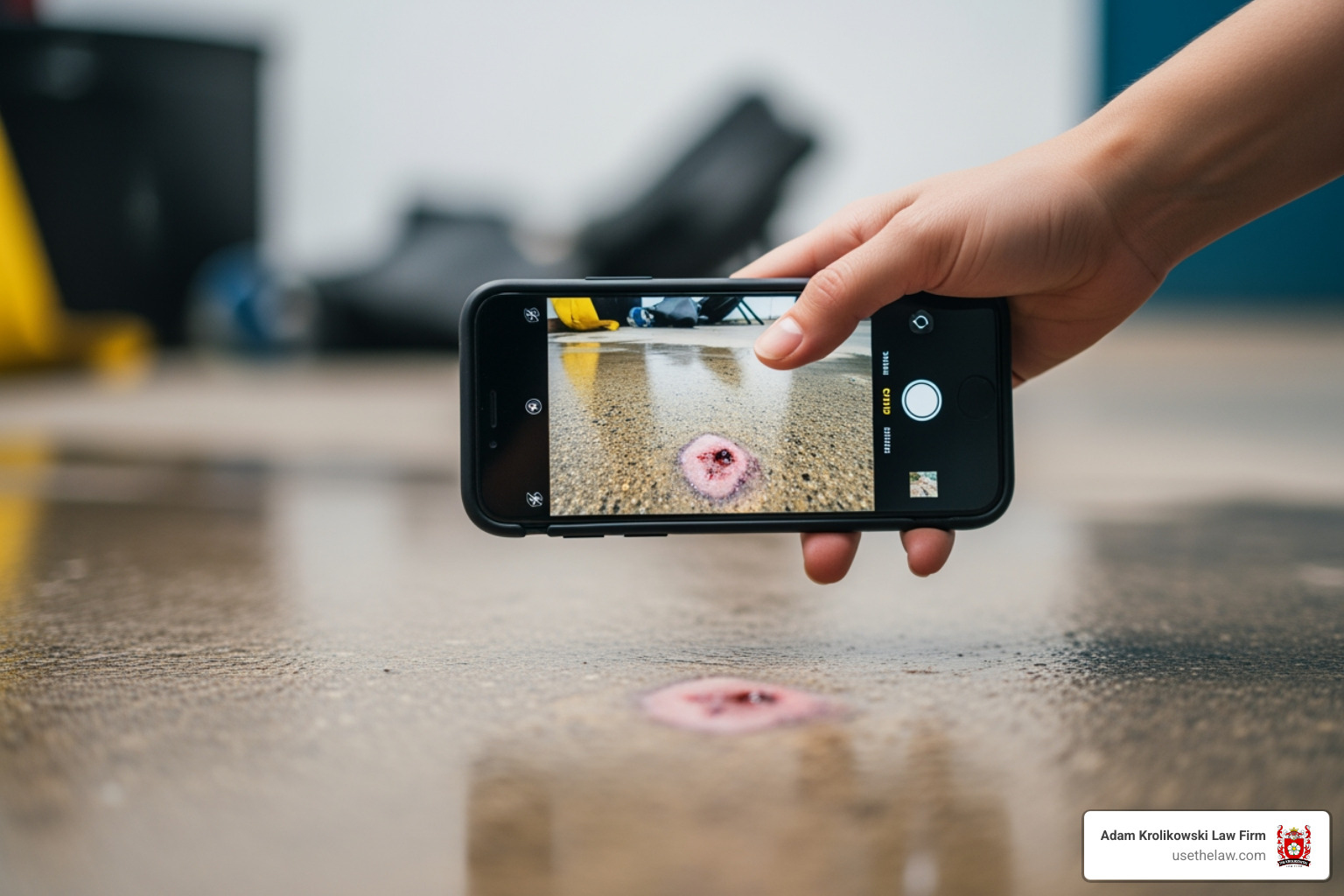
Documentation is absolutely critical. If you’re physically able, take photos and videos of the accident scene. Capture the hazard that caused your fall—the wet floor, the broken step, the dim lighting, whatever it was. Photograph your injuries too. If anyone witnessed what happened, get their names and phone numbers before they leave. Keep the clothes and shoes you were wearing; they might contain important evidence. Save every medical bill, receipt, and any documentation of missed work.
Here’s something many people don’t realize: you should avoid giving statements to insurance adjusters without legal guidance. The property owner’s insurance company will likely contact you quickly, and they’ll sound friendly and helpful. But remember, their job is to pay you as little as possible. Don’t give recorded statements or sign anything until you’ve talked with a santa ana premises liability attorney. You might accidentally say something that undermines your claim.
When to Contact a Santa Ana Premises Liability Attorney
The ideal time to reach out to a santa ana premises liability attorney is right after you’ve received necessary medical care. I know you’re dealing with a lot, but waiting too long can actually hurt your case. You should definitely contact us after receiving medical care, before accepting any settlement offer from an insurance company, when the property owner disputes responsibility, or when your case involves serious injuries or multiple potentially liable parties.
Insurance companies often make quick, lowball settlement offers hoping you’ll accept before you realize what your claim is truly worth. Once you accept and sign, you typically can’t go back and ask for more, even if you find your injuries are worse than you thought.
At Adam Krolikowski Law Firm, we’ve built our practice around handling difficult cases that other attorneys might turn away. With over 25 years of experience, we’re not intimidated by complex premises liability claims or aggressive insurance company tactics. Understanding the benefits hiring personal injury law attorney can help you make the right decision during this stressful time.
The Role of Your Legal Representative
When you work with us, you’re getting more than someone to fill out paperwork. We become your advocate, handling every aspect of your claim so you can focus on healing. We’ll thoroughly investigate your accident, tracking down surveillance footage, interviewing witnesses, reviewing property maintenance records, and consulting with professionals who can support your case.
We’ll gather and organize all the evidence needed to prove your claim, from medical records and bills to documentation of your lost income. Calculating your damages goes beyond adding up your current bills—we work to assess the full extent of your losses, including future medical care, ongoing lost earnings, and the non-economic impacts like pain and suffering.
We’ll handle all communications with the insurance company, protecting you from their tactics and fighting for fair compensation. If they won’t offer a reasonable settlement, we’re fully prepared to file a lawsuit and take your case to court. Our litigation team has decades of combined courtroom experience, and we’re not afraid to go to trial when necessary.
For more on how we provide legal representation personal injury attorney services, we’re here to answer your questions and discuss your specific situation.
Conclusion
When you’re injured on someone else’s property in Santa Ana, it’s easy to feel overwhelmed. But here’s what you need to remember: property owners have a real, legal responsibility to keep their premises safe. It’s not just about being a good neighbor—it’s the law. When they know about a dangerous condition, or when they should know about it, they’re obligated to fix it or warn you. When they don’t, and you get hurt, that’s not just unfortunate—it’s actionable.
Your rights in these situations are substantial. California law recognizes that you deserve compensation for what you’ve been through: the medical bills piling up, the wages you’ve lost while recovering, the pain you’re enduring, and the way your life has been disrupted. Even if you made a mistake that contributed to your accident, you can still recover damages under our state’s comparative negligence system.
But let’s be honest—knowing you have rights and actually exercising them are two different things. Premises liability claims involve intricate legal questions: Did the owner truly breach their duty? Can you prove all four elements of negligence? How do you calculate damages for future medical needs or lost earning capacity? And then there are the insurance companies, who are incredibly skilled at minimizing payouts and shifting blame onto injured people.
That’s where having a santa ana premises liability attorney on your side makes all the difference.
At Adam Krolikowski Law Firm, we’ve spent over 25 years representing accident victims across Santa Ana, Los Angeles, and Orange County. We’ve built our practice on taking cases that matter—including the complicated ones that other firms might turn away. We understand that your injury isn’t just a case number; it’s a disruption to your life, your family, and your future.
Time matters more than you might think. California’s statute of limitations gives you two years from your injury date to file a claim. That might sound like plenty of time, but evidence can disappear, witnesses’ memories fade, and delays can weaken your position. The sooner you reach out, the better we can protect your interests.
If you’ve been hurt on someone else’s property due to their negligence, you don’t have to steer this alone. We’re here to listen to your story, answer your questions honestly, and help you understand your options. Let us handle the legal complexities while you focus on healing. Contact an Orange County personal injury lawyer for a consultation and take the first step toward getting the compensation you deserve.