

CA Sexual Harassment Lawyer: Secure Justice 2025
Why California Workers Need to Know Their Sexual Harassment Rights
Finding the right CA sexual harassment lawyer is crucial for workers facing unwelcome conduct. California offers some of the nation’s strongest legal protections against workplace harassment, but knowing your rights and taking the correct steps is key to securing justice.
Quick Guide to Finding a CA Sexual Harassment Lawyer:
- Document everything – Keep detailed records of incidents, dates, witnesses, and evidence.
- Report internally – Follow company procedures when it is safe to do so.
- Seek legal help immediately – California has a 3-year statute of limitations for filing claims.
- Choose experience – Look for lawyers with a background in California employment law and FEHA cases.
- Know your protections – California’s Fair Employment and Housing Act provides broader coverage than federal law.
Despite growing awareness from movements like #MeToo, sexual harassment remains a significant workplace problem. Many workers suffer in silence, unsure of their rights or fearing retaliation. California law is clear: employers must take all reasonable steps to prevent harassment. When it occurs, you have legal recourse.
This guide covers everything you need to know about sexual harassment law in California, from recognizing harassment to finding the right attorney to fight for you.
Defining Sexual Harassment in the California Workplace
Sexual harassment is not about romance or compliments; it’s about unwelcome conduct that makes you feel uncomfortable, intimidated, or unsafe at work. California law uses the “severe or pervasive” standard to define illegal harassment. This means either a single serious incident or a pattern of smaller ones that create a toxic work environment. If the conduct interferes with your job, it’s a legal problem.
Recognizing the forms of harassment helps you know when a line has been crossed:
- Verbal harassment includes unwelcome sexual advances, crude jokes, or suggestive comments.
- Physical harassment is any unwanted touching, from grabbing to blocking your path.
- Visual harassment involves displaying sexually suggestive images or persistent, objectifying staring.
Importantly, sexual harassment is a form of gender-based harassment. Bullying or intimidation based on your gender identity or sexual orientation can be illegal, even if not explicitly sexual. For more details, see our guide on hostile work environments.
The Two Main Types of Sexual Harassment
The law recognizes two main categories of harassment that every worker should understand.
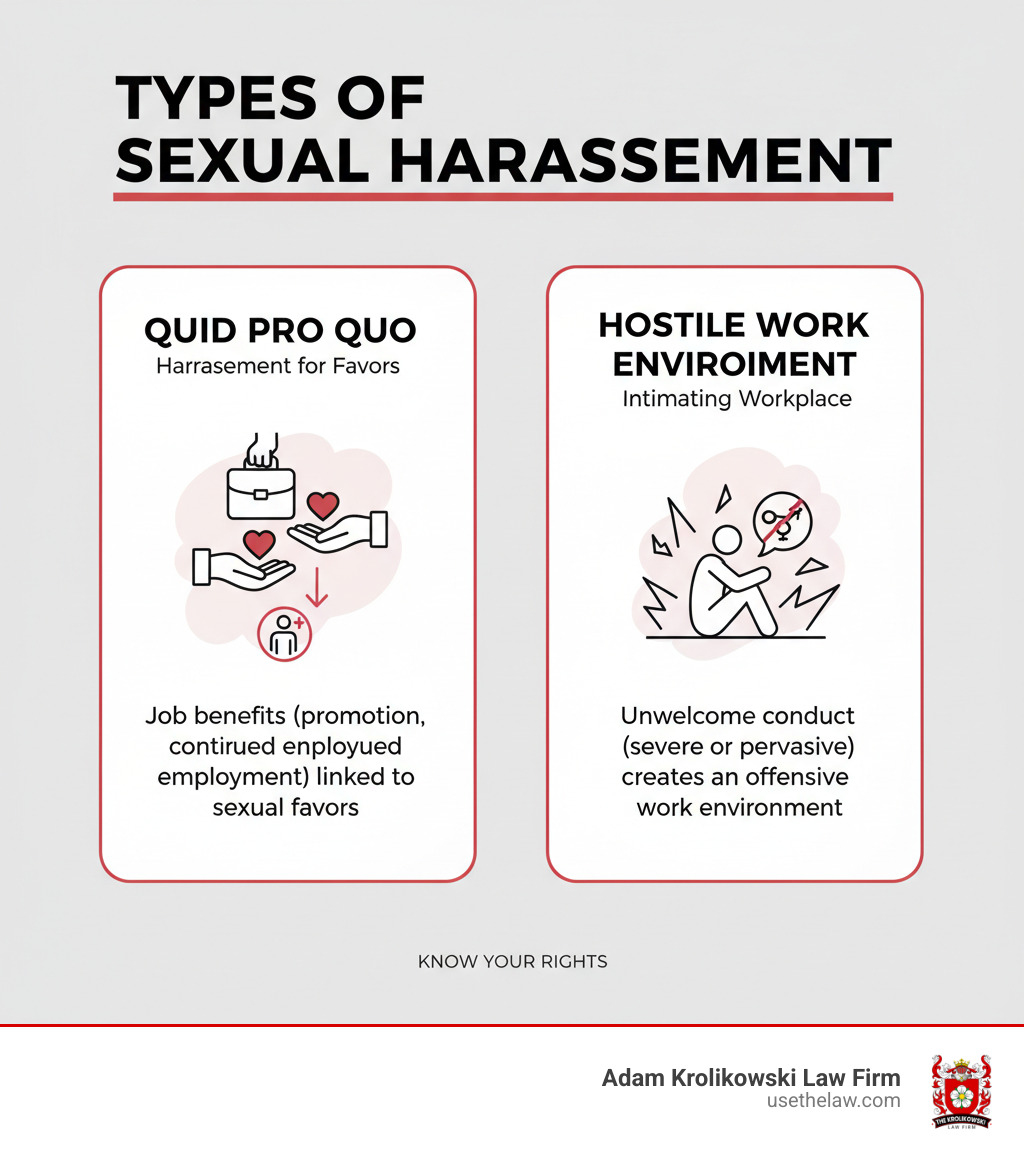
Quid pro quo harassment (Latin for “this for that”) occurs when a person in power demands sexual favors as a condition of your job, a promotion, or other benefits. For example, a supervisor might suggest a promotion in exchange for a date. These demands are illegal whether you accept or reject them.
Hostile work environment harassment creates an intimidating atmosphere through persistent offensive conduct. This can include constant sexual jokes, unwanted touching, or displaying explicit materials. The behavior must be severe or frequent enough to alter your work conditions and create an objectively hostile environment.
Understanding both types helps you recognize the full scope of illegal behavior. If you’re facing broader gender-related issues, our article on gender discrimination offers more insight.
California’s Core Legal Protections
California’s Fair Employment and Housing Act (FEHA) provides broader protections than federal laws. FEHA applies to employers with just five employees (federal law requires 15), so small business employees are protected.
Under California Government Code §12940(j), employers are also responsible for preventing harassment by non-employees. If a client or vendor harasses you and your employer knows but does nothing, they can be held liable. California also has strong anti-retaliation laws, meaning your employer cannot punish you for reporting harassment. A CA sexual harassment lawyer can explain how these protections apply to you. For a full overview of workplace protections, see our guide on discrimination law.
Your Rights and Immediate Steps to Take
If you experience sexual harassment, know that California law provides powerful protections. Taking the right steps now can make a significant difference in your case.

The most critical first step is to document everything. Keep a detailed record of each incident, including dates, times, what was said or done, how it made you feel, and the names of any witnesses. Also, note your reaction, such as telling the person to stop. This documentation is powerful evidence.
Saving evidence is also crucial. Screenshot inappropriate texts, forward harassing emails to a personal account, and save voicemails. Keep all evidence in a safe place outside of work.
Regarding reporting harassment, you have options. You can report to your HR department or supervisor. While California law doesn’t require internal reporting before seeking legal help, it can sometimes resolve the issue and shows you attempted to work within the company’s system.
What to Do if You Experience or Witness Harassment
Your response to harassment can change the outcome. If you feel safe, clearly communicate that the conduct is unwelcome. A firm “That’s inappropriate and needs to stop” can be effective. Document this conversation.
Follow your company’s policy for reporting harassment, and put your complaints in writing to create a paper trail. If you witness harassment, support the victim by letting them know what you saw and that you’re willing to back up their story. Encourage them to report it, but respect their decision.
Contacting a CA sexual harassment lawyer early is often a wise step. An attorney can guide you through your options, even if you haven’t reported the incident internally. You can find an attorney for workplace harassment who understands California’s protections.
Understanding and Fighting Against Retaliation
Fear of retaliation is normal, but California law strictly prohibits it. Illegal retaliation is any punishment from your employer for reporting harassment. This can include termination, demotion, negative performance reviews, unfair schedule changes, or being excluded from meetings.
California’s anti-retaliation laws are among the strongest in the nation. If you face negative treatment after reporting harassment, you may have a separate legal claim for retaliation. Your documentation is vital for establishing the connection between your complaint and the employer’s actions.
You are protected for filing formal complaints, participating in investigations, or even just opposing discriminatory practices. If you believe you’re experiencing retaliation, learn more about your rights regarding workplace retaliation in Los Angeles.
How a CA Sexual Harassment Lawyer Can Secure Justice
When facing sexual harassment, you don’t have to go through the legal battle alone. A skilled CA sexual harassment lawyer can be your strongest ally, guiding you through the complex process of seeking justice.

Harassment cases have legal nuances that require experienced representation. A lawyer can turn your experience into a strong legal strategy by:
- Evaluating your case: An attorney will listen to your story and provide an honest assessment of whether your experience meets the legal threshold for harassment.
- Filing claims: Your lawyer will handle the complex paperwork and deadlines for filing with agencies like the California Civil Rights Department (CRD) and the Equal Employment Opportunity Commission (EEOC).
- Negotiating settlements: Many cases are resolved through negotiation. Your attorney will advocate for fair compensation, so you don’t have to accept a lowball offer.
- Litigating in court: If a trial is necessary, your lawyer will build a compelling case, interview witnesses, and fight for you in court.
Throughout the process, your attorney’s primary role is protecting your rights. For more information on legal support, visit our page on More info about California Employment Law Firms.
The Legal Claim Process in California
California’s legal process has critical deadlines. The statute of limitations gives you 3 years from the last incident to file a lawsuit. However, you must first file an administrative complaint.
You must file with the CRD (formerly DFEH) within one year of the last incident. This step is required before you can sue in court. Many cases are also cross-filed with the federal Equal Employment Opportunity Commission (EEOC), which has a 300-day deadline.
After an investigation, the agency will issue a right-to-sue letter. Once you receive it, you have a limited time to file your lawsuit (typically 90 days from the EEOC or one year from the CRD). A knowledgeable CA sexual harassment lawyer is essential to ensure no deadlines are missed.
What a CA Sexual Harassment Lawyer Helps You Recover
California law allows for comprehensive compensation to address the financial and emotional impact of harassment.
- Lost wages and back pay: Covers income lost due to termination, demotion, or unpaid leave.
- Front pay: Compensates for future lost earnings if your career trajectory has been damaged.
- Emotional distress damages: Acknowledges the real injuries of anxiety, depression, and humiliation.
- Punitive damages: Punishes employers for outrageous conduct and deters future harassment.
- Attorney’s fees: Successful plaintiffs can often recover their legal costs, making it possible to pursue a case without financial strain.
This approach aims to make victims whole again. If wrongful termination was involved, our guide on More info on Wrongful Termination has more information.
Employer Obligations and How CA Law Differs from Federal Law
In California, employers have a proactive duty to prevent harassment. Under Cal Government Code Sec. 12940 (k), they must “take all reasonable steps necessary to prevent discrimination and harassment from occurring,” even if no one complains.
This means employers must have clear anti-harassment policies, provide mandatory training (for companies with 5+ employees), and respond promptly with corrective action when harassment is reported. Once an employer is aware of harassment, they must conduct a thorough, impartial investigation and take steps to stop the behavior.
California’s protections are significantly broader than federal law, which can greatly impact your case.
| Feature | California (FEHA) | Federal (Title VII) |
|---|---|---|
| Applicability | Employers with 5 or more employees (all employers for harassment claims). | Employers with 15 or more employees. |
| Definitions | Broadly defines harassment, including conduct by non-employees (clients, vendors) if the employer knew or should have known. No distinction between quid pro quo and hostile work environment for handling cases. | Defines harassment, generally requiring employer knowledge for non-employee harassment. Distinguishes between quid pro quo and hostile work environment. |
| Employer Duty | Proactive duty to prevent harassment, mandatory training for all employees, and immediate corrective action. | Reactive duty to address harassment once aware, with some preventative recommendations. |
| Damages | Broader range of damages, including emotional distress, punitive damages, and attorney’s fees. | More limited caps on compensatory and punitive damages based on employer size. |
Key differences include FEHA’s coverage of smaller companies (5+ employees vs. 15+) and its rules holding employers liable for harassment by non-employees like clients or vendors if the employer knew and did nothing.
Consequences for Employer Negligence
Employers face serious consequences for failing to prevent or address sexual harassment. This employer liability is what holds them accountable.
Failure to investigate a complaint or conducting a biased, sham investigation can form the basis of a legal claim. An inadequate response, such as a mere warning to the harasser without further action, is also not sufficient under California law.
Legal penalties for negligence can be substantial, including compensating you for damages, civil penalties, and punitive damages designed to punish egregious behavior. A CA sexual harassment lawyer ensures employers are held to their legal obligations. For more on your fundamental protections, see our section on More info on Employee Rights.
Frequently Asked Questions about Sexual Harassment Claims
Dealing with workplace sexual harassment brings up many questions. With over 25 years of experience helping California workers, we’ve answered some of the most common concerns.
Is it hard to prove sexual harassment if there were no witnesses?
While challenging, it is not impossible. Harassment often occurs without witnesses. A strong case can be built using other forms of evidence. Your detailed personal records, such as a journal, are powerful. Emails, texts, and voicemails can show a pattern of inappropriate behavior. A sudden downturn in your performance reviews after reporting harassment can serve as evidence of retaliation. A skilled CA sexual harassment lawyer knows how to find and present this evidence to build a compelling case.
Can I sue if I quit my job because of the harassment?
Yes. If the harassment made your work environment so intolerable that a reasonable person would feel forced to quit, it is known as “constructive discharge.” Legally, this is treated like a wrongful termination. To prove it, you must show your employer created or knowingly allowed the intolerable conditions to persist, causing you to resign. We have 25 years of experience handling these complex cases and know how to fight for the compensation you deserve.
What if the harasser wasn’t my boss or even a coworker?
Under California law, your employer must protect you from harassment by anyone in the workplace, including clients, vendors, or customers. The key is whether your employer knew or should have known about the harassment and failed to take immediate and appropriate corrective action. For example, if you report a client’s inappropriate comments and your manager does nothing, your employer can be held responsible. A CA sexual harassment lawyer can help you hold your employer accountable for failing to provide a safe work environment.
Conclusion
Sexual harassment can make you feel powerless, but remember: you have rights, you have options, and you are not alone. Everyone deserves a workplace free from harassment and fear.

Key takeaways from this guide include the importance of documenting everything, understanding your strong protection against retaliation, and knowing that California law places a heavy duty on employers to prevent and address harassment. Taking action not only seeks justice for you but also helps create safer workplaces for everyone.
At Adam Krolikowski Law Firm, we understand the difficulty of coming forward. With over 25 years of experience in employment law, we have helped countless individuals steer these challenges. We take on complex cases that other attorneys might avoid because we believe everyone deserves strong legal representation.
Our firm serves clients in Orange County and Los Angeles. We are committed to listening to your story with compassion and fighting for the justice you deserve. If you have experienced sexual harassment and need guidance, contact a legal professional to understand your options. The sooner you reach out, the better we can protect your rights.
You deserve to work with dignity and respect. Let us help you make that a reality.
Contact Us
Practice Areas
Recent Articles
- « Previous
- 1
- 2
- 3
- Next »