

The Hidden Dangers of Golf Cart Accidents
A golf cart accident can cause serious injuries or death, often from ejections, rollovers, and collisions. These incidents are rising across the United States, with children making up one-third of all cases. Injuries range from traumatic brain injuries to fractures.
Common causes and key facts about golf cart accidents:
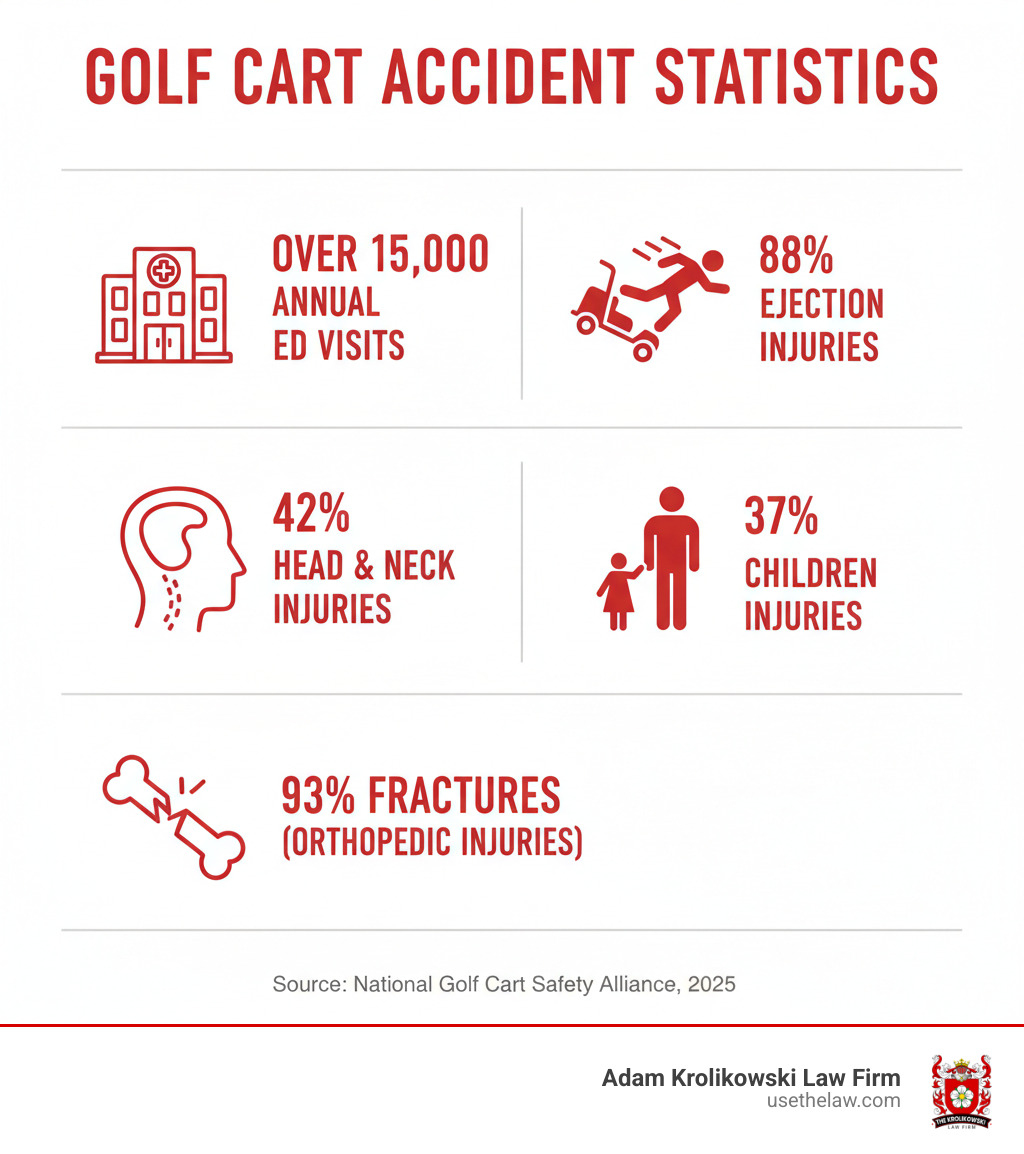
- Ejection is the leading cause of injury (88% of reported cases)
- Sharp turns can throw passengers out at speeds as low as 11 mph
- Children are especially vulnerable, with a median age of 11 years
- Head and neck injuries occur in 42% of cases
- Alcohol is detected in 59% of adult accident victims
- Over 15,000 emergency department visits occur annually in the U.S.
Golf carts are no longer confined to fairways; they are now common in communities, on campuses, and even on public roads. This expanded use has led to a dramatic rise in severe injuries. Research shows golf cart injuries in children are as severe as those from all-terrain vehicles (ATVs), yet many people still view them as safe. This misconception puts passengers at risk.
The numbers are stark. From 2012 to 2021, over 35,000 people visited emergency rooms for golf cart-related orthopedic injuries alone, with fractures accounting for 93% of cases. These are life-changing injuries.
Most golf carts lack basic safety features like seat belts, roll cages, or doors. Their open-air design, rear-facing seats without restraints, and tendency to tip over on uneven ground make them dangerous. When combined with inexperienced drivers or alcohol, the results can be devastating.
Golf cart accident terms to know:
- personal injury lawyer orange county
- santa ana personal injuries lawyer
- santa ana bicycle accidents lawyer
The Sobering Statistics: How Dangerous Are Golf Carts?
Many assume golf carts are safe due to their slow speed, but the statistics tell a different story. As their use expands beyond golf courses into neighborhoods and resorts, injuries have climbed. A golf cart accident is now a common cause of serious harm.
Researchers comparing pediatric injuries from golf carts to all-terrain vehicles (ATVs) found something shocking: golf carts cause injuries just as severe as ATVs, which are widely recognized as dangerous.
Table: Golf Cart vs. ATV Pediatric Injury Statistics (Children)
| Metric | Golf Cart Patients | ATV Patients | P-value |
|---|---|---|---|
| Median Age | 11 years | 12 years | p=0.003 |
| Intracranial Injuries | 34% | 19% | p<0.0001 |
| Overall Injury Severity | 5 | 5 | p=0.27 |
| ICU Admission | 20% | 16% | p=0.24 |
| Immediate Surgery | 11% | 11% | p=0.96 |
| Mortality | 1.7% | 1.4% | p=0.72 |
| Ejection (reported cases) | 88% | N/A | N/A |
| Extremity Injuries | 39% | 56% | p<0.0001 |
This data, from a five-year study, is eye-opening. Children in golf cart crashes had the same overall injury severity scores as those in ATV accidents. They required intensive care, emergency surgery, and died at nearly identical rates.
The Alarming Comparison to ATVs
What’s more concerning is that golf cart patients suffered more intracranial injuries than ATV patients (34% vs. 19%). A vehicle many consider safe is causing more head trauma than a machine known for being dangerous.
The ejection rate is also revealing. In 88% of reported cases, golf cart patients were thrown from the vehicle. Most carts lack seat belts, doors, or roll bars. When a cart tips, turns sharply, or stops suddenly, passengers are ejected—often landing on pavement or hitting their heads. A child can be ejected from a cart going just 11 mph in a sharp turn.
Children at High Risk
One-third of all golf cart accidents involve children, a statistic that should concern every parent. The median age of injured children in the study was just 11. They are ending up in emergency rooms with traumatic brain injuries, skull fractures, and broken bones.
Head and neck injuries account for 42% of all golf cart injuries. For children, these injuries can have lifelong consequences, affecting everything from academic performance to physical coordination. The lack of safety restraints makes children especially vulnerable, as they are smaller and more easily distracted.
Many of these injuries are preventable with simple safety measures like requiring passengers to remain seated and installing seat belts. For more information, you can read about golf cart accident statistics. The message is clear: golf carts are not toys. The risk is real, and the consequences can be life-changing.
Common Causes and Devastating Consequences
The casual appearance of golf carts masks a dangerous reality. Accidents are often the result of specific, predictable behaviors.
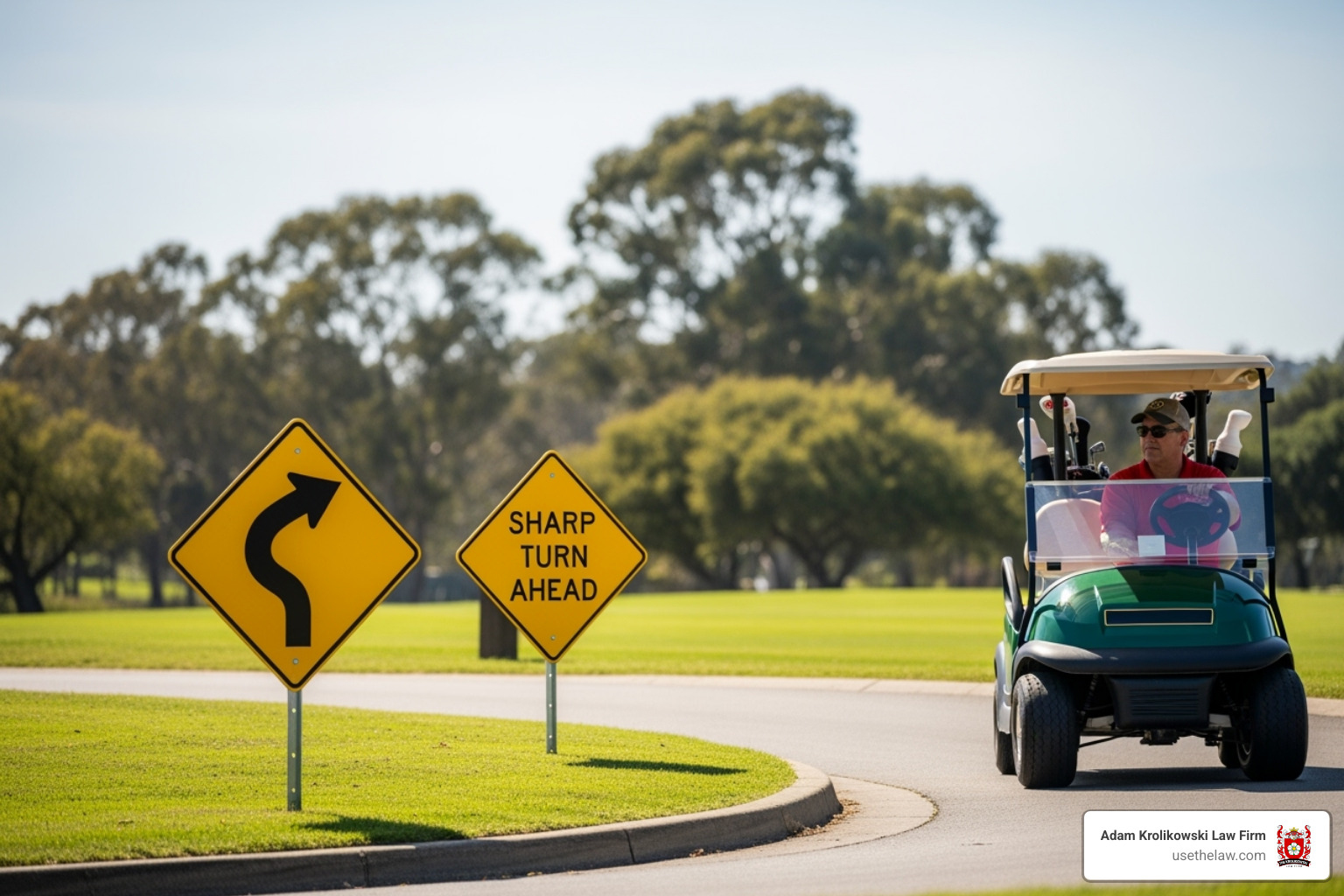
Understanding the Causes of a Golf Cart Accident
Certain patterns emerge when we look at why golf cart accidents happen.
Ejection is the biggest danger. A sharp turn at just 11 mph can be enough to throw an unsecured passenger out. Sudden stops and collisions have the same effect, as most carts lack seat belts and have open sides.
Overcrowding is a hazard. Cramming too many people onto a cart, especially with passengers on rear-facing seats without restraints, is incredibly dangerous.
Inexperienced drivers make mistakes. Many operators lack training and don’t understand how the vehicles handle, especially on turns or hills. Distractions only worsen the risk.
Alcohol dramatically increases risk. Alcohol was detected in 59% of adult golf cart injury victims, with an average BAC more than twice the legal driving limit. Impaired judgment behind any wheel is dangerous.
The terrain matters. Golf carts are designed for flat courses but are now used on hills and unpaved trails. Their high center of gravity makes them prone to tipping over; 20% of injuries involve a rollover.
Simple operational errors cause harm. Reversing downhill can lead to loss of control, and forgetting to engage the brake can let the cart roll away and injure someone.
Collisions are common. Even at low speeds, hitting another cart, a pedestrian, or a car can cause significant injuries.
For more details on what leads to these incidents, our article on common causes of golf cart accidents explores each factor.
The Severe Injuries from a Golf Cart Accident
Injuries from a golf cart accident can be life-changing. Without safety features, passengers are completely exposed.
Head injuries are the most frightening. Traumatic brain injuries and skull fractures occur in 42% of cases. Children are at high risk, with 34% of pediatric injuries involving intracranial trauma. These injuries can affect cognitive function and quality of life for years.
Spinal cord damage can mean permanent disability. Being thrown from a cart or crushed in a rollover can lead to paralysis or chronic pain.
Broken bones are the most common injury. Fractures accounted for 93% of golf cart-related orthopedic ER visits from 2012-2021. Many require surgery and months of physical therapy.
Joints get dislocated from the violent impact of hitting the ground. Shoulders, hips, and knees often bear the brunt.
Amputations can be necessary in cases of severe crushing injuries.
Internal injuries from blunt force trauma can damage organs and cause internal bleeding.
Some accidents are fatal. The death of a 4-year-old in a rollover in Ontario and the incident involving John Elway’s business partner show that these vehicles can kill. The medical bills and financial burdens that follow can be overwhelming, which is why understanding your legal options is so important.
Navigating the Legal Aftermath of a Golf Cart Accident
After a golf cart accident, medical care is the priority. But soon, legal questions arise: Who’s responsible? Can you seek compensation?
The legal landscape for golf carts is complex. They exist in a gray area between cars and toys, and rules vary by location. A key distinction is between criminal and civil liability. Just because no one is charged with a crime doesn’t mean they aren’t civilly responsible for the harm caused.
When No Criminal Charges Are Filed
A high-profile case illustrates this. In 2014, Jeffrey Sperbeck, a business partner of John Elway, died after falling from a golf cart Elway was driving. The coroner ruled the death an accident, and no criminal charges were filed.
However, the absence of criminal charges doesn’t mean there’s no legal recourse. Criminal law punishes wrongdoing, while civil law focuses on compensating injured parties. The standard of proof is also different. Criminal cases require proof “beyond a reasonable doubt,” a high bar. Civil cases only require “a preponderance of the evidence,” meaning it’s more likely than not that negligence occurred.
For golf cart accident victims, this opens paths to compensation. You might file a civil lawsuit for medical bills, lost income, and pain and suffering. If a death occurred, family members can file a wrongful death claim.
Property owners may also be liable. If an accident happened at a country club or gated community, the responsible party’s homeowner’s insurance policy might provide coverage. Unsafe conditions could also lead to a premises liability claim.
Proving negligence requires showing that someone owed you a duty of care, they breached that duty, this breach caused your injuries, and you suffered actual damages. This could involve showing the driver was reckless or that a rental company failed to maintain the cart.
Understanding golf cart accident responsibility is complicated. At Adam Krolikowski Law Firm, we handle complex cases with over 25 years of experience in personal injury law. If you’ve been injured in a golf cart accident, we can help you understand your rights. Visit our personal injury lawyer in Orange County page to learn more. While compensation can’t undo the harm, it can provide financial stability and a sense of justice.
Driving Change: Regulations and Safety Recommendations
The rise in golf cart accidents makes it clear: we need better safety measures and more consistent rules. Currently, the legal landscape is a patchwork of inconsistent state and local laws with major gaps in oversight.
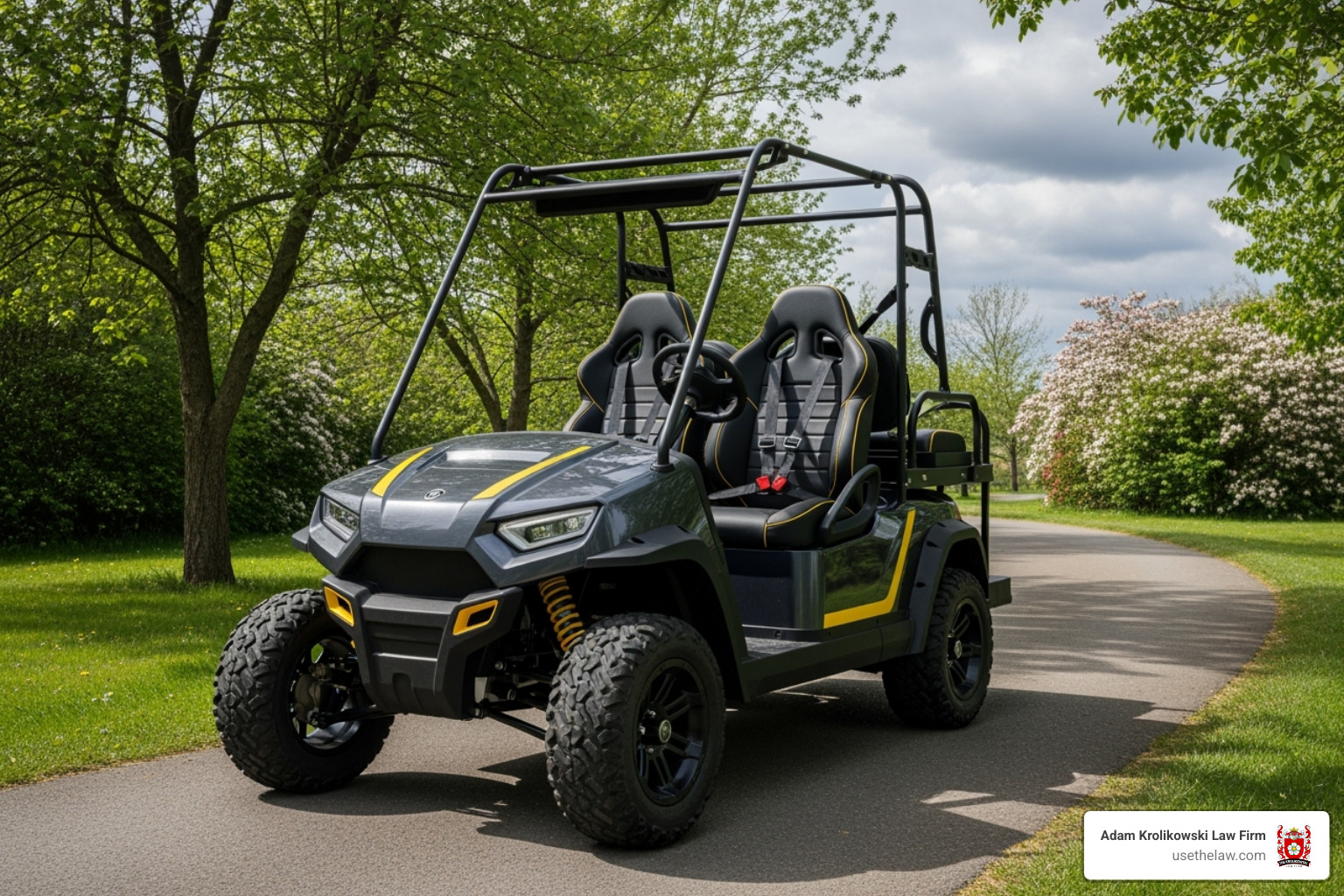
Unlike cars, most golf carts aren’t subject to federal safety standards from the National Highway Traffic Safety Administration (NHTSA) unless they qualify as Low-Speed Vehicles (LSVs). LSVs can go 20-25 mph and must have safety features like headlights and seatbelts. Most standard golf carts fall into a regulatory gray zone.
This creates wildly different laws. Minimum operator age is 13 in some states, 14 in Florida, and 15 in others. When carts are on public roads, the rules are even more varied. While 19 states allow them on roads with 25-35 mph speed limits, only 5 require seatbelts. Laws regarding alcohol impairment are also not as clear or strictly enforced as they are for cars, a major concern since alcohol is a factor in 59% of adult injury cases. We need clear rules similar to those for automobiles, as noted by the Public Health Agency of Canada’s recommendations for preventing injuries.
Essential Safety Measures for Operators and Passengers
With inconsistent regulations, safety is largely up to operators and passengers. Here are the most critical practices:
- Always remain seated while the cart is moving to prevent ejection.
- Wear seatbelts if available, and consider installing them if you don’t have them.
- Adhere to passenger limits to maintain stability.
- Avoid impairment from alcohol or drugs.
- Reduce speed on turns and hills to prevent rollovers and ejections.
- Drive defensively and be aware of your surroundings.
- Lock the brake before exiting the cart.
- Keep all limbs inside the cart at all times.
- Children should never operate golf carts without direct adult supervision.
A Call for Stricter Standards
The data shows we must change how we regulate golf carts.
Mandatory safety features like seatbelts, roll cages, and better brakes should be standard.
Standardized manufacturing would make carts more stable and less prone to rollovers.
Consistent regulations across states would eliminate confusion about age limits, licensing, and on-road use.
Public awareness campaigns are needed to educate people about the real dangers.
If you’ve been injured in a golf cart accident, these regulatory gaps don’t diminish your rights. Our firm has over 25 years of experience helping injury victims with complex cases.
Frequently Asked Questions about Golf Cart Accidents
People often have similar questions after a golf cart accident. The legalities can be confusing since these vehicles occupy a middle ground between toys and cars. Here are some common questions we hear.
Can I be held liable if a passenger falls out of my golf cart?
Yes, you could be held liable. As the operator, you have a duty of care to your passengers. If you were driving recklessly, speeding through turns, or were impaired, you could be found negligent and responsible for their injuries.
However, other factors matter. If the passenger was behaving recklessly, their actions might reduce your liability. If unsafe property conditions contributed to the fall, the property owner could also be partly responsible. Your homeowner’s insurance policy may offer coverage, but policies vary. For more details, you can read our insights on golf cart accident responsibility.
Are there different laws for golf carts on private vs. public roads?
Yes, the rules change dramatically depending on where you are.
On private property like golf courses or gated communities, rules are set by the property owner and are often relaxed.
On public roads, you must follow a maze of state and local traffic laws. These can require a driver’s license, registration, and insurance. If your cart is a Low-Speed Vehicle (LSV) (capable of 20-25 mph), it must meet federal safety standards, including having headlights, taillights, and seatbelts. The rules are inconsistent from one place to the next, so always check your local laws before driving on public roads.
What is the most common injury in a golf cart crash?
The injuries we see are sobering, but certain patterns are clear from the data.
Fractures are the most common orthopedic injury, making up 93% of related ER visits. These broken bones often require surgery and extensive rehabilitation.
Head and neck injuries are also very common, accounting for 42% of all injuries. Traumatic brain injuries are a serious risk, especially for children.
The primary cause of these injuries is ejection. A staggering 88% of reported injuries involve someone being thrown from the cart. Without the protection of an enclosed vehicle, occupants are vulnerable to severe blunt force trauma, spinal injuries, and lacerations. In the worst cases, these accidents can lead to amputations or death.
If you or a loved one has been injured in a golf cart accident, understanding your legal rights is crucial. Our team at Adam Krolikowski Law Firm has over 25 years of experience helping accident victims. Learn more about how a personal injury lawyer in Orange County can assist you.
Conclusion
Golf carts have evolved beyond their original purpose, moving from courses to communities and public roads. This convenience has come at a cost: golf cart accidents are a serious public health issue.
As we’ve discussed, these accidents cause injuries as severe as ATV crashes, including traumatic brain injuries, spinal damage, and even death. Children are particularly vulnerable, accounting for one-third of all victims.
The root of the problem is a collective misconception. We treat golf carts like harmless toys, yet they lack basic safety features like seatbelts and roll cages. This, combined with inexperienced drivers, alcohol impairment, and inconsistent regulations, creates a recipe for disaster. The legal aftermath is also complex, requiring a careful understanding of negligence and liability.
Golf carts are not toys. They are vehicles that demand the same respect and caution as a car. Always stay seated, use seatbelts, never drive impaired, and supervise children closely.
If you or someone you love has been injured in a golf cart accident, you don’t have to face the aftermath alone. The Adam Krolikowski Law Firm has over 25 years of experience with complex personal injury cases. We are here to guide you through the legal process and fight for the compensation you deserve. Learn more from a personal injury lawyer in Orange County who cares about your outcome.
