

Why California Workers Have More Legal Protections Than Most Americans
If you’re searching for a labor lawyer california, you likely face workplace issues that require legal guidance. California offers some of the strongest employee protections in the nation, going far beyond federal requirements to safeguard workers’ rights.
Quick Answer for California Labor Lawyer Search:
- What they handle: Wage theft, discrimination, wrongful termination, harassment, and workplace safety violations
- Common specialties: Employment law, workers’ compensation, class action lawsuits, and retaliation claims
- Typical fees: Most work on contingency (no fee unless you win), with rates ranging from $90-$450/hour when billing hourly
- Key agencies: California Civil Rights Department, Division of Labor Standards Enforcement (DLSE)
- Average settlements: Wrongful termination cases average around $40,000, but can reach millions for severe violations
California’s labor laws create a safety net that protects workers in ways that federal law simply doesn’t. The state requires meal breaks, provides broader discrimination protections, and allows employees to file Private Attorneys General Act (PAGA) claims on behalf of other workers.
“The problems we should face at work should be about professional goals, not dealing with discrimination, retaliation, or other rights violations.”
Understanding your rights isn’t just about knowing the law—it’s about recognizing when they’ve been violated and knowing what to do next.
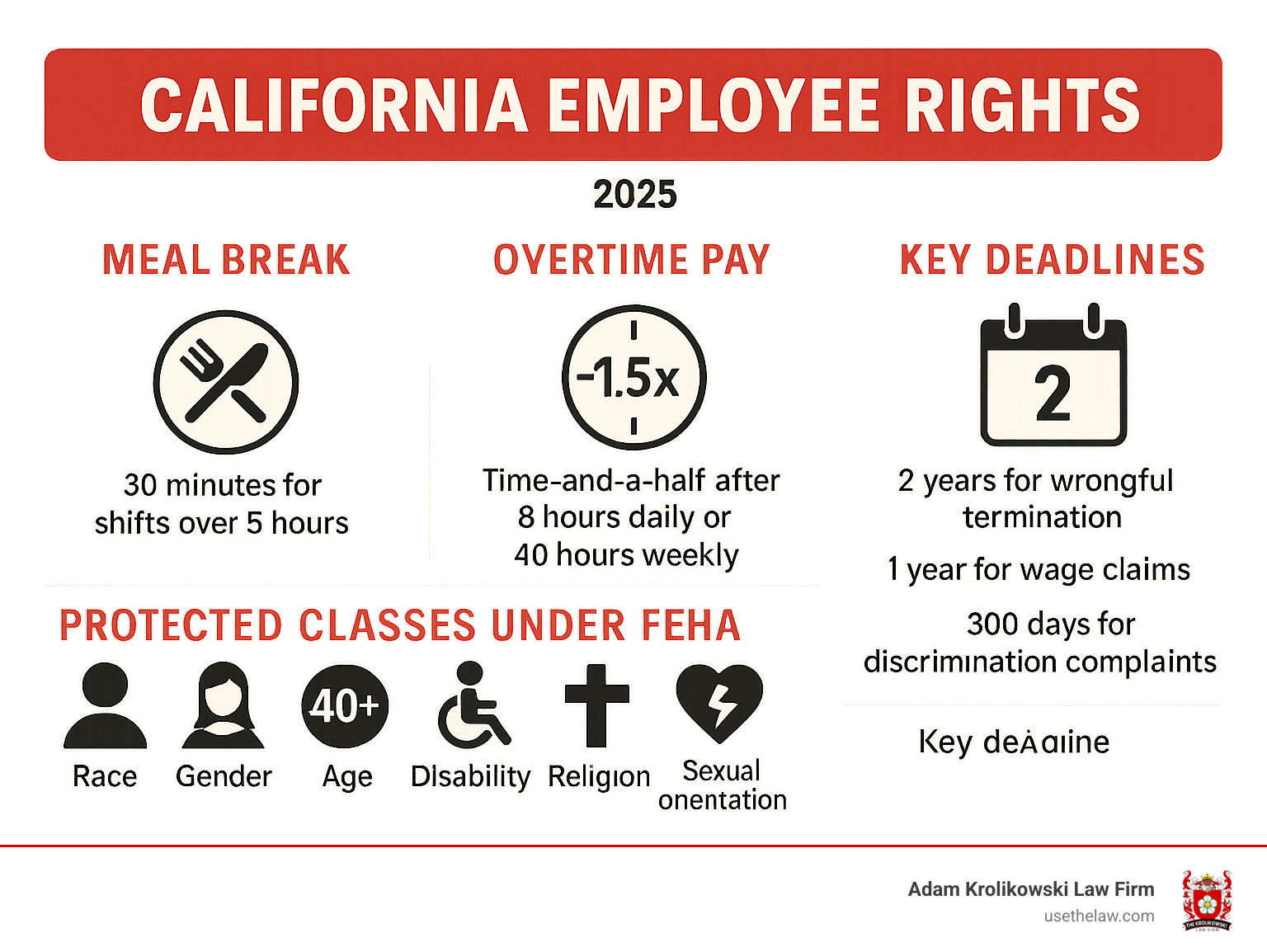
Quick labor lawyer california terms:
Your Fundamental Rights Under California Law
California provides some of the strongest employee protections in the country, building a comprehensive safety net that goes far beyond federal requirements.

At the heart of these protections is the Fair Employment and Housing Act (FEHA), which shields you from discrimination and harassment based on personal characteristics unrelated to your job performance.
While California is an “at-will” employment state, this rule has significant exceptions. Your boss cannot fire you for discriminatory reasons, for blowing the whistle on illegal activities, or for exercising your legal rights. The state also carefully regulates wages, hours, and break times and guarantees your right to a safe workplace.
California vs. Federal Law: Why the Golden State is Different
Federal labor laws often set the minimum standard, but California consistently raises the bar, giving workers stronger protections.
Take a look at some key differences:
| Feature | California Law | Federal Law |
|---|---|---|
| Minimum Wage | Higher than federal minimum, with regular increases | Lower baseline minimum wage |
| Overtime Rules | Time-and-a-half after 8 hours daily and 40 hours weekly; double time after 12 hours daily | Time-and-a-half only after 40 hours weekly |
| Meal Breaks | Mandatory 30-minute unpaid break for shifts over 5 hours | Not required at all |
| Rest Breaks | Mandatory 10-minute paid break every 4 hours | Not required at all |
| Protected Classes | Broader protections including sexual orientation, gender identity, marital status, genetic information | Covers fewer categories |
| PAGA Claims | Employees can sue on behalf of the state for violations | No equivalent law |
One of California’s most unique tools is the Private Attorneys General Act (PAGA). This law allows you to act on behalf of the state when your employer violates labor codes, suing not just for yourself but for other affected workers. PAGA gives individual employees the power to hold companies accountable.
Protected Classes and Anti-Discrimination
California’s FEHA prohibits workplace discrimination based on personal characteristics like your race, gender, age, or disability status. Under FEHA, your employer cannot discriminate against you based on your race and ancestry, color, national origin, religion, sex (including pregnancy), gender identity, sexual orientation, marital status, medical conditions, disabilities, age (if you’re over 40), military service, or genetic information. The law also protects you from retaliation for reporting discrimination.
The need for these protections is real. In 2020 alone, the California Civil Rights Department received over 18,000 reports of workplace discrimination. Disability discrimination accounted for 15% of these reports, while retaliation made up 24% of all employment complaints.
These aren’t just numbers—they represent real people who faced unfair treatment. If you’re dealing with a hostile work environment or harassment, you don’t have to face it alone. More info about California Workplace Harassment Lawyer
Wage, Hour, and Break Regulations
California’s wage and hour laws ensure you are paid fairly and get adequate rest. The state’s minimum wage consistently stays above the federal level.
California’s overtime rules are also more generous. You earn time-and-a-half for hours over 8 in a day or 40 in a week, and for the first 8 hours on a seventh consecutive workday. You get double time for work over 12 hours in a day or over 8 hours on that seventh day.
Meal periods are mandatory. If you work over 5 hours, you get a 30-minute unpaid, uninterrupted break. A second break is required for shifts over 10 hours. You must be completely relieved of all duties.
Rest breaks are also required. You get a paid 10-minute break for every 4 hours worked. When you leave a job, final paycheck laws ensure you get your money quickly, with penalties for employer delays.
These are your legal rights. If your employer isn’t following these rules, a labor lawyer california can help you recover unpaid wages and penalties. More info about Orange County Workers Comp Lawyer
Common Workplace Violations That Warrant Legal Action
Despite California’s robust labor protections, workplace violations are common. Recognizing them early is key to getting the justice you deserve.

If you suspect something is wrong, start documenting everything: save emails, texts, and pay stubs, and write down what happened and when. This paper trail is crucial if you need to prove your case.
Retaliation complaints made up 24% of all employment complaints filed with the California Civil Rights Department, showing that workers who speak up often face payback. California law strictly prohibits this retaliation.
When violations lead to legal action, the results can be significant. The average wrongful termination settlement in California is around $40,000, but cases with serious violations can result in much higher awards.
Wrongful Termination
While California is an “at-will” employment state, there are important exceptions. It is illegal for an employer to fire you for discriminatory or retaliatory reasons.
- Discriminatory Firing: You cannot be fired based on your race, gender, age (over 40), disability, religion, sexual orientation, or other protected characteristic.
- Retaliation: You are protected from being fired for reporting discrimination, filing a wage claim, whistleblowing on illegal activity, taking protected leave, or serving on a jury.
- Constructive Discharge: If your employer creates a hostile work environment to force you to quit (e.g., by cutting hours or demoting you), it can be treated as wrongful termination.
- Breach of Contract: If you have a written or implied employment contract, your employer must follow its terms when ending your employment.
More info about Wrongful Termination Lawyer Los Angeles
Workplace Discrimination and Harassment
Discrimination and harassment create toxic work environments that are illegal in California. Discrimination can include being passed over for promotions, receiving unequal pay, or an employer’s failure to provide reasonable accommodations for disabilities or religious practices.
Harassment is unwelcome conduct based on a protected characteristic that is severe or pervasive enough to create a hostile or intimidating workplace. This includes sexual harassment, which can take two forms:
- Quid Pro Quo: A person in power demands sexual favors in exchange for job benefits or to avoid negative consequences.
- Hostile Work Environment: A pattern of unwelcome sexual conduct, such as inappropriate comments, unwanted touching, or explicit images, makes the workplace feel threatening.
More info about Sexual Harassment Lawyer in Orange County, CA
Wage and Hour Disputes
Wage and hour violations are surprisingly common. If your employer has shortchanged you, a labor lawyer california can help you recover what you’re owed, plus penalties.
- Unpaid Overtime: Failing to pay time-and-a-half for work over 8 hours a day/40 hours a week, or double time for work over 12 hours a day.
- Off-the-Clock Work: Not paying for time spent on work-related tasks before or after your shift, or during meal breaks.
- Employee Misclassification: Incorrectly classifying employees as independent contractors to avoid paying minimum wage, overtime, and other benefits.
- Illegal Deductions: Taking money from your wages for things like cash shortages or damaged equipment without your written consent.
- Tip Pooling Violations: Employers cannot take a cut of employee tips or interfere with lawful tip-sharing arrangements.
The Legal Process: How a Labor Lawyer in California Can Help
Facing workplace violations can feel overwhelming, but you don’t have to do it alone. A labor lawyer california can be your advocate and guide through the legal journey.

The legal process often starts with a consultation to evaluate your case. From there, your claim may go through government agencies like the Division of Labor Standards Enforcement (DLSE) for wage claims or the California Civil Rights Department for discrimination cases. This may lead to a resolution or be the first step before a lawsuit.
Potential outcomes can be life-changing. You may be able to recover:
- Lost wages (past and future)
- Emotional distress damages for anxiety and stress
- Punitive damages to punish employers for outrageous conduct
- Attorney’s fees and costs, meaning the employer often pays your legal bills if you win.
The Role of a California Labor Lawyer in Your Claim
When you hire a labor lawyer california, you gain a strategic partner to steer you through employment law.
- Case Evaluation and Evidence Gathering: We start by digging deep into your situation, examining emails, pay stubs, and company policies to build a strong foundation for your case. We help you identify crucial documentation and use legal tools to uncover evidence.
- Negotiating Settlements: Many cases are resolved through negotiation, which is often faster and less stressful than a trial. We understand what your case is worth and fight to get you the compensation you deserve.
- Court and Arbitration: If a fair settlement isn’t possible, we are prepared to take your case to court or arbitration. We prepare every case for trial, which often encourages better settlement offers.
- Maximizing Compensation: We know how to use California’s unique laws, including statutes that can make your employer pay your legal costs, to dramatically increase your final recovery.
Filing a Claim and Critical Deadlines
Time is not on your side. California has strict deadlines (statutes of limitations), and missing one can permanently bar your claim.
- Discrimination/Harassment: You typically have one year from the last discriminatory act to file with the California Civil Rights Department.
- Wage/Hour Violations: You generally have three years from when the wages were due. Written contracts can extend this to four years.
Once you receive a “right-to-sue” letter from an agency, new deadlines begin. You generally have two years under the California Code of Civil Procedure for wrongful termination based on public policy violations. However, if your termination involved discrimination, you must first file with the Civil Rights Department and then have only one year from your right-to-sue letter to file in court.
To protect yourself, report problems in writing, get medical help for emotional distress, avoid quitting if possible, and never sign a severance agreement without legal review. The sooner you contact a labor lawyer california, the better we can protect your rights. More info about Employee Attorney
Frequently Asked Questions about California Labor Law
When you’re dealing with workplace issues, you probably have a lot of questions running through your mind. We’ve been helping California workers for over 25 years, and these are some of the most common concerns people bring to us.
What does a labor lawyer in California typically charge?
Here’s some good news: most labor lawyer california professionals work on what’s called a contingency fee basis. This means you don’t pay us a dime unless we win your case. It’s that simple.
When we do win, our fee comes as a percentage of whatever settlement or award you receive. This arrangement levels the playing field, allowing you to take on even large corporations without worrying about upfront legal costs.
Some attorneys do charge hourly rates, which can range from $90 to $450 per hour. However, the contingency model is much more common for employee-side representation, and it’s what we typically use at our firm.
What makes this even better is that we often cover all the legal fees, court costs, and even fees for outside professionals ourselves. You don’t have to worry about paying anything out of pocket while we’re fighting for your rights.
Can my employer fire me for complaining about illegal activity?
Absolutely not. California law takes retaliation very seriously, and employers who try to punish employees for doing the right thing face significant legal consequences.
You’re protected when you engage in what the law calls “protected activities.” This includes reporting discrimination or harassment, filing a wage claim with the Labor Commissioner, or acting as a whistleblower about illegal company practices.
If your employer fires you, demotes you, cuts your hours, or makes your work life miserable because you spoke up about illegal activity, you likely have a strong wrongful termination and retaliation claim. The law is firmly on your side in these situations.
We’ve seen employers try all sorts of creative ways to get back at employees who report problems. None of these tactics are legal, and we know how to hold companies accountable for this behavior.
What is the first step if I believe my rights were violated?
The most important thing you can do right now is document everything. This can’t be stressed enough – your documentation often makes or breaks your case.
Keep records of incidents, including dates, times, and witnesses present. Save emails, text messages, and any written communications related to the problem. Hold onto pay stubs, performance reviews, and company policies. If someone said something inappropriate, write down exactly what was said as soon as possible.
Think of yourself as building a story that shows what really happened. The more evidence you have, the stronger your position becomes.
Once you’ve started gathering your documentation, the next step is to contact a labor lawyer california for a consultation. We can review your situation, help you understand your legal options, and give you an honest assessment of your case’s strength.
Don’t wait too long to reach out. California has strict deadlines for filing different types of claims, and we want to make sure you don’t miss any important time limits. The sooner you call, the more options we typically have available to help you.
Most initial consultations are free, so there’s no risk in getting professional advice about your situation.
Conclusion
California provides powerful protections for employees, but having rights on paper is only half the battle. When employers violate the law, the burden falls on you to seek justice. This process can be overwhelming, with strict deadlines to meet and powerful corporate opponents.
You don’t have to face these challenges alone. Too many workers accept unfair treatment because they worry they can’t fight back. That’s where having a labor lawyer california on your side makes all the difference.
At Adam Krolikowski Law Firm, we have spent over 25 years fighting for people like you in Orange County and beyond. We handle complex personal injury, workers’ compensation, and employment law cases that other attorneys might turn away.
We understand that workplace violations affect more than just your paycheck—they can damage your career and your family’s security. Whether you’re dealing with unpaid overtime, harassment, or wrongful termination, we’re here to help you fight back.
The clock is ticking on your rights. California’s labor laws have strict deadlines that can bar you from seeking justice if you wait too long. Don’t let another day pass wondering if you have a case.
If you believe your rights have been violated, contact us today. We can help you understand your options and steer the path toward justice. If you believe your rights have been violated, contact a California Employment Law Firm to understand your options
Contact Us
Practice Areas
Recent Articles
- « Previous
- 1
- 2
- 3