

Why Construction Projects Need Legal Protection
A lawyer for construction handles legal issues across the building industry, from contract disputes and defect claims to workplace injuries and payment problems. Construction law covers everything from project planning through completion, protecting owners, contractors, workers, and other stakeholders when disputes arise.
When you need a construction lawyer:
- Contract review – Before signing agreements to avoid liability exposure
- Payment disputes – When contractors or suppliers aren’t paid
- Construction defects – For structural, electrical, or plumbing problems
- Workplace injuries – To file workers’ compensation or personal injury claims
- Project delays – When timelines and costs spiral out of control
- Mechanic’s liens – To secure payment or defend against claims
Construction is built on deadlines and deliveries, but disputes happen often. The legal issues can be complex, involving multiple parties, technical documents, and strict timelines. In many states, you have as little as two years from finding damage to file a lawsuit.
Corporate entities generally cannot represent themselves in court – they must have legal representation. Even individual property owners benefit from legal guidance, especially when dealing with construction defects, contractor disputes, or workplace accidents.
The stakes are high in construction. Projects range from small home improvements to multi-million dollar developments. Without proper legal support, you risk financial losses, project delays, and unresolved disputes that could have been prevented.
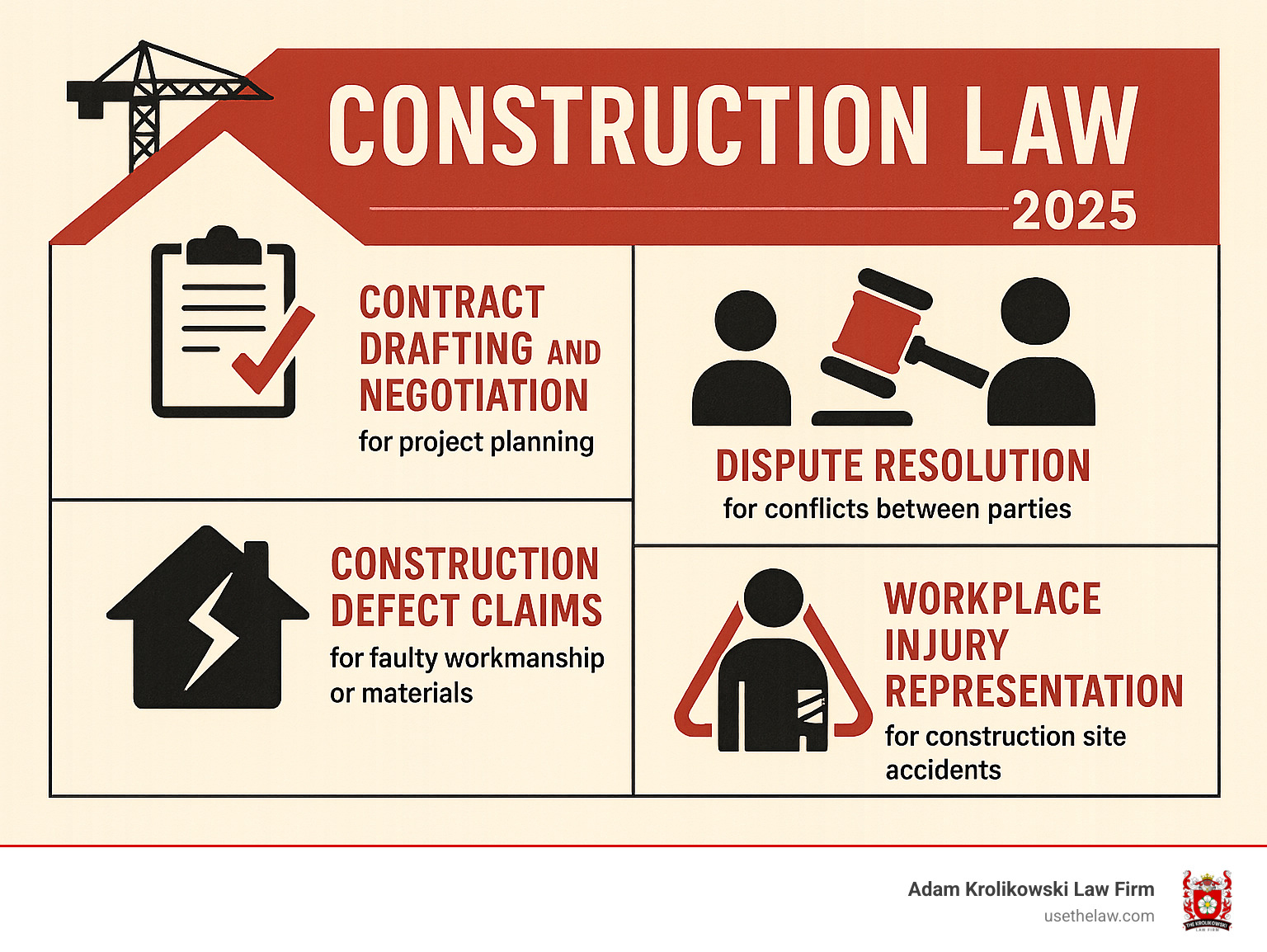
The Scope of Construction Law: Key Issues and Legal Services

Construction law touches every corner of the building industry. From the moment someone breaks ground to the final walk-through, legal issues can pop up at any stage. As a lawyer for construction matters, we help clients steer this complex landscape, managing risks and ensuring everyone follows the rules – whether they’re local building codes or federal safety standards.
Our work starts early in the process. We review contracts before anyone signs them, help with permit applications, and make sure projects comply with regulations. But we’re also there when things go wrong – handling payment disputes, construction defects, and workplace injuries.
The construction industry operates under layers of laws. You’ve got local building codes, state licensing requirements, federal OSHA standards, and environmental regulations. It’s a lot to keep track of, especially when you’re focused on getting a project done on time and on budget.
Proactive Legal Support: Contracts and Risk Management
The foundation of any successful construction project is a solid contract. Before anyone picks up a hammer, we review construction agreements to make sure they protect our clients from unnecessary risks. A well-written contract is like a roadmap – it tells everyone where they’re going and what to expect along the way.
Contract negotiation involves more than just price and timeline. We help clients understand their liability exposure, define the scope of work clearly, and establish procedures for handling change orders. Insurance requirements need to be spelled out, and payment schedules should be fair and realistic.
Risk management goes beyond contracts. Construction sites must comply with OSHA standards to keep workers safe. Building codes vary by location, and permit requirements can be surprisingly complex. We guide clients through these regulatory problems, helping them avoid costly delays and violations.
Change orders are a common source of disputes. When the original plans need to be modified, everyone needs to agree on the new scope, timeline, and cost. Having clear procedures in place prevents small changes from becoming big problems.
We also help with insurance requirements and compliance issues. Construction projects involve multiple parties, and everyone needs appropriate coverage. Getting this right from the start saves headaches later.
For more insights into contracts and compliance, these resources can be helpful:
- Construction Executive: The Best Laid Plans: Contingency in a Construction Contract
- Construction Business Owner: 5 Areas of Compliance to Consider for 2022 Growth
Resolving Conflicts: Disputes, Defects, and Payment Issues
Even with the best planning, construction projects can hit snags. Contractor disputes arise when parties disagree about timelines, costs, or quality of work. Project delays can cascade through a project, affecting everyone involved and potentially leading to significant financial losses.
Payment disputes are unfortunately common in construction. Contractors and subcontractors sometimes don’t get paid on time, or property owners might withhold payment due to perceived problems with the work. Mechanic’s liens provide a legal tool for securing payment, but the rules vary by state and deadlines are strict.
Construction defect claims can be particularly complex. Some defects are obvious right away – we call these patent defects. Others, called latent defects, might not show up for years. These could include structural defects, water damage, or faulty roofing that fails prematurely.
Scope of work conflicts often arise when there’s disagreement about what was actually included in the original contract. Was that electrical work part of the base bid or an extra? These disputes can get expensive quickly if not resolved properly.
When construction defects surface, time is critical. Many states give property owners just two years from finding damage to file a lawsuit. Whether you’re facing a claim or need to make one, having a lawyer for construction matters on your side makes a big difference.
Protecting Workers: A Focus on Construction Site Injuries
Construction sites are inherently dangerous places. Despite safety regulations and training, workplace accidents happen. When they do, injured workers need to understand their rights and options.
Workers’ compensation typically covers medical expenses and lost wages for injured workers. But sometimes, third-party liability comes into play. If someone other than the direct employer contributed to the accident through negligence, additional compensation might be available.
Construction site injury claims can involve various types of accidents. Scaffolding accidents happen when equipment fails or isn’t properly assembled. Crane accidents can be catastrophic, often involving multiple parties. Trench collapses are particularly dangerous and often preventable with proper safety measures.
Employer negligence cases arise when safety standards aren’t followed. This might involve inadequate training, faulty equipment, or failure to follow OSHA regulations. These cases can be complex because they involve technical safety standards and multiple potentially responsible parties.
The key is acting quickly after a construction site injury. Workers’ compensation claims have deadlines, and evidence can disappear from job sites. Getting proper medical attention is the first priority, but legal guidance should follow soon after.
If you or someone you know has been affected by a construction site injury, these resources provide valuable information:
- Construction Accident Lawyer
- Orange County Construction Accident Attorney
- Construction Accident Lawyer in Orange County, CA
- Santa Ana Construction Accidents & Workers’ Compensation Challenges
- Construction Accident Injury Attorney Los Angeles
- Construction Accident Law Firm
- Construction Site Injury Claims
- Construction Accident Law Firm Near Me
- Trench Excavation Accident Lawyer in Orange County, CA
- Trench Collapse Attorney
- Crane Accident Attorney Complete Guide
- Scaffolding Accident Lawyer in Orange County, CA
- Construction Site Injury
- Firefighter Injury Attorney
- Firefighter Workers’ Compensation
- Police & Firefighter Injuries Lawyer
- Police & Firefighter Injuries in Orange County, CA
Who Needs a Lawyer for Construction and When to Hire One
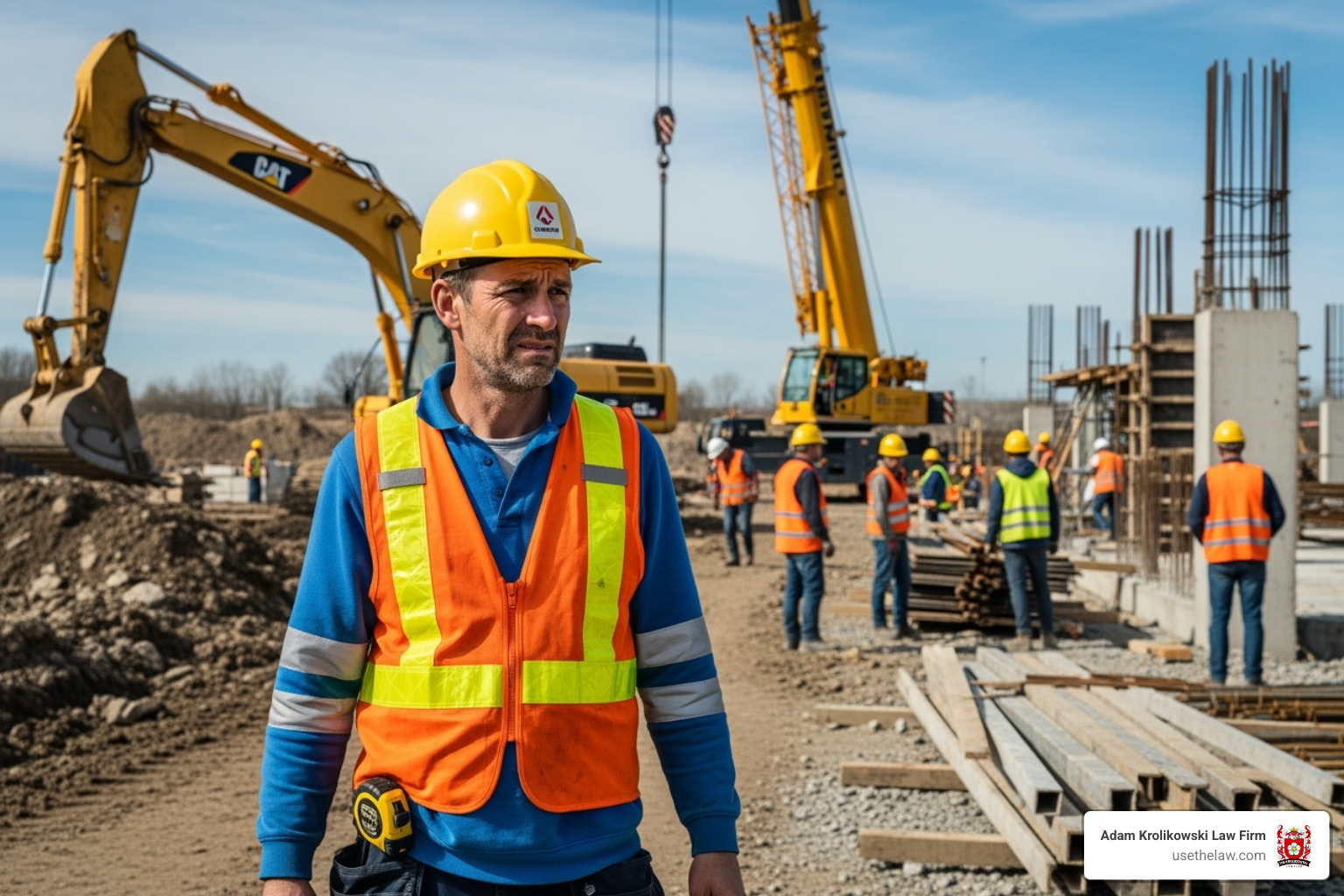
Construction projects bring together many different people and businesses, each with their own interests to protect. When things go wrong – and unfortunately, they often do – having the right legal representation can make all the difference between a minor setback and a financial disaster.
The decision to hire a lawyer for construction usually comes down to three key factors: how complex your situation is, how much money is at stake, and whether you’re facing tight legal deadlines. In construction, these deadlines can be surprisingly short, sometimes as little as two years from when you find a problem.
Here’s something important to know: if you’re a business or corporation, you generally can’t represent yourself in court. You’ll need a lawyer. Even if you’re an individual property owner, the complexity of construction law makes legal guidance invaluable when disputes arise.
Diverse Clientele in Construction Law
Construction touches everyone from the homeowner adding a deck to major developers building shopping centers. That’s why a lawyer for construction works with such a wide variety of clients.
Property owners – both residential and commercial – often need legal help when contractors don’t finish work properly, projects run over budget, or defects appear after completion. Developers face complex zoning laws, permitting requirements, and financing issues that require legal guidance from the very start of a project.
General contractors need legal support for contract negotiations, managing subcontractor relationships, and ensuring they comply with safety regulations and building codes. Subcontractors frequently deal with payment disputes and scope disagreements that can threaten their business if not handled properly.
Material suppliers may need help securing payment or resolving disputes over delivery schedules and product quality. Architects and engineers sometimes face professional liability claims that require defense, while lenders want to protect their investments in construction projects.
Injured construction workers represent another significant group who need legal representation. Construction sites are dangerous places, and when accidents happen, understanding your rights under workers’ compensation laws or potential third-party claims becomes crucial.
Critical Moments to Seek a Lawyer for Construction
Timing matters enormously in construction law. Waiting too long to get legal help can limit your options or even eliminate them entirely due to strict filing deadlines.
Before signing any contract is the most important time to involve a lawyer. A construction attorney can review agreements to make sure they’re legally sound and don’t expose you to unnecessary liability. Getting the contract terms right from the beginning can prevent most disputes later.
When disputes escalate beyond normal project disagreements, legal intervention becomes necessary. Maybe the contractor isn’t following the plans, or payment schedules have broken down. Once communication breaks down and emotions run high, having a lawyer step in can often resolve issues more efficiently than continued arguing.
Findy of construction defects triggers some of the shortest deadlines in law. In many states, you have as little as two years from finding damage to file a lawsuit. Even if you’re trying to work things out directly with the builder, the legal clock keeps ticking. A lawyer can help preserve your rights while you attempt to resolve issues.
Payment disputes happen frequently in construction. Whether you’re a contractor not getting paid for completed work or a property owner facing what you believe are excessive charges, a lawyer for construction can help enforce proper payment terms or defend against improper claims, including complex mechanic’s lien issues.
Workplace injuries require immediate legal attention. Construction site accidents can be severe, and understanding whether you’re limited to workers’ compensation or might have claims against other parties requires legal analysis of the specific circumstances.
Approaching legal deadlines is obviously a critical time to seek help, but ideally you won’t wait this long. If you suspect any legal issues with your construction project, speaking with a construction law attorney early gives you the most options and the best chance of a favorable outcome.
Many attorneys offer free consultations, which allows them to understand your situation and provide initial guidance about your rights and options. This can be invaluable even if you’re not sure whether you need ongoing legal representation.
Navigating Construction Disputes: Litigation and Its Alternatives
When construction disputes happen, you have several paths forward. Think of it like choosing the right tool for the job – sometimes you need a hammer, sometimes a screwdriver works better. While traditional court battles are always an option, they’re often like using a sledgehammer when you really need a precision instrument.
The good news? There are usually faster, less expensive ways to resolve your construction dispute. Understanding these options can save you time, money, and a lot of stress.
Traditional Litigation and Small Claims Court
When someone mentions taking a dispute to court, they’re talking about traditional litigation. This means filing a lawsuit and working through the court system, which can lead to bench trials, jury trials, and potentially appeals down the road. It’s the most formal way to resolve disputes, but it’s also typically the most time-consuming and expensive.
Here’s something important to remember: if you’re a business or corporation, you generally cannot represent yourself in court. You’ll need a lawyer for construction to handle these complex legal proceedings. The rules are strict about this, and courts won’t bend them.
For smaller disputes, you might consider small claims court. These courts are designed to be a more affordable option where individuals can pursue legal action without the full complexity of a traditional civil trial. You’re usually expected to represent yourself in small claims court, which sounds appealing at first.
But here’s the catch – small claims courts have monetary limits that typically range from $2,000 to $25,000, depending on your state. When you think about most construction disputes, whether it’s a payment issue, defect claim, or contractor disagreement, the financial stakes often far exceed these limits. A roof leak that causes water damage or a foundation problem can easily cost tens of thousands to fix.
This means small claims court works well for very minor disagreements, but most construction issues need formal legal representation to handle the complexity and financial impact involved.
Alternative Dispute Resolution (ADR)
Alternative Dispute Resolution, or ADR, offers a middle ground between informal negotiation and full-blown litigation. Think of it as finding a solution that works for everyone without the drama and expense of a courtroom battle.
When direct negotiation between parties breaks down, ADR methods like mediation and arbitration can be incredibly effective. These approaches are often more flexible and less adversarial than traditional litigation.
Mediation brings in a neutral third party to facilitate communication between the disputing parties. The mediator doesn’t make decisions for you – instead, they help guide the conversation toward a mutually agreeable solution. It’s a non-binding process, which means you’re not forced to accept any agreement that doesn’t work for you.
What makes mediation particularly valuable in construction disputes is that it can preserve business relationships. When you’re dealing with contractors, subcontractors, or suppliers you might work with again, maintaining a professional relationship matters. Mediation allows everyone to save face while finding practical solutions.
Arbitration takes a different approach. Here, a neutral third party (or panel of arbitrators) listens to arguments and evidence from both sides, then makes a decision. Unlike mediation, arbitration typically results in a binding decision that’s legally enforceable, much like a court judgment.
Many construction contracts actually include arbitration clauses, requiring disputes to be resolved this way rather than through traditional litigation. This can be beneficial because arbitration is usually faster and more cost-effective than going to court.
Both mediation and arbitration offer significant advantages: they’re typically more cost-effective and time-efficient than traditional litigation. They also provide more privacy and give you more control over the outcome. Instead of leaving your fate in the hands of a judge or jury who may not understand construction industry practices, you’re working with professionals who know the business.
The key is choosing the right approach for your specific situation. Sometimes a quick mediation session can resolve what seemed like a major dispute. Other times, you need the finality that arbitration or litigation provides.
Choosing the Right Construction Lawyer for Your Case
Finding the right lawyer for construction can feel overwhelming when you’re already dealing with a legal issue. The stakes are high, the law is complex, and you need someone who truly understands both the legal side and the practical realities of construction work.
The good news? Taking time to choose carefully now can save you significant headaches and money down the road. Here’s what you should look for and how to prepare for that first important conversation.
Key Qualities to Look For in a Lawyer for Construction
When you’re vetting attorneys, think beyond just their law degree. Construction law touches on everything from contract negotiations to workplace safety, so you want someone who really gets the industry.
Look for relevant experience and industry knowledge first and foremost. Some attorneys have actually worked in construction before practicing law – as contractors, tradespeople, roofers, carpenters, or real estate developers. This hands-on background gives them insights that purely academic lawyers might miss. When your lawyer for construction understands why certain building techniques are used or how job sites actually operate, they can build stronger cases and give more practical advice.
Find someone with the right focus for your specific situation. Construction law covers a lot of ground, and many attorneys concentrate on particular areas. Some primarily represent contractors, others focus on homeowners, and still others handle mainly workplace injuries. If you’re dealing with a construction defect, you want someone who has handled similar defect claims. If you’re an injured worker, seek out an attorney experienced with workers’ compensation and construction site accidents.
Communication matters more than you might think. Your attorney should explain legal concepts in plain English, not legal jargon that leaves you more confused. They should return your calls promptly and keep you updated as your case progresses. You’re already stressed about your legal issue – you don’t need the added worry of wondering what’s happening with your case.
Local knowledge is crucial because construction law varies significantly by location. An attorney familiar with Orange County or Los Angeles regulations, local courts, and regional construction practices will steer your case more effectively than someone from across the country. They’ll know which judges prefer mediation, which local contractors have good reputations, and how local building departments typically handle disputes.
Be upfront about fee structures and billing options from the start. Some attorneys work on contingency fees (they only get paid if you win), others charge hourly rates, and some offer flat fees for certain services. Understanding the costs upfront prevents unpleasant surprises later.
Preparing for Your Initial Consultation
Walking into your first meeting with a lawyer for construction well-prepared makes a huge difference. The more organized information you bring, the better they can assess your situation and give you useful advice.
Start by gathering all your documents. This includes every contract related to your project – prime contracts, subcontracts, purchase orders, and any change orders. Don’t forget correspondence like emails, letters, and text messages. These communications often reveal crucial details about what went wrong and when.
Visual evidence tells a powerful story, especially for construction defect claims or workplace injuries. Bring photographs or videos of the problem areas, damaged work, or accident scenes. If you don’t have photos yet, take some before your meeting.
Timeline documentation helps your attorney understand the sequence of events. Gather project schedules, progress reports, inspection records, and any documentation showing delays or missed deadlines. Payment records are equally important – invoices, receipts, lien waivers, and records of what’s been paid and what’s still owed.
If you’ve received any official notices – like notices of claim, notices of default, or legal summons – bring those immediately. These often have strict response deadlines that could affect your case.
Before your meeting, create a simple timeline of what happened, when it happened, and who was involved. You don’t need a legal brief, just a chronological summary that helps you tell your story clearly.
During your consultation, ask the questions that matter most to your situation. Find out about their fees and billing options, their experience with cases like yours, and what legal services they offer. Ask about your legal options and potential outcomes. Is a lawsuit your best bet, or might mediation or arbitration work better? What are the likely costs and timelines? How will they keep you informed throughout the process?
This preparation helps the attorney evaluate your case efficiently and discuss realistic strategies for moving forward. Most importantly, it helps you make an informed decision about whether this lawyer for construction is the right fit for your specific needs.
Conclusion
Building something great takes more than hammers and hard hats – it takes solid legal protection too. Throughout this guide, we’ve explored how a lawyer for construction serves as your safety net in an industry where million-dollar projects can turn into costly nightmares overnight.
The smart approach? Proactive legal strategy. Getting your contracts reviewed before you sign them, understanding your insurance requirements, and knowing the rules upfront can save you from headaches down the road. Think of it like wearing a hard hat – you don’t wait until something falls on your head to put it on.
But even with the best planning, disputes happen. Materials arrive late, work doesn’t meet standards, or someone gets hurt on the job. When these situations arise, having legal counsel who understands both the law and the construction industry makes all the difference. We’ve seen how dispute avoidance through clear contracts and good communication can prevent many problems, but when conflicts can’t be avoided, you need someone in your corner who knows how to fight for your rights.
Protecting your rights means understanding the complexity of construction law. From OSHA safety standards to mechanic’s lien deadlines, from workers’ compensation claims to construction defect lawsuits – there are countless legal landmines waiting for the unprepared. The timelines are often shorter than you’d expect, and the stakes are usually higher than you’d like.
Navigating this complexity requires more than just legal knowledge – it takes real-world understanding of how construction projects actually work. That’s why our team combines legal training with hands-on industry experience, giving us insight into both the courtroom and the job site.
For issues involving construction site injuries in Orange County, the team at Adam Krolikowski Law Firm has over 25 years of experience handling complex claims. We understand that construction accidents can change lives in an instant, and we’re committed to helping injured workers and their families get the compensation they deserve.
Whether you’re dealing with a contract dispute, fighting a defect claim, or recovering from a workplace injury, you don’t have to face these challenges alone.
Get help from a Construction Accident Lawyer in Orange County, CA
