

Why Trench Accidents Demand Immediate Legal Action
A trench accident lawyer helps construction workers injured in excavation collapses secure compensation. By investigating the accident, identifying all liable parties (contractors, property owners), and calculating full damages, they can pursue workers’ compensation claims and third-party lawsuits for medical expenses, lost wages, and pain and suffering.
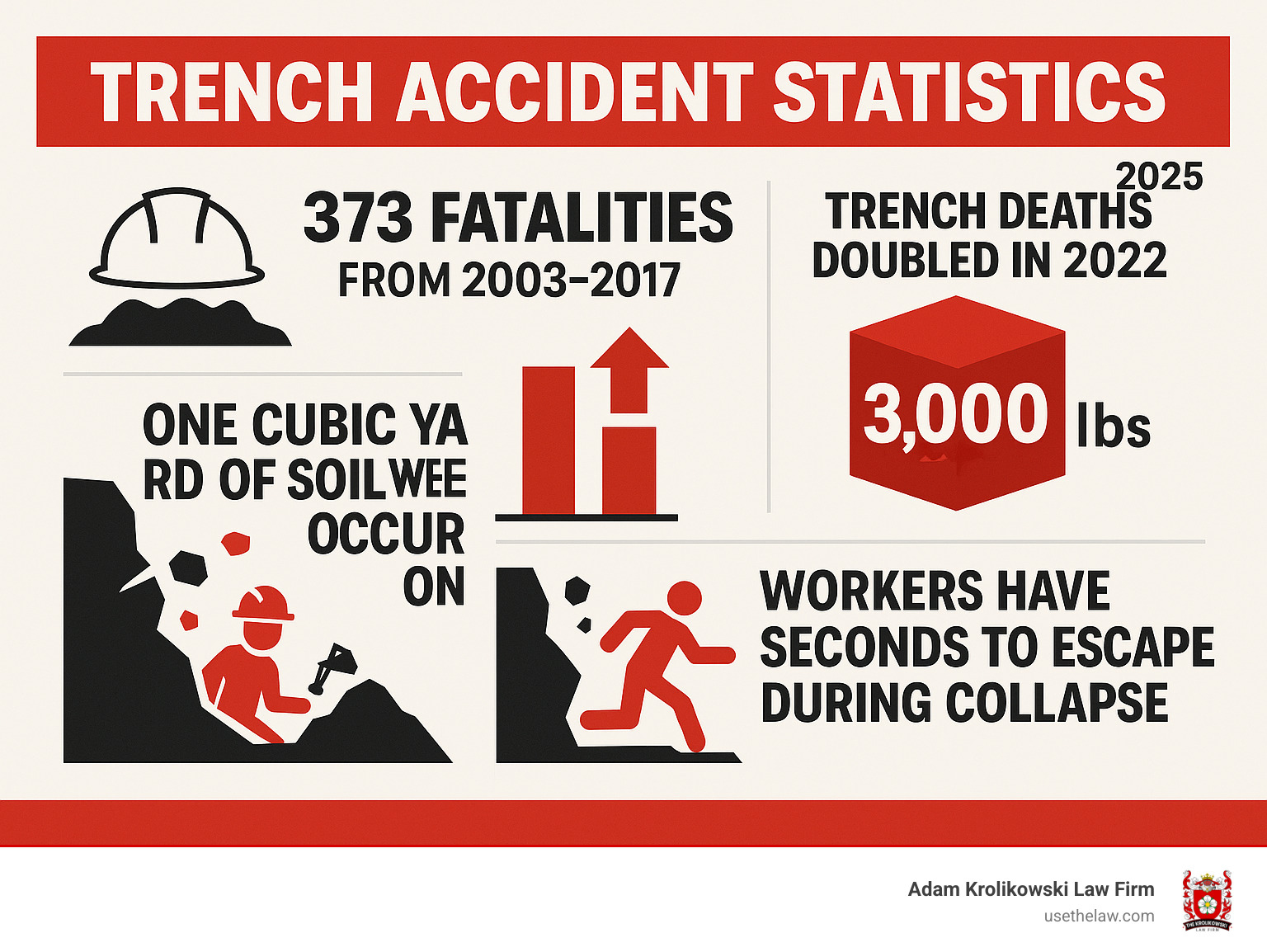
Construction trenches are incredibly dangerous. Statistics show that trench-related fatalities doubled in 2022, reaching the highest rate in 18 years, with at least two workers dying each month. The danger is severe, as one cubic yard of soil weighs up to 3,000 pounds, and a collapse can happen in seconds. Over 80% of these fatalities occur on construction sites.
When trenches collapse, workers suffer devastating consequences like suffocation, crush injuries, and traumatic brain or spinal cord damage. These accidents are often preventable and occur when employers neglect OSHA-mandated safety measures like shoring, sloping, or trench boxes.
If you’ve been injured in a trench collapse, time is critical. California has a strict statute of limitations for filing claims, and evidence at the scene can disappear quickly. Seeking legal help immediately is crucial.
Trench accident lawyer glossary:
Understanding the Dangers: Causes and Consequences of Trench Collapses
Trench collapses happen in seconds, but their devastating results are often preventable. Thousands of pounds of earth can give way, trapping workers with little chance of escape. The primary threat is soil instability, where soil composition, moisture, and vibrations from equipment can turn a worksite into a death trap.
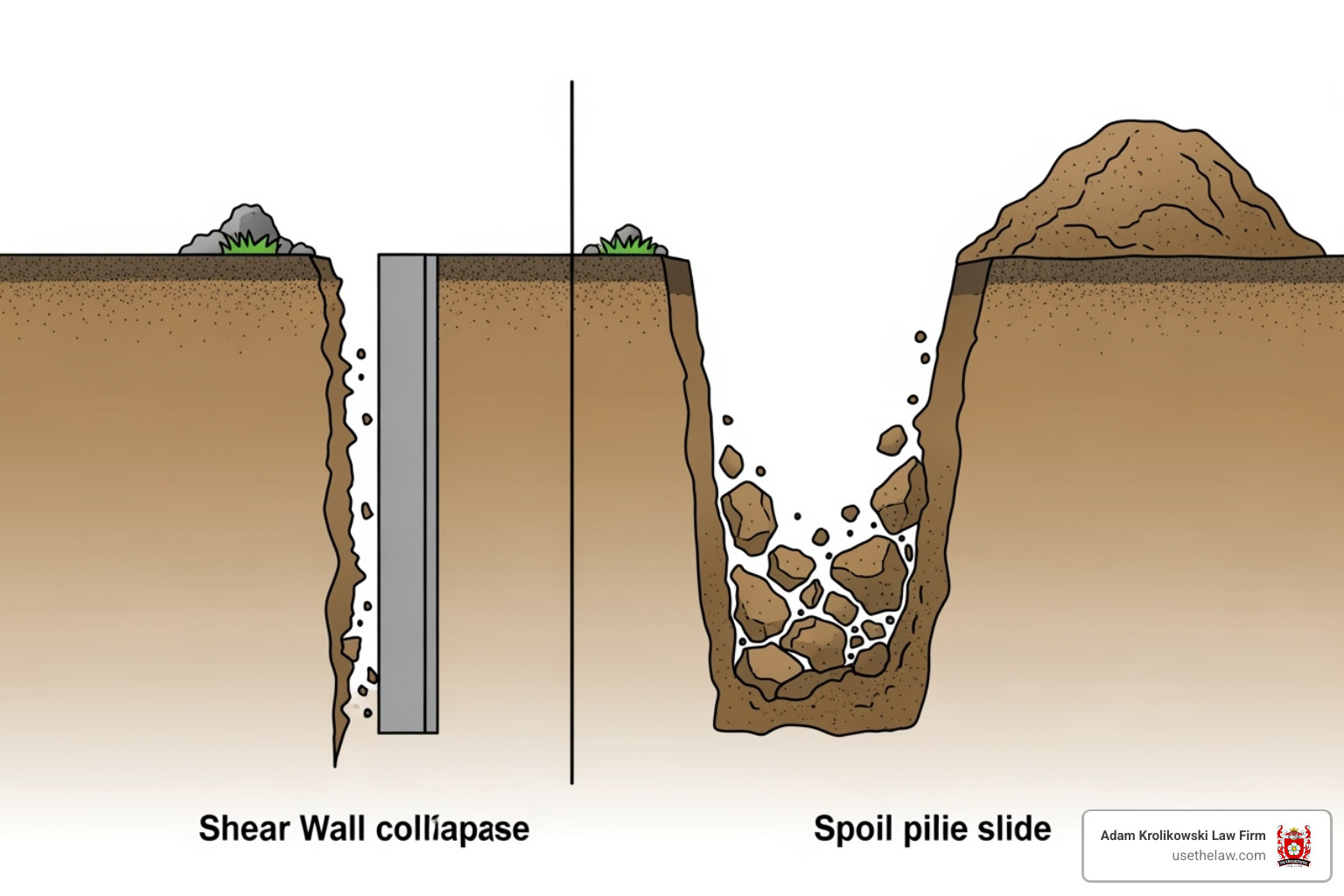
Common collapse types include a shear wall collapse, where a vertical section slides down, and a spoil pile slide, where excavated dirt piled too close to the edge falls back in. Both can occur without warning, often triggered by heavy equipment vibrations or water accumulation that weakens the soil. When companies use inadequate protective systems or skip proper inspections, they put lives at risk.
The human cost is immense. Workers face asphyxiation when buried, severe Crush injuries that shatter bones and damage organs, and spinal cord damage leading to paralysis. Survivors often endure internal injuries requiring extensive recovery and significant psychological trauma, including PTSD.
Common Causes of Excavation Accidents
A trench accident lawyer often finds that collapses stem from the same dangerous shortcuts. Key causes include:
- Unprotected trench walls: Failure to use shoring, sloping, or trench boxes.
- Failure to test soil: Different soil types require different safety measures.
- Negligent supervision: No qualified person on-site to identify hazards.
- Improperly placed spoil piles: Piling excavated dirt closer than two feet from the trench edge adds weight and a slide risk.
- Failure to follow OSHA guidelines: Ignoring these life-saving requirements to save time or money.
- Lack of worker training: Workers are not taught to identify hazards or follow safety procedures.
Devastating Injuries Sustained in Trench Cave-Ins
The violence of a collapse leads to severe or fatal injuries. Suffocation is the leading cause of death. Traumatic brain injuries and Concussions can cause lasting cognitive problems. The immense weight can break bones, sometimes requiring amputations, and cause internal injuries that necessitate emergency surgery. These injuries create enormous financial and emotional burdens on families. If you’ve suffered a Construction Site Injury in a trench collapse, understanding your legal rights is the first step toward recovery.
Safety Regulations and Determining Liability
The construction industry is governed by strict safety rules, primarily from the Occupational Safety and Health Administration (OSHA), designed to prevent trenching accidents. A key OSHA rule is the “competent person” requirement. This individual must be on-site, trained to identify trench hazards, and have the authority to stop work if unsafe conditions arise.
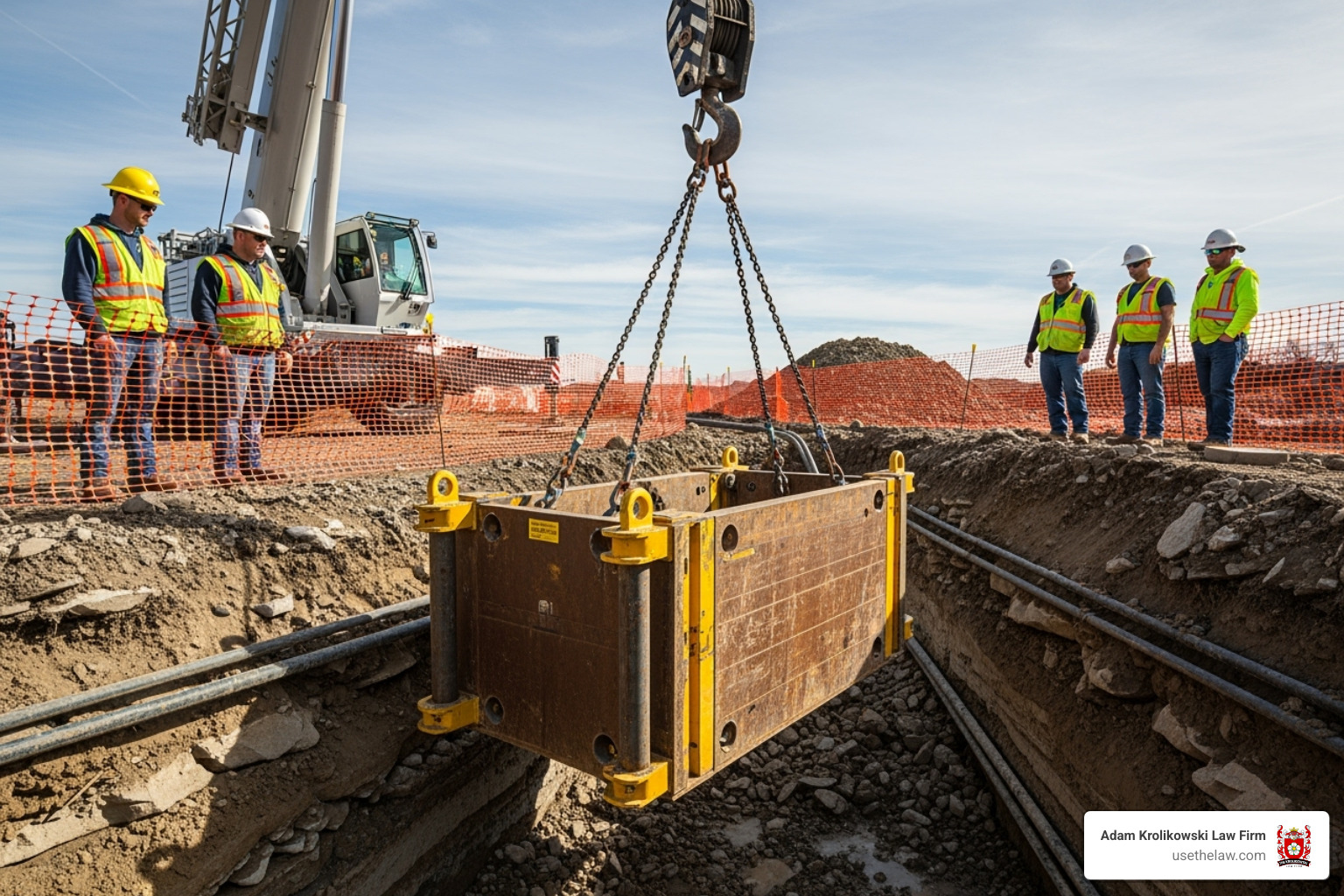
OSHA mandates three primary protective systems: shoring (supports to hold walls in place), sloping (cutting walls back at a safe angle), and shielding (using trench boxes to protect workers). These are not optional.
Who Can Be Held Liable for a Trench Accident?
Determining liability is complex because multiple parties are often involved. A trench accident lawyer investigates to identify every party whose negligence contributed. Liable parties may include:
- General contractors: They have overall responsibility for site safety.
- Subcontractors: They are directly liable for the safety of their excavation work.
- Property owners: They may be liable if they knew of hazards on their property and failed to warn contractors.
- Engineers and architects: They can be held responsible for flawed excavation designs.
- Equipment manufacturers: They are liable if defective trench boxes, shoring, or other equipment contributed to the collapse.
Understanding Liability Personal Injury Cases is key to securing full compensation by holding all responsible parties accountable.
OSHA’s Mandated Safety Measures
OSHA’s regulations (29 CFR 1926.651) are non-negotiable. Key requirements include:
- Trench inspections: A competent person must inspect trenches daily and after any event that could increase risk, like a rainstorm.
- Safe entry and exit: For trenches four feet or deeper, a ladder, ramp, or other exit must be within 25 feet of any worker.
- Cave-in protection: This is mandatory for trenches five feet or deeper. For trenches over 20 feet deep, a registered professional engineer must design the protective system.
- Material placement: Excavated soil, tools, and equipment must be kept at least two feet from the trench edge to prevent collapses.
When these rules are broken, California Workplace Safety Violations Impact Workers Comp Claims, and injured workers need legal help to hold negligent parties accountable.
Your Legal Pathways After a Trench Accident
If you’re hurt in a trench accident, you have legal options to help you recover. The two main pathways are workers’ compensation claims and third-party lawsuits. Understanding the difference is the first step toward securing the compensation you deserve.

Time is a critical factor. Filing deadlines, or statutes of limitations, are strict. Missing them can mean losing your right to compensation forever, which is why contacting a trench accident lawyer quickly is vital.
Workers’ Compensation vs. Third-Party Claims
Workers’ compensation is a no-fault system that provides immediate medical care and partial wage replacement. You can receive these benefits even if you were partially at fault. However, in exchange, you generally cannot sue your employer directly, and you cannot recover damages for pain and suffering.
Third-party claims are lawsuits against negligent parties other than your employer, such as the general contractor, a subcontractor, or an equipment manufacturer. These claims require proving fault but allow you to seek much more comprehensive compensation, including for pain and suffering and your full lost wages. You can often pursue both types of claims at the same time.
| Feature | Workers’ Compensation | Third-Party Lawsuits |
|---|---|---|
| Fault Required | No – benefits provided regardless of who caused the accident | Yes – must prove another party’s negligence caused your injuries |
| Medical Coverage | Covers all reasonable medical expenses related to your injury | Can recover full medical costs, including future care needs |
| Wage Replacement | Typically pays about two-thirds of your average weekly wage | Can recover 100% of lost wages and future earning capacity |
| Pain & Suffering | Not covered | Fully compensable, often the largest component of damages |
| Who You Can Sue | Cannot sue your employer (with rare exceptions) | Can sue general contractors, subcontractors, property owners, equipment manufacturers |
| Timeline | Benefits can begin within weeks of filing | Can take months or years to resolve, but results in larger settlements |
Navigating these options is complex. For more insight, see Workers Compensation vs Personal Injury Claims Decision Making in Santa Ana.
Compensation and the Statute of Limitations
Compensation is divided into economic and non-economic damages.
Economic damages cover calculable financial losses. This includes all past and future medical expenses, lost wages, and loss of earning capacity if your injuries prevent you from returning to your previous job.
Non-economic damages address the human cost of your injuries, such as pain and suffering, emotional distress, permanent scarring or disfigurement, and loss of enjoyment of life. In fatal accidents, surviving family members can file wrongful death claims for funeral costs, lost financial support, and loss of companionship.
Be aware of California’s statute of limitations. You generally have two years from the injury date to file a personal injury or wrongful death lawsuit. For workers’ compensation, you must notify your employer within 30 days and file a claim within one year. These are hard deadlines. Understanding California’s statute of limitations is crucial, as waiting too long can mean losing your rights forever.
The Role of a Trench Accident Lawyer
After a trench collapse, you face serious injuries, medical bills, and an uncertain future. Navigating the legal system or fighting with insurance companies shouldn’t be your burden. A trench accident lawyer can manage these complexities for you.

Construction accident cases are complicated, often involving multiple parties and technical safety regulations. Evidence can disappear quickly from a job site, so getting legal help promptly is essential to protect your rights.
Immediate Steps for Injured Workers
What you do right after a trench collapse can significantly impact your case. Follow these steps:
- Get medical help immediately. Adrenaline can mask serious injuries, and medical records create a clear timeline.
- Report the accident to your supervisor as soon as possible, preferably in writing.
- Document the scene. If you can, take photos of the collapsed trench, equipment, and your injuries.
- Get contact information from witnesses. Their accounts can be vital.
- Do not speak with insurance adjusters alone. They work for the insurance company, not you. It is best to say, “I need to speak with my lawyer first.” Knowing When to Contact a Personal Injury Law Attorney can prevent costly mistakes.
How a Knowledgeable Trench Accident Lawyer Can Help
A lawyer does more than file paperwork; they become your advocate and investigator. They will:
- Investigate the accident by visiting the site, interviewing witnesses, and consulting with engineering experts.
- Preserve crucial evidence before it is lost or destroyed.
- Identify all responsible parties, including contractors, property owners, and equipment manufacturers, to maximize your chances of full compensation.
- Calculate the full value of your case, including future medical costs, lost earning capacity, and pain and suffering.
- Handle all negotiations with insurance companies, who are trained to minimize payouts.
- Take your case to court if a fair settlement cannot be reached.
The Benefits Hiring Personal Injury Law Attorney include having an experienced professional manage the legal fight while you focus on recovery.
Why You Need a Trench Accident Lawyer Promptly
Waiting to hire a lawyer can jeopardize your case. Legal deadlines are strict; miss them, and you lose your right to compensation. Insurance companies have teams of professionals working against you, and a lawyer levels the playing field. Early legal action helps secure your financial future by starting the process of building a strong case immediately. A Construction Accident Law Firm with a track record in these complex cases can guide you through the process and fight for the outcome you deserve.
Frequently Asked Questions about Trench Accident Claims
After a trench accident, it’s normal to have questions about your legal rights. Here are answers to some of the most common ones.
Can I sue my employer if I get workers’ compensation benefits?
Generally, no. The workers’ compensation system operates under an “exclusive remedy” rule. This means that in exchange for no-fault medical and wage benefits, you give up the right to sue your direct employer for negligence.
However, this rule does not prevent you from filing a third-party lawsuit against other negligent parties. In trench accidents, this could be the general contractor, a different subcontractor, the property owner, or an equipment manufacturer. A trench accident lawyer can help identify these parties. A third-party claim is crucial because it allows you to recover damages for pain and suffering, which workers’ comp does not cover. In rare cases of intentional harm by an employer, a direct lawsuit may be possible.
How much does it cost to hire a lawyer for my case?
Most personal injury lawyers work on a contingency fee basis. This means you pay no upfront fees. The lawyer covers all costs of investigating and pursuing your case. They only get paid if you win a settlement or verdict. Their fee is a pre-agreed percentage of the total recovery. This arrangement allows injured workers to get quality legal help without financial risk.
How long will my trench accident lawsuit take?
The timeline for a trench accident case varies. Some cases resolve in months, while others can take a year or more. Factors that influence the duration include:
- Case complexity: Cases with multiple defendants or complex safety violations take longer to investigate.
- Severity of injuries: It’s often best to wait until you reach “maximum medical improvement” to understand the full extent of your damages before settling.
- The negotiation process: A case may settle quickly if the insurance company is reasonable, or it may take longer if they dispute liability or damages.
- Trial: If a fair settlement isn’t offered, taking the case to trial will extend the timeline.
Your lawyer will keep you informed of the progress and provide realistic timelines for your specific situation.
Conclusion
Trench accidents are among the most dangerous and preventable tragedies in the construction industry, with fatalities reaching an 18-year high in 2022. A single cubic yard of soil can weigh 3,000 pounds, giving a worker mere seconds to escape a collapse. These incidents are often caused by contractors who ignore OSHA safety rules for shoring, sloping, and supervision.
Victims suffer life-altering injuries, including suffocation, traumatic brain injuries, and spinal cord damage. While workers’ compensation provides immediate benefits, it does not cover the full extent of a victim’s losses. A third-party claim against negligent contractors, property owners, or other entities is often necessary to secure full compensation for medical bills, lost income, and pain and suffering.
Navigating the legal aftermath is complex. Insurance companies may push for a quick, low settlement, and multiple parties may share liability. At Adam Krolikowski Law Firm, we have over 25 years of experience fighting for injured workers in Orange County, Santa Ana, and Los Angeles. We handle the complex construction accident cases that others may not, using our knowledge of OSHA regulations to build strong claims.
Time is limited. California’s statute of limitations requires you to act quickly, and crucial evidence can be lost. We work on a contingency fee basis, so you pay nothing unless we win your case.
If you or a loved one was injured in a trench collapse, don’t face this alone. It is vital to understand your options.
Contact us today for a free consultation with a Trench Excavation Accident Lawyer in Orange County, CA. We are here to fight for the justice you deserve.
