

When Disability Discrimination Happens in Orange County, You Need to Know Your Rights
If you’re looking for an ada lawyer free consultation in Orange County, here’s what you need to know right away:
Quick Answer: How to Get a Free ADA Consultation in Orange County
- Contact an ADA attorney directly – Many disability rights lawyers offer free initial consultations with no obligation
- Gather your documentation – Collect records of the discrimination, accommodation requests, and any employer responses
- Know your deadline – You typically have 180 to 300 days to file an EEOC charge after discrimination occurs
- Reach out to referral services – Your local bar association can connect you with screened ADA attorneys
- Contact Adam Krolikowski Law Firm – Get a free consultation to evaluate your disability discrimination case in Orange County
More than 54 million Americans – over 20% of the entire U.S. population – live with a disability. That’s tens of millions of people who could face discrimination at work, in public spaces, or online at any moment. And yet, far too many of them never take legal action because they simply don’t know where to start or whether they can afford to.
Here’s the reality: you shouldn’t have to pay just to find out if your rights have been violated.
Whether you’re dealing with an employer who refused to make a reasonable accommodation after your workplace injury, a public business in Orange County that won’t let you bring your service animal inside, or a company website that’s completely inaccessible to you – these aren’t just frustrations. Under the Americans with Disabilities Act (ADA), many of these situations are illegal.
This guide walks you through everything you need to know about finding the right legal help, what to expect from a free consultation, and how to take your first steps toward protecting your rights in Orange County.
Why You Need an ADA Lawyer Free Consultation in Orange County
Navigating the legal system is a bit like trying to assemble a 5,000-piece puzzle where the pieces are made of glass and half of them are invisible. When you are dealing with a disability, the last thing you need is the added stress of legal fees just to see if you have a case. That is why an ada lawyer free consultation in Santa Ana or surrounding Orange County areas is so vital.

During a free consultation, we take the time to look at the big picture. We aren’t just looking at a single event; we are evaluating how the law applies to your specific life circumstances. For many residents in Orange County, the courts can be intimidating. Having a professional assessment helps you understand if your rights were actually stepped on or if there was just a misunderstanding.
Most importantly, many ADA cases are handled on a contingency fee basis. This means you don’t pay hourly rates or upfront retainers. We only get paid if we win your case or secure a settlement. This levels the playing field, allowing everyday people to stand up against large corporations or unfair employers without risking their life savings.
Understanding the Role of an ADA Lawyer Free Consultation
An ADA lawyer acts as your voice in a system that often ignores the needs of the disabled. Our role involves more than just filing papers; we are advocates who understand the nuances of both federal and California state laws. We handle everything from negotiating settlements with stubborn insurance companies to litigating complex discrimination cases in court.
If you feel your rights have been threatened, a consultation is the first step in determining your entitlements. You can find more info about disability discrimination to see how these laws protect employees in Southern California.
What to Expect During Your ADA Lawyer Free Consultation
Think of your first meeting as a “legal check-up.” We aren’t going to grill you under a bright light; we want to hear your story. We will review any evidence you have—emails, medical records, or witness statements—and analyze the timeline of events.
Timing is everything in ADA law. We will check to see if you are within the statute of limitations and help develop a strategy that fits your goals. Whether you want your job back, a specific accommodation, or financial compensation for the harm you’ve suffered, we use this time to map out the road ahead. For general information on the law itself, you can always visit the official ADA guidance provided by the Department of Justice.
Understanding Disability Discrimination Laws and Eligibility
The laws surrounding disability rights have evolved significantly over the last few decades. It started with the Americans with Disabilities Act of 1990, but it didn’t stop there. Congress eventually realized the original law was being interpreted too narrowly by the courts, leading to the ADA Amendments Act (ADAAA) of 2008.
These laws are designed to ensure that people with disabilities have the same opportunities as everyone else. This includes protection in employment, state and local government services, public accommodations, and even transportation.
Qualifying for Protection Under the ADA in Orange County
To be protected by the ADA, you must have a “disability,” which the law defines in three ways:
- A physical or mental impairment that substantially limits one or more major life activities.
- A record of such an impairment (like being a cancer survivor).
- Being “regarded as” having such an impairment (even if you don’t actually have one, but your employer thinks you do and treats you poorly because of it).
“Major life activities” aren’t just walking and seeing. They include things like caring for yourself, performing manual tasks, hearing, eating, sleeping, and even the operation of major bodily functions like your immune system or neurological functions. Understanding the nuances, such as the benefits of understanding partial vs total disability, can help you see where your situation fits into the legal framework.
The Difference Between the ADA, ADAAA, and Rehabilitation Act
It can get confusing with all the acronyms flying around. Here is a simple breakdown:
| Feature | Americans with Disabilities Act (ADA/ADAAA) | Rehabilitation Act (Section 501/504) |
|---|---|---|
| Who it Covers | Private employers (15+ employees), state/local gov | Federal agencies and programs receiving federal funds |
| Disability Definition | Expanded by ADAAA to include major bodily functions | Very similar to ADA, but often used for federal workers |
| Filing Deadlines | Generally 180 or 300 days for EEOC charges | Much shorter for federal employees (often 45 days) |
| Mitigating Measures | Cannot consider things like meds or prosthetics | Similar standards apply |
The ADAAA was a game-changer because it clarified that “episodic” conditions (like epilepsy or MS) or conditions in remission (like cancer) are still considered disabilities if they would limit a major life activity when they are active. You can find a detailed fact sheet on ADAAA requirements on the EEOC website.
Identifying Violations in Employment and Public Spaces
Discrimination doesn’t always look like someone saying, “You’re fired because of your wheelchair.” It is often much more subtle. It can happen during the hiring process, when a qualified candidate is passed over because the interviewer assumes they won’t be able to keep up. It happens when an employee is denied a promotion or is harassed by coworkers while management turns a blind eye.
Common ADA Compliance Issues for Businesses
Public accommodations—like restaurants, hotels, and retail stores in Santa Ana—must be accessible. If a business is open to the public, it must remove “architectural barriers” whenever it is “readily achievable” to do so. Common violations we see include:
- Parking: Not enough van-accessible spaces or no international symbol of accessibility.
- Entrances: Heavy doors, stairs without ramps, or narrow doorways (pathways should generally be at least 36 inches wide).
- Restrooms: No grab bars, sinks that are too high, or stalls that are too small for a wheelchair to turn around in.
- Service Animals: Refusing entry to a person with a service dog (unless the animal is out of control or poses a direct safety threat).
You can find a full common accessibility violations list on the ADA.gov website to see if a local business is breaking the law.
Website Accessibility and Digital Barriers
In our modern world, a “public space” isn’t just a physical building; it’s also the internet. While the law is still catching up in some areas, courts in California have been very supportive of the idea that websites must be accessible.
If a blind person cannot use a screen reader to navigate a company’s website because the images don’t have text descriptions, that is a barrier. If a person with a motor disability cannot use a website because it requires a mouse instead of a keyboard, that is a barrier. Businesses should follow the Web Content Accessibility Guidelines (WCAG) to ensure everyone has access. For more help on what this looks like for individuals, check out these legal resources for website accessibility.
Requesting Reasonable Accommodations and the Interactive Process
One of the most powerful parts of the ADA is the requirement for “reasonable accommodations.” This means an employer must make changes to the work environment or the way things are usually done to help a person with a disability apply for a job, perform their duties, or enjoy equal benefits of employment.
Common accommodations include:
- Providing specialized equipment or software.
- Modifying work schedules (e.g., allowing for medical appointments).
- Reassigning “non-essential” tasks to other employees.
- Improving physical access to the breakroom or restroom.
If you are struggling with a long-term condition, getting long term disability legal help can ensure your employer treats you fairly.
When are Accommodations Required?
An employer is required to provide an accommodation if they know about the disability and the employee is a “qualified individual”—meaning they can do the “essential functions” of the job with or without the help.
The law requires a “good faith dialogue,” often called the interactive process. Once you ask for help, the employer can’t just say “no.” They must sit down with you to figure out what will work. For a deep dive into these rules, see the EEOC’s guidelines on reasonable accommodation.
Understanding Undue Hardship and Employer Defenses
There is a limit, however. An employer doesn’t have to provide an accommodation if it would cause an “undue hardship.” This means the change would be significantly difficult or expensive, considering the company’s size and resources.
Other defenses include the “Safe Harbor” rule (protecting buildings that met 1991 standards before 2010 updates were required) or the “Fundamental Alteration” defense (where the change would completely change the nature of the business).
Steps to Filing a Complaint and Finding Legal Resources in Orange County
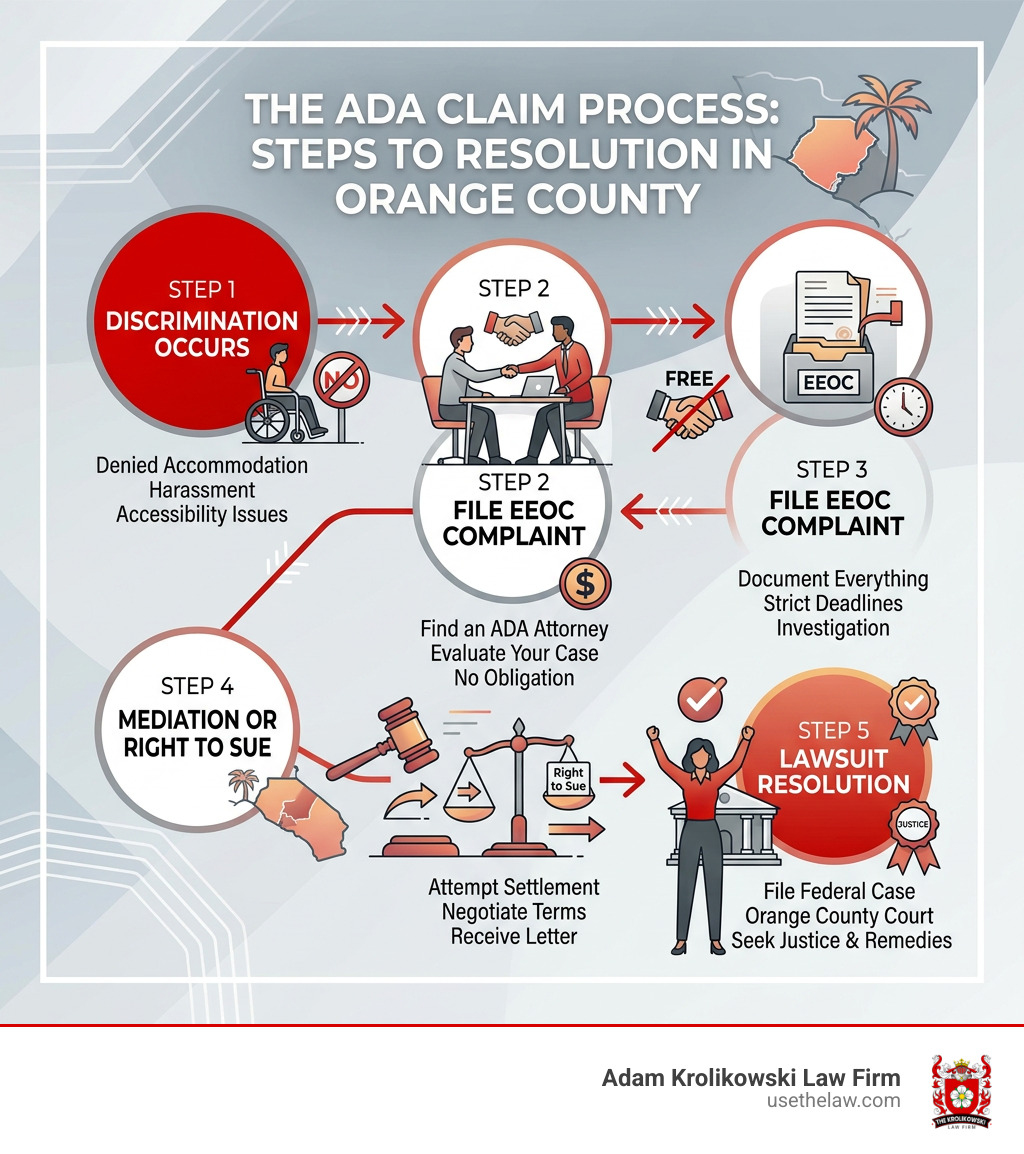
If you have been discriminated against, you can’t usually just walk into court and file a lawsuit the next day. For employment cases, you must “exhaust your administrative remedies” first. This usually means filing a “Charge of Discrimination” with the Equal Employment Opportunity Commission (EEOC) or the California Civil Rights Department (CRD).
Once they investigate (or decide not to), they will issue a “Right to Sue” letter. Then you can head to court.
Timelines for Filing an ADA Discrimination Claim
Don’t wait! The clock starts ticking the moment the discrimination happens.
- General Rule: You have 180 days to file with the EEOC.
- Extension: In California, because we have our own state anti-discrimination laws, this deadline is usually extended to 300 days.
- Federal Employees: You often have only 45 days to contact an EEO counselor.
Missing these deadlines can end your case before it even starts. If you need support, the National Disability Rights Network resources can provide a list of advocacy systems in every state.
Finding Reputable Legal Help and Referral Services
Finding an ada lawyer free consultation in Orange County doesn’t have to be hard. You can start with the local bar associations, which often have referral services that screen attorneys for experience and insurance.
Non-profit organizations and pro bono clinics can also be great resources for those with very limited income. When looking for a referral service, ensure they meet the American Bar Association referral standards to ensure you are getting quality help.
Frequently Asked Questions about ADA Lawyers
How do I know if I have a valid disability discrimination case?
If you have a physical or mental impairment, you are qualified for your job, and you were treated worse than others—or denied a reasonable accommodation—you likely have a case. The best way to be sure is to schedule a free consultation to have the facts reviewed by a professional.
Are short-term injuries protected under the ADA?
Yes, they can be! Under the ADAAA, even a temporary injury (like a broken leg that takes months to heal) can be protected if it “substantially limits” a major life activity during that time. Don’t assume that because your injury isn’t permanent, you don’t have rights.
What kind of compensation can I receive from an ADA lawsuit?
Depending on the case, you could receive:
- Back Pay: Wages lost from being fired or denied a promotion.
- Front Pay: Wages for future lost earnings.
- Compensatory Damages: For emotional distress and suffering.
- Punitive Damages: To punish an employer who acted with malice.
- Attorney’s Fees: The court can order the employer to pay your legal costs.
Conclusion
At Adam Krolikowski Law Firm, we believe that no one in Orange County should be treated like a second-class citizen because of a disability. Whether you are in Santa Ana or anywhere else in the region, your rights are worth fighting for.
With over 25 years of experience, we specialize in taking on the complex cases that other firms might turn away. We understand the interplay between personal injury, workers’ compensation, and employment law, giving us a unique perspective on how to get you the justice you deserve.
If you believe you’ve been a victim of discrimination, don’t wait until your deadlines pass. Contact an Employment Lawyer in Orange County California today for your free consultation. We are here to listen, to advise, and to fight for your future.
Contact Us
Practice Areas
Recent Articles
- « Previous
- 1
- 2
- 3